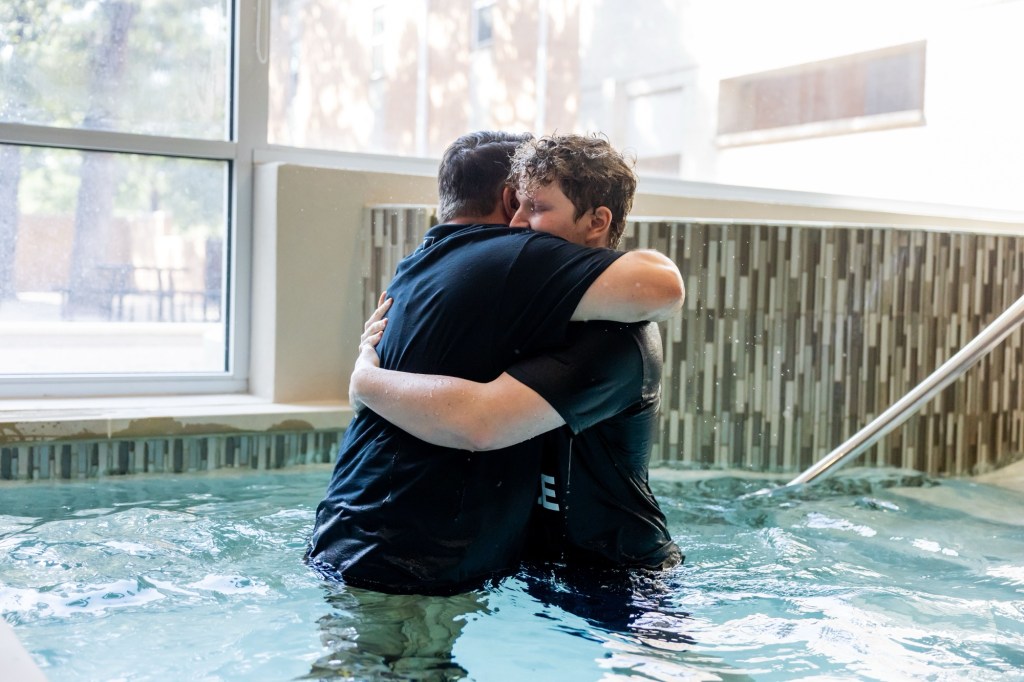
John the Baptist declared, “I have baptized you with water, but the Lord will baptize you with the Holy Spirit.” (Mark 1:8) After His resurrection, Jesus appeared for forty days, proving His resurrection and teaching about the kingdom of God. (Acts 1:3) He said, “You heard from Me; for John baptized with water, but you will be baptized with the Holy Spirit not many days from now.” (Acts 1:4–5) This was fulfilled in the outpouring of the Spirit at Pentecost (Acts 2:1–4):
> “When the day of Pentecost arrived, they were all together in one place. And suddenly there came from heaven a sound like a mighty rushing wind, and it filled the entire house where they were sitting. And divided tongues as of fire appeared to them and rested on each one of them. And they were all filled with the Holy Spirit and began to speak in other tongues as the Spirit gave them utterance.”
Peter, filled with the Holy Spirit, identified this event as the fulfillment of Joel’s prophecy (Acts 2:14–21), declaring that God’s Spirit would be poured out on all flesh, culminating in salvation for “everyone who calls upon the name of the Lord” (Acts 2:21).
Jesus had earlier told Nicodemus that a person must be “born of water and the Spirit” to enter God’s kingdom (John 3:5). He later told His disciples, those who had stayed with Him, saying, “The words that I have spoken to you are spirit and life” (John 6:63), showing the deep connection between the Spirit and the Word of God. Paul affirms this in Ephesians 5:25–26, saying Christ sanctifies the Church by “the washing of water with the Word.”
John’s baptism was a baptism of repentance, pointing forward to Christ (Acts 19:1–7). But the true baptism that saves is the baptism of Jesus—by the Word, which is the Spirit. As John himself said, “He must increase, but I must decrease” (John 3:30w). When the Gospel is proclaimed, the Spirit comes with it, as seen in Acts 10:44–46, where the Holy Spirit fell on Gentiles simply by hearing the Word, without any laying on of hands.
Scripture also clearly states that Jesus Himself never baptized with water (John 4:1–2). Paul declared, “For Christ did not send me to baptize but to preach the gospel, and not with words of eloquent wisdom, lest the cross of Christ be emptied of its power.” (1 Corinthians 1:17) Salvation, therefore, is by grace through faith (Ephesians 2:8–22), with the Spirit and the Word working as one. Peter confirms that Scripture is Spirit-inspired (2 Peter 1:20–21), and Paul affirms that the Gospel—the law of the Spirit of life (i.e., the Gospel)—frees believers from the law of sin and death (Genesis 2:16-17; Romans 8:1–4).
In essence, the baptism of the Holy Spirit is the cleansing and life-giving work of God through His Word, fulfilling John’s prophecy about Jesus Christ and securing eternal life for all who believe in His Word.
The Bible declares:
“In the beginning was the Word, and the Word was with God, and the Word was God.” (John 1:1)
“And the Word became flesh and lived among us. We have seen His glory, the glory as of the only Son from the Father, full of grace and truth.” (John 1:14)
“For from His fullness we have all received, grace upon grace. For the law was given through Moses; grace and truth came through Jesus Christ.” (John 1:16-17)
Here’s an honest question then: Why do some pastors imply there’s something special to be baptized at the Jordan River? Isn’t baptism at the Jordan River the epitome of John’s baptism, which cannot save one who has not received the Holy Spirit? If we have been baptized as Christians, is it not then a regression to submit ourselves for baptism at the Jordan River?
Christ’s Great Commission in Matthew 28:19-20 calls us not only to baptize but also to teach believers to obey all that He has commanded. While water baptism is an outward sign of faith and an important act of obedience, the mission of the Church goes beyond this initial step. If we recognize that the Holy Spirit works through the Word of God, then the emphasis must be on guiding Christians to live according to His Word—allowing the Spirit to transform their hearts and actions. Assurance of salvation is vital, but it should be coupled with ongoing discipleship, where believers are taught, challenged, and equipped to follow the commands of Christ daily. True discipleship involves a life shaped by the Word, not just a moment of ritual.
The parable of the sower, as taught by Jesus Christ, affirms that genuine Christian transformation occurs when one hears and truly understands the Word of God (Matthew 13:23). In harmony with this, Paul teaches in Romans that faith is born through hearing—specifically, by hearing the words of Christ (Romans 10:17).
Here’s the call for all of us Christians: If we truly desire to improve the church, we must return to the Bible. Let us relearn the authentic teachings of Scripture and let go of traditions that have, over time, weakened the church. Together, we can make the church shine as the true light of the world by faithfully reflecting the teachings of Jesus Christ.
Peter, in the words of Acts 3:6, declared, “I possess neither silver nor gold, but in the name of Jesus Christ, I offer you what I have.” Share this article freely, for you freely receive. Take note, underlines and highlights are clickable links for definitions or Bible references. Stay updated by heading to our about page and subscribe directly to receive notifications in your inbox. Blessings!
Songwriters get their inspiration from life experiences and the things they observe. Likewise, I often write from encounters, conversations, and observations about life, people, and experiences. Someone said, “The pastor should submit to an elder because he is the higher authority between the two.”
Perhaps it’s true, in practice, among contemporary church. But certainly not true with Scriptures. So, let me say it out loud here. That has become the practice because mostly elders are businessmen, and they have the power of the purse.
Again, let me say it out loud here. The Bible did rebuke people who attempted to use money to buy themselves power. In Acts 8, Peter rebuked Simon the sorcerer, saying, “May your silver perish with you, because you thought you could obtain the gift of God with money! You have neither part nor lot in this matter, for your heart is not right before God. Repent, therefore, of this wickedness of yours, and pray to the Lord that, if possible, the intent of your heart may be forgiven you. For I see that you are in the gall of bitterness and in the bond of iniquity” (Acts 8:20-23). So, be careful not to use money to manipulate yourself to power within the church.
Now, on our topic, where in the Bible can we find an elder superior to a pastor? Let’s take Ephesians 4:11-14 for our discussion. In the said passages, the Bible names the following biblical functions: the apostles, the prophets, the evangelists, the pastors, and teachers.
Now, in Titus, Paul called on him to appoint elders (Titus 1:4-9). The same can be seen with Timothy; hence, Paul provided the qualifications for both the elders and the deacons (1 Timothy 3). Paul then, in 1 Timothy 4:13, told Timothy to devote himself to the public reading of Scripture, exhortation, and teaching. Exhortation and teaching are both functions of an evangelist, pastor, and teacher. Titus also was commanded to teach according to sound doctrine. He is to declare the instruction of Paul, which is the New Testament Bible to us, to exhort and rebuke with all authority.
What biblical roles of Ephesians 4:11 were Titus and Timothy performing? As we can see in Scripture, there were only five functions mentioned. We can be sure they aren’t apostles or prophets, but they could be performing one or two of the functions or all three: evangelist, pastor, and teacher. Paul in his second letter to Timothy reminds Timothy to do the work of an evangelist (2 Timothy 4:5).
Consequently, based on our short study, both were pastors. They were tasked with caring for the church (1 Timothy 1:2-5;4:6-16;6:11-21; 2 Timothy 2:1-2, 14-15; 3:10-4:5; Titus 2:1-3:11). It’s significant to mention that 1 & 2 Timothy, together with Titus, have been categorized as pastoral letters. And both Timothy and Titus were tasked with appointing elders and even deacons. So who appears to have higher authority? The elder or the pastor?
Actually, there’s no hierarchy in God’s ministry. Paul, in 1 Corinthians 3:5-11, made an example of himself and Apollos. Paul was an apostle of Christ Jesus, but Apollos wasn’t. Yet, Paul states they were both servants of Jesus through whom people heard the Gospel and believed, as the Lord assigned to each (1 Corinthians 3:5).
Clearly there’s no hierarchy in God’s ministry. So, Paul went on to explain: “I planted, Apollos watered, but God gave the growth. So neither he who plants nor he who waters is anything, but only God who gives the growth. He who plants and he who waters are one, and each will receive his wages according to his labor. For we are God’s fellow workers. You are God’s field, God’s building. According to the grace of God given to me, like a skilled master builder, I laid a foundation, and someone else is building upon it. Let each one take care how he builds upon it. For no one can lay a foundation other than that which is laid, which isJesus Christ.” (1 Corinthians 3:6-11)
Here, therefore, is the conclusion: the highest authority of the church is Christ Jesus, the Bible, the Word of God. Scripture states, “In the beginning was the Word, and the Word was with God, and the Word was God. He was in the beginning with God. All things were made through Him, and without Him was not any thing made that was made. In Him was life, and the life was the light of men.” (John 1:1-4)
“And the Word became flesh and dwelt among us, and we have seen His glory, glory as of the only Son from the Father, full of grace and truth.” (John 1:14)
“For from His fullness we have all received, grace upon grace. For the law was given through Moses; grace and truth came through Jesus Christ.” (John 1:16-17)
Whosoever speaks the Word of God rightly has the higher authority because all authority of the church resides in and from Scripture.
Take a look at the Jerusalem council of Acts 15. The conflict wasn’t resolved by someone in authority, but by he who has the Word of God (Acts 15:13-29).
Jesus Christ declares, “All authority in heaven and on earth has been given to Me. Go therefore and make disciples of all nations, baptizing them in the name of the Father and of the Son and of the Holy Spirit, teaching them to observe all that I have commanded you. And behold, I am with you always, to the end of the age.” (Matthew 28:18-20)
Take this example: Apollos, in Acts 18, though eloquent and competent in the Scriptures, had been corrected by Priscilla and Aquila, so that his message may be thoroughly accurate, according to God’s Word. Once again, evidently, the final authority of the church resides in Christ Jesus, through the Bible, the Scriptures.
To cite an example outside of the Scripture: During the time of Martin Luther, despite the accepted authority of the Pope and the Roman Catholic Church, Christians who held on to the belief that salvation comes by faith in Christ alone— the righteous shall live by faith (Romans 1:17)— uphold the authority of the Bible over the prevailing religious authority.
Christian leaders, be careful not to claim authority upon yourselves. Whatever Christian ordination you have received, the authority resides in Scriptures, not upon us.
The Bible does call on the church to respect their leaders. See Hebrews 13:7, “Remember your leaders, those who spoke to you the word of God. Consider the outcome of their way of life, and imitate their faith.” And again, “Obey your leaders and submit to them, for they are keeping watch over your souls, as those who will have to give an account. Let them do this with joy and not with groaning, for that would be of no advantage to you.” (Hebrews 13:17)
A Christian leader, be it a pastor, an elder or a deacon, should always speak from God’s Word. It’s a high calling that comes with much responsibility. We are to give an account to Jesus Christ. Consequently, let us always keep in mind the instructions of Paul: “Keep a close watch on yourself and on the teaching. Persist in this, for by so doing you will save both yourself and your hearers.” (1 Timothy 4:16)
To all the believers, Jesus assures servants of His Words, saying, “Whoever receives you receives Me, and whoever receives Me receives Him who sent Me. The one who receives a prophet because he is a prophet will receive a prophet’s reward, and the one who receives a righteous person because he is a righteous person will receive a righteous person’s reward. And whoever gives one of these little ones even a cup of cold water because he is a disciple, truly, I say to you, he will by no means lose his reward.” (Matthew 10:40-42)
On the other hand, to us disciples of Jesus, ministers of His Word, Jesus states, “Whoever humbles himself like this child is the greatest in the kingdom of heaven. Whoever receives one such child in My name receives Me, but whoever causes one of these little ones who believe in Me to sin, it would be better for him to have a great millstone fastened around his neck and to be drowned in the depth of the sea.” (Matthew 18:4-6)
Never wish for the title but forget God’s Word. The final authority of the church isn’t the pastor, nor the elder, but Christ Jesus and His Word.
Peter, in the words of Acts 3:6, declared, “I possess neither silver nor gold, but in the name of Jesus Christ, I offer you what I have.” Share this article freely, for you freely receive. Take note, underlines and highlights are clickable links for definitions or Bible references. Stay updated by heading to our about page and subscribe directly to receive notifications in your inbox. Blessings!
In my previous post, I noted, “The healed blind man did not only experience restored eyesight, but more importantly recovery from spiritual blindness.” Notably, John 1 also suggests the concept of spiritual blindness. Consider John 1:10–11:
He [Jesus] was in the world, and the world was made through Him, yet the world did not know Him. He came to His own, and His own people did not receive Him.
We will examine the first chapter of John’s Gospel to see how the apostle outlined his summary in the opening verses, then compare it with John 9. Before proceeding, we should refresh our grasp of the continuing context in John 9, which immediately follows the intense conflicts of the previous chapter.
In John 8, Jesus delivered a lengthy critique of the Pharisees and scribes. In fact, friction between Jesus Christ and the Sanhedrin appears as early as John 7:32. The Sanhedrin functioned as the supreme religious authority and court among the Jewish people during Jesus’s era. It included both Sadducees and Pharisees under the High Priest, totaling 71 members. After Jerusalem’s destruction in AD 70, the Sanhedrin was dissolved.
Pharisees and scribes were regarded as the leading interpreters of Scripture. Their encounter with Jesus may have started near the temple (John 8:2) and probably ended within its grounds, since John 8:59 records, “So they picked up stones to throw at Him, but Jesus hid Himself and went out of the temple.” The exchange became tense because Jesus claimed divinity by stating, “Truly, truly, I say to you, before Abraham was, I am” (John 8:58). Did Jesus err in taking the title “I am” from Exodus 3:14? The LORD God identified Himself to Moses in Exodus 3 as the great “I Am,” calling him to guide Israel from Egypt. In 1 Corinthians 10:1–4, Paul retells the Exodus and identifies Jesus Christ as the Rock that guided Israel. Let us now consider John 1:1–5:
In the beginning was the Word, and the Word was with God, and the Word was God. He was in the beginning with God. All things were made through Him, and without Him was not any thing made that was made. In Him was life, and the life was the light of men. The light shines in the darkness, and the darkness has not overcome it.
“And the Word became flesh and dwelt among us, and we have seen His glory, glory as of the only Son from the Father, full of grace and truth … For from His fullness we have all received, grace upon grace. For the Law was given through Moses; grace and truth came through Jesus Christ. No one has even seen God; the only God who is at the Father’s side, He had made Him known.”
Psalm 33:6,9 says, “By the Word of the LORD the heavens were made, and by the breath of His mouth all their host … For He spoke, and it came to be; He commanded, it stood firm.”
Both John and the Psalmist spoke of the Word; that is, Christ Jesus, the only Son of the Father. He spoke, then everything came to exist. Therefore, Jesus Christ is indeed the Great “I am,” the Second Person of the Holy Trinity, God.
Consider how this reality is reflected in the events of John 9:30-33:
The man answered, “Why, this is an amazing thing! You do not know where He comes from, and yet He opened my eyes. We know that God does not listen to sinners, but if anyone is a worshipper of God and does His will, God listens to Him. Never since the world began has it been heard that anyone opened the eyes of a man born blind. If this man were not from God, He could do nothing.”
Remarkable, isn’t it? The formerly blind man echoed what John stated in John 1:1–5: Jesus Christ is of divine origin. This matches what Jesus told the Pharisees and scribes, prompting their desire to stone him (8:58–59). It is ironic that the Pharisees, who should know Scripture better, seemed less perceptive than the man. This appears to be a case of spiritual blindness, don’t you think?
Spiritual blindness, therefore, does not mean ignorance of the Scripture, but rather having false beliefs.
Again in John 1:9-13:
The true light, which gives light to everyone, was coming into the world. He was in the world, and the world was made through Him, yet the world did not know Him. He came to His own, and His own people did not receive Him. But to all who did receive Him, who believed in His name, He gave the right to become children of God, who were born, not of blood nor of the will of the flesh nor of the will of man, but of God.
The former blind man answered the inquiry from his fellow Jew, “The man called Jesus made mud and anointed my eyes and said to me, ‘Go to Siloam and wash,’ So I went and washed and received my sight.” (John 9:11)
The man born blind encountered Jesus, the True light that illuminates everyone, which explains why he could perceive Jesus’s origin more clearly than the Pharisees. He also gained his sight—a welcome addition, I might add.
So the Pharisees again asked him how he had received his sight. And he said to them, “He put mud on my eyes and I washed, and I see.” Some of the Pharisees said, “This man is not from God, for He does not keep the Sabbath.” But others said, “How can a man who is a sinner do such signs?” And there was a division among them. So they said again to the blind man, “What do you say about Him, since He opened your eyes?” He said, “He is a Prophet.” (John 9:15-17)
The blind man recognized the signs and declared, “Jesus is the Prophet of God.” Because he believed Jesus, Christ granted him the right to become a child of God. Coincidence? Certainly not—everything arises through God’s divine providence. Scripture noted,
But to all who did receive Him, who believed in His name, He gave the right to become children of God, who were born, not of blood nor of the will of the flesh nor of the will of man, but of God. (John 1:12-13)
The formerly blind man did not choose to know Christ Jesus; instead, Jesus stated, “But that the works of God might be displayed in him” (John 9:3). Likewise, the “work of God is for people to believe in Jesus Christ, whom the Father has sent” (John 6:29). The mission is complete.
The blind man accurately identified Jesus as the Prophet of God, because the “Son of Man”—the Messianic title of Christ—implies He is the Anointed One of God the Father; consequently, Jesus should fulfill all three roles: Prophet (Deuteronomy 18:15), Priest (Psalm 110:4), and King (Psalm 2:6–9).
However, the Pharisees had also met Jesus Christ, yet they challenged him within the temple area. In fact, the parents of the man born blind declined to speak about Jesus Christ, particularly to acknowledge him as the Christ, because the religious leaders—including the Pharisees—had already agreed to expel anyone who confessed faith in the Son of Man (John 9:22).
True enough, the former blind man was only able to confess faith in Jesus, for in the fullness of Christ he had received grace upon grace (John 1:16). Indeed, such an amazing grace was displayed by Christ Jesus in John 9:35–38:
Jesus heard that they had cast him [the former blind man] out, and having found him He said, “Do you believe in the Son of Man?” He answered, “And who is He, Sir, that I may believe in Him?” Jesus said to him, “You have seen Him, and it is He who is speaking to you.” He said, “Lord, I believe,” and he worshiped Him.’“
The blind man was literally in darkness, and we may say he actually personified the whole nation of Israel in the story— blind spiritually. The healing of the man born blind indeed was an impossible task humanly speaking— exactly what the healed blind man said to the Pharisees: “Never since the world began has it been heard that anyone opened the eyes of a man born blind” (John 9:32). See Isaiah’s prophecy concerning Jesus Christ, the Anointed One of God the Father:
Behold My Servant, whom I uphold, My Chosen, in whom My soul delights; I have put My Spirit upon Him; He will bring forth justice to the nations. (Isaiah 42:1)
Thus says God, the LORD, who created the heavens and stretched them out, who spread out the earth and what comes from it, who gives breath to the people on it and spirit to those who walk in it: “I am the LORD; I have called You in righteousness; I will take You by the hand and keep You; I will give You as a Covenant for the people, a light for the nations, to open the eyes that are blind, to bring out the prisoners from the dungeon, from the prison those who sit in darkness. I am the LORD; that is My name; My glory I give to no other, nor My praise to carved idols. Behold, the former things have come to pass, and new things I now declare; before they spring forth I tell you of them.” (Isaiah 42:5-9)
The Pharisees, aware of the scriptural prophecies regarding the Christ, likely recognized the signs; nevertheless, many others declined to accept Christ and labeled Him a sinner because He healed on a Sabbath. See John 9:16:
Some of the Pharisees said, “This man is not from God, for He does not keep the Sabbath.” But others said, “How can a man who is a sinner do such signs?” And there was a division among them.
Because the Pharisees upheld the Law of Moses, Jesus said to them,
For if you believed Moses, you would believe Me; for he wrote about Me. But if you do not believe his writings, how will you believe My words? (John 5:46-47)
The Pharisees failed to see Christ in Scripture due to their self-centeredness, believing that no matter what they do, they would always be God’s children. A false assumption. In Matthew 3, John the Baptist was baptizing in the Jordan River, and the Pharisees came to him. John said to them,
And do not presume to say to yourselves, ‘We have Abraham as our father,’ for I tell you, God is able from these stones to raise up children for Abraham. (Matthew 3:9)
So again John 1:12-13:
But to all who did receive Him [Jesus Christ], who believed in His name, He gave the right to become children of God, who were born, not of blood nor of the will of the flesh nor of the will of man, but of God.
Spiritual blindness can be deadly. The Pharisees comprehended all prophecies in Scripture. It was not that they couldn’t see the signs; they did. They were not victims of unbelief; rather, they were enslaved by their false beliefs. See Mark 7:8–9, 13:
You leave the commandment of God and hold to tradition of men. You have a fine way of rejecting the commandment of God in order to establish your tradition! Thus making void the Word of God by your tradition that you have handed down. And many such things you do.
The Pharisees asserted they upheld Moses’s teachings (John 5:46–47). They may have done so in part, yet in reality they constructed their own traditions. These human-made customs kept them from recognizing that Jesus Christ, “the Son of Man — is the Lord of Sabbath” (Matthew 12:8).
Similarly, the only way for anyone seeking or studying Scripture to find the True Christ of the Bible is to allow the Word of God to speak to us. Do not allow traditions or creeds of men to be our guide; rather, Scripture alone!
The story of John 9 should inspire us to see it’s all by God’s grace that anyone can come to know Jesus Christ, the Son of Man. The former blind man, humanly speaking, lost a lot when he received his sight. He may have lost or was severed from his parents and the community, since he had been cast out of the synagogue. Yet, it is amazing how people who seemed to have lost a lot found it easier to find Christ.
Although much remains to discuss in John 9, I have chosen to end my blog post on “Spiritual Blindness” here. If the Lord permits, I may add a follow-up post later.
Peter, in the words of Acts 3:6, declared, “I possess neither silver nor gold, but in the name of Jesus Christ, I offer you what I have.” Share this article freely, for you freely receive. Take note, underlines and highlights are clickable links for definitions or Bible references. Stay updated by heading to our about page and subscribe directly to receive notifications in your inbox. Blessings!