Peter, in the words of Acts 3:6, declared, “I possess neither silver nor gold, but in the name of Jesus Christ, I offer you what I have.” Share freely, for you freely receive. Stay updated by heading to our about page and subscribe directly to receive notifications in your inbox. Blessing!
The call for discipleship has veered off course. Many have projected their ministries as discipleship but have primarily focused on strategies. While some of these are indeed proper ways to do discipleship, those are mere forms, lacking substance. The true essence of discipleship lies in teachings about Christ Jesus, His church, salvation, and many other biblical truths. That’s the short answer to our title’s question.
In today’s context, discipleship has been centered around activities like food, games, and camaraderie, which have neglected the true essence of Christian fellowship. True fellowship is built on shared faith, belief, and a deep understanding of God’s word. It is a call for partnership, as illustrated by the passages below, which offer a comprehensive explanation of this concept.
The apostle Paul writing to a church said, “I am filled with gratitude for your constant remembrance in all my prayers for you all. I pray with joy because of your PARTNERSHIP in the gospel from the very beginning until now.” (Philippians 1:3-5)
Note that the word “partnership,” translated from the Greek word “koinōnia,” is the same Greek word translated as “fellowship”. So the ultimate objective of discipleship is to establish a fellowship or partnership.
How did the Philippians partner with Paul? First, they shared a common faith (as evident in Philippians 1:25-30). Second, they diligently supported Paul’s ministry (as demonstrated in Philippians 4:15-18).
See Acts 2:41-47, “Those who received his word were baptized, and approximately three thousand souls were added that day. They devoted themselves to the apostles’ teachings and FELLOWSHIP, breaking bread and praying together. Awe filled every soul, and many wonders and signs were performed by the apostles. All who believed were united and shared everything in common. They sold their possessions and distributed the proceeds to those in need. Day by day, they attended the temple together and shared meals in their homes. They received their food with joy and generosity, praising God and being well-liked by everyone. The Lord continued to add to their number day by day those who were being saved.”
Doubtless, Christians’ fellowship is a partnership that involves sharing God’s grace. The Apostle Paul emphasizes this in Galatians 6:6-7, stating that those who learn the word should share all good things with those who teach. He warns against deception, emphasizing that whatever one sows, they will reap. In this partnership, servants of God’s word and learners are equal partners in the ministry. It is crucial to not shortchange each other but to share all good things. Hebrews 13:16 further underscores this principle, encouraging us not to neglect doing good and sharing what we have, as such sacrifices are pleasing to God. The same truth about fellowship is evident in Romans 15:26-27 and 2 Corinthians 9:6-15.
Next passage, “For they gave according to their means, as I can testify, and beyond their means, of their own accord, begging us earnestly for the favor of TAKING PART in the relief of the saints— and this, not as we expected, but they gave themselves first to the Lord and then by the will of God to us.” (2 Corinthians 8:3-5)
In the context of Corinthians, the same Greek word for fellowship and partnership was translated “taking part.” This implies that fellowship requires involvement and, once again, a genuine concern for the common good.
Next, consider Ephesians 3:8-10, the apostle Paul said, “To me, though I am the very least of all the saints, this grace was given, to preach to the Gentiles the unsearchable riches of Christ, and to bring to light for everyone what is the PLAN of the mystery hidden for ages in God, who created all things, so that through the church the manifold wisdom of God might now be made known to the rulers and authorities in the heavenly places.”
In this passage, koinōnia refers to God’s plan that enables Christians to grasp the truths of His mystery. This passage serves as a call for a deeper understanding of God’s word. As Paul explained in Romans, “How then will they call on Him in whom they have not believed? And how are they to believe in Him of whom they have never heard? And how are they to hear without someone preaching? And how are they to preach unless they are sent? As it is written, ‘How beautiful are the feet of those who preach the good news!’” (Romans 10:14-15) Christians are called to honor those who faithfully proclaim the Gospel. Jesus Christ declared, “Truly, truly, I say to you, whoever receives the one I send receives Me, and whoever receives Me receives the one who sent Me.” (John 13:20) Be cautious not to reject or malign those who faithfully serve God’s word.
As you can see, fellowship isn’t just about spending time together. It does not simply involve playing games, eating together, but more importantly, sharing each other’s burdens, studying, and understanding God’s word.
In John’s epistle, he declared, “That which was from the beginning, which we have heard, which we have seen with our eyes, which we looked upon and have touched with our hands, concerning the word of life— the life was made manifest, and we have seen it, and testify to it and proclaim to you the eternal life, which was with the Father and was made manifest to us— that which we have seen and heard we proclaim also to you, so that you too may have FELLOWSHIP with us; and indeed our FELLOWSHIP is with the Father and with His son Jesus Christ.” (1 John 1:1-3)
John emphasizes that genuine Christian fellowship cannot be devoid of God’s truth. Christians can only be in fellowship with fellow believers. Paul declared, “Do not be unequally yoked with unbelievers. For what partnership has righteousness with lawlessness? Or what fellowship has light with darkness?” (2 Corinthians 6:14). Isn’t this truth a contradiction with our present order of the church? Are you certain you have been fellowshipping only with believers every Sunday? Isn’t that the reason so-called churches today are chaotic? In your discipleship programs, are you imparting God’s truths? Have you been diligently studying Scripture accurately? While many Christians dislike theology, it is the cornerstone of true Christian fellowship.
The Book of Revelation concludes with Christ Jesus’ final words to the church. It explains the fulfillment of all prophecy, as Scripture states, “And He who was seated on the throne said, ‘Behold, I am making all things new.’ Also, He said, ‘Write this down, for these words are trustworthy and true.’ And He said to me (John), ‘It is done! I am the Alpha and the Omega, the beginning and the end. To the thirsty I will give from the spring of the water of life without payment. The one who conquers will have this inheritance, and I will be his God, and he will be My son.’” (Revelation 21:5-7)
Unfortunately, as long as Christians have diverse interpretations of God’s Word, the truthful teachings of Christ Jesus will never be universally proclaimed. However, this does not mean that we cannot know God’s truth by our own. We simply need to study the Word of God diligently.
Once more, Paul cautions Christians, “I appeal to you, brothers, to watch out for those who cause divisions and create obstacles contrary to the doctrine that you have been taught; avoid them. For such persons do not serve our Lord Christ, but their own appetites, and by smooth talk and flattery they deceive the hearts of the naive.” (Rom 16:17-18) Mind you, Paul wasn’t referring to what has been taught today but the teachings of his generation— the Scripture.
John emphasizes the significance of adhering to God’s truth. He asserts that those who disregard Christ’s teachings do not have God. Conversely, those who remain steadfast in his teachings are blessed with the Father and the Son. Additionally, John warns against accepting individuals who bring false teachings into one’s home or offer greetings, as such actions can contribute to their wicked deeds. (See 2 John 1:9-11.)
Discipleship centered around God’s word is the true essence of discipleship. It involves learning and living in accordance with His teachings. Jesus Christ affirms, “If you abide in My word, you are truly My disciples, and you will know the truth, and the truth will set you free.” (John 8:31-32) Discipleship is not a program or strategy; it is a call to follow Jesus Christ and abide in His Word.
In John 6, after Jesus Christ unveiled truths about Himself and the purpose of His coming, His large following dwindled. Scripture stated, “When many of His disciples heard it, they said, ‘This is a difficult saying; who can listen to it?’ (John 6:60). After this, many of His disciples turned back and no longer walked with Him” (John 6:66). Are we superior to Christ Jesus? Are we more adept at presenting God’s truth that we measure ministry success based on the number of people joining Christian programs? Or perhaps these programs fail to impart the challenging truths about following Jesus Christ? Perhaps these programs lack substance; they are designed to entice people rather than teach them to bear their crosses and follow Christ Jesus? Christ’s parable of the sower cannot be a mistake. Consider that only one type of soil is suitable—the one that listens to God’s word and comprehends. Perhaps Christians ought to carefully assess their programs if they have gained widespread acceptance. Verify if their programs indeed are aligned with God’s word. Christians’ ministry is never measured by numbers but by substance.
Peter’s message at Pentecost was a resounding success, attracting three thousand souls to faith. Could this number be a majority compared to the vast crowd gathered at Pentecost? Scripture declares, “And Isaiah cries out concerning Israel: ‘Though the number of the sons of Israel be as the sand of the sea, only a remnant of them will be saved, for the Lord will carry out His sentence upon the earth fully and without delay.’ And as Isaiah predicted, ‘If the Lord of hosts had not left us offspring, we would have been like Sodom and become like Gomorrah’” (Romans 9:27-29). Paul further emphasized God’s words, stating, “So too at the present time, there is a remnant, chosen by grace” (Romans 11:5). A remnant certainly does not represent the majority; rather, it is a small remaining quantity of a total number. Do you dare say Scripture was wrong? Or perhaps, Christian ministers today are better than Jesus Christ? Instead of focusing on the ninety-nine who never realized they too were lost, let’s focus on the one sheep that was lost but has returned. Isn’t that the teachings of Christ Jesus in His parable of the lost sheep? (Luke 15:1-7)
Jesus Christ declared, “Enter by the narrow gate. For the gate is wide and the way is easy that leads to destruction, and those who enter by it are many. For the gate is narrow and the way is hard that leads to life, and those who find it are few.” (Matthew 7:13-14)
Be cautious, as the Bible, particularly in Proverbs, twice warns, “There is a way that appears to be right to a man, but its end leads to death.” (Proverbs 14:12; 16:25)
Peter, in the words of Acts 3:6, declared, “I possess neither silver nor gold, but in the name of Jesus Christ, I offer you what I have.” Share freely, for you freely receive. Stay updated by heading to our about page and subscribe directly to receive notifications in your inbox. Blessing!
Although others may teach about a possible chance even after death, the Bible is unequivocal that our sole opportunity for salvation lies in this present life or existence. Jesus Christ, through a parable, imparted this profound truth.
“There was a rich man who was clothed in purple and fine linen and who feasted sumptuously every day. And at his gate was laid a poor man named Lazarus, covered with sores, who desired to be fed with what fell from the rich man’s table. Moreover, even the dogs came and licked his sores. The poor man died and was carried by the angels to Abraham’s side. The rich man also died and was buried, and in Hades, being in torment, he lifted up his eyes and saw Abraham far off and Lazarus at his side. And he called out, ‘Father Abraham, have mercy on me, and send Lazarus to dip the end of his finger in water and cool my tongue, for I am in anguish in this flame.’ But Abraham said, ‘Child, remember that you in your lifetime received your good things, and Lazarus in like manner bad things; but now he is comforted here, and you are in anguish. And besides all this, between us and you a great chasm has been fixed, in order that those who would pass from here to you may not be able, and none may cross from there to us.’ And he said, ‘Then I beg you, father, to send him to my father’s house— for I have five brothers—so that he may warn them, lest they also come into this place of torment.’ But Abraham said, ‘They have Moses and the Prophets; let them hear them.’ And he said, ‘No, father Abraham, but if someone goes to them from the dead, they will repent.’ He said to him, ‘If they do not hear Moses and the Prophets, neither will they be convinced if someone should rise from the dead.’” (Luke 16:19-31)
Here are some detailed facts:
After death, both Lazarus and the rich man found themselves in Hades. Hades was the place of death before God’s final judgment at the coming of Christ Jesus (as mentioned in 2 Corinthians 5:10, John 5:28-29; Revelation 20:11-14, and so on).
The rich man, who had lived luxuriously and cared little for Lazarus’ destitute state, ended up in the place of torment. In contrast, Lazarus, despite being poor, was also in Hades but in a blissful state, in Abraham’s bosom.
Perhaps you might ask, “Why did Lazarus find himself in a state of bliss? Was it simply because he was poor?” The answer to that question wasn’t explicitly stated in the story, but rather in the context of the parable. See Luke 16:13-16:
Jesus Christ said, “No servant can serve two masters, for either he will hate the one and love the other, or he will be devoted to the one and despise the other. You cannot serve God and money.” The Pharisees, who were lovers of money, heard all these things, and they ridiculed Him. And He (Jesus) said to them, “You are those who justify yourselves before men, but God knows your hearts. For what is exalted among men is an abomination in the sight of God. “The Law and the Prophets were until John; since then the good news of the kingdom of God is preached, and everyone forces his way into it.”
The parable was spoken in response to the Pharisees’ hardness of heart. They refused God’s offer of salvation because they had much to give up—they were lovers of money. Consequently, by inference, Lazarus, despite having no riches, was dependent on God’s mercy and trusted in His grace, which explains why he ended up in Abraham’s side. Keep in mind that Abraham was the father of faith, as Paul states in Romans 4:9-12. Therefore, by implication, Lazarus also, lived in faith.
Hoping that this simple explanation would clear out myths about death and heaven. Paul, writing to the Corinthians, said, “I know a man in Christ who fourteen years ago was caught up to the third heaven—whether in the body or out of the body I do not know, God knows. And I know that this man was caught up into paradise—whether in the body or out of the body I do not know, God knows— and he heard things that cannot be told, which man may not utter.” (2 Corinthians 12:2-4)
Easton’s Bible Dictionary explain: According to the Jewish notion there were three heavens,
Clearly, at the time of Paul, heaven remained inaccessible to man. He was only privileged to glimpse a vision of heaven even before Christ had returned.
Furthermore, in Christ’s parable, Jesus made it clear that there was a vast chasm between the realms of the living and the dead, and no one from either side could cross over. Therefore, after death, the destination of people was sealed, and they were only waiting for the final judgment. Hence, the idea of praying for the dead is nowhere in the Bible.
Jesus asserted that no one would be permitted to return to the realm of the living after death. Christ further explained that even those who had been informed about His resurrection would ultimately end up in the place of torment in Hades because they had failed to believe the teachings of Moses and the Prophets—a reference to the Old Testament Scriptures. Jesus, speaking about His resurrection, said, “These are My words that I spoke to you while I was still with you, that everything written about Me in the Law of Moses, the Prophets, and the Psalms must be fulfilled.” (Luke 24:44)
The entire Bible is about Jesus Christ. Therefore, it is crucial to be careful not to reject His Word.
Yes, God’s offer of salvation through Christ Jesus is a second chance. Better yet, a limited chance because it is only valid while we are still alive. Once we die, our time is up. Go, therefore, and share the Gospel with your loved ones, family, and friends. Knowing that it’s their chance of a lifetime.
Peter, in the words of Acts 3:6, declared, “I possess neither silver nor gold, but in the name of Jesus Christ, I offer you what I have.” Share freely, for you freely receive. Stay updated by heading to our about page and subscribe directly to receive notifications in your inbox. Blessing!
I’ve heard of many preachers and read devotionals that emphasize Peter’s conviction, love, and commitment to Jesus Christ in John 21. In this passage, Jesus asks Peter three times, “Do you love Me more than these?” (John 21:15-17). However, have we ever considered what Jesus meant by “these”?
To clarify, let’s examine the context of the story. In John 20:21, Jesus commands Peter and the other apostles to go out and preach the Gospel, saying, “Peace be with you. As the Father has sent Me, so I am sending you.” This took place in Jerusalem soon after Christ’s resurrection.
Jesus first appeared to His apostles twice in Jerusalem. The first time is detailed in John 20:19-23, and the second time, with Thomas present, is described in John 20:24-29. John 21 aligns with Matthew 28:9-10, which summarizes the events of John 20:19-29, where Jesus instructs them to leave Jerusalem and wait for Him in Galilee, promising another appearance. Acts 1:3 informs us that Jesus appeared to the apostles multiple times over forty days, teaching them about the kingdom of God, His last appearance being in Jerusalem before His ascension to heaven (Acts 1:3-11).
The setting of John 21:1-3 is in Galilee, where Peter decided to go fishing with some of the other disciples, many of whom were fishermen by trade. This leads me to pose a few questions: Was Peter faithful to the words of Christ? Didn’t Peter and the other apostles receive the Holy Spirit when Jesus breathed on them in Jerusalem (John 20:19-22)? Hadn’t Jesus called Peter to follow Him even before His crucifixion, death, and resurrection (John 1:40-43)? Previously, when Jesus first called them, He said, “Follow Me, and I will make you fishers of men” (Matthew 4:18-19; Mark 1:16-17). Notice that John 21 begins by telling us that Peter and the others went fishing.
Returning to the central question: When Jesus asked Peter, “Do you love Me more than these?”, was He referring to Peter’s former profession or perhaps his need for provision and food? Did Peter forget Jesus’ teaching on trusting God for provision when they were initially sent out in Matthew 10? Jesus instructed, “Acquire no gold or silver or copper for your belts, no bag for your journey, or two tunics or sandals or a staff, for the laborer deserves his food” (Matthew 10:9-10). Once more, it’s worth noting that Christ’s words address the apostles, urging them not to be concerned about food or provisions. Jesus is fully aware of their needs.
In some ways, Peter seems to have faltered. So, did Peter prove himself faithful in John 21?
Now, consider the remarkable catch of fish described in John 21:5-11. After fishing all night and catching nothing (John 21:3-4), it was only after Jesus told them to cast their net on the right side of the boat that they caught a large number of fish. Was it because they cast their net on the right side that they succeeded? I am convinced they tried both sides throughout the night without success. This substantial catch teaches us that it was ultimately Jesus’ work, reinforcing the lesson that God is our true provider, as emphasized in Matthew 6:24-33.
Here are the highlights of Jesus’ teaching:
You cannot serve both God and money. Jesus urges us to let go of our anxieties about life—what we will eat or drink, and what we will wear. Is life not more than food and the body more than clothing? Consider the birds of the air: they neither sow, reap, nor gather into barns, yet our heavenly Father provides for them. Are we not of greater value than they?
Reflect on the lilies of the field and their effortless growth: they neither toil nor spin. Yet, Jesus assure us, even Solomon in all his glory was not adorned like one of these. If God so beautifully clothes the grass of the field, which flourishes today and is cast into the oven tomorrow, will He not care for us even more, O you of little faith?
Do not be anxious, asking, “What shall we eat?” or “What shall we drink?” or “What shall we wear?”, for those who do not believe chase after such things, yet our heavenly Father knows our needs. Instead, .
David, in one of his Psalms, stated, “I have been young, and now am old, yet I have not seen the righteous forsaken or his children begging for bread” (Psalms 37:25).
Peter, along with the other apostles and ourselves, must learn to have faith so that we may faithfully follow Jesus Christ and honor His Word.
John’s narrative does not end here. For the third time, Jesus asked Peter, “Do you love Me?” (John 21:17). After Peter’s response, Jesus assured him that he would be faithful and would ultimately die a martyr’s death, reiterating His call to follow Him (John 17-19).
Hold your horses! Haven’t we been told by preachers and devotionals that Jesus used the Greek word “agápē” (G25) for love on two occasions? However, on the third occasion, out of compassion for Peter’s inability to meet such a high standard of love, Jesus used “phileō” instead. A quick search using a lexicon reveals that when Jesus spoke of God’s love for Him, He also used “phileō.” This is evident in John 5:20: “For the Father loves (phileō) the Son and shows Him all that He Himself is doing. And greater works than these will He show Him, so that you may marvel.” Therefore, Jesus didn’t lower His demand for love from Peter; the same can be said for us. It is a myth to claim that God or Jesus Christ lowered His standard for humanity. If that were the case, then Jesus would not have needed to offer Himself and die on the cross to redeem those of us who believe, as stated in 2 Corinthians 5:21.
Let’s revisit our discussion on John 21. No one can be truly faithful to Jesus Christ unless God performs a significant work in our hearts. Remember that God is the potter and we are His clay. Just as a potter sometimes destroys his creations to perfect them, Jesus—our potter—works on Peter and on us. Therefore, do not despair if you fail repeatedly. Instead, continue to heed Jesus’ call to follow Him.
After Jesus revealed to Peter that he would soon be faithful, Peter remained anxious and impatient, eager to know about others. He asked Jesus about John, as seen in John 21:20-21:
“Peter turned and saw the disciple whom Jesus loved (John) following them, the one who also had leaned back against him during supper and had asked, ‘Lord, who is it that is going to betray you?’ When Peter saw him, he said to Jesus, ‘Lord, what about this man?’”
In response, Jesus lovingly rebuked Peter while encouraging him, revealing His timeline for return as stated in John 21:22-23:
“Jesus said to him (Peter), ‘If it is My will that he (John) remain until I come, what is that to you? You follow Me!’ So the rumor spread among the brothers that this disciple was not to die; yet Jesus did not say to him that he was not to die, but, ‘If it is My will that he (John) remain until I come, what is that to you?’”
This was not the only instance where Jesus assured that His return would be within the lifetime of John and perhaps some other disciples, as noted in Matthew 16:28.
Jesus declared to His apostles, “Truly, I say to you, there are some standing here who will not taste death until they see the Son of Man coming in His kingdom” (Matthew 16:28).
Are there any apostles of Jesus Christ still living today? Perhaps they are just hiding away, reminiscent of the conspiracies about Elvis Presley still being alive in some discreet location. Alternatively, should we trust Christ’s declaration to His apostles that He truly returned, which contradicts much of what is taught today?
Additionally, in Matthew 10, before sending out His apostles to proclaim the imminent coming of His kingdom, Jesus said, “When they persecute you in one town, flee to the next, for truly, I say to you, you will not have gone through all the towns of Israel before the Son of Man comes” (Matthew 10:23).
If you approach the scriptures with an open heart and set aside any preconceived notions about the Second Coming of Jesus Christ, you will find consistent affirmations from the apostles regarding this truth. While many people believe that Christ’s return is still in the future, Jesus has consistently stated that His coming is soon. However, “soon” was meant for His apostles, not for us.
I want to highlight that John assured us his writing was truthful. In John 21:24, it states, “This is the disciple who is bearing witness about these things, and who has written these things, and we know that his testimony is true.”
In John 20-21, John assures his readers that Jesus is truly alive. He emphasizes this in John 21:14, which states, “This was now the third time that Jesus was revealed to the disciples after He was raised from the dead.”
This is the core message John conveys to his immediate audience and to everyone reading his Gospel today. Both Peter and John, along with all the followers of Jesus at that time, received the comforting assurance that Jesus’ return would happen within their lifetimes.
As I conclude this sharing, I encourage you to consider a few questions: Could Jesus lie? Was He mistaken in telling His apostles that He would return in their lifetime? Or is it possible that biblical scholars, preachers, and pastors are wrong in asserting that the Second Coming is still to come?
Your answers to these questions will reflect your understanding of Jesus Christ. Remember that Jesus is the promised prophet mentioned in Deuteronomy 18:15-22.
Here are the highlights of Deuteronomy 18:15-22:
The LORD your God will raise up a prophet like Moses from among the Israelites—listen to Him. Peter, inspired by the Holy Spirit, testifies that Jesus Christ is the promised Great Prophet of God (Acts 3:19-23).
God will raise a prophet from among the Israelites, placing His words in His mouth. Those who do not listen will be held accountable. Jesus Christ is the fulfillment of this promised prophet (John 8:28; John 12:49-50; John 15:15).
A prophet who speaks in God’s name without His command or claims to speak in the name of other gods shall die. If you are wondering how to determine whether the word the LORD has not spoken, know that if a prophet’s predictions do not come true, that message is not from the LORD, and you need not fear such a prophet. So here is the thing: Anyone who insists that Christ Jesus did not return during the lifetime of His apostles is essentially accusing Jesus of being a false prophet or a liar. Isn’t that blasphemy?
I understand that this topic can be confusing. If you choose to believe Christ’s declaration about His imminent return, you may be left with many questions. I empathize with your journey and assure you that sincere inquiry will lead to understanding. Keep in mind that this quest for truth is vital.
In conclusion, the Gospels teach us the truth about Jesus Christ and serve as an apologetic against false teaching. We should hold preachers accountable for their messages. John 21 focuses on Jesus, not Peter, so let’s refrain from moralizing biblical characters like Peter, Paul, or others. Do not let yourself be shortchanged. Reject feel-good messages that do not contain God’s truth. Always ask, “Is it sound teaching?”
Peter, in the words of Acts 3:6, declared, “I possess neither silver nor gold, but in the name of Jesus Christ, I offer you what I have.” Share freely, for you freely receive. Stay updated by heading to our about page and subscribe directly to receive notifications in your inbox. Blessing!
One of the many incredible prophecies of Christ Jesus could be that of His death and resurrection. In Matthew 12:38, when challenged for a sign, Jesus stated, “For just as Jonah was three days and three nights in the belly of the great fish, so will the Son of Man be three days and three nights in the heart of the earth” (Matthew 12:40).
In John 2:19, again being asked for a sign, Jesus replied, “Destroy this temple, and in three days I will raise it up” (John 2:19). John explained that Jesus was talking about the temple of His body (John 2:21)
The resurrection of Jesus after three days and three nightsin the grave is clearly a central proof that He indeed was the Christ. Sadly, however, the modern church has diminished Christ Jesus’ declaration by insisting on a Friday death and burial, and a Sunday resurrection. This fascination with Sunday has no roots in the early church; rather, it’s a modern concept. Tracing its beginning almost always leads back to the time of Constantine. When politics and religion intermingle, there is always a risk. Christians should remember that Jesus Christ declared to the Jewish religious leaders, “My kingdom is not of this world. If My kingdom were of this world, My servants would have been fighting, that I might not be delivered over to the Jews. But My kingdom is not from the world” (John 18:36).
It is indeed difficult to pinpoint the exact day Jesus was crucified. However, if He was to be the sacrificial lamb acceptable to God, He must have fulfilled Scripture. The slaying of the Passover lamb has always occurred on the 14th of Nisan, regardless of the day of the week. On the 15th of Nisan, that is always a special or high Sabbath (John 19:31; Leviticus 23:6-8). Christ’s body was hurriedly placed in the burial site before dusk, just before the special or high Sabbath, as no work can be done on a Sabbath (John 19:40-42).
Since the 14th and 15th of Nisan can fall on different days, similar to how our birthdays shift each year due to the calendar cycle, the number of days between Passover and the Feast of Firstfruits will vary annually. Considering that Jesus Christ was fulfilling His prophecy of three days and three nights, these must be the exact days in between required to fulfill that prophecy.
The Feast of Firstfruits, however, cannot occur on just any day; it always takes place on the first regular Sabbath following the High Sabbath or the 15th of Nisan. Yes, the resurrection of Jesus Christ did not occur on a Sunday but rather on a regular Sabbath. Refer to Leviticus 23:10-11:
“Speak to the people of Israel and say to them: ‘When you enter the land that I am giving you and harvest its crops, you shall bring a sheaf of the firstfruits of your harvest to the priest. He shall wave the sheaf before the LORD, so that you may be accepted. On the day after the (15th of Nisan) Sabbath, the priest shall wave it.’” Hence, Paul refers to Jesus Christ as the firstfruits in 1 Corinthians 15:23.
As I have explained, during the Passover festival week, there would be two Sabbaths: the special or high Sabbath (15th of Nisan) and the regular Sabbath. Leviticus 23:10-11 refers to the day (or Sabbath) after the high or special Sabbath. How do I know this for sure? Because the following festival, the Feast of Weeks (commonly known as Pentecost), is counted starting from the day the wave offering of Firstfruits has been presented, which is the regular Sabbath. See Leviticus 23:15-16:
“You shall count seven full weeks from the day (Sabbath) after the Sabbath (15th of Nisan), starting from the day (Sabbath) you brought the sheaf for the wave offering. You will count fifty days to the day after the seventh Sabbath. Then you shall present a grain offering of new grain to the LORD.”
Contrary to common Christian teachings and traditions, Pentecost always falls on a Sabbath, not a Sunday. This distinction is significant for Jewish people. As a result, many modern Christians’ emphasis on Sunday observance has led Jews to reject Jesus Christ and the Gospel, as they believe Jesus did not fulfill Scripture.
So here lies the cause of confusion: modern Christians have been observing the traditions of men rather than adhering to Scripture. Don’t we Christians realize that the words of Jesus Christ, spoken against the Jewish religious leaders, are very much applicable to our discussion here? See Mark 7:6-8:
“Jesus said, ‘Well did Isaiah prophesy of you hypocrites, as it is written: ‘This people honors Me with their lips, but their heart is far from Me; in vain do they worship Me, teaching as doctrines the commandments of men.’ ‘You leave the commandment of God and hold to the tradition of men.’”
Whenever Christians neglect Scripture and follow the traditions of men, we misread and misapply the Bible. To further prove my point, let’s look at New Testament accounts concerning the resurrection. See Mark 16:1-2:
“When the Sabbath was past, Mary Magdalene, Mary the mother of James, and Salome bought spices so that they might go to anoint Him. Very early on the first day of the week, when the sun had risen, they went to the tomb.”
Mark referred to two Sabbaths in his narrative. Here, the first one is correctly translated into English as “Sabbath,” pointing to the special or high Sabbath. The second, which is translated as “first day of the week,” actually refers to the first regular weekly Sabbath. A quick check on an interlinear Bible would show both terms, “Sabbath” and “week,” were derive from the Greek word #4522, “sabbaton.”
Mary Magdalene and the other women visited the empty tomb on the regular Sabbath, not on a Sunday. This misinterpretation may have arisen during the time of Constantine, as the Romans had an affinity for the Sun God, Sol Invictus. I encourage you to conduct your own research on this topic.
Jesus Christ fulfilled three of the feasts outlined in Leviticus 23. As I mentioned in a previous post, these festivals served as rehearsals, anticipating the coming of the Messiah. This explains the excitement of the Jews when Jesus entered Jerusalem on a donkey (John 12:12-15).
The three festivals are the Feasts of Passover and Unleavened Bread (crucifixion), and the Feast of Firstfruits (resurrection). Please see Scripture for confirmation.
Paul explains in 1 Corinthians 5:7-8: “Cleanse out the old leaven that you may be a new lump, as you really are unleavened. For Christ, our Passover lamb, has been sacrificed. Let us therefore celebrate the festival, not with the old leaven, the leaven of malice and evil, but with the unleavened bread of sincerity and truth.”
Jesus Christ was the Passover lamb; through His sacrifice and offering, He made all who believe in Him righteous (unleavened) in God’s sight.
Furthermore, Paul explained in 1 Corinthians 15:23: “But each in his own order: Christ the firstfruits, then at His coming those who belong to Christ.”
Without a doubt, Paul referred to Christ’s resurrection as the fulfillment of the Feast of Firstfruits, thus designating Jesus as the firstfruits.
Before I conclude this discussion, I want to highlight what Luke’s Gospel reveals about the expectations of the Jews, particularly Jewish Christians. You can find this in Luke 24:13-27. In this account, the risen Lord Jesus Christ first listened to the conversation of two of His disciples before engaging with them. One of the disciples expressed their hopes by saying, “But we had hoped that He (Jesus) was the one to redeem Israel. Yes, and besides all this, it is now the third day since these things happened” (Luke 24:21).
Christ’s resurrection comes with the certainty that He would be buried for three days and three nights before rising from the dead. The Jewish religious leaders understood the significance of Jesus fulfilling His prophecy, which is why they placed guards outside the tomb to prevent any human intervention. You can find this account in Matthew 27:62-65. Ultimately, Jesus rose from the dead exactly as He had predicted—”on the third day.”
The purpose of sharing this information is not to confuse or cause discord among Christians. Instead, it aims to educate, clarify, and explain the truths of Scripture, so that Christians may find unity in their faith. Also, it serves to affirm inerrancy of the New Testament Scripture.
Many Christians may easily dismiss this discussion by saying, “Oh, it’s a small thing. The important thing is that I believe in Jesus.” However, we must remember that Christ Jesus warned us to be careful not to become a stumbling block for others in their faith. We live in an age where information is readily available, but both falsehoods and truths are prevalent on the internet. Those who evaluate, study, and scrutinize the Bible alongside Christian claims and practices often choose not to engage with Christianity due to inconsistencies in its teachings, claims, and practices.
Each Christian is a defender of the faith. While being unable to explain God’s word is one issue, being part of the misrepresentation is another matter entirely. It’s essential to recognize that our belief in Christ Jesus comes with a responsibility to others. Jesus Christ and the apostles warned us about the consequences of causing others to stumble in their faith.
The Gospel of Jesus Christ is God’s power for salvation (Romans 1:16). We Christians possess immense power. Isn’t it often said, “With great power comes great responsibility”? This is the story of Jesus Christ presented in the Gospels from the Feast of Passover to that of the Firstfruits. We know Jesus is the Christ because He fulfilled Scripture.
Peter, in the words of Acts 3:6, declared, “I possess neither silver nor gold, but in the name of Jesus Christ, I offer you what I have.” Share freely, for you freely receive. Stay updated by heading to our about page and subscribe directly to receive notifications in your inbox. Blessing!
Jesus Christ in John 10 proclaims, “I am the good shepherd” (John 10:11). This declaration echoes Ezekiel 34:11, where the Lord God declares, “Behold, I, I Myself will search for My sheep and will seek them out.”
Christ Jesus came to fulfill both the Law and the Prophets (Matthew 5:17-18). If He had arrived and left other Old Testament Scriptures unfulfilled for millennia, then His Word would have been deemed incomplete. However, Christ Jesus is the Word (John 1:1-5, 14-18), and He has undoubtedly fulfilled all His promises. Therefore, it is our responsibility to reconcile His teachings with our own.
Being ridiculed by the religious leaders of Israel for mingling with sinners and tax-collectors, Jesus Christ then told them two parables:
“What man of you, having a hundred sheep, if he has lost one of them, does not leave the ninety-nine in the open country, and go after the one that is lost, until he finds it? And when he has found it, he lays it on his shoulders, rejoicing. And when he comes home, he calls together his friends and his neighbors, saying to them, ‘Rejoice with me, for I have found my sheep that was lost.’ Just so, I tell you, there will be more joy in heaven over one sinner who repents than over ninety-nine righteous persons who need no repentance.” “Or what woman, having ten silver coins, if she loses one coin, does not light a lamp and sweep the house and seek diligently until she finds it? And when she has found it, she calls together her friends and neighbors, saying, ‘Rejoice with me, for I have found the coin that I had lost.’ Just so, I tell you, there is joy before the angels of God over one sinner who repents.” (Luke 15:4-10)
In Christ’s parable, the lost sheep represents the sinners and tax collectors who are seeking salvation through His words and teachings. If Jesus Christ fulfills the prophecy in Ezekiel 34 as the Shepherd of God’s flock, then it follows that those who oppose Him and His message are false shepherds.
If God condemned the false shepherds of the Old Testament, would He not do the same today for pastors who do not guide people to His Word?
Christianity centers on God’s Word. Men’s traditions have no authority over God’s Word. Christ Jesus and His Word is the final arbiter of faith and truth.
Peter, in the words of Acts 3:6, declared, “I possess neither silver nor gold, but in the name of Jesus Christ, I offer you what I have.” Share freely, for you freely receive. Stay updated by heading to our about page and subscribe directly to receive notifications in your inbox. Blessing!
At its inception, Christianity was not divided. Scripture states, “There is one body and one Spirit—just as you were called to the one hope that belongs to your call—one Lord, one faith, one baptism, one God and Father of all, who is over all and through all and in all” (Ephesians 4:4-6). Here, Paul refers to the church as the “body” (Ephesians 1:22-23). However, today we see Christians divided among themselves. Why is this the case? Is it solely due to differences in doctrine? Many Christians tend to avoid discussing theological doctrines in order to maintain the unity of the church.
The real issue is not doctrine itself, but rather false doctrines. This concern is echoed in the letters of Paul, Peter, and other New Testament writers. Therefore, Christians should study the Bible to understand the true doctrines of Scripture and achieve unity in faith. This is precisely the goal of our ministry: to teach Christians how to rightly interpret the Word of God.
Unfortunately, many pastors, despite their seminary training, choose to adhere to the writings of men. It is essential for all Christians to agree that the Bible is the only book inspired by God, inerrant, and the sole source of truth for faith. If God’s workers continue down this path, it is not surprising that Christianity remains fragmented, incohesive, and divided.
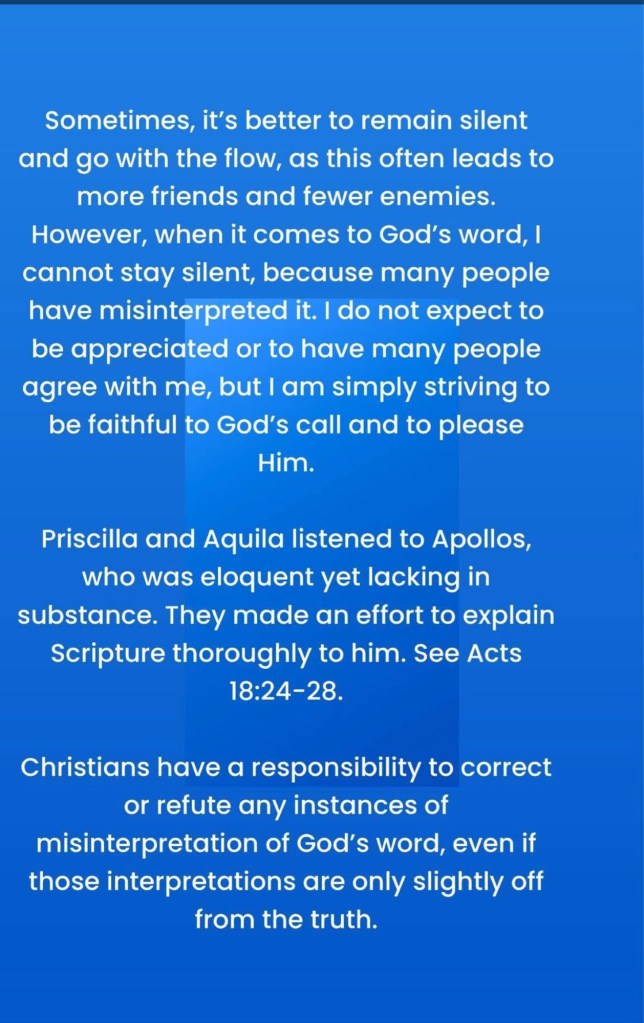
I was once told, “Pastor, your ministry might not interest a lot of people.” However, we are not seeking a large audience, but rather individual Christians who are eager to deepen their understanding of Scripture. The apostle Paul instructed, “What you have heard from me in the presence of many witnesses, entrust to faithful men who will be able to teach others also” (2 Timothy 2:2).
Christians, do not settle for simply listening and hearing. Be like the Bereans; learn to verify teachings against Scripture. Paul warned, “Keep a close watch on yourself and on the teaching. Persist in this, for by doing so you will save both yourself and your hearers” (1 Timothy 4:16).
Scripture also states, “There is a way that seems right to a man, but its end is the way to death” (Proverbs 14:12). Follow Jesus Christ and His Word—He alone is the way, the truth, and the life (John 14:6).
If Christians are united in their faith, there should be minimal conflict. But it has to be the right doctrine and faith. Our ministry’s goal is to strengthen and unify that faith. However, we recognize that this is not always easy, especially within a congregation. Jesus Christ didn’t convert five thousand people at once; He initially started with twelve, one of whom would betray Him. Therefore, it is important to start with individuals or a small group and allow growth to happen naturally.
Jesus Christ told a parable, saying, “The kingdom of heaven is like a grain of mustard seed that a man took and sowed in his field. It is the smallest of all seeds, but when it has grown it is larger than all the garden plants and becomes a tree, so that the birds of the air come and make nests in its branches.” (Mat 13:31-32)
Paul teaches, “I planted, Apollos watered, but God gave the growth.” (1Co 3:6)
Pastors and Christians need to understand that we are not tasked with building the church; rather, we are called to equip people with the Word of God. It is Christ Jesus alone who builds His church, as stated in Mattew 16:18. Scripture said, “So then you (that is, Gentile believers) are no longer strangers and aliens, but you are fellow citizens with the saints (Jewish Christians) and members of the household of God (the church), built on the foundation of the apostles and prophets (Scripture, both New & Old), Christ Jesus Himself being the cornerstone, in whom the whole structure, being joined together, grows into a holy temple in the Lord. In Him you also are being built together into a dwelling place for God by the Spirit.” (Eph 2:19-22)
Numbers do not mean anything to God; rather, it is the quality and character of His people that matters.
The Bible teaches, “After this many of His (Jesus Christ’s) disciples turned back and no longer walked with Him. So Jesus said to the twelve, “Do you want to go away as well?” Simon Peter answered Him, “Lord, to whom shall we go? You have the words of eternal life, and we have believed, and have come to know, that you are the Holy One of God.” Jesus answered them, “Did I not choose you, the twelve? And yet one of you is a devil.”” (Jhn 6:66-70)
At the end of the day, only those who are truly converted and understand the Scripture well will continue to live in faith and spread the Word.
Peter, in the words of Acts 3:6, declared, “I possess neither silver nor gold, but in the name of Jesus Christ, I offer you what I have.” Share freely, for you freely receive. Stay updated by heading to our about page and subscribe directly to receive notifications in your inbox. Blessing!
In John 9, Jesus’ disciples asked Him, “Rabbi, who sinned, this man or his parents, that he was born blind?” Jesus answered, “It was not that this man sinned, or his parents, but that the works of God might be displayed in him.” (John 9:2-3)
What did Jesus mean by “the works of God”? In John 6:29, we see that the work of God is for people to believe in Jesus Christ, whom He has sent.
John 9 is not solely about miracles and healings; rather, John emphasizes that these events are signs of Christ Jesus (John 20:30-31). Before Christ’s coming, the Jews experienced four hundred years of silence from God—where no miracles or words were spoken (What were the 400 years of silence? | GotQuestions.org; I disagree with the last sentence on this site. To understand why, visit my blog site https://unlearningtraditionrelearningscripture.com). Malachi foretold that Israel should anticipate the arrival of a forerunner preceding the coming of Christ Jesus (Malachi 3:1-5; 4:1-6). Thus, the signs performed by Christ announced His arrival (John 7:31). Although recognized by the religious leaders, they ultimately rejected Jesus, misleading Israel and condemning Him to the cross (John 11:47-48).
Are we faithfully bringing Jesus Christ to the awareness of others? Is our teaching about Jesus Christ aligned with Scripture? As Christians, are we living lives that reflect God’s grace?
We must always be vigilant about what we teach. It is essential to convey only the truths found in Scripture. Paul warned against those who teach about another Jesus or another Gospel (Galatians 1:6-7; 2 Corinthians 11:3-4).
“I am astonished that you are so quickly deserting him who called you in the grace of Christ and are turning to a different gospel—not that there is another one, but there are some who trouble you and want to distort the gospel of Christ.” (Galatians 1:6-7)
“But I am afraid that as the serpent deceived Eve by his cunning, your thoughts will be led astray from a sincere and pure devotion to Christ. For if someone comes and proclaims another Jesus than the one we proclaimed, or if you receive a different spirit from the one you received, or if you accept a different gospel from the one you accepted, you put up with it readily enough.” (2 Corinthians 11:3-4)
Let us learn only from the Word of God and not from men. Jesus Christ told a parable: “Can a blind man lead a blind man? Will they not both fall into a pit? A disciple is not above his teacher, but everyone when fully trained will be like his teacher.” (Luke 6:39-40)
True teaching of God’s Word is only truly learned when one is thoroughly trained in it. While reading men’s writings can sometimes be helpful, it should always be approached with discernment and discretion. We must be careful not to repeat the mistakes of others, as this could lead us to mislead those we teach. If that happens, can we still claim to be doing the work of God, which is to lead people to believe in Jesus Christ?
Peter, in the words of Acts 3:6, declared, “I possess neither silver nor gold, but in the name of Jesus Christ, I offer you what I have.” Share freely, for you freely receive. Stay updated by heading to our about page and subscribe directly to receive notifications in your inbox. Blessing!
Can a Christian claim to believe in Jesus Christ and yet be ignorant of His Word? This is the paradox of modern Christianity.
As John 1:14-18 and John 1:1 make clear, Jesus Christ is the Word. Therefore, a person can’t claim to believe in Jesus Christ and not know His Word. Some have even rejected the teachings of the Bible while simultaneously claiming to be Christians.
Shouldn’t Christians always be honest and straightforward? If someone hasn’t converted yet, we shouldn’t call them Christians. Attending a Sunday gathering doesn’t automatically make someone a Christian, and neither does water baptism if there’s no genuine conversion.
In their efforts to fill up Sunday gatherings, Christians have been misguided in their approach to growing the body of believers. Instead of sharing the Scripture and teaching people the truth first, they’ve prioritized bringing people to join Sunday gatherings. Many times without clear confirmations, they rush them into baptism without ensuring that they’ve truly converted to Christ Jesus and His Word.
True Christianity requires a deep understanding of the Word of God. We should not rush people into baptism or joining a Sunday gathering but rather share the Scripture with them until they demonstrate full submission to Jesus Christ and His Word.
In reality, as I have discussed in my other blog “Sunday Cliché”, modern Christianity has blended together Christians and nominal Christians. Aren’t you then dangerously exposing new Christians to “wolves in sheep’s clothing”?
Conversion into Christianity is a process. It is not like buying somebody a ticket and sending the person for a ride. Recognize that time is essential for studying the Scripture so that we can fully comprehend God’s Word and grow in our faith. Patiently guide a person to Christ Jesus. If you’re not equipped to teach, then you ought to learn first the fundamentals of the faith. The apostle Paul told Timothy, “You then, my child, be strengthened by the grace that is in Christ Jesus, and what you have heard from me in the presence of many witnesses entrust to faithful men, who will be able to teach others also (2Ti 2:1-2)”. That, and that alone, is the true essence of discipleship.
Ultimately, the best way to determine if someone is a Christian is by observing how they respond to life’s challenges and temptations. If they demonstrate a genuine commitment to Christ and His Word, then they are truly a Christian. As the saying goes, “The proof of the pudding is in the eating.”
Peter, in the words of Acts 3:6, declared, “I possess neither silver nor gold, but in the name of Jesus Christ, I offer you what I have.” Share freely, for you freely receive. Stay updated by heading to our about page and subscribe directly to receive notifications in your inbox. Blessing!
“The Jews therefore marveled, saying, “How is it that this man [Jesus Christ] has learning, when He has never studied?” So Jesus answered them, “My teaching is not Mine, but His who sent Me. If anyone’s will is to do God’s will, he will know whether the teaching is from God or whether I am speaking on My own authority. The one who speaks on his own authority seeks his own glory; but the one who seeks the glory of Him who sent Him is true, and in Him there is no falsehood.”
So, how do we know that we are learning from Jesus Christ, the Father, and the Holy Spirit, not from men? The teaching should always be in sync with the Scripture. Unlike today, a lot of Christian doctrines are misaligned, opposing each other.
Example: Christians teach that at the moment of death, believers would go to heaven, and yet they also say Jesus has yet to return. However, Jesus, in John 14:6, said, “I am the way, and the truth, and the life. No one comes to the Father except through Me.” Christ beforehand also said, “Let not your hearts be troubled. Believe in God; believe also in Me. In My Father’s house are many rooms. If it were not so, WOULD I HAVE TOLD YOU THAT I GO TO PREPARE A PLACE FOR YOU? AND IF I GO AND PREPARE A PLACE FOR YOU, I WILL COME AGAIN AND WILL TAKE YOU TO MYSELF, THAT WHERE I AM YOU MAY BE ALSO.” (John 14:1-3)
We all know forty days after Jesus’ resurrection [Acts 1:3], He ascended to the Father, thereby fulfilling His promise to prepare and return to take the believers to be with Him in heaven. So, if the Christian teaching today is correct, and He has yet to return, then no one can go to the Father at the moment because Jesus promised and made clear He alone is the way to the Father, and He would return to take the believers to heaven. In other words, before Jesus’ return, heaven should be off-limits to us.
That truth is reinforced by Hebrews 9:28: “So also Christ, having been offered once to bear the sins of many, WILL APPEAR A SECOND TIME, NOT TO BEAR SIN, BUT TO BRING SALVATION TO THOSE WHO ARE WAITING FOR HIM.”
Christians today aren’t the only ones waiting for Christ’s return. The contemporaries of Paul and Peter, Christians before the destruction of the Jerusalem temple, were waiting as well. See passages below.
“so that you are not lacking in any gift, as you wait for the revealing of our Lord Jesus Christ” (1Co 1:7)
“But our citizenship is in heaven, and from it we await a Savior, the Lord Jesus Christ” (Php 3:20)
“For not only has the word of the Lord sounded forth from you in Macedonia and Achaia, but your faith in God has gone forth everywhere, so that we need not say anything. For they themselves report concerning us the kind of reception we had among you, and how you turned to God from idols to serve the living and true God, and to wait for His Son from heaven, whom He raised from the dead, Jesus who delivers us from the wrath to come.” (1Th 1:8-10)
Paul and his generation of Christians were waiting for Christ’s return. Peter made clear however, the return of Christ Jesus and His salvation would be consummated in his generation. See 1Peter 1:10-13.
“CONCERNING THIS SALVATION, the prophets [OT prophets] who prophesied about the grace that was to be yours [Peter’s contemporary Christians] searched and inquired carefully, inquiring what person or time the Spirit of Christ in them was indicating when He [God] predicted the sufferings of Christ and the subsequent glories. IT WAS REVEALED TO THEM THAT THEY WERE SERVING NOT THEMSELVES [OT prophets] BUT YOU [Peter’s contemporary Christians], in the things that have now been announced to you [Peter’s contemporaries] through those who preached the good news to you [Peter’s contemporaries] by the Holy Spirit sent from heaven, things into which angels long to look. THEREFORE, PREPARING YOUR [Peter’s contemporary Christians] MINDS FOR ACTION, AND BEING SOBER-MINDED, SET YOUR HOPE [Peter’s contemporary Christians] FULLY ON THE GRACE THAT WILL BE BROUGHT TO YOU [Peter’s contemporary Christians] AT THE REVELATION [or appearing] OF JESUS CHRIST.”
Peter, therefore rightly reiterated Jesus’ Word and promise. See Matthew 16:28. “Truly, I say to you [Peter and his fellow apostles], there are some standing here who will not taste death until they see the Son of Man coming in His kingdom.”
Unless perhaps, the then apostles of Christ are still alive today – similar to the conspiracy theory about Elvis Presley being alive still and in hiding somewhere 😝.
If somebody promised to meet you at a specific time then stood you up, what do you make of that person? Trustworthy or not? Oh, maybe you would say perhaps he has a legitimate reason for being remiss of his word? But that can’t be true with Christ Jesus. The promised great prophet of Deuteronomy 18:15-22; Acts 3:22-23; Acts 7:37.
Do you understand the implications of such teaching? Asserting that Jesus Christ is yet to come; contrary to the claim of the Scripture. It opposes the very Word and promise of Christ Jesus. Therefore, futurist preachers today are actually – perhaps unknowingly but still by inference – saying Jesus failed in His Word and promise. The renowned, actually it should be infamous, C.S. Lewis said perhaps Jesus was hallucinating so He said those words to His apostles. Lewis even said, “Matthew 24:34 is the most embarrassing verse in the Bible” because Jesus promised to return to the generation of His apostles, but He did not. [https://www.behindthegospels.com/p/surprised-by-cs-lewis-the-most-embarrassing]
I don’t know about most Christians, but I would always adhere to Jesus Christ and His infallible words. It cannot be that Christ remised on His Word. Rather, if the Bible says one thing and the contemporary teaching opposes it, the Bible being infallible would mean it is always right. It’s our Christian duty to study the Bible until we have reconciled with God’s Word, discerning the truth. If modern Christian teaching does not stand up to the scrutiny of Scripture, then it ought to be disputed and corrected – even if it would invite attacks from critics because they insist on their truth.
Let me forewarn everyone though, back in the garden of Eden and with the temptation of Jesus Christ, it was the devil who had twisted God’s Word. No wonder, therefore, the unbelieving Jews opposed Christ’s Words, so Jesus refers to them as children of the devil (John 8:44-45). Certainly, we would not want to be in opposition to God’s Word.
In conclusion, Scripture said,
“He [Jesus Christ] was foreknown before the foundation of the world but was made manifest in the last times [last days] for the sake of you [Peter’s immediate audience or readers] who through Him are believers in God, who raised Him from the dead and gave Him glory, so that your faith and hope are in God. Having purified your souls by your obedience to the truth for a sincere brotherly love, love one another earnestly from a pure heart, since you have been born again, not of perishable seed but of imperishable, through the living and abiding word of God;for “All flesh is like grass and all its glory like the flower of grass. The grass withers, and the flower falls, but the word of the Lord remains forever.”And this word is the good news that was preached to you.” (1Pe 1:20-25)
Scripture made clear, that no one was mysteriously born again, but by the unchanging imperishable Word of God. Would you rather trust in man’s teachings or only the Word of God? Seek and discern the source of your learnings. Was it from man’s imagination or the diligent and careful study of God’s Word? Truthful teaching of God’s Word should always adhere to, not oppose, clear and straightforward teachings of the Scripture.
Jesus Christ said, “The Spirit is the one who gives life. The flesh doesn’t help at all. The words that I have spoken to you are spirit and are life.” (John 6:63)
Peter, in the words of Acts 3:6, declared, “I possess neither silver nor gold, but in the name of Jesus Christ, I offer you what I have.” Share freely, for you freely receive. Stay updated by heading to our about page and subscribe directly to receive notifications in your inbox. Blessing!






 Unlearning Tradition, Relearning Scripture