The Gospel writers started their narrative differently. Matthew begins with the genealogy of Jesus Christ. Luke started with the birth of John the Baptist. John, on the other hand, took off from the opening phrase of Genesis “in the beginning”. Mark announced with a bang, “Jesus Christ is the Son of God.”
The church at that time had been facing a lot of challenges. False gospel (Galatians 1:6-7; 2 Corinthians 11:3-4) and false Christ (1 John 5:1-6) had been introduced into mainstream Christianity of those days. Well, not surprisingly, because Jesus had told the disciples ahead that “false christs and false prophets will arise” (Mark 13:22).
Mark wasn’t an apostle of Jesus Christ. John Mark was first mentioned in Acts 12:12. He initially travelled with Paul and Barnabas. An argument ensued between Paul and Barnabas because of Mark. Paul refused to take him along in their next missionary journey because Mark abandoned them midway in their previous journey (Acts 13:13; 15:37-39). Colossians revealed that Barnabas and Mark were related, some translations say cousins, others Mark was Barnabas’ nephew. (Colossians 4:10) Paul and Mark had evidently reconciled as can be seen in Colossians. On his farewell letter, Paul states that Mark is very useful to him for ministry. (2 Timothy 4:11) John Mark, a young man, followed Jesus after His arrest. However, he had to flee because he was about to be seized (Mark 14:51-52).
1 Peter, written after the events of Acts 12, 13, and 15, reveals that Mark was now accompanying Peter (1 Peter 5:13). Peter gestured that they were at Babylon. Early Christians understood Babylon as Jerusalem, not Rome, the Great City where Jesus was crucified (Revelation 11:8; Revelation 18:21). Revelation 18:20-21 announced the fulfillment of God’s judgment against the Great City, as prophesied by Jesus Christ (Matthew 23:36-38).
Mark’s Gospel was generally accepted to be dated in the mid-50s AD, written after the events of Acts 13 (48 AD) and 15 (48-49 AD), and before Mark wrote on behalf of Peter around 64 AD (1 & 2 Peter; 1 Peter 5:13). Consequently, Peter holds the authority behind the Gospel of Mark.
So, why did Mark open his Gospel with the statement “The beginning of the Gospel of Jesus Christ” and emphatically declare that Jesus is the Son of God?
Perhaps 1 John could shed some light. Believed to be written by John, while exiled at Patmos (Revelation 1:9). Seven times 1 John refers to Jesus Christ as the Son of God (1 John 3:8; 4:15; 5:5; 5:10; 5:12; and 5:20). And here are the statements that stand out:
> “Whoever confesses that Jesus is the Son of God, God abides in him, and he in God.” (1 John 4:15)
> “Who is it that overcomes the world except the one who believes that Jesus is the Son of God?” (1 John 5:5)
> “If we receive the testimony of men, the testimony of God is greater, for this is the testimony of God that he has borne concerning his Son. Whoever believes in the Son of God has the testimony in himself. Whoever does not believe God has made him a liar, because he has not believed in the testimony that God has borne concerning his Son. And this is the testimony, that God gave us eternal life, and this life is in his Son. Whoever has the Son has life; whoever does not have the Son of God does not have life.” (1 John 5:9-12)
> “I write these things to you who believe in the name of the Son of God, that you may know that you have eternal life.” (1 John 5:13)
> “And we know that the Son of God has come and has given us understanding, so that we may know him who is true; and we are in him who is true, in his Son Jesus Christ. He is the true God and eternal life.” (1 John 5:20)
Clearly, 1 John and Mark’s Gospel were written to defend the truth that Jesus is the Son of God. 1 John was written about a decade later, indicating that false teachings about Christ Jesus were widespread and persistent. Mark practically opened and closed his Gospel with the declaration that Jesus is the Son of God.
It is best, therefore, to keep that in mind as we study the Gospel of Mark. It’s a defense of Christ’s divinity.
Peter, in the words of Acts 3:6, declared, “I possess neither silver nor gold, but in the name of Jesus Christ, I offer you what I have.” Share this article freely, for you freely receive. Take note, underlines and highlights are clickable links for definitions or Bible references. Stay updated by heading to our about page and subscribe directly to receive notifications in your inbox. Blessings!
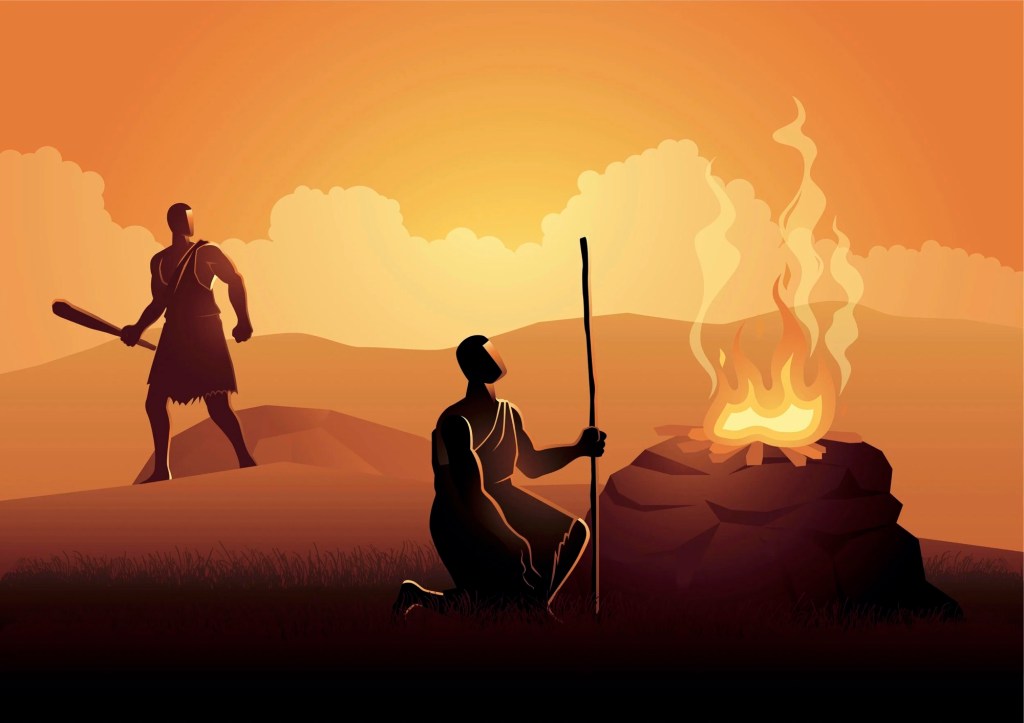
Reflecting on God’s desire for us who claim to follow Jesus Christ, let us consider the story of Cain and Abel as a case study. Why was Abel’s offering acceptable to God, while Cain’s was not?
Abel’s offering pleased God because it reflected a heart that honored Him first. In Genesis 4:3-7, we see that Abel offered the firstborn of his flock, signifying that he gave first to God. Cain, on the other hand, “in the course of time” offered some of the produce of the ground, but not the first fruits, indicating a lack of priority or wholehearted devotion.
Some interpret Abel’s offering as acceptable because it resembled the later Mosaic Law requirement to offer the fat portions to the Lord (Leviticus 3:16). However, the Law was established long after Cain and Abel, so their actions were not legally obligatory. Instead, God’s demand for the fat portions of all animal offerings reflected Abel’s genuine heart of giving to God first, not the other way around.
See God’s response to Cain—“If you do well, will you not be accepted?”—reveals that the real issue was the heart and attitude behind the offering. The act of giving must come from a place of surrender and prioritizing God above all.
This principle is echoed throughout Scripture. The story of Elijah and the widow shows the same heart condition: the widow gave the first portion of her last meal to God’s servant, demonstrating trust and putting God first. As a result, she and her son were sustained throughout the famine. (1 Kings 17:8-16)
Similarly, Paul commended the Macedonians in 2 Corinthians 8:1-6 because they gave themselves first to the Lord before giving their material support, even in extreme poverty. Their offering was accepted because it flowed from a surrendered heart.
The lesson is clear: God delights in offerings given with a heart that honors Him first. Gifts that are leftovers or given without full surrender do not please Him. True worship and acceptable giving are rooted in putting God above all else, both in life, in our ministry for God, and in offerings.
Consequently, Paul quoted Jesus saying, “It is more blessed to give than to receive (Acts 20:35),” a statement Jesus spoke before sending out His disciples. For us who serve the Lord Jesus Christ, this means we are called to share the Gospel without seeking payment. Yet, in the same context, the Lord also said, “The laborer deserves his food.” (Matthew 10:8-10) This reminds us that those who labor in the Word of God, as well as those who support them, should do so willingly and freely, without compulsion. In doing this, we reflect the heart of Abel, who offered the first and best of what he had to God, giving with a heart of faith and devotion.
Peter, in the words of Acts 3:6, declared, “I possess neither silver nor gold, but in the name of Jesus Christ, I offer you what I have.” Share this article freely, for you freely receive. Take note, underlines and highlights are clickable links for definitions or Bible references. Stay updated by heading to our about page and subscribe directly to receive notifications in your inbox. Blessings!
I’ve come to realize that many pastors are hesitant to discuss money because they’ve been taught and told not to speak on the topic. However, Paul addressed this issue on several occasions. Are pastors inferior to an apostle? Paul made it clear in Ephesians that both are mandated by Christ Jesus for His ministry. (Ephesians 4:11-14) While I understand that some people assume the role of a pastor but lack the necessary skills or love for God’s ministry. Some view the ministry not as a calling but as a profession, even worse, as an opportunity to gain wealth. (1 Timothy 6:3-5)
No wonder Paul said, “For we are not, like so many, peddlers of God’s word, but as men of sincerity, commissioned by God, in the sight of God we speak in Christ.” (2 Corinthians 2:17) This article applies only to the latter group: people who are genuinely committed to doing God’s work.
Here’s the silent truth: Pastors are even ridiculed when people discover that someone has been supporting them, despite the clear biblical teaching that it’s the right of the pastor to receive support.
For example, Paul said, “In the same way, the Lord commanded that those who proclaim the Gospel should get their living by the Gospel.” (1 Corinthians 9:14) It’s the right of pastors to receive their living from the Gospel, because it’s commanded by Jesus Christ (Luke 10:2-8).
Paul also said, “Let the one who is taught the word share all good things with the one who teaches.” (Galatians 6:6) This clearly teaches that the giving and receiving of ministry support is directly between the teacher and the learner.
Furthermore, Jesus instructed His disciples, “The harvest is abundant, but the laborers are few. Go your way; behold, I am sending you out as lambs in the midst of wolves. Carry no moneybag, no knapsack, no sandals, and greet no one on the road. Whenever you enter a house, first say, ‘Peace be to this house!’ If a son of peace is there, your peace will rest upon him. But if not, it will return to you. Stay in the same house, eating and drinking what they provide, for the laborer deserves his wages. Do not go from house to house.” (Luke 10:2-7)
Despite these clear teachings, God’s workers often face little support and are subjected to ridicule and accusations of wrongdoing. Paul himself expressed his frustration, stating, “Did I commit a sin in humbling myself so that you might be exalted? Because I preached God’s Gospel to you without charge? I robbed other churches by accepting support from them in order to serve you. And when I was with you and in need, I did not burden anyone. The brothers who came from Macedonia supplied my need. So I refrained and will refrain from burdening you in any way.” (2 Corinthians 11:7-9)
The Corinthian church was biblically obligated to actively support Paul’s ministry in their midst. Scripture emphasizes the responsibility of believers to help God’s workers, declaring, “Therefore, we ought to support God’s workers like these, so that we may be fellow workers for the truth.” (3 John 1:8)
Despite this clear mandate, Paul did not receive the support that was rightfully due him from the Corinthians. Instead, he endured their criticisms. In response, he wrote:
“I am here for the third time, ready to come to you. I will not be a burden because I seek not what is yours but you. Children are not obligated to save for their parents, but parents for their children. I will gladly spend and be spent for your souls. If I love you more, am I to be loved less? But since I did not burden you, you say, I was crafty and got the better of you by deceit.” (2 Corinthians 12:14‑16)
Paul’s words reveal his profound love for the Corinthians and his willingness to sacrifice for their spiritual growth, even without receiving the support that was biblically warranted. This passage serves as a reminder to recognize, honor, and assist those who faithfully labor in God’s work, fulfilling the partnership that Scripture envisions between God’s servants and His people.
God designed it that way. Both God’s workers and Christians who support them are considered workers in the Gospel. (3 John 1:8) God intended it to be a partnership. Therefore, Paul expressed his gratitude to the Philippians, saying, “I thank my God in all my remembrance of you, always in every prayer of mine for you all, making my prayer with joy, because of your partnership in the Gospel from the first day until now.” (Philippians 1:3-5) The Macedonians and the Philippians are essentially the same people. Paul revealed that they are his sole supporters, stating, “And you Philippians yourselves know that in the beginning of the gospel, when I left Macedonia, no church entered into partnership with me in giving and receiving, except you only.” (Philippians 4:15)
John teaches that those who prevent people from directly supporting God’s workers are considered evildoers. (3 John 1:9-11)
Demetrius, who welcomes and supports God’s workers, contrasts sharply with Diotrephes, who refuses and hinders others from doing the same. It is crucial to discern who you listen to and follow.
Shame on you, Diotrephes! You are wrongfully accusing God’s workers of wrongdoing by denying them support and hindering others from doing so. Let’s not be deceived by the cunning and deceitful reasoning of some people who exploit your ignorance of Bible teachings. Regrettably, some have accused God’s workers of wrongdoing while neglecting accountability in their own collections of donations from God’s people.
I am simply stating the truth. I have received an unusual call from God. My mission is to study the Bible, explain its teachings clearly and without restraint, and share them with others. God’s people should not be offended by God’s Word. If you have any doubts, I encourage or even challenge you to study the Bible thoroughly. Discover for yourself the authentic teachings of the Scriptures.
P.S. This is a follow through to my previous posting “Supporting Christian Workers: A Biblical Approach”
Peter, in the words of Acts 3:6, declared, “I possess neither silver nor gold, but in the name of Jesus Christ, I offer you what I have.” Share this article freely, for you freely receive. Take note, underlines and highlights are clickable links for definitions or Bible references. Stay updated by heading to our about page and subscribe directly to receive notifications in your inbox. Blessings!
Jesus once said, “You have heard that it was said, ‘You shall love your neighbor and hate your enemy.’ But I tell you, love your enemies and pray for those who persecute you, so that you may be children of your Father in heaven. For He causes His sun to rise on both the evil and the good, and sends rain on the just and the unjust.” (Matthew 5:43-45)
This challenges us to think deeply: does material abundance automatically mean we are blessed by God? If that were so, it would suggest that many wealthy but ungodly individuals are more favored than the faithful who live humbly. Yet Jesus reminds us that God’s providential grace is given to all, regardless of faith (Psalms 145:9; Acts 14:17).
It is common for Christians to fall into the trap of equating wealth with divine favor, forgetting that both abundance and scarcity are tests of our faith. The greater question is this: in times of plenty or in want, will we continue to praise God and live in obedience to Him?
Jesus often warned of the spiritual dangers of riches. Luke recounts the parable of the rich fool (Luke 12:13–21), and all three Synoptic Gospels tell of the rich young ruler (Matthew 19:16-24; Mark 10:17-23; Luke 18:18-25). When asked to surrender his possessions and follow Christ, the young man went away sorrowful. This led Jesus to declare, “Truly, I say to you, only with difficulty will a rich person enter the kingdom of heaven.” (Matthew 19:23)
Many contemporary preachers equate wealth with divine favor, but Proverbs 10:22 reminds us that “the blessing of the LORD makes rich, and He adds no sorrow with it.” True blessing lies not in amassing possessions but in finding contentment in God’s daily provision and being ready to share whenever He calls. This truth is evident in Jesus’ warning to the man obsessed with building larger storehouses for his wealth: “Fool! This night your soul is required of you, and the things you have prepared, whose will they be?” He concluded, “So is the one who lays up treasure for himself and is not rich toward God.” (Luke 12:20-21) On the other hand, Jesus praised the poor widow who gave two copper coins in contrast to the wealthy who contributed large sums of money, saying, “This poor widow has given more than everyone else. Because they all gave from abundance, but she, out of poverty, has given everything she had, all she had to live one day.” (Mark 12:41-44)
Paul, applying the teachings of Jesus, contrasted the wealthy Corinthians with the impoverished yet generous Macedonian believers. Despite their poverty, the Macedonians displayed the heart and teachings of Christ through remarkable generosity (2 Corinthians 8:1–6). Their giving was voluntary, sacrificial, and inspired by deep devotion to God—an “act of grace” (2 Corinthians 8:6).
Likewise, Paul praised the Philippians for their gifts, expressing the “act of grace” in another way: “a fragrant offering, a sacrifice acceptable and pleasing to God” (Philippians 4:18). It is called an act of grace because everything we have comes from God, and our ability to give flows from His grace.
In Matthew 25:31–46, Jesus confirmed this truth when He told the faithful who gave to those in need, “As you did it to one of the least of these brothers, you did it to Me” (v.40). Conversely, those who withheld care, generosity, and compassion faced the opposite judgment (vv.41–46). True generosity reflects God’s grace working in our hearts.
Let’s take a moment to reflect on the greatness of God? He alone is the source of everything good, while we are simply recipients, entrusted with the privilege to care, to share, and to give. Yet, our acts of grace are credited to us. As Philippians 4:17 shows, Paul expressed his gratitude by saying, “Not that I seek the gift, but I seek the fruit that increases to your credit.” It is no wonder Paul recalled the teachings of Jesus and said: “It is more blessed to give than to receive” (Matthew 10:8; Matthew 25:34-40; Luke 14:12-14; 2 Corinthians 9:6-12; Philippians 4:17-20; Hebrews 13:16). A truth quite the opposite of what many believe, isn’t it?
Christians, we are called to live by faith. James reinforces that faith without works is dead (James 2:14–20). Authentic faith expresses itself in action—serving others, meeting needs, and living out love. Salvation comes through faith, but genuine faith is proven in a daily walk of obedience.
Paul’s words in Philippians 2:12–13 remind us that faith is not a single moment but an ongoing journey of surrender and obedience to God. He calls on us believers to “work out [our] own salvation with fear and trembling,” not to earn salvation, but to live in a way that reflects the gift we have received. Our life’s testimony—through seasons of joy or struggle—reveals our trust in His perfect will. As the Gospel transforms us, God Himself works in our hearts, shaping our desires and guiding our actions for His glory. In response, we are to let His salvation manifest in how we live, bringing forth good works as the fruit of our faith.
This reflection encourages us to pause and reflect on what truly constitutes as blessings. It prompts us to assess how our faith is manifested in our daily lives. In fact, even in our ministry and sharing of the Gospel, as stated in Acts 20:35, “It is more blessed to give than to receive.”
Peter, in the words of Acts 3:6, declared, “I possess neither silver nor gold, but in the name of Jesus Christ, I offer you what I have.” Share this article freely, for you freely receive. Take note, underlines and highlights are clickable links for definitions or Bible references. Stay updated by heading to our about page and subscribe directly to receive notifications in your inbox. Blessings!
The idea of “once saved, always saved” stems from misinterpretations of selected Bible verses by some Christians. These passages seem to imply that God predestines certain individuals for salvation. Yet, a closer and more comprehensive reading of Scripture shows that this belief is inaccurate. The Bible does not universally call all believers the elect; rather, it speaks to a specific generation—the Jews who lived during Jesus’ ministry, the generation that rejected Him and contributed to His crucifixion.
Paul clarified this in Romans 11:1-6, where he spoke of a “remnant chosen by grace”:
> “I ask, then, has God rejected His people? By no means! For I myself am an Israelite, a descendant of Abraham, a member of the tribe of Benjamin. God has not rejected His people whom He foreknew. Do you not know what the Scripture says of Elijah, how he appeals to God against Israel? ‘Lord, they have killed Your prophets, they have demolished Your altars, and I alone am left, and they seek my life.’ But what is God’s reply to him? ‘I have kept for Myself seven thousand men who have not bowed the knee to Baal.’ So too at the present time there is a remnant, chosen by grace. But if it is by grace, it is no longer on the basis of works; otherwise grace would no longer be grace.”
Jesus expressed the same principle in several passages:
John 6:38-40 – “For I have come down from heaven, not to do My own will but the will of Him who sent Me… that I should lose nothing of all that He has given Me, but raise it up on the last day.”
John 6:44 – “No one can come to Me unless the Father who sent Me draws him. And I will raise him up on the last day.”
John 6:65 – “This is why I told you that no one can come to Me unless it is granted him by the Father.”
These verses affirm that salvation is achieved not by human effort or desire, but by God’s grace through faith in Christ. The Gospel is the power by which God calls people to faith—not an exclusive key held only for a select group, as extreme interpretations of “election” suggest.
The teaching that God chooses some for salvation and rejects others can breed spiritual arrogance. It is presumptuous to claim such privilege, especially when lives labelled as “elect” sometimes fail to reflect Christ’s character.
Paul’s statement in Romans 11:5—“a remnant chosen by grace”—points to the fulfillment of Old Testament promises found in Isaiah 11:11-16 and Jeremiah 31:31-34:
> “In that day the Lord will extend his hand yet a second time to recover the remnant that remains of his people, from Assyria, from Egypt, from Pathros, from Cush, from Elam, from Shinar, from Hamath, and from the coastlands of the sea… And there will be a highway from Assyria for the remnant that remains of his people, as there was for Israel when they came up from the land of Egypt.” (Isaiah 11:11-16)
> “Behold, the days are coming, declares the LORD, when I will make a new covenant with the house of Israel and the house of Judah… I will put my law within them, and I will write it on their hearts. And I will be their God, and they shall be my people… For I will forgive their iniquity, and I will remember their sin no more.” (Jeremiah 31:31-34)
These passages remind us that God’s covenant and salvation are rooted in His grace, not in human assumptions of guaranteed election.
Christians, live your lives in a way that truly honours Jesus. Do not depend on an empty confession of faith in Him. Genuine Christianity requires a transformed life. One is either a Christian or not; there is no middle ground. May we find inspiration in Paul’s declaration:
> “For I am already being poured out as a drink offering, and the time of my departure has come. I have fought the good fight, I have finished the race, I have kept the faith. Henceforth there is laid up for me the crown of righteousness, which the Lord, the righteous judge, will award to me on that day, and not only to me but also to all who have loved His appearing.” (2 Timothy 4:6-8)
Peter, in the words of Acts 3:6, declared, “I possess neither silver nor gold, but in the name of Jesus Christ, I offer you what I have.” Share this article freely, for you freely receive. Take note, underlines and highlights are clickable links for definitions or Bible references. Stay updated by heading to our about page and subscribe directly to receive notifications in your inbox. Blessings!
This posting is bound to stir controversy. However, as we have been guided by God’s Word and come to the realization that we may have been mistaken in our belief, shaped by long‑standing traditions and practices, having recognized the error, shouldn’t we reconsider our stance?
Only those touched by the Gospel of Jesus Christ possess the fervent boldness to express their faith. However, any heated matter will cool down if not constantly maintained. Our faith in Jesus Christ must be continually challenged to ensure that our passion for Christ remains unwavering. The primary adversary of all Christians is the deceptive wolves in sheep’s clothing.
Have you encountered any of these individuals? The Bible states:
“Do not be unequally yoked with unbelievers. For what partnership has righteousness with lawlessness? Or what fellowship has light with darkness? What accord has Christ with Belial? Or what portion does a believer share with an unbeliever? What agreement has the temple of God with idols? For we are the temple of the living God; as God said, ‘I will make My dwelling among them and walk among them, and I will be their God, and they shall be My people. Therefore, go out from their midst and be separate from them, says the Lord. Touch no unclean thing; then I will welcome you, and I will be a father to you, and you shall be sons and daughters to Me, says the Lord Almighty.’” (2 Corinthians 6:14-18)
In Paul’s context, the unbelievers he mentioned are not those outside the Christian faith. Instead, they are the wolves in sheep’s clothing within the church. A deeper understanding of this point can be gained by reading Paul’s letter, as least beginning at 2 Corinthians 2:17-7:1; 10:1-12:21.
The identity of the true church can become blurred when a venue where Christians gather also includes those who are ungodly or unrepentant. Scripture speaking about the church states:
“Do you not know that Christians are God’s temple and that God’s Spirit dwells in His church? If anyone destroys God’s temple, God will destroy him. For God’s temple is holy, and you are that temple.” (1 Corinthians 3:16-17)
No wonder, Paul called on the church to “purge the evil from within them” (1 Corinthians 5:13). It raises the question: how can we distinguish who truly belongs to the church? Only God knows who truly belongs to Him (2 Timothy 2:19). Confusion arises when human-made buildings or organizations—formed outside the pattern of Scripture—are still called churches. Jesus said in Matthew 16:18,
“On this Rock I will build My church, and the gates of Hades shall not prevail against it.”
Paul’s perspective on marriages between believers and unbelievers differs from the stance of much of contemporary Christianity. Rather than opposing such unions outright, he presents them as opportunities for the believing spouse to influence and possibly lead the other towards faith. This idea is captured in 1 Corinthians 7:16: “For how do you know, wife, whether you will save your husband? Or how do you know, husband, whether you will save your wife?”
The Rock is Christ Himself (1 Corinthians 10:4), and Peter’s confession—“You are the Christ, the Son of the Living God”—confirms this foundation.
Weekly Sunday gatherings are best understood as occasions for Christians to meet, sometimes accompanied by family and friends who may not yet share their faith, to listen to God’s Word.
The Apostle Paul demonstrated this practice by addressing a variety of audiences: he spoke to people in the marketplace and at the Areopagus in Athens (Acts 17:16-34), taught in the Hall of Tyrannus in Ephesus (Acts 19:8-10), and preached in the synagogues of Thessalonica (Acts 17:1-4), Berea (Acts 17:10-12), and Antioch (Acts 13:14-16). None of these locations were ever described as churches.
Instead, Scripture points out that early Christians gathered in their own homes, forming house churches, as seen in Romans 16:3-5, 1 Corinthians 16:19, Colossians 4:15, and Philemon 1:1-2. This does not imply that believers never assembled in larger spaces for fellowship among themselves, but no building was ever called a church in the biblical sense. Jesus Christ, when teaching about matters of the church, said:
“For where two or three are gathered in My name, there am I among them.” (Matthew 18:20)
The essence of the church is not tied to a specific building or location, but to the fellowship of believers who gather in the name of Christ. This truth is affirmed in John 4:21-24, where worship is shown to transcend physical spaces, focusing instead on spirit and truth.
“Believe Me, woman,” Jesus replied, “a time is coming when you will worship the Father neither on this mountain nor in Jerusalem. You worship what you do not know; we worship what we do know, for salvation is from the Jews. But a time is coming and has now come when the true worshipers will worship the Father in spirit and in truth, for the Father is seeking such as these to worship Him. God is Spirit, and His worshipers must worship Him in spirit and in truth.” (John 4:21-24)
Paul urges Christians to dedicate their lives as a living act of spiritual worship. He instructs believers not to conform to the patterns of this world but to be transformed by the renewing of their minds. Through this transformation, we gain the ability to discern and approve what is the good, pleasing, and perfect will of God. (Romans 12:1-2)
Christians frequently invoke 2 Corinthians 6:14, “Do not be unequally yoked with unbelievers,” to dissuade marriages between different denominations, like a Roman Catholic and an evangelical Christian. Yet, they seem to overlook the threat posed by wolves in sheep’s clothing among their own congregations. This creates an irony: the very misuse of 2 Corinthians 6:14 pressures believers to marry solely within their circle, even if some within that circle may, in fact, be spiritual pretenders.
I posed this question online: Are Christians allowed to be unequally yoked? Here’s the response:
Christians are not permitted to be unequally yoked, according to the teachings of the Bible. The phrase “unequally yoked” comes from 2 Corinthians 6:14, which advises believers not to form binding partnerships with non-believers. This guidance applies to marriage, close friendships, and business relationships where values and life directions might conflict.
Being yoked together implies moving in the same direction and sharing a purpose. If one partner does not share the same faith, it can lead to spiritual struggles, conflicts in values, and difficulty in walking in God’s will. Therefore, Christians are encouraged to seek relationships that strengthen their faith and align with biblical principles.
I fully agree with the second part of the response. However, it appears excessive to completely avoid business relationships or close friendships with unbelievers. This is easily refuted by Paul’s instructions in 1 Corinthians 5:9-13.
“I wrote you in my letter not to associate with sexually immoral people. I was not including the sexually immoral of this world, or the greedy and swindlers, or idolaters. In that case you would have to leave this world. But now I am writing you not to associate with anyone who claims to be a brother but is sexually immoral or greedy, an idolater or a verbal abuser, a drunkard or a swindler. With such a man do not even eat. What business of mine is it to judge those outside the church? Are you not to judge those inside? God will judge those outside. ‘Expel the wicked man from among you.’” (1 Corinthians 5:9-13)
Moreover, Paul’s instructions in 1 Corinthians 7 offer a different perspective on marriage. The principle of “garbage in, garbage out” is evident in the AI’s response. We must exercise caution and discernment with information from the internet.
Christianity generally holds that 2 Corinthians 6:14 applies to marriage. However, its intended context and application are for the church, similar to Paul’s instructions in 1 Corinthians 5:9-13.
Here are the key points on marriage from Paul’s instruction in 1 Corinthians 7:
“To the rest I say (I, not the Lord) that if any brother has a wife who is an unbeliever, and she consents to live with him, he should not divorce her. If any woman has a husband who is an unbeliever, and he consents to live with her, she should not divorce him. For the unbelieving husband is made holy because of his wife, and the unbelieving wife is made holy because of her husband. Otherwise your children would be unclean, but as it is, they are holy. But if the unbelieving partner separates, let it be so. In such cases the brother or sister is not enslaved. God has called you to peace. For how do you know, wife, whether you will save your husband? Or how do you know, husband, whether you will save your wife?Only let each person lead the life that the Lord has assigned to him, and to which God has called him. This is my rule in all the churches.” (1Co 7:12-17)
It’s easy to select, quote verses, and make judgments. However, every verse in Scripture has its context, and each context addresses a specific concern. Let’s avoid misinterpretation and misapplication of God’s Word.
Let us share our faith with our unbelieving loved ones, including those with unbelieving partners. We should share our faith without enforcing it. Faith is best demonstrated through our actions and lifestyle.
Let me repeat Paul’s message:
“For how do you know, wife, whether you will save your husband? Or how do you know, husband, whether you will save your wife? Only let each person lead the life that the Lord has assigned to him, and to which God has called him. This is my rule in all the churches.” (1Co 7:16-17)
Apparently, the problem isn’t having an unbelieving partner, but rather when the believing person compromises their faith.Instead of living a life of faith to influence their unbelieving partners, they submit to their ways. This is where the issue lies.
Of course, the ideal marriages should be between fellow believers in the Lord Jesus Christ. However, it’s also important to recognize that we only truly get to know the person we’ve married when we’ve lived together under one roof. In such a scenario, the ideal setting may not always be as perfect as we imagine. So, perhaps there goes Paul’s teaching for all churches. (1 Corinthians 7)
Important to note, however, was Paul’s instruction in 1 Corinthians 7:15. He emphasized, “But if the unbelieving partner separates, let it be so. In such cases, the brother or sister is not enslaved. God has called you to peace.” This teaching reminds Christians not to compromise their faith within a marriage with an unbeliever. If the unbelieving spouse refuses to accept or live peacefully with your faith, you are called to let them go, so that you may live in the peace God intends and freely practice your faith.
Paul’s statement in 1 Corinthians 7:17 is striking: he emphasises that his instructions are not mere suggestions, but a rule for all the churches. This shows the weight and authority of his words, meant to guide the believers collectively, not just optional advice for individual interpretation.
In my 26 years of being a Christian, I’ve encountered numerous non-Christians who live according to some teachings of Jesus. For instance, they follow Jesus’ teachings,
“So whatever you wish that others would do to you, do also to them, for this is the Law and the Prophets.” (Matthew 7:12)
They are aware of what is harmful to them and refrain from doing it to others, and vice versa. They do what is good to them to others. On the other hand, I’ve also come across a significant number of professing Christians who are actually devilish and engage in actions contrary to the Bible. Some of these actions are openly displayed, while others are kept secret or done in the dark. In such cases, it becomes challenging to discern who is truly far from God’s kingdom.
The Bible told of a story of a man who approached Jesus with a question. After Jesus responded, another person remarked,
“To love God with all your heart, mind, and strength, and to love your neighbor as yourself, is far greater than all the sacrifices and offerings.”
Jesus then stated, “You are not far from the kingdom of God.” (Mark 12:34) This story is found in Mark 12:28-34. The only missing element was a confession of faith in Jesus Christ.
Let me be clear: Salvation is not something that can be passed on to others. Not even to our partners in life, sons or daughters. It is a personal journey that involves a sincere confession of faith in Christ Jesus. This confession acknowledges that without Jesus, no one can earn eternal life. A true confession of faith in Jesus Christ demands a profound transformation in one’s believes, character and values.
The responsibility of living for Jesus rests on us who believe, and we are tasked not only to live our faith but teach it to our husbands or wives, and most especially to our children. Now, after faithfully doing our Christian duty, the rest is upon God’s grace. Paul states,
“I planted, Apollos watered, but God gave the growth. So neither he who plants nor he who waters is anything, but only God who gives the growth.” (1Co 3:6-7)
Christians are called to live in accordance with the teachings of the Bible, allowing God’s Word to shape and transform their lives for His glory. Regarding marriage, Paul recognized its inherent complexities. In 1 Corinthians 7:12, he begins with, “To the rest I say (I, not the Lord),” expressing pastoral counsel that carefully considers the nuances of the situation. This phrasing reflects his unique role as a divinely inspired writer of Scripture, as affirmed in 2 Peter 1:20-21. In contrast, modern pastors, though able to offer wise guidance, cannot claim the same level of authority as Paul did in his inspired writings.
Servants of God’s Word, we are called to present ourselves as approved before Him: diligent workers, unashamed, and rightly handling the Word of truth, as written in 2 Timothy 2:15. This command was given to Timothy and speaks to us today, we who profess to be called by Jesus to teach and share His Word. As we seek to guide others, let us avoid unnecessary complications. In matters of marriage, let us faithfully lean on God’s instructions found in 1 Corinthians 7, using His Word as our clear and unwavering guide.
May this article shed light on the topic of mixed marriages. Pray, read the Bible, and always be guided by Scripture. May the grace of God be upon everyone who reads this article.
P.S. I’m open to reconsider my stance if someone can provide a more effective teaching on this subject. However, these are the teachings I’ve encountered in Scripture.
Peter, in the words of Acts 3:6, declared, “I possess neither silver nor gold, but in the name of Jesus Christ, I offer you what I have.” Share this article freely, for you freely receive. Take note, underlines and highlights are clickable links for definitions or Bible references. Stay updated by heading to our about page and subscribe directly to receive notifications in your inbox. Blessings!
No, that is not correct. The recent earthquakes are not connected to Christ’s return. Let us look into Scripture to see where such an idea might have originated. The Bible says:
“Jesus left the temple and was going away when His disciples came to show Him the temple buildings. But He said to them, ‘Do you see all of these? Truly, I tell you, not one stone here will remain on another; every one will be thrown down.’ Later, as He sat on the Mount of Olives, the disciples approached Him privately and asked, ‘Tell us, when will these things happen, and what will be the sign of Your comingand of the end of the age?’” (Matthew 24:1-3)
Let us explore the question: When will the temple be destroyed? What will be the sign of Your coming and of the end of the age? These seemingly three distinct questions collectively encapsulate a single, overarching inquiry.
Take note, the disciples sought the sign of Jesus’ coming because of His prediction of the temple’s destruction. They were well aware of the connection between the desolation of the temple and the two other events – the coming of Jesus and the end of the age. Jesus first warned them about the deceptive nature of false prophets. He cautioned them:
“Be on guard against false prophets. Many will come in My name, claiming to be the Christ, and they will lead many astray.” (Matthew 24:4-5)
Let’s quickly address the concept of “end of the age.” The Bible states:
“On many past occasions and in many different ways, God spoke to our fathers through the prophets. But in these last days He has spoken to us by His Son, whom He appointed heir of all things, and through whom He made the universe” (Hebrews 1:1-2).
Here’s the proof that God is going to create a new people, see Isaiah 65:17-19:
“For behold, I create new heavens and a new earth, and the former things shall not be remembered or come into mind. But be glad and rejoice forever in that which I create; for behold, I create Jerusalem to be a joy, and her people to be a gladness. I will rejoice in Jerusalem and be glad in My people; no more shall be heard in it the sound of weeping and the cry of distress.”
In the Gospel of Luke, during the Last Supper or the Passover meal, the Bible states:
“And Jesus took bread, and when He had given thanks, He broke it and gave it to His disciples, saying, ‘This is My body, which is given for you. Do this in remembrance of Me.’ And likewise the cup after they had eaten, saying, ‘This cup that is poured out for you is the new covenant in My blood.’” (Luke 22:19-20)
Here is the essence of Christ’s declaration of the New Covenant. Paul, in 2 Corinthians 5:16-17 states:
“From now on, therefore, we regard no one according to the flesh (i.e., circumcision or Old Covenant). Even though we once regarded Christ according to the flesh, we regard Him thus no longer. Therefore, if anyone is in Christ, he is a new creation. The old has passed away; behold, the new has come.”
Back to Christ’s warning against deceptive false prophets (Matthew 24:4-5). As students of the Bible, we should have noticed Jesus’ repeated warning to His disciples on this matter in Matthew 24. Jesus cautions:
“Then if anyone says to you, ‘Look, here is the Christ!’ or ‘There he is!’ do not believe it. For false christs and false prophets will arise and perform great signs and wonders, so as to lead astray, if possible, even the elect. See, I have told you beforehand. So, if they say to you, ‘Look, he is in the wilderness,’ do not go out. If they say, ‘Look, he is in the inner rooms,’ do not believe it’” (Matthew 24:23-26).
It was undoubtedly of utmost importance for Jesus to reiterate this warning three times, as seen for the first time in Matthew 24:4-5. But why did He do so?
Let’s take a look at Jesus’ declaration, both to the Pharisees and to His disciple on the same reference “look, here it is! or there!”
“Being asked by the Pharisees when the kingdom of God would come, Jesus answered them, “The kingdom of God is not coming in ways THAT CAN BE OBSERVED, nor will they say, ‘Look, here it is!’ or ‘There!’ for behold, the kingdom of God is in the midst of you.” And Jesus said to the disciples, “The days are coming when you will desire to see one of the days of the Son of Man, and you will not see it. And they will say to you, ‘Look, there!’ or ‘Look, here!’ Do not go out or follow them. For as the lightning flashes and lights up the sky from one side to the other, so will the Son of Man be in His day. But first He must suffer many things and be rejected by this generation.” (Luke 17:20-25)
Contrary to popular belief, Jesus wasn’t implying that His coming would be swift and easily noticeable by saying, “For as the lightning flashes and illuminates the sky from one side to the other.” Instead, Christ was quoting Zechariah 9:14:
“Then the LORD will appear over them, and His arrow will be sent forth like lightning; the Lord GOD will sound the trumpet and will march forth in the whirlwinds of the south.”
In essence, Jesus declares that He, the Son of Man, will return in the glory of LORD or YHWH, the covenant name of God. God Almighty – God the Father, God the Son and the Holy Spirit.
Look at Jesus words again: “The days are coming when you will desire to see one of the days of the Son of Man, and you will not see it. And they will say to you, ‘Look, there!’ or ‘Look, here!’ Do not go out or follow them.” (Luke 17:22-23)
By quoting from Zechariah 9, Jesus assures His disciples that He is the Christ, the King who came to Jerusalem riding a donkey (Zechariah 9:9). This prophecy was fulfilled just days later in Luke 19:28-38. Contrary to contemporary Christian beliefs and teachings, the Bible never taught about two separate comings of Jesus Christ. With the coming of Jesus, the Christ, He was to fulfill Scriptures (Matthew 5:17; Luke 24:44). The Book of Hebrews clearly teaches:
“Just as man is appointed to die once, and after that to face judgment, so also Christ was offered once to bear the sins of many; and He will appear a second time, not to bear sin, but to bring salvation to those who eagerly await Him” (Hebrews 9:27-28).
It is not two comings, but by His return, He completed His salvation work for all who believe in Him. Christ Jesus’ return would be marked by glory and power, not by a visible appearance, but rather by the event of the temple’s desolation or destruction, which occurred in 70 AD. Contrary to contemporary Christian teachings and beliefs, Acts 1:11 explicitly states that Jesus will return in glory, not in a physical form. Jesus’ coming on the clouds signifies His return in glory, as specifically stated by Paul in 1 Timothy 3:16.
“Indeed, we confess, is the mystery of godliness: He was manifested in the flesh, vindicated by the Spirit, seen by angels, proclaimed among the nations, believed on in the world, and taken up in glory.”
After Christ’s ascension, Jesus manifested Himself to Stephen before his martyrdom for the faith and to Paul during his Damascus encounter. In Acts, Jesus was either seen on the right hand of God (Acts 7:55-56), in glory (Acts 9:3-7), or in the Spirit (Acts 16:7).
Consequently, Jesus cautioned His disciples against believing claims of seeing Him visibly during His coming. Refer to Luke 17:22-24, where He addressed the disciples and said:
“The days are coming when you will yearn to witness one of the days of the Son of Man, but you will not be able to see it. They will say to you, ‘Look, there!’ or ‘Look, here!’ Do not go out or follow them. For as the lightning flashes and illuminates the sky from one side to the other, so will the Son of Man be in His day.”
The same message was conveyed by Jesus in Matthew 24:23-27. In verse 27, Jesus seems to have likened His return to the lightning that illuminates the sky from one side to the other (Luke 17:24), but in reality, He quotes Zechariah 9:14:
“Then the LORD will appear over them, and His arrow will go forth like lightning; the Lord GOD will sound the trumpet and will march forth in the whirlwinds of the south”
The declaration in Zechariah 9:14-17 signifies that Jesus would return in glory and power, and His salvation would be completed upon His return, same with Hebrews 9:28.
“So also Christ was offered once to bear the sins of many; and He will appear a second time, not to bear sin, but to bring salvation to those who eagerly await Him.” (Hebrews 9:28)
There’s no huge gap after all in Christ’s coming, unlike the beliefs of many today. It’s been millennia since Jesus appeared. Instead, Jesus fulfilled Scriptures, as foreshadowed by the Exodus to the Promised Land. Israel spent forty years in Exodus with Moses before Joshua led them in conquering the Promised Land. Luke explained the transfiguration of Jesus, stating:
“Suddenly two men, Moses and Elijah, began talking with Jesus. They appeared in glory and spoke about His departure, which He was about to accomplish at Jerusalem” (Luke 9:30-31).
The Greek word translated “departure” literally means “exodus,” so like the Exodus, which was the shadow of things to come. Jesus was in fulfillment of Scriptures; He led His people in exodus to the true Promised Land. The Bible states:
“For if Joshua had given them rest, God would not have spoken of another day later on. So then, there remains a Sabbath rest for the people of God, for whoever has entered God’s rest has also rested from his works as God did from His.” (Hebrews 4:8-10)
The Promised Land signifies rest. God has welcomed back mankind – that is, those who believe in Jesus Christ – to the Garden of Eden, where God is in communion with man, and man works not to survive, but in the command of God. (Genesis 2:15) Jesus Christ declares:
“Do not work for the food that perishes, but for the food that endures to eternal life, which the Son of Man will give to you. For on Him God the Father has set His seal.” (John 6:27)
Work on how to increase your faith, and always believe in Jesus Christ. For Jesus states:
“So don’t worry about these things, saying, ‘What will we eat? What will we drink? What will we wear?’ These things dominate the thoughts of unbelievers, but your heavenly Father already knows all your needs. Seek the Kingdom of God above all else, and live righteously, and He will give you everything you need.” (Matthew 6:31-33)
Next, in Matthew 24:6-8, Jesus states:
“And you will hear of wars and rumors of wars. See that you are not alarmed, for this must take place, but the end is not yet. For nation will rise against nation, and kingdom against kingdom, and there will be famines and earthquakes in various places. All these are but the beginning of the birth pains.”
During the time of the disciples, were there no wars or rumors of wars, nor were there any earthquakes? The Jewish war occurred during the era of Jesus Christ’s disciples. According to the Jewish historian Flavius Josephus, a severe earthquake struck Jerusalem during the festival of Pentecost (Shavuot) in 66 AD, just before the outbreak of the Jewish-Roman War. Josephus also recorded the occurrence of famine during that period.
Furthermore, the decades preceding the 70 AD destruction of Jerusalem and the temple were marked by a series of geological upheavals throughout the Roman Empire. Although not confined to Jerusalem, earthquakes devastated cities in Crete, Smyrna, Miletus, Campania, and the renowned 63 AD earthquake that obliterated Pompeii. These events were widely interpreted by early followers as forewarnings of the city’s impending downfall.
Continuing on, in Matthew 24:9-15, Jesus next states:
“Then they will deliver you (i.e., the disciples) up to tribulation and put you to death, and you will be hated by all nations for My name’s sake. And then many will fall away and betray one another and hate one another. And many false prophets will arise and lead many astray. And because lawlessness will be increased, the love of many will grow cold. But the one who endures to the end will be saved. And this gospel of the kingdom will be proclaimed throughout the whole world as a testimony to all nations, and then the end will come.”
The Book of Acts chronicles the spread of the Gospel. It begins in Jerusalem (Acts 2-7), extends to all Judea and Samaria (Acts 8), and ultimately reaches the ends of the earth (Acts 11:19-28:31). Paul was in Rome at the conclusion of Luke’s narration in Acts. As the capital of the Roman Empire, Rome represented the culmination of the then-known Jewish world, fulfilling Acts 1:8. Jesus prophesied to His apostles:
“But you will receive power when the Holy Spirit has come upon you, and you will be my witnesses in Jerusalem and in all Judea and Samaria, and to the ends of the earth.”
Jesus finally revealed the sign of His coming, saying:
“So, when you see the abomination of desolation spoken of by the prophet Daniel standing in the holy place (let the reader understand), then let those in Judea flee to the mountains. Those on the housetop should not descend to take what is in their house, and those in the field should not turn back to retrieve their cloaks. Alas, women who are pregnant and those who are nursing infants during those days! Pray that your flight may not occur in winter or on a Sabbath. For then there will be great tribulation, such as has never been experienced since the beginning of the world and will never be again. If those days had not been shortened, no human being would be saved. However, for the sake of the elect, those days will be shortened.” (Matthew 24:15-22)
The destruction of the temple was the sign of Jesus’ coming, as mentioned in Daniel’s prophecies (Daniel 8:13, 9:26-27, and 12:11-13). Anyone still skeptical that Jesus in Matthew 24:15 spoke of the temple’s desolation should simply refer to Luke’s narration on the same event.
“But when you see Jerusalem surrounded by armies, then know that its desolation has come near. Then let those who are in Judea flee to the mountains, and let those who are inside the city depart, and let not those who are out in the country enter it, for these are days of vengeance, to fulfill all that is written. Alas for women who are pregnant and for those who are nursing infants in those days! For there will be great distress upon the earth and wrath against this people. They will fall by the edge of the sword and be led captive among all nations, and Jerusalem will be trampled underfoot by the Gentiles, until the times of the Gentiles are fulfilled.” (Luke 21:20-24)
Interestingly, many people overlooked the fact that Jesus quoted Daniel 12:1 in Matthew 24:21, stating:
“For then there will be great tribulation, such as has not been from the beginning of the world until now, no, and never will be.”
Moreover, it’s crucial to note that Daniel 12:3 states:
“And those who are wise shall shine like the brightness of the sky above; and those who turn many to righteousness, like the stars forever and ever.”
Jesus quoted this verse when He spoke about the kingdom of heaven. Refer to Matthew 13:43. Let us learn from Christ’s teaching on Daniel 12:3 or Matthew 13:43, the context for Jesus’ teaching in Matthew 13:44-52.
“Then the righteous will shine like the sun in the kingdom of their Father. He who has ears, let him hear (Daniel 12:3). The kingdom of heaven is like treasure hidden in a field, which a man found and covered up. Then in his joy he goes and sells all that he has and buys that field.” “Again, the kingdom of heaven is like a merchant in search of fine pearls, who, on finding one pearl of great value, went and sold all that he had and bought it.” “Again, the kingdom of heaven is like a net that was thrown into the sea and gathered fish of every kind. When it was full, men drew it ashore and sat down and sorted the good into containers but threw away the bad. So it will be at the end of the age. The angels will come out and separate the evil from the righteous and throw them into the fiery furnace. In that place there will be weeping and gnashing of teeth.” “Have you understood all these things?” They said to Jesus, “Yes.” And He said to them, “Therefore every scribe who has been trained for the kingdom of heaven is like a master of a house, who brings out of his treasure what is new and what is old.” And when Jesus had finished these parables, he went away from there,” (Matthew 13:43-53)
So, here’s the challenge: have we truly been trained for the kingdom of heaven? Sadly, the fallacy concerning the Return of Jesus has persisted for too long that people have accepted it as the truth. Indeed, as the saying goes, “Repeat a lie often enough, and it becomes the truth.”
Have we been obedient to do our part in God’s kingdom? Paul wrote in Romans:
“So we (i.e., God’s church), though many, are one body in Christ, and individually members one of another. Having gifts that differ according to the grace given to us, let us use them: if prophecy, in proportion to our faith; if service, in our serving; the one who teaches, in his teaching; the one who exhorts, in his exhortation; the one who contributes, in generosity; the one who leads, with zeal; the one who does acts of mercy, with cheerfulness.” (Romans 12:5-8)
Some individuals have been serving for financial gain, but Paul emphasizes that they are not like many others who peddle God’s word. Instead, they are sincere men, commissioned by God, who speak in Christ in the presence of God. (2 Corinthians 2:17) Others, similarly fixated on their calculators evaluating their contributions to God’s work, behave like stock market investors. When their investments decrease, their giving also diminishes. However, what happens when the market is thriving? Do their giving practices align with the increase in their financial standing?
Here’s a story from the Bible:
“Jesus sat opposite the treasury and observed the people depositing money into the offering box. Many wealthy individuals contributed substantial sums. However, a poor widow approached and placed two small copper coins, which constitute a penny. Jesus then called His disciples to Him and said, ‘Truly, I say to you, this impoverished widow has contributed more than all those who are giving to the offering box. They all contributed out of their abundance, but she, despite her poverty, has given everything she had, all that she needed to sustain herself.’” (Mark 12:41-44)
Let us all give to the Lord what has been entrusted to us first. Scripture state:
“Beware lest you say in your heart, ‘My power and the might of my hand have gotten me this wealth.’ You shall remember the LORD your God, for it is He who gives you power to get wealth.” (Deuteronomy 8:17-18)
Christ Jesus told of a person who came to Him, asking about eternal life. Sadly though, being rich, Jesus issued a challenge to him. He walked away sorrowfully. (Matthew 19:16-22) Jesus then turned to His disciples and said:
“Truly, I say to you, only with difficulty will a rich person enter the kingdom of heaven. Again I tell you, it is easier for a camel to go through the eye of a needle than for a rich person to enter the kingdom of God.” (Matthew 19:23-24)
In several instance, the Bible warns against the love of money (1 Timothy 6:10; Hebrews 13:5). Some individuals are called to fulfill their work full-time in Christ’s ministry, while others are blessed with wealth. The Bible states:
“God’s workers accept nothing from people who are not believers. Therefore, we ourselves should support them so that we can be their partners as they teach the truth.” (3 John 5-8)
This serves as a test of our faithfulness to Jesus Christ, for both us as servants of God’s work and all Christians. God’s workers should remain faithful to His Word, and the church should partner with them through support and giving. Consider the story of Elijah in 1 Kings 17. It was not Elijah who was provided with sustenance, but the widow who gave him food.
“So Elijah arose and went to Zarephath. And when he came to the gate of the city, behold, a widow was there gathering sticks. And he called to her and said, ‘Bring me a little water in a vessel, that I may drink.’ And as she was going to bring it, he called to her and said, ‘Bring me a morsel of bread in your hand.’ And she said, ‘As the LORD your God lives, I have nothing baked, only a handful of flour in a jar and a little oil in a jug. And now I am gathering a couple of sticks that I may go in and prepare it for myself and my son, that we may eat it and die.’ And Elijah said to her, ‘Do not fear; go and do as you have said. But first make me a little cake of it and bring it to me, and afterward make something for yourself and your son. For thus says the LORD, the God of Israel, “The jar of flour shall not be spent, and the jug of oil shall not be empty, until the day that the LORD sends rain upon the earth.” And she went and did as Elijah said. And she and he and her household ate for many days. The jar of flour was not spent, neither did the jug of oil become empty, according to the word of the LORD that He spoke by Elijah.” (1 Kings 17:10-16)
Back to our topic, thrice, Jesus warned the disciples, saying:
“If anyone says to you, ‘Look, here is the Christ!’ or ‘There!’ don’t believe it. False christs and false prophets will rise and perform great signs and wonders to deceive, if possible, even the elect. I have already told you this. Therefore, if they say to you, ‘Look, He is in the desert!’ don’t go out; or ‘Look, He is in the inner rooms!’ don’t believe it. Just as the lightning flashes from the east to the west, so too will the coming of the Son of Man. Wherever the dead body is, the eagles will gather around it.” (Matthew 24:23-28)
For Matthew 24:28, most modern translations of the Bible have it as “Wherever the corpse is, there the vultures will gather.” However, the above translation from the NKJV uses “eagle” instead of “vultures.” In Greek, the word “Aetos” (G105) should have been translated as “eagles” instead of “vultures.” This verse is a reference to Deuteronomy 28:49, which states:
“The LORD will bring a nation against you (i.e., the Old Covenant Israel) from far away, from the end of the earth, swooping down like the eagle, a nation whose language you do not understand.”
In 70 AD, Rome, the foreign nation, destroyed both the city of Jerusalem and the sanctuary. God’s judgment was imminent for the generation that crucified Jesus, oppressed, and killed His apostles. Jesus declared:
“Truly, I say to you, all these things will come upon this generation” (Matthew 23:36).
Christ reiterated His judgment, stating:
“Truly, I say to you, this generation will not pass away until all these things take place” (Matthew 24:34).
So, why did post-first-century Christianity commit mistakes until today? Why is our current understanding of Christ’s return completely different from what I explained here? Christian theologians heavily relied on the early church fathers writings instead of the Scriptures, leading to their errors becoming our errors. Jesus emphasized the importance of discipleship, stating:
“Can a blind man lead a blind man? Will they not both fall into a pit? A disciple is not above his teacher, but everyone when he is fully trained will be like his teacher.” (Luke 6:39-40)
We have only one Teacher, and that’s Jesus Christ, our Lord and Savior. (Isaiah 30:22-21; 1 Corinthians 3:5-11) Let us learn from His Word, not from human writings. Be a Berean, verifying every teaching we hear or read from Scripture. (Acts 17:11) The Bible alone is inerrant.
At Unlearning Tradition, Relearning Scripture, we strive to restore the Bible’s authentic teachings. However, the only effective approach is to return to the traditional study of the Bible, as we were trained in seminary. This involves exegeting each passage, analyzing its context, audience, and historical relevance. Before the Bible addressed us, it first spoke to the early Christian community. Reading the Bible in the context of our current events would be eisegesis, which involves inserting our own ideas into the text rather than reading it as it was originally intended.
God through Jesus Christ promised us His eternal blessings. But distorted teachings on the Bible, and the need to live and survive have challenged our faith. How can we understand God’s Word in the midst of life’s turmoil?
The Bible states, “Be still, and know that I am God. I will be exalted among the nations, I will be exalted in the earth!” (Psalm 46:10). Take time to learn from the Bible, and live in faith. Live a victorious life in Jesus Christ.
Jesus states, “I have said these things to you, that in Me you may have peace. In the world you will have tribulation. But take heart; I have overcome the world.” (John 16:33)
Peter, in the words of Acts 3:6, declared, “I possess neither silver nor gold, but in the name of Jesus Christ, I offer you what I have.” Share this article freely, for you freely receive. Take note, underlines and highlights are clickable links for definitions or Bible references. Stay updated by heading to our about page and subscribe directly to receive notifications in your inbox. Blessings!
Since last week, our study was on Matthew 12:1-8. The focus of Matthew 12 may be seen in verses 6-8. Jesus states,“I tell you, something greater than the temple is here. And if you had known what this means, ‘I desire mercy, and not sacrifice,’ you would not have condemned the guiltless. For the Son of Man is Lord of the Sabbath.” (Matthew 12:6-8)
Key to understanding Matthew 12 boils down to comprehending its context, Christ’s declarations, and His quote from Hosea 6:6, “For I desire mercy and not sacrifice, the knowledge of God rather than burnt offerings.”
Christ’s Quotation of Hosea 6:6
Hosea, the last prophet to condemn the Ten Tribes of Israel, particularly the Northern kingdom, delivered his prophecies long after the kingdom’s division during the reign of Rehoboam. Despite its prosperity under Jeroboam’s rule, the Northern kingdom became insecure that Jews from the North might continue to travel to Jerusalem for worship, as per the Law of Moses. Consequently, Jeroboam constructed a rival temple in both Bethel and Dan. (1 Kings 12:25-33) This act marked the beginning of the Northern kingdom’s decline, ultimately leading to its conquest by the Assyrians in 722 BC, fulfilling God’s pronouncement of judgment upon the Ten Tribes – “I will put an end to the kingdom of the house of Israel.” (Hosea 1:4)
Before Hosea, Amos had already prophesied the downfall of Israel. The LORD declared, “Behold, I am establishing a plumb line in the midst of My people Israel;I will never again pass by them. The high places of Isaac shall be desolate, and the sanctuaries of Israel shall be laid waste, and I will rise against the house of Jeroboam with the sword.” (Amos 7:8-9) Amos repeated this same message of judgment, see Amos 8:2, “The end has come upon my people Israel;I will never again pass by them.”
Christ’s quotation of Hosea 6:6, “For I desire mercy and not sacrifice, the knowledge of God rather than burnt offerings,” was a pivotal moment. Interestingly, this wasn’t the first time Jesus had quoted this verse. He had done so earlier in Matthew 9:13, highlighting the primary purpose of His coming—to offer redemption (“For I did not come to call the righteous, but sinners”).
Context of Matthew
The context of Matthew was the arrival of Jesus, the promised Christ (or Messiah) of the Old Testament Scripture. And yet, Jews of Jesus’ days, though acknowledging His signs (John 2:23), refused to acknowledge the truth; they were in denial.
Christ’s Declaration
In John’s Gospel, Jesus makes a bold declaration: “Destroy this temple, and in three days I will raise it up.” (John 2:19) John clarifies that Jesus is referring to the temple of His body, which is His church. (John 2:21-22) Jesus delves into the theme of the temple in Matthew 12. Let us explore the story.
Pharisees questioned Jesus for allowing His disciples to pluck grain and eat on the Sabbath. In response, Jesus cited the example of David taking the bread of Presence, which was forbidden to him under the Mosaic Law because it was reserved for the priests. This pointed out their hypocrisy. Jesus then addressed the priests, noting that they were engaged in slaughtering animals for sacrifice on the Sabbath and other days, as per Numbers 28:9-10, yet they were not guilty. To emphasize the truth, Jesus declared, “I tell you, something greater than the temple is here.” He emphasized that if priests were not guilty for performing their duty, then Jesus Christ, who was greater than the temple, was even more deserving of their reverence. He then quoted Hosea 6:6 to support his claim: “Jesus is the fulfillment of God’s offer for redemption, as stated in Hosea 6:1-2: ‘Come, let us return to the LORD; for He has torn us apart so that He may heal us; He has struck us down, and He will bind us up. After two days, He will revive us; on the third day, He will raise us up, so that we may live before Him.’” Consequently, Jesus declared in John 2:19 that He would raise this temple (which, as explained in John 2:21, refers to His body) after three days.
Understanding the Doctrine of the Church
Understanding the doctrine of the church begins with recognizing that its establishment is rooted in the proclamation of the Gospel and the resurrection of Christ. Hosea 6:2, “On the third day He will raise us up, that we may live before Him,” holds significant importance in this context. It is essential to grasp that the church is not a physical structure or a place of assembly, but rather God’s people who are saved by grace through faith in Christ’s death and resurrection. As Jesus stated to Peter, “On this rock—referring to the confession of Peter, Jesus is the Christ, the Son of God (Matthew 16:16)—I will build My church, and the gates of Hades will not overpower it. I will give you the keys of the kingdom of heaven, and whatever you bind on earth will have been bound in heaven, and whatever you loose on earth will have been loosed in heaven.” (Matthew 16:18-19) Christ Jesus and His Gospel serve as the keys to entrance into God’s kingdom. Jesus further emphasizes, “I am the way, and the truth, and the life. No one comes to the Father except through Me.” (John 14:6)
Hebrews clearly taught that for as long as the temple in Jerusalem stands, the present age (i.e. the Jewish age, Hebrews 9:8-10) exists, which deals with food and drink and various washings, regulation until the time of reformation. (Hebrews 9:1-10) The reformation here has nothing to do with the reformation of Martin Luther and his contemporaries, but all about God’s workings. Hebrews 2:5 called it “the world to come“, while in 6:5, it’s referred to as the “age to come“. Jesus Christ and Paul spoke of only two ages, the present age and the age to come. See Luke 20:34-36.
“And Jesus said to them, “The sons of this age marry and are given in marriage, but those who are considered worthy to attain to that age and to the resurrection from the dead neither marry nor are given in marriage, for they cannot die anymore, because they are equal to angels and are sons of God, being sons of the resurrection.” (Luke 20:34-36)
It’s evident that “the present age or this age” refers to the era before the resurrection of the dead. The age that follows would be the age of the New Heaven and the New Earth. Hebrews 9:8-10 provides a brief reference. The present age encompasses the period when temple regulations and sacrifices were still practiced. The time of Reformation would mark the cessation of the temple and its regulations and offerings. Do you still see the temple standing today?
Sabbath
Back on our discussion on Matthew. Jesus Christ further highlights His claim of divinity by declaring “For the Son of Man is Lord of the Sabbath” (Matthew 12:8). “Son of Man” is a reference to the Anointed One, the Christ (or Messiah) of Daniel 7:13-14. The Messiah was tasked with ruling over God’s kingdom.
“I saw in the night visions, and behold, with the clouds of heaven there came one like a Son of Man, and He came to the Ancient of Days and was presented before Him. And to Him was given dominion and glory and a kingdom, that all peoples, nations, and languages should serve Him; His dominion is an everlasting dominion, which shall not pass away, and His kingdom one that shall not be destroyed.” (Daniel 7:13-14)
As the Lord of the Sabbath, Jesus actually shifted the discussion to His role as the Lord of creation. Genesis begins with God as the Creator (Genesis 1:1). The subsequent passages in Genesis 1 use creation language until Genesis 2:1-2, where God completed all His work and rested on the seventh day, which is the Sabbath. This is the underlying implication of Christ’s assertion that He is the Lord of the Sabbath.
Creation language was clearly in play when Paul explained in Romans 8:18-23 the expectations and hope of redemption of Israel.
“For I consider that the sufferings of this present time are not worth comparing with the glory that is to be revealed to us. For the creation waits with eager longing for the revealing of the sons of God. For the creation was subjected to futility, not willingly, but because of Him who subjected it, in hope that the creation itself will be set free from its bondage to corruption and obtain the freedom of the glory of the children of God. For we know that the whole creation has been groaning together in the pains of childbirth until now. And not only the creation, but we ourselves, who have the firstfruits of the Spirit, groan inwardly as we wait eagerly for adoption as sons, the redemption of our bodies. For in this hope we were saved. Now hope that is seen is not hope. For who hopes for what he sees? But if we hope for what we do not see, we wait for it with patience. Likewise the Spirit helps us in our weakness. For we do not know what to pray for as we ought, but the Spirit himself intercedes for us with groanings too deep for words. And He who searches hearts knows what is the mind of the Spirit, because the Spirit intercedes for the saints according to the will of God. And we know that for those who love God all things work together for good, for those who are called according to His purpose. For those whom He foreknew He also predestined to be conformed to the image of his Son, in order that He might be the firstborn among many brothers. And those whom He predestined He also called, and those whom He called He also justified, and those whom He justified he also glorified.” (Romans 8:18-30)
As I have wrote and explained in several of my articles. Do not be bothered by doctrines such as “foreknowledge”, “predestination”, supposedly supporting the idea of “election”. All these terms applies only to the Old Covenant Israel. See Romans 11:5-8.
“So too at the present time there is a remnant, chosen – Greek word same as “election” – by grace. But if it is by grace, it is no longer on the basis of works; otherwise grace would no longer be grace. What then? Israel failed to obtain what it was seeking. The elect obtained it, but the rest were hardened, as it is written, “God gave them a spirit of stupor, eyes that would not see and ears that would not hear, down to this very day.”” (Romans 11:5-8)
Paul made it clear that, despite the election, salvation is still by grace. He reiterated his teaching in Ephesians 2:8-9, stating, “For by grace you have been saved through faith. This is not your own doing; it is a gift from God, not a result of works, so that no one may boast.”
Now, even with Revelation, the concept of creation language was evident. Jesus Christ, in Revelation 21:5 states, “Behold, I am making all things new.” “It is done! I am the Alpha and the Omega, the beginning and the end.” (Revelation 21:6)
John, in Revelation, saw the passing of the first heaven and the first earth, and the coming of the new heaven and a new earth. This connects us back to Genesis 1:1, “In the beginning, God created the heavens and the earth“. So, was it a literal passing away of the physical creation or covenant creation language? Paul, in Romans 8, used creation language to assure believers of God’s covenant redemption. Or in plain words, God’s promised redemption.
The theme of a new heaven and a new earth may be found in Isaiah 65:17-66:24. It speaks of the renewal of God’s people. Hence, “heaven and earth” is covenant language of God’s creation. Proof may be seen in Isaiah 51:16. God declared, “And I have put My words in your mouth and covered you in the shadow of My hand, establishing the heavens and laying the foundations of the earth, and saying to Zion, ‘You are My people.’” (Isaiah 51:16)
The Bible, particularly in Hebrews 4:4, quotes Genesis 2:1-2. Surprisingly, Hebrews asserts that the Sabbath rest for the people of God is not yet complete. This is evident in Hebrews 4:9-10, which states, “So then, there remains a Sabbath rest for the people of God, for whoever has entered God’s rest has also rested from his works as God did from His.” This implies that God is still actively engaged in His creation work. Interestingly, in John’s Gospel, when Jesus was questioned about healing on a Sabbath, he responded, “My Father is working until now, and I am working.” (John 5:17) What was the work that Jesus Christ ought to complete? In Matthew 5:17-18, Jesus states, “Do not think that I have come to abolish the Law or the Prophets; I have not come to abolish them but to fulfill them. For truly, I say to you, until heaven and earth pass away, not an iota, not a dot, will pass from the Law until all is accomplished.” The phrase “heaven and earth” refers to the Old Covenant Israel. With the judgment of God against them, destroying the temple and scattering them in AD 70, the Mosaic law, which was the basis of them being instituted as God’s people became the source of their judgment. See Deuteronomy 28:15-68 & Leviticus 26:14-46, but for a quick summary of the Mosaic Covenant on Disobedience, see Deuteronomy 28:58-61.
“If you are not careful to do all the words of this law that are written in this book, that you may fear this glorious and awesome name, the LORD your God, then the LORD will bring on you and your offspring extraordinary afflictions, afflictions severe and lasting, and sicknesses grievous and lasting. And He will bring upon you again all the diseases of Egypt, of which you were afraid, and they shall cling to you. Every sickness also and every affliction that is not recorded in the book of this law, the LORD will bring upon you, until you are destroyed.”
John, in Revelation saw the visions of God’s judgment, see Revelation 8:6-9:21; 15-16, 18, and noticed covenant language of God’s punishment from the Law and the Prophets. Paul, in Romans 8 states, “There is therefore now no condemnation for those who are in Christ Jesus. For the law of the Spirit of life (i.e. The Gospel of the New Covenant) has set you free in Christ Jesus from the law of sin and death (Genesis 2:16-17; Romans 5:12-14; 1 Corinthians 15:21-22). For God has done what the law (i.e Mosaic Law), weakened by the flesh, could not do. By sending His own Son in the likeness of sinful flesh and for sin, He condemned sin in the flesh, in order that the righteous requirement of the law might be fulfilled in us, who walk not according to the flesh but according to the Spirit.” (Romans 8:1-4)
How was the righteous requirement of the law fulfilled in us? See Hebrews 9:11-12, 15, 28.
“But Christ has appeared as a high priest of the good things that have come. In the greater and more perfect tabernacle not made with hands (that is, not of this creation), He entered the most holy place once for all time, not by the blood of goats and calves, but by his own blood, having obtained eternal redemption.” (Hebrews 9:11-12)
“Therefore, Jesus is the mediator of a new covenant, so that those who are called might receive the promise of the eternal inheritance, because a death has taken place for redemption from the transgressions committed under the first covenant.” (Hebrews 9:15)
“So also Christ, having been offered once to bear the sins of many, will appear a second time, not to bear sin, but to bring salvation to those who are waiting for Him.” (Hebrews 9:28)
Conclusion
The temple, the Sabbath, they were all pointing to the fact that mankind remains outside of the Garden of Eden. See Revelation 21:1, with the passing of the first heaven and the first earth, and the arrival of the new heaven and the earth, John saw no temple. Because the Lord God the Almighty and the Lamb are its temple. (Revelation 21:22). No wonder, Paul states, “Therefore let no one pass judgment on you in questions of food and drink, or with regard to a festival or a new moon or a Sabbath. These are a shadow of the things to come, but the substance belongs to Christ.” (Colossians 2:16-17)
Moreover, in another vision, but the same context, after God’s judgment on Old Covenant Israel, Scripture states, “Here is a call for the endurance of the saints, those who keep the commandments of God and their faith in Jesus. And I heard a voice from heaven saying, ‘Write this: Blessed are the dead who die in the Lord from now on.’ ‘Blessed indeed,’ says the Spirit, ‘that they may rest from their labors, for their deeds follow them!‘” (Revelation 14:12-13)
Isn’t this the fulfillment of God’s promised of Sabbath rest for His people? Scripture states, “For whoever has entered God’s rest has also rested from his works as God did from His” (Hebrews 4:9-10). Henceforth, Christians shouldn’t be bothered by the Sabbath, nor the temple. With the completion of the New Creation, the New Heaven and the New Earth, Scripture states, “Behold, the dwelling place of God is with man. He will dwell with them, and they will be His people, and God Himself will be with them as their God.” (Revelation 21:3)
No wonder Jesus declares, “Woman, believe Me, the hour is coming when neither on this mountain nor in Jerusalem will you worship the Father. You worship what you do not know; we worship what we know, for salvation is from the Jews. But the hour is coming, and is now here, when the true worshipers will worship the Father in spirit and truth, for the Father is seeking such people to worship him. God is spirit, and those who worship him must worship in spirit and truth.” (John 4:21-24)
Did Jesus just hint at the temple’s impending destruction? Consequently, He told the Samaritan woman, “The hour is coming when neither on this mountain nor in Jerusalem will you worship the Father.” On the other hand, when Jesus said, “But the hour is coming and is now here,” He declared that henceforth, people should worship God in truth and in spirit because judgment is imminent. The temple, together with all its regulations and practices has become obsolete, see Hebrews 8:13, “In speaking of a new covenant, He makes the first one obsolete. And what is becoming obsolete and growing old is ready to vanish away.”
Is everyone now enjoying God’s Sabbath rest? No, according to the Bible, “Blessed are those who wash their robes, so that they may have the right to the tree of life and that they may enter the city by the gates. Outside are the dogs, sorcerers, sexually immoral people, murderers, idolaters, and everyone who loves and practices falsehood.” (Revelation 22:14-15) The preaching of the Gospel remains significant. Scripture states, “Then I saw another angel flying directly overhead, with an eternal gospel to proclaim to those who dwell on earth, to every nation, tribe, language, and people.” (Revelation 14:6)
We Christians are called to live by faith and share the Good News of the Bible with those who are outside, not yet part of God’s grace, so that they may also experience the same blessings we have. Unfortunately, many Christians remain confused and don’t understand the blessings they already possess. They often confuse material possessions as indicators of God’s blessings, leading them to be too busy pursuing these possessions and neglecting the need to study the Bible and truly comprehend God’s true riches. They settle for Sunday worship services, which are not as substantial as joining a Bible study group. This is the true reason why the church isn’t growing in Christ Jesus. Take time to reflect on your walk with Jesus Christ. The Bible states, “The things that are seen are transient, but the things that are unseen are eternal” (2 Corinthians 4:18). So, decide which one should be your priority?
Blessings!
Peter, in the words of Acts 3:6, declared, “I possess neither silver nor gold, but in the name of Jesus Christ, I offer you what I have.” Share this article freely, for you freely receive. Take note, underlines and highlights are clickable links for definitions or Bible references. Stay updated by heading to our about page and subscribe directly to receive notifications in your inbox. Blessings!
Today, the Roman Catholics celebrate Palm Sunday. Scripture tells us this was the triumphant entry of Jesus, fulfilling Zechariah 9:9, the coming of the King.
Scripture states, “Rejoice greatly, O daughter of Zion! Shout aloud, O daughter of Jerusalem! Behold, your King is coming to you; righteous and having salvation is He, humble and mounted on a donkey, on a colt, the foal of a donkey. I will cut off the chariot from Ephraim and the war horse from Jerusalem; and the battle bow shall be cut off, and He shall speak peace to the nations; His rule shall be from sea to sea, and from the River to the ends of the earth.” (Zechariah 9:9-10) In other words, Jesus Christ, the King who rode on a donkey, was to liberate Israel and bring peace to all people – that’s the meaning of sea to sea, to the ends of the earth.
Reading from Matthew 21:4-9, hysteria and excitement were all over Jerusalem. They exclaimed, “Hosanna to the Son of David! Blessed is He who comes in the name of the Lord! Hosanna in the highest!”
“Blessed is He who comes in the name of the Lord!” is taken from Psalm 118, specifically verses 24-26. This psalm is recited annually during the Feast of Tabernacle, which serves as a rehearsal for the promise of Israel’s regathering. However, the Jews misunderstood its significance. They were perplexed by Christ’s denouncement of the temple (John 2:13-20). Moreover, as mentioned in John 2:13, the upcoming Jewish feast they were about to celebrate was not the Feast of Tabernacle, but the Passover. To add to the complexity, the religious leaders refused to acknowledge Jesus as the Christ, poisoning the minds of the Jews causing them to reject Him.
Luke tells us Jesus knew He would be rejected; Scripture said He wept.
“And when Jesus drew near and saw the city, He wept over it, saying, ‘Would that you, even you, had known on this day the things that make for peace! But now they are hidden from your eyes. For the days will come upon you, when your enemies will set up a barricade around you and surround you and hem you in on every side and tear you down to the ground, you and your children within you. And they will not leave one stone upon another in you, because you did not know the time of your visitation.’” (Luke 19:41-44)
The triumphant entry of Jesus Christ was the tipping point for Israel, a point of no return. Because of their rejection of Christ Jesus, judgment came upon them in 70 A.D. Here, Jesus spoke about the second and final destruction of the temple, saying, “and they will not leave one stone upon another in you, because you did not know the time of your visitation”. Precisely Jesus’ declaration in Matthew 23:36-24:2. Of which, the disciples understood as the return of Jesus and the end of the age – See Matthew 24:3.
“As Jesus sat on the Mount of Olives, the disciples came to Him privately, saying, ‘Tell us, when will these things be, and what will be the sign of your coming and of the end of the age?’”
Did Jesus failed to bring peace? Of course not. Jesus declared to His disciples, “Peace I leave with you; My peace I give to you. Not as the world gives do I give to you. Let not your hearts be troubled, neither let them be afraid. You heard Me say to you, ‘I am going away, and I will come to you.’ If you loved Me, you would have rejoiced, because I am going to the Father, for the Father is greater than I.” (John 14:27-28)
Sadly, like the unbelieving Jews that rejected Jesus Christ, Christians today have the same expectation and misconception of God’s promise of peace.
Paul states, “Rejoice in the Lord always. I will say it again: Rejoice! Let your gentleness be evident to all. The Lord is near. Do not be anxious about anything, but in every situation, by prayer and petition, with thanksgiving, present your requests to God. And the peace of God, which transcends all understanding, will guard your hearts and your minds in Christ Jesus.” (Philippians 4:4-7)
God’s peace does not mean we will be spared from troubling times. An example from Daniel, he was left in the den of lions, without a doubt a life threatening circumstance, and yet, was left unharmed by the lions, see Daniel 6. Scripture concludes, “So Daniel was taken up out of the den, and no kind of harm was found on him, because he had trusted in his God.”
God’s peace comes by faith in Him. The present war in the Middle East has tremendous consequences for the world. Economists and political analysts have projected difficulties and hard times ahead. But as a Christian, we ought to know who holds tomorrow. So live in faith. Walk by faith, and God will sustain us.
Crucial to understand as well is the fulfillment of God’s Word is never dependent on man’s actions. Contrary to what is being taught and believed, the rejection of the Jews didn’t delay the fulfillment of God’s kingdom. Jesus Christ fulfilled Scripture, ushering in His kingdom. The Bible states, “Let us be grateful for receiving a kingdom that cannot be shaken, and thus let us offer to God acceptable worship, with reverence and awe, for our God is a consuming fire.” (Hebrews 12:28-29)
God’s kingdom cannot be shaken, because it’s a spiritual kingdom. Not a physical one like the kingdom of David or Solomon. Jesus Christ declares, “My kingdom is not of this world. If My kingdom were of this world, My servants would have been fighting, that I might not be delivered over to the Jews. But My kingdom is not from the world.” (John 18:36)
Again, Jesus Christ states, “The kingdom of God is not coming in ways that can be observed, nor will they say, ‘Look, here it is!’ or ‘There!’ for behold, the kingdom of God is in the midst of you.” (Luke 17:20-21)
Jesus Christ states, “I have said these things to you, that in Me you may have peace. In the world you will have tribulation. But take heart; I have overcome the world.” (John 16:33)
Paul states, “For the kingdom of God is not a matter of eating and drinking but of righteousness, peace, and joy in the Holy Spirit.” (Romans 14:17) God’s kingdom is a matter of the heart, consciousness, and faith. Consequently, significant to ask: What is the condition of our hearts? Do we really have a heart of worship and believe in Jesus Christ?
Peter, in the words of Acts 3:6, declared, “I possess neither silver nor gold, but in the name of Jesus Christ, I offer you what I have.” Share this article freely, for you freely receive. Take note, underlines and highlights are clickable links for definitions or Bible references. Stay updated by heading to our about page and subscribe directly to receive notifications in your inbox. Blessings!
I would venture to say that Elijah was disheartened. He recognized God’s immense power and greatness, yet he struggled to comprehend how wicked individuals could persist in their wickedness.
Elijah, demonstrating God’s supreme power over anything else, defeated Jezebel’s false prophets. Instead of fearing God, Jezebel, in a defiant act, killed all the prophets of God. (1 Kings 18-19)
Jezebel openly opposed God and His servants, while wolves in sheep’s clothing concealed their true identities and intentions but do the same (Matt 7:15; 16:6; Mk 12:38; Luke 12:15; Acts 20:29-30). The latter gained approval from their peers and have swayed people with their charming words, dramatic displays, and cunning tactics (2Co 4:2; 11:13-15; Rom 16:18; Eph 4:14; Rev 2:20). It’s no wonder we encounter such individuals who are respected and hold leadership positions within Christian communities. This is one of the reasons why local churches fail, besides flawed doctrines. Shouldn’t we Christians feel discouraged as well? Like in the days of Jezebel, evil always seems to triumph over good. Both Jezebel and the wolves in sheep’s clothing acted in defiance of God. The latter is far worse because they claim faith and yet act in defiance.
Jesus Christ condemned churches that resembled Jezebel or harbored her within their midst. In Revelation 2:19-20, Christ declares:
“I am aware of your works, your love, faith, service, and patient endurance, and that your latter works surpass your initial ones. However, I have a serious issue with you: you tolerate that woman Jezebel, who falsely claims to be a prophetess. She is teaching and seducing my servants to engage in sexual immorality and consume food that has been sacrificed to idols.”
Jezebel’s ways subtly transform Christian devotion to God and the Bible into something else; that’s the point of Christ Jesus in Revelation.
Jezebel, the wicked and idolatrous queen of King Ahab, wielded significant influence behind the throne. Obedient to her wishes, Ahab constructed a sanctuary for Baal and supported numerous pagan prophets (1 Kings 18:19). In essence, Jezebel represents the epitome of idolatry. Paul, in Colossians, clarified that idolatry goes beyond mere devotion to graven images. Instead, it encompasses sexual immorality, impurity, passion, evil desires, and covetousness (Col 3:5). Essentially, it is the love of the world rather than God, Jesus Christ, and His Word. That is exactly the reason for resurgence of wolves in sheep’s clothing in the Christian communities. They desire salvation and yet loved money, power and recognition.
Simon the Sorcerer of Acts 8 exemplifies such people. The Bible clearly says Simon believed and was baptized (Acts 8:13). Yet, he had no real transformation; he still sought after fame. Hence, Scripture narrative describes that he remained lost (Acts 8:18-22).
God changes not. Stop explaining away God’s character and His will. Christians, let us be discerning. Do not simply receive any teachings, but examine the Scriptures daily to see if these things are true. Beware of Jezebels as exemplified in Revelation. Christ Jesus denounced it then and still does. Be faithful to God, Jesus Christ, and His Word. Only then may we please God. Jesus said, “And do not fear those who kill the body but cannot kill the soul. Rather fear Him who can destroy both soul and body in hell.” (Matthew 10:28)
People may believe they are saved and yet, in reality remains lost. There is a reason that the Bible twice states, “There is a way that seems right to a man, but its end is the way to death.” (Proverbs 14:12; 16:25)
Paul declared, “Keep a close watch on yourself and on the teaching. Persist in this, for by so doing you will save both yourself and your hearers.” (1 Timothy 4:16)
The way to salvation encompasses both our beliefs and life.
Despite prevailing wickedness, let us not doubt God’s justice, righteousness, and grace. God through Isaiah, His prophet, declares, “For My thoughts are not your thoughts, neither are your ways My ways. For as the heavens are higher than the earth, so are My ways higher than your ways and My thoughts than your thoughts. For as the rain and the snow come down from heaven and do not return there but water the earth, making it bring forth and sprout, giving seed to the sower and bread to the eater, so shall My word be that goes out from my mouth; it shall not return to Me empty, but it shall accomplish that which I purpose, and shall succeed in the thing for which I sent it.” (Isa 55:8-11)
Trust God, He never fails in His Word! The only reason some thought otherwise was because they fail to truly comprehend the Bible.
Peter, in the words of Acts 3:6, declared, “I possess neither silver nor gold, but in the name of Jesus Christ, I offer you what I have.” Share this article freely, for you freely receive. Take note, underlines and highlights are clickable links for definitions or Bible references. Stay updated by heading to our about page and subscribe directly to receive notifications in your inbox. Blessing!