In our Bibles, the Old Testament ends with Malachi, and the New Testament begins with Matthew. Malachi is often regarded as the last prophet to speak directly to Israel, and after his prophecy, there was a span of roughly four hundred years before John the Baptist appeared. This period mirrors the time between Joseph’s passing (Genesis 50:26) and the rise of Moses, when Israel endured four centuries of slavery in Egypt. God’s words to Abraham were fulfilled, as stated in Genesis 15:13-14:
> “Then the LORD said to Abram, ‘Know for certain that your offspring will be sojourners in a land that is not theirs and will be servants there, and they will be afflicted for four hundred years. But I will bring judgment on the nation that they serve, and afterward they shall come out with great possessions.’”
During those four hundred silent years in Egypt, Scripture records nothing new, and God seemed silent. It was only in Exodus 2:24 that we read:
> “And God heard their groaning, and God remembered His covenant with Abraham, with Isaac, and with Jacob.”
From the time of Malachi to the ministry of John the Baptist, history repeated itself with another four hundred years of silence. The arrival of Jesus Christ signified the culmination of this period, a moment that could be called the Second Exodus. Luke 9:30-31 affirms this during the transfiguration:
> “And behold, two men talked with Jesus, who were Moses and Elijah, who appeared in glory and spoke of His exodus, which He was about to accomplish at Jerusalem.”
For the second time, Jesus Christ was leading Israel out of bondage—this time from the law into grace (John 1:14-17). Paul highlights this transition in Galatians 3:23: “Before faith came, we were held captive under the law, imprisoned until the coming faith would be revealed.” Understanding this backdrop is crucial to grasping the Gospel of Mark.
The first instance of this is mentioned by Paul in his letter to the Corinthians, describing the exodus. He emphasizes that the ancestors of the Jews were all under the cloud, passed through the sea, and were baptized into Moses in both the cloud and the sea. They shared the same spiritual nourishment and drank from the spiritual Rock that accompanied them, which was Christ. (1 Corinthians 10:1-4)
Now, Mark begins by declaring Jesus Christ as the Son of God and the beginning of the Gospel. He cites two Old Testament prophecies, though he attributes them to Isaiah alone:
> “As it is written in Isaiah the prophet, ‘Behold, I send My messenger before Your face, who will prepare Your way, the voice of one crying in the wilderness: “Prepare the way of the Lord, make His paths straight.”’”
The two referenced prophets are Isaiah (40:3) and Malachi (3:1). John the Baptist, therefore, is presented as the partial fulfillment of these prophecies, with the complete fulfillment through the coming of Jesus Christ.
Malachi 3:1 foretold:
> “Behold, I send My messenger, and he will prepare the way before Me. And the Lord whom you seek will suddenly come to His temple; and the messenger of the covenant in whom you delight, behold, He is coming, says the LORD of hosts.”
Mark then introduces John the Baptist:
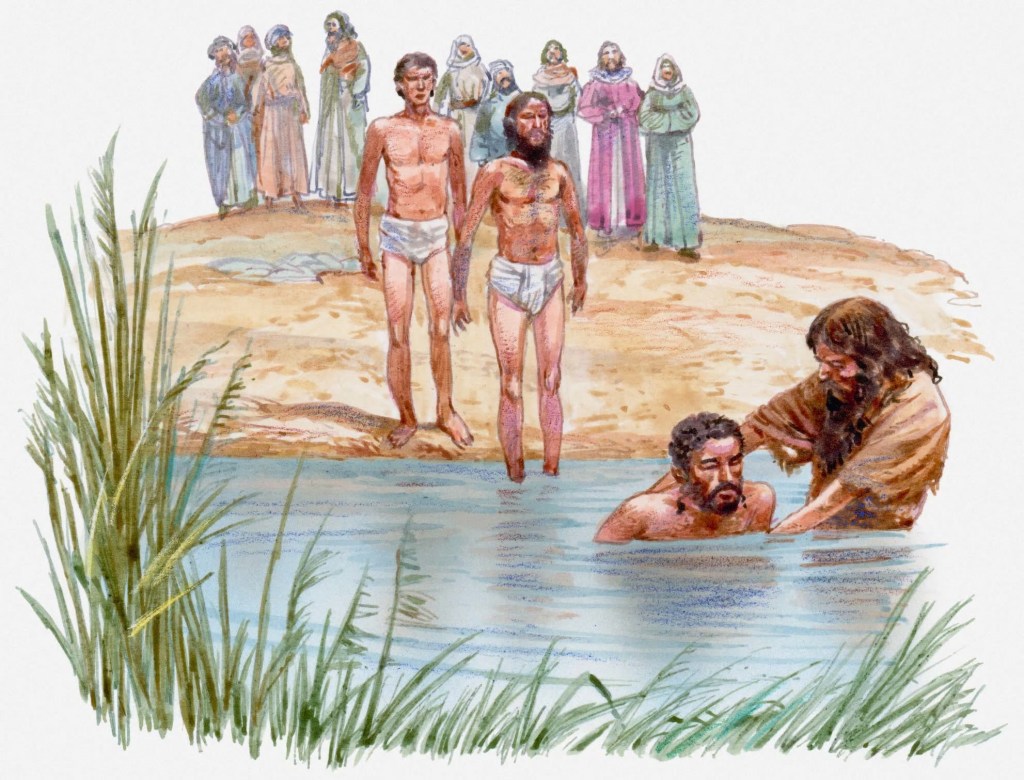
> “John appeared, baptizing in the wilderness and proclaiming a baptism of repentance for the forgiveness of sins. And all the country of Judea and all Jerusalem were coming to him and were being baptized by him in the river Jordan, confessing their sins. Now John was clothed with camel’s hair and wore a leather belt around his waist and ate locusts and wild honey. And he preached, saying, ‘After me comes He who is mightier than I, the strap of whose sandals I am not worthy to stoop down and untie. I have baptized you with water, but He will baptize you with the Holy Spirit.’” (Mark 1:2-8)
John’s message, “Repent, for the kingdom of heaven is at hand” (Matthew 3:2), puzzled many. The Jews knew Old Testament prophecy well, and Daniel had foretold that God’s kingdom would appear during the reign of the Fourth Gentile Kingdom—Rome—following Babylon, Medo-Persia, and Greece. With John and Jesus’ arrival, the kingdom of God had indeed come.
Yet, as in John’s day, people today debate whether the kingdom truly arrived, expecting an earthly utopia. Many Jews back in the days of John and Jesus were also disheartened when political circumstances did not change, remaining under Roman rule. Judas Iscariot, a Zealot hoping for rebellion, betrayed Jesus when his expectations were unmet. Despite spending three years with Jesus, Judas never abandoned his own agenda.
Jesus confirmed John’s role as the Elijah who was to come:
> “From the days of John the Baptist until now, the kingdom of heaven has suffered violence, and the violent take it by force. For all the Prophets and the Law prophesied until John, and if you are willing to accept it, he is Elijah who is to come.” (Matthew 11:12-14)
Understanding these truths lays the proper foundation for studying the Gospel of Mark, which shows Jesus as the fulfillment of the Law and Prophets (Matthew 5:17; Luke 24:25-27) and the dawn of God’s kingdom.
Peter, in the words of Acts 3:6, declared, “I possess neither silver nor gold, but in the name of Jesus Christ, I offer you what I have.” Share this article freely, for you freely receive. Take note, underlines and highlights are clickable links for definitions or Bible references. Stay updated by heading to our about page and subscribe directly to receive notifications in your inbox. Blessings!
I went into a writing hiatus due to the ongoing festivity. Also, it is a good time to take a backseat, relax, and recharge, Lord willing, for another year of blogging. The last blog I wrote, “Scripture vs. Tradition,” got a good number of views and responses. To think that I haven’t even shared it on my best media platform. Thanks be to God that He has provided me a platform to share God’s truth.
Strange though, that even while in a hiatus, I cannot fail to notice that though the COVID-19 pandemic still persists, a lot of people got married this year. Many have resolved to live together without marriage. So, the marriage of people even during this time is actually good, for the idea of marriage was introduced at the very beginning of the Bible, the Book of Genesis. See Genesis 2:18,21-24.
Then the LORD God said, “It is not good that the man should be alone; I will make him a helper fit for him.” … So the LORD God caused a deep sleep to fall upon the man, and while he slept took one of his ribs and closed up its place with flesh. And the rib that the LORD God had taken from the man He made into a woman and brought her to the man. Then the man said, “This at last is bone of my bones and flesh of my flesh; she shall be called Woman, because she was taken out of Man.” Therefore a man shall leave his father and his mother and hold fast to his wife, and they shall become one flesh.
It seems odd that Genesis 2:24 should be applied to Adam’s circumstance, his taking of a wife in Eve, for Adam does not have a human parent whom he should separate from as suggested by numerous Bible commentaries. There must be another meaning to Genesis 2:24 that would still be consistent with the context of Genesis chapters one and two – the story of God’s Creation.
The apostle Paul quoted Genesis 2:24 (“Therefore a man shall leave his father and his mother and hold fast to his wife, and they shall become one flesh”) in two separate letters written to the church; first, see 1 Corinthians 6:12-17.
“All things are lawful for me,” but not all things are helpful. “All things are lawful for me,” but I will not be dominated by anything. “Food is meant for the stomach and the stomach for food”—and God will destroy both one and the other. The body is not meant for sexual immorality, but for the Lord, and the Lord for the body.And God raised the Lord and will also raise us up by His power. Do you not know that your bodies are members of Christ? Shall I then take the members of Christ and make them members of a prostitute? Never! Or do you not know that he who is joined to a prostitute becomes one body with her? For, as it is written, “The two will become one flesh.” But he who is joined to the Lord becomes one spirit with Him.
The context of Paul’s discourse clearly was about the church, the body of Christ. Paul was rebuking the church for bringing their disputes before the courts of men; see 1 Corinthians 6:5-7.
Can it be that there is no one among you wise enough to settle a dispute between the brothers, but brother goes to law against brother, and that before unbelievers? To have lawsuits at all with one another is already a defeat for you.
The apostle Paul teaches that Christ is the Head and the church is His body; see Colossians 1:15,17-18.
He [Jesus Christ] is the image of the invisible God, the firstborn of all creation … And He is before all things, and in Him all things hold together. And He is the head of the body, the church. He is the beginning, the firstborn from the dead, that in everything He might be preeminent.
In Romans 12:4-5, the Bible says the same: the “body” is the church.
For as in one body we have many members, and the members do not all have the same function, so we, though many, are one body in Christ, and individually members one of another.
This is also seen in1 Corinthians 12:27, which says, “Now you are the body of Christ and individually members of it.“
As can be seen above, Paul uses the word “body” to mean the church, and Christians are its individual members. The church then is not the building but the people of God. The church also is joined to the Lord and becomes one spirit with Him, hence here is a clear application of Genesis 2:24 having been quoted by Paul; see 1 Corinthians 6:15-17.
Do you not know that your bodies are members of Christ? Shall I then take the members of Christ and make them members of a prostitute? Never! Or do you not know that he who is joined to a prostitute becomes one body with her? For, as it is written, “The two will become one flesh.” But he who is joined to the Lord becomes one spirit with Him.
Understanding Genesis 2:24 from the perspective presented by Paul through 1 Corinthians 6:12-17 should enlighten us about the union of the church with the Lord. Scripture then, through Genesis 2:24, prophetically foretold God’s New Creation; see 2 Corinthians 5:17, “If anyone is in Christ, he is a new creation. The old has passed away; behold, the new has come.
The “church” then is the New Creation of God. The other quotation of Genesis 2:24 by Paul may be found in Ephesians 5:31-32.
“Therefore a man shall leave his father and mother and hold fast to his wife, and the two shall become one flesh.” THIS MYSTERY IS PROFOUND, AND I AM SAYING THAT IT REFERS TO CHRIST AND THE CHURCH.
Both in Ephesians and 1 Corinthians, Paul’s quotation of Genesis 2:24 spoke of the union—or, as Paul viewed it, the betrothal—of Christ with the church while waiting for the Wedding Banquet – the Second Coming of Jesus Christ. Yes, until the Return of Christ Jesus consummating His kingdom, the church remains in betrothal, not yet married to Christ. See 2 Corinthians 11:2; Paul, speaking to the church, said:
For I feel a divine jealousy for you, since I betrothed you to one husband, to present you as a pure virgin to Christ.
It is important to know and believe in the Jesus Christ of the Bible, based not on human conjecture but on the Word of God. The Bible alone is God’s revelation for anyone to know Him, His message, and His promises.
It is most important to remember that the Wedding Banquet of Christ and the church, as taught by Jesus to His disciples, will occur at His Return; see Matthew 24:44-25:7.
Therefore you also must be ready, for the Son of Man is coming at an hour you do not expect. “Who then is the faithful and wise servant, whom His Master [Jesus Christ] has set over His household [Kingdom of heaven], to give them their food at the proper time? Blessed is that servant whom His master will find so doing when He comes. Truly, I say to you, He will set him over all His possessions [God’s kingdom] … As the Bridegroom (Jesus Christ) was delayed, they all became drowsy and slept. But at midnight there was a cry, ‘Here is the Bridegroom! Come out to meet Him.’ Then all those virgins rose and trimmed their lamps.
In Matthew 25:5, “As the Bridegroom was delayed,” the delay was not a deviation from Jesus’ promise but according to the plan of God; see 2 Peter 3:4,8-9.
They will say, “Where is the promise of His coming? … But do not overlook this one fact, beloved, that with the Lord one day is as a thousand years, and a thousand years as one day. The Lord is not slow to fulfill His promise as some count slowness, but is patient toward you, not wishing that any should perish, but that all should reach repentance.
God may be patient, but His patience is not forever; grace is. The passing of the heavens and the earth refers to God’s old covenant with Israel becoming obsolete. Yes, the Mosaic Covenant in Mount Sinai had become obsolete; see Hebrews 8:13.
In speaking of a new covenant, He [God] makes the first one obsolete. And what is becoming obsolete and growing old is ready to vanish away.
Note that the Greek phrase “growing old is ready to vanish away” appears in the “present, active, participle,” indicating an ongoing process within the generation it described. And it’s not literal passing of heavens and earth as has been taught. See Isaiah 66:1, Scripture said:
Thus says the LORD: “Heaven is My throne, and the earth is My footstool; what is the house that you would build for Me, and what is the place of My rest?
God declared heaven to be His throne, why then would He literally destroy even His place of throne? Can you see the irony of misunderstanding Scripture?
When Moses had finished writing the words of this law in a book to the very end, Moses commanded the Levites who carried the ark of the covenant of the LORD, “Take this Book of the Law and put it by the side of the ark of the covenant of the LORD your God, that it may be there for a witness against you … Assemble to me all the elders of your tribes and your officers, that I may speak these words in their ears and call heaven and earth to witness against them …Then Moses spoke the words of this song until they were finished, in the ears of all the assembly of Israel“Give ear, O heavens, and I will speak, and let the earth hear the words of my mouth.”
I did not write the whole of Deuteronomy 32 due to its length. It would be good though to read the entirety of Deuteronomy 28 to 33 for better comprehension. The Mosaic Covenant making Israel God’s people rest upon the condition of obedience to the Law. In Deuteronomy 32:1, Moses’ utterance of heavens and the earth was a covenant-making terminology. Therefore, the metaphorical expression “destruction of heavens and the earth” then speaks of the abolition of the Old Covenant.
Furthermore, there’s no real delay that was not according to God’s grace. The “delay” was actually the time for the preparation of the harvest; see John 4:34-38.
Jesus said to His disciples, “My food is to do the will of God the Father who sent Me and to accomplish His work [the New Creation, see Genesis 2:1-3; John 5:17; Hebrews 4:4-11; Revelation 14:13]. Do you not say, ‘There are yet four months, then comes the harvest’? Look, I tell you, lift up your eyes, and see that the fields are white for harvest. Already the one who reaps is receiving wages and gathering fruit for eternal life, so that sower and reaper may rejoice together. For here the saying holds true, ‘One sows and another reaps.’ I sent you to reap that for which you did not labor. Others have labored, and you have entered into their labor.”
Again, the presumed delay concerning Jesus’ Return for people who witnessed His Advent was simply a period for the preparation of the harvest – the preaching of the Gospel for the deliverance of Jews who would believe so be saved and the increase of wickedness of all who refused Jesus so as be judge for God’s final punishment. That explains Jesus’ command to His disciples before sending them out to preach the Gospel; see Matthew 10:5-7,23.
These twelve Jesus sent out, instructing them, “Go nowhere among the Gentiles and enter no town of the Samaritans, but go rather to the lost sheep of the house of Israel. And proclaim as you go, saying, ‘The kingdom of heaven is at hand.’ … When they persecute you in one town, flee to the next, for truly, I say to you, you will not have gone through all the towns of Israel before the Son of Man comes.
See Matthew 10:23; again Jesus clearly proclaimed that His Return would be at the lifetime of His apostles. There is therefore no argument regarding Jesus’ return, and with His return, the Old Covenant would pass away while ushering in His New Covenant.
See also Matthew 24:34-36.
Truly, I say to you, this generation (the apostles’) will not pass away until all these things take place (the Second Coming with the destruction of the Jewish temple). Heaven and earth (Mosaic Covenant) will pass away, but My words will not pass away. “But concerning that day and hour no one knows, not even the angels of heaven, nor the Son, but the Father only.“
Oh yes, Jesus said, “No one knows that day and hour except God the Father.” Christ was referring to the Zechariah 14:5-9, specifically verse 9.
Then the LORD my God will come, and all the holy ones with Him. On that day there shall be no light, cold, or frost. AND THERE SHALL BE A UNIQUE DAY, WHICH IS KNOWN TO THE LORD, NEITHER DAY NOR NIGHT, BUT AT EVENING TIME THERE SHALL BE LIGHT. On that day living waters shall flow out from Jerusalem, half of them to the eastern sea and half of them to the western sea. It shall continue in summer as in winter. And the LORD will be King over all the earth. On that day the LORD will be one and His name one.
For the sake of argument, it might not be known to Jesus while He was still on earth, but He surely knew the day and the hour after His ascension because He said so; see Revelation 1:1,7.
The revelation of Jesus Christ, which God gave Him to show to His servants the things that must soon take place … Behold, He [Jesus Christ] is coming with the clouds, and every eye will see Him, even those who pierced Him, and all tribes of the earth will wail on account of Him. Even so. Amen.
“And I will pour out on the house of David and the inhabitants of Jerusalem a spirit of grace and pleas for mercy, so that, when they look on Me, on Him whom they have pierced, they shall mourn for Him, as one mourns for an only child, and weep bitterly over Him, as one weeps over a firstborn.
Jesus received the revelation from God the Father and He gave it to John, His apostle, and He told him the time is near, He is coming! Once again, this agrees with the timetable of Jesus that His Return would be in the generation of His apostles (Matthew 16:27-28 and Matthew 10:23).
And as I have shared earlier, the Second Coming of Jesus Christ is the time of the Wedding Banquet (Matthew 25:10), and also the time of His judgment against Israel (1 Thessalonians 2:14-16), thereby destroying the Jewish temple and abolishing the Old Covenant, with the Mosaic Covenant being annulled (Matthew 24:1-3,34-35; Hebrews 8:13), because Jesus Christ came to fulfill both the Law and the Prophets (Matthew 5:17).
Jesus Christ indeed is the Bridegroom who was to come; see Mark 2:18-20.
Now John’s disciples and the Pharisees were fasting. And people came and said to Him, “Why do John’s disciples and the disciples of the Pharisees fast, but Your disciples do not fast?” And Jesus said to them, “Can the wedding guests fast while the Bridegroom is with them? As long as they have the Bridegroom with them, they cannot fast. The days will come when the Bridegroom is taken away from them, and then they will fast in that day.
See alsoJohn 3:25-30. Here John the Baptist witnessed that Jesus is the Bridegroom.
Now a discussion arose between some of John’s disciples and a Jew over purification. And they came to John [the Baptist] and said to him, “Rabbi, He (Jesus Christ) who was with you across the Jordan, to whom you bore witness—look, He is baptizing, and all are going to Him.” John answered, “A person cannot receive even one thing unless it is given him from heaven. You yourselves bear me witness, that I said, ‘I am not the Christ, but I have been sent before Him.’ The one who has the bride is the Bridegroom. The friend of the bridegroom, who stands and hears Him, rejoices greatly at the Bridegroom’s voice. Therefore this joy of mine is now complete. He must increase, but I must decrease.”
As I had mentioned earlier, Paul, in 2 Corinthians 11:2, clearly said the church prior to the return of Jesus was still in betrothal with the Lord. Nelson’s New Illustrated Bible Dictionary explained the concept of Jewish betrothal.
Betrothal is a mutual promise or contract for a future marriage. In Hebrew custom, betrothal was actually part of the marriage process. A change of intention by one of the partners after he or she was betrothed was a serious matter, subject in some instances to penalty by fine. A Jewish betrothal could be dissolved only by the man’s giving the woman a certificate of divorce. A betrothal usually lasted for one year. During that year the couple were known as husband and wife, although they did not have the right to be united sexually. Betrothal was much more closely linked with marriage than our modern engagement.But the actual marriage took place only when the bridegroom took the bride to his home and the marriage was consummated in the sexual union.
When did Jesus, the Bridegroom, take His bride to be home with Him? See John 14:3, Jesus declares,
And if I go and prepare a place for you (the disciples), I will come again and will take you to Myself, that where I am you may be also.
The so-called First Advent of Jesus then is the coming of the Bridegroom betrothing the church to Him, as prophesied by the Old Testament Prophets of God and announced by John the Baptist, the forerunner of Christ Jesus, announcing His coming so the kingdom of heaven indeed is at hand. See Matthew 3:1-3.
In those days John the Baptist came preaching in the wilderness of Judea, “Repent, for the kingdom of heaven is at hand.” For this is He who was spoken of by the prophet Isaiah when he said, “The voice of one crying in the wilderness: ‘Prepare the way of the Lord; make His paths straight.’”
Being asked by the Pharisees when the kingdom of God would come, He [Jesus] answered them, “The kingdom of God is not coming in ways that can be observed, nor will they say, ‘Look, here it is!’ or ‘There!’ for behold, the kingdom of God is in the midst of you.”
The evidence of God’s kingdom rests on the reality that Jesus Christ came, for He declared, “For behold, the kingdom of God is in the midst of you.” Moreover, it cannot be observed or seen, for Jesus said, “The kingdom of God is not coming in ways that can be observed, nor will they say ‘Look, here it is!’ or ‘There!’”
It is ironic then that many who profess to be Christians remain adamant, refusing to believe Jesus’ declaration that He would return to consummate His Reign and Kingdom before the demise of His first generation disciples; see Matthew 16:27-28.
For the Son of Man is going to come with His angels in the glory of His Father, and then HE WILL REPAY EACH PERSON ACCORDING TO WHAT HE HAS DONE. Truly, I say to you, there are some standing here who will not taste death until they see the Son of Man coming in His kingdom.”
Did you notice that the judgment was not according to faith, but what a person has done, indicating judgment was according to the Mosaic Law, which was by works, not faith. Therefore, it’s a Jewish judgment. That explains Jesus’ statement against the unbelieving Jews, “Do not think that I will accuse you to the Father. There is one who accuses you: Moses, on whom you have set your hope.” (John 5:45) However, the judgment of the last days was ultimately due to the denial of Jesus as the Christ. They hold on to the Law which cannot save but condemns them (Galatians 3:10-11).
And let me remind everyone, Jesus made clear that the reality and presence of His kingdom cannot be observed or seen by the natural sight for it is a spiritual kingdom, right here in the midst of our present existence. Evil may continue to exist around us, but in God’s kingdom, which we may be part by faith in Christ Jesus, we are safely in the hands of the “Mighty Counselor, Mighty God, Everlasting Father, Prince of Peace (Isaiah 9:6)”.
By the way, Isaiah 9:6-7 is often quoted in reference to the Christmas festivity. But bear in mind that Isaiah 9:6-7 is not simply a declaration of Jesus’ birth, MORE SO HIS REIGN, KINGSHIP, AND OF COURSE KINGDOM.
To further understand the reality of God’s reign and the fact that Jesus had returned just as He had promised in numerous occasion and teaching, you may want to read my blog “Scripture vs. Tradition“.
Returning to the theme of the Marriage or Wedding Banquet: at the time of Paul, before the Return of Christ Jesus, the church remained betrothed to the Bridegroom; the marriage or union of Christ and the church had yet to be completed. I mentioned earlier that Paul did quote Genesis 2:24 and applied it to the relationship of Christ and the church. But before Paul, it is most important that Jesus Christ also quoted Genesis 2:24 (“Therefore a man shall leave his father and his mother and hold fast to his wife, and the two shall become one flesh”). See Matthew 19:1-9.
Now when Jesus had finished these sayings (Jesus’ teachings about the “Kingdom of Heaven”, Matthew 18) … And Pharisees came up to Him and tested Him by asking, “Is it lawful to divorce one’s wife for any cause?”He answered, “Have you not read that He who created them from the beginning made them male and female, and said, ‘Therefore a man shall leave his father and his mother and hold fast to his wife, and the two shall become one flesh’?So they are no longer two but one flesh. What therefore God has joined together, let not man separate.” They said to Him, “Why then did Moses command one to give a certificate of divorce and to send her away?” He said to them, “Because of your hardness of heart Moses allowed you to divorce your wives, but from the beginning it was not so. And I say to you: whoever divorces his wife, except for sexual immorality, and marries another, commits adultery.”
Isn’t it clear that God’s creation of man and his wife was to be one flesh, joined by God in union with Himself? See the Trinity God’s declaration and purpose in creation (Genesis 1:26-27).
Then God said, “Let us make man in Our image, after Our likeness … So God created man in His own image, in the image of God He created him; male and female He created them.
The Trinity God is in perfect union with each Person of the GodHead – God the Father, Jesus Christ and the Holy Spirit. So for man to be created in God’s image and likeness, it also spoke of the same perfect unity. Man (male and female) were in perfect unity with God before the fall. But due to the disobedience of both Adam and Eve, breaking God’s Covenant with them, mankind is no longer in unity with God. They were banished from the Garden of Eden – the picture of God’s presence with man.
Thanks be to God for His grace. See 1 Corinthians 15:22-26; Paul wrote:
For as in Adam all die, so also in Christ shall all be made alive. But each in his own order: Christ the firstfruits, then at His coming those who belong to Christ. Then comes the end, when He delivers the kingdom to God the Father after destroying every rule and every authority and power. For He must reign until He has put all His enemies under His feet. The last enemy to be destroyed is death.
As I have explained in my blog “Scripture vs. Tradition”, without the Return of Christ Jesus completing His kingdom, there is no resurrection yet. And death occurred in Genesis, immediately after Adam and Eve broke God’s covenant, just as God declared it would be once they disobeyed Him and ate the forbidden fruit. Again, as I have mentioned in my other blogs, it was a spiritual death that occurred – the alienation of man from God so they were banished from the Garden of Eden. Physical death came hundreds of years later, not immediately as pronounced by God, which is a natural consequence of man’s departure from God’s presence for what remains of man was his natural composition. Man was made from dust, thereby susceptible to decay. So the resurrection then is a spiritual one. Christians were made alive in Christ Jesus by faith. The resurrection or restoration of God’s union with man into the Garden of Eden was fulfilled after His Return – the Wedding Banquet.
The coming of the Bridegroom was announced by John the Baptist, some two thousand years ago. Jesus Christ came announcing His building of the church; see Matthew 16:18-19.
And I tell you, you are Peter, and on this Rock I will build My church, and the gates of hell shall not prevail against it. I will give you the keys of the kingdom of heaven, and whatever you bind on earth shall be bound in heaven, and whatever you loose on earth shall be loosed in heaven.”
Jesus Christ is the Rock (1 Corinthians 10:4), Peter confessed “Jesus is the Christ, the Son of the Living God (Matthew 16:16), He alone would build His church through the preaching of the Gospel. The church would fully be united with the GodHead – God the Father, God the Son, and God the Holy Spirit – with the Return of Christ, at the Wedding Banquet of Christ and the church.
Let me repeat, Christ Jesus, not Peter, is the Rock by which the church would be built. See Ephesians 2:18-22.
For through Him we both (Jews and Gentiles) have access in one Spirit to the Father. So then you are no longer strangers and aliens, but YOU (Gentiles) ARE FELLOW CITIZENS WITH THE SAINTS AND MEMBERS OF THE HOUSEHOLD OF GOD (the church), BUILT ON THE FOUNDATION OF THE APOSTLES AND PROPHETS, CHRIST JESUS HIMSELF BEING THE CORNERSTONE, in whom the whole structure, being joined together, grows into a holy temple in the Lord. In Him you also are being built together into a dwelling place for God by the Spirit.
See also, 1 Corinthians 10:1-4.
For I do not want you to be unaware, brothers, that our fathers were all under the cloud, and all passed through the sea, and all were baptized into Moses in the cloud and in the sea, and all ate the same spiritual food, and all drank the same spiritual drink. For they drank from the spiritual Rock that followed them, and the Rock was Christ.
Christ Jesus indeed is the Rock, the Cornerstone by which His church is built. The church was betrothed to Christ at the time of Paul and the first generation Christians until the Wedding Banquet was consummated at the Return of Jesus. And bear in mind that Jesus promised to return before the demised of His immediate disciples – Peter, James and John and the rest of His apostles (cf. Matthew 10:23; Matthew 16:28).
Now, if it will be insisted that Jesus hasn’t returned, then there will be two possibilities only. As Christians, we hold on to the inerrant Word of God or the Scripture. Therefore every pronouncement of Jesus is true. So first, they must assume that the apostles are still alive today waiting for the return of Jesus, which of course is an impossibility. Then second, Jesus is not true to His Word, His pronouncement had fail, which I reject and am left with no choice but to understand and accept that the traditional teaching about Jesus’ Second Coming is erroneous, for it cannot stand the scrutiny of Scripture.
Hence, believing that Jesus Christ had fulfilled all His promises, He then is the Bridegroom who came just as He had promised and He was, and remains, not a runaway bridegroom – knowingly or unknowingly projected by the traditional and popular teachings today. Actually, not only today but at the onset of the belief or teaching that Jesus has yet to return.
So sad that many who profess to love the Lord Jesus Christ fail to read and check the validity of each teaching and claim. The claim that Jesus is coming soon is based on the imagination of man, not the Word of God. Quoting a Scripture here and there but denying or ignoring the context or background for which it was spoken is a dilution of the the Word of God, of which Jesus had forewarned against; see Revelation 22:16-20.
> “I, Jesus, have sent My angel to testify to you about these things for the churches. I am the root and the descendant of David, the bright morning star.” The Spirit and the Bride say, “Come.” And let the one who hears say, “Come.” And let the one who is thirsty come; let the one who desires take the water of life without price. (Revelation 22:16-17)
> I WARN EVERYONE WHO HEARS THE WORDS OF THE PROPHECY OF THIS BOOK: IF ANYONE ADDS TO THEM, GOD WILL ADD TO HIM THE PLAGUES DESCRIBED IN THIS BOOK, AND IF ANYONE TAKES AWAY FROM THE WORDS OF THE BOOK OF THIS PROPHECY, GOD WILL TAKE AWAY HIS SHARE IN THE TREE OF LIFE AND IN THE HOLY CITY, WHICH ARE DESCRIBED IN THIS BOOK.He who testifies to these things says, “Surely I am coming soon.” Amen. Come, Lord Jesus! (Revelation 22:18-20)
At the beginning of my blog, I shared that I took a rest from writing to relax and recharge. But due to Christ Jesus, the Reason of the Season, I was compelled to write this blog. However, due to the length of the discussion that would ensue, I have to end here for the moment. An understanding of the Wedding Banquet, vis-a-vis the church, is essential to our faith and walk. We shouldn’t simply celebrate the birth of Jesus Christ and hope for the coming of His kingdom; rather, we ought to celebrate the festivity with the knowledge that the reality of His Kingdom is present and existing now. Glory be to God and Him alone!
“For to us a Child is born, to us a Son is given; and the government shall be upon His shoulder, and His name shall be called Wonderful Counselor, Mighty God, Everlasting Father, Prince of Peace. Of the increase of His government and of peace there will be no end, on the throne of David and over His kingdom, to establish it and to uphold it with justice and with righteousness from this time forth and forevermore.” (Isaiah 9:6-7)
The zeal of the LORD of hosts has done it! Season’s Greetings to everyone!
Peter, in the words of Acts 3:6, declared, “I possess neither silver nor gold, but in the name of Jesus Christ, I offer you what I have.” Share this article freely, for you freely receive. Take note, underlines and highlights are clickable links for definitions or Bible references. Stay updated by heading to our about page and subscribe directly to receive notifications in your inbox. Blessings!
In my previous post, I noted, “The healed blind man did not only experience restored eyesight, but more importantly recovery from spiritual blindness.” Notably, John 1 also suggests the concept of spiritual blindness. Consider John 1:10–11:
He [Jesus] was in the world, and the world was made through Him, yet the world did not know Him. He came to His own, and His own people did not receive Him.
We will examine the first chapter of John’s Gospel to see how the apostle outlined his summary in the opening verses, then compare it with John 9. Before proceeding, we should refresh our grasp of the continuing context in John 9, which immediately follows the intense conflicts of the previous chapter.
In John 8, Jesus delivered a lengthy critique of the Pharisees and scribes. In fact, friction between Jesus Christ and the Sanhedrin appears as early as John 7:32. The Sanhedrin functioned as the supreme religious authority and court among the Jewish people during Jesus’s era. It included both Sadducees and Pharisees under the High Priest, totaling 71 members. After Jerusalem’s destruction in AD 70, the Sanhedrin was dissolved.
Pharisees and scribes were regarded as the leading interpreters of Scripture. Their encounter with Jesus may have started near the temple (John 8:2) and probably ended within its grounds, since John 8:59 records, “So they picked up stones to throw at Him, but Jesus hid Himself and went out of the temple.” The exchange became tense because Jesus claimed divinity by stating, “Truly, truly, I say to you, before Abraham was, I am” (John 8:58). Did Jesus err in taking the title “I am” from Exodus 3:14? The LORD God identified Himself to Moses in Exodus 3 as the great “I Am,” calling him to guide Israel from Egypt. In 1 Corinthians 10:1–4, Paul retells the Exodus and identifies Jesus Christ as the Rock that guided Israel. Let us now consider John 1:1–5:
In the beginning was the Word, and the Word was with God, and the Word was God. He was in the beginning with God. All things were made through Him, and without Him was not any thing made that was made. In Him was life, and the life was the light of men. The light shines in the darkness, and the darkness has not overcome it.
“And the Word became flesh and dwelt among us, and we have seen His glory, glory as of the only Son from the Father, full of grace and truth … For from His fullness we have all received, grace upon grace. For the Law was given through Moses; grace and truth came through Jesus Christ. No one has even seen God; the only God who is at the Father’s side, He had made Him known.”
Psalm 33:6,9 says, “By the Word of the LORD the heavens were made, and by the breath of His mouth all their host … For He spoke, and it came to be; He commanded, it stood firm.”
Both John and the Psalmist spoke of the Word; that is, Christ Jesus, the only Son of the Father. He spoke, then everything came to exist. Therefore, Jesus Christ is indeed the Great “I am,” the Second Person of the Holy Trinity, God.
Consider how this reality is reflected in the events of John 9:30-33:
The man answered, “Why, this is an amazing thing! You do not know where He comes from, and yet He opened my eyes. We know that God does not listen to sinners, but if anyone is a worshipper of God and does His will, God listens to Him. Never since the world began has it been heard that anyone opened the eyes of a man born blind. If this man were not from God, He could do nothing.”
Remarkable, isn’t it? The formerly blind man echoed what John stated in John 1:1–5: Jesus Christ is of divine origin. This matches what Jesus told the Pharisees and scribes, prompting their desire to stone him (8:58–59). It is ironic that the Pharisees, who should know Scripture better, seemed less perceptive than the man. This appears to be a case of spiritual blindness, don’t you think?
Spiritual blindness, therefore, does not mean ignorance of the Scripture, but rather having false beliefs.
Again in John 1:9-13:
The true light, which gives light to everyone, was coming into the world. He was in the world, and the world was made through Him, yet the world did not know Him. He came to His own, and His own people did not receive Him. But to all who did receive Him, who believed in His name, He gave the right to become children of God, who were born, not of blood nor of the will of the flesh nor of the will of man, but of God.
The former blind man answered the inquiry from his fellow Jew, “The man called Jesus made mud and anointed my eyes and said to me, ‘Go to Siloam and wash,’ So I went and washed and received my sight.” (John 9:11)
The man born blind encountered Jesus, the True light that illuminates everyone, which explains why he could perceive Jesus’s origin more clearly than the Pharisees. He also gained his sight—a welcome addition, I might add.
So the Pharisees again asked him how he had received his sight. And he said to them, “He put mud on my eyes and I washed, and I see.” Some of the Pharisees said, “This man is not from God, for He does not keep the Sabbath.” But others said, “How can a man who is a sinner do such signs?” And there was a division among them. So they said again to the blind man, “What do you say about Him, since He opened your eyes?” He said, “He is a Prophet.” (John 9:15-17)
The blind man recognized the signs and declared, “Jesus is the Prophet of God.” Because he believed Jesus, Christ granted him the right to become a child of God. Coincidence? Certainly not—everything arises through God’s divine providence. Scripture noted,
But to all who did receive Him, who believed in His name, He gave the right to become children of God, who were born, not of blood nor of the will of the flesh nor of the will of man, but of God. (John 1:12-13)
The formerly blind man did not choose to know Christ Jesus; instead, Jesus stated, “But that the works of God might be displayed in him” (John 9:3). Likewise, the “work of God is for people to believe in Jesus Christ, whom the Father has sent” (John 6:29). The mission is complete.
The blind man accurately identified Jesus as the Prophet of God, because the “Son of Man”—the Messianic title of Christ—implies He is the Anointed One of God the Father; consequently, Jesus should fulfill all three roles: Prophet (Deuteronomy 18:15), Priest (Psalm 110:4), and King (Psalm 2:6–9).
However, the Pharisees had also met Jesus Christ, yet they challenged him within the temple area. In fact, the parents of the man born blind declined to speak about Jesus Christ, particularly to acknowledge him as the Christ, because the religious leaders—including the Pharisees—had already agreed to expel anyone who confessed faith in the Son of Man (John 9:22).
True enough, the former blind man was only able to confess faith in Jesus, for in the fullness of Christ he had received grace upon grace (John 1:16). Indeed, such an amazing grace was displayed by Christ Jesus in John 9:35–38:
Jesus heard that they had cast him [the former blind man] out, and having found him He said, “Do you believe in the Son of Man?” He answered, “And who is He, Sir, that I may believe in Him?” Jesus said to him, “You have seen Him, and it is He who is speaking to you.” He said, “Lord, I believe,” and he worshiped Him.’“
The blind man was literally in darkness, and we may say he actually personified the whole nation of Israel in the story— blind spiritually. The healing of the man born blind indeed was an impossible task humanly speaking— exactly what the healed blind man said to the Pharisees: “Never since the world began has it been heard that anyone opened the eyes of a man born blind” (John 9:32). See Isaiah’s prophecy concerning Jesus Christ, the Anointed One of God the Father:
Behold My Servant, whom I uphold, My Chosen, in whom My soul delights; I have put My Spirit upon Him; He will bring forth justice to the nations. (Isaiah 42:1)
Thus says God, the LORD, who created the heavens and stretched them out, who spread out the earth and what comes from it, who gives breath to the people on it and spirit to those who walk in it: “I am the LORD; I have called You in righteousness; I will take You by the hand and keep You; I will give You as a Covenant for the people, a light for the nations, to open the eyes that are blind, to bring out the prisoners from the dungeon, from the prison those who sit in darkness. I am the LORD; that is My name; My glory I give to no other, nor My praise to carved idols. Behold, the former things have come to pass, and new things I now declare; before they spring forth I tell you of them.” (Isaiah 42:5-9)
The Pharisees, aware of the scriptural prophecies regarding the Christ, likely recognized the signs; nevertheless, many others declined to accept Christ and labeled Him a sinner because He healed on a Sabbath. See John 9:16:
Some of the Pharisees said, “This man is not from God, for He does not keep the Sabbath.” But others said, “How can a man who is a sinner do such signs?” And there was a division among them.
Because the Pharisees upheld the Law of Moses, Jesus said to them,
For if you believed Moses, you would believe Me; for he wrote about Me. But if you do not believe his writings, how will you believe My words? (John 5:46-47)
The Pharisees failed to see Christ in Scripture due to their self-centeredness, believing that no matter what they do, they would always be God’s children. A false assumption. In Matthew 3, John the Baptist was baptizing in the Jordan River, and the Pharisees came to him. John said to them,
And do not presume to say to yourselves, ‘We have Abraham as our father,’ for I tell you, God is able from these stones to raise up children for Abraham. (Matthew 3:9)
So again John 1:12-13:
But to all who did receive Him [Jesus Christ], who believed in His name, He gave the right to become children of God, who were born, not of blood nor of the will of the flesh nor of the will of man, but of God.
Spiritual blindness can be deadly. The Pharisees comprehended all prophecies in Scripture. It was not that they couldn’t see the signs; they did. They were not victims of unbelief; rather, they were enslaved by their false beliefs. See Mark 7:8–9, 13:
You leave the commandment of God and hold to tradition of men. You have a fine way of rejecting the commandment of God in order to establish your tradition! Thus making void the Word of God by your tradition that you have handed down. And many such things you do.
The Pharisees asserted they upheld Moses’s teachings (John 5:46–47). They may have done so in part, yet in reality they constructed their own traditions. These human-made customs kept them from recognizing that Jesus Christ, “the Son of Man — is the Lord of Sabbath” (Matthew 12:8).
Similarly, the only way for anyone seeking or studying Scripture to find the True Christ of the Bible is to allow the Word of God to speak to us. Do not allow traditions or creeds of men to be our guide; rather, Scripture alone!
The story of John 9 should inspire us to see it’s all by God’s grace that anyone can come to know Jesus Christ, the Son of Man. The former blind man, humanly speaking, lost a lot when he received his sight. He may have lost or was severed from his parents and the community, since he had been cast out of the synagogue. Yet, it is amazing how people who seemed to have lost a lot found it easier to find Christ.
Although much remains to discuss in John 9, I have chosen to end my blog post on “Spiritual Blindness” here. If the Lord permits, I may add a follow-up post later.
Peter, in the words of Acts 3:6, declared, “I possess neither silver nor gold, but in the name of Jesus Christ, I offer you what I have.” Share this article freely, for you freely receive. Take note, underlines and highlights are clickable links for definitions or Bible references. Stay updated by heading to our about page and subscribe directly to receive notifications in your inbox. Blessings!