Christendom will soon commemorate Reformation Day, which commemorates the revolt against the erroneous teachings of the Roman Catholic Church. Ironically, centuries after the Reformation, the Christian Church did precisely what it had revolted against. They developed traditions that are not found in the Bible. I will cite only one example here:
Some pastors held the title of reverend, derived from the Latin word “reverendus,” meaning “worthy of respect” or “one who is to be revered.” However, the Bible exclusively attributes reverence to God. For instance, Psalms 111:9 states, “God sent redemption to His people; He has commanded His covenant forever. Holy and reverend is His name.” Shouldn’t Christians, despite their religious positions, be mindful of not robbing God of His rightful reverence by attributing it to men?
The Septuagint, the Greek translation of the Hebrew Scriptures, rendered the word corresponding to “reverend” as phoberos. This term appears only three times throughout the New Testament—Hebrews 10:27, Hebrews 10:31, and again in Hebrews 12:21—and in each case, it is used exclusively in reference to God.
In Ephesians 4:11, Christ Jesus specifically gifted the church with the apostles, prophets, pastors, teachers, and evangelists. There is no mention of a reverend. Therefore, why create titles that are not found in Scripture?
When Christians loosely attribute to men what is solely God’s, they lose sight of God’s true nature. Vanity in human titles deprives God of what is rightfully His. If we Christians genuinely promote the Gospel, we wouldn’t succumb to the temptation of upholding human vanities.
Anyone who disagrees kindly study your Bibles. Let me know if there’s one instance man was attributed with reverence.
Isn’t it just a vanity act for human titles? If you’re interested, here’s a related blog: [Vanity in Human Titles].
Peter, in the words of Acts 3:6, declared, “I possess neither silver nor gold, but in the name of Jesus Christ, I offer you what I have.” Share this article freely, for you freely receive. Take note, underlines and highlights are clickable links for definitions or Bible references. Stay updated by heading to our about page and subscribe directly to receive notifications in your inbox. Blessings!
Vine’s New Testament Dictionary defines “pastor” in Greek as poimen (G4166), meaning a shepherd, one who tends herds or flocks. This term appears 18 times in the New Testament: 13 times referring to Jesus Christ, 4 times to literal shepherds at His birth, and once to pastors in Ephesians 4:11.
In 1 Peter 2:25, the Bible states: “For you were straying like sheep, but have now returned to the Shepherd and Overseer of your souls.” Here, Jesus is both the Shepherd (poimen, G4166) and Overseer (episkopos, G1985), often translated as bishop or elder. This raises the question: is there a difference between “pastor” and “bishop”?
1 Peter 5:1-4 provides insight:
“So I exhort the elders among you, as a fellow elder … shepherd the flock of God that is among you, exercising oversight…” This shows that elders (presbuteros, G4245) are called to shepherd (poimainō, G4165) and oversee (episkopeō, G1983). Verse 5 clarifies that presbuteros refers to seasoned believers, not necessarily overseers or bishops (episkopos, G1985). In the New Testament, episkopos appears five times (1Ti 3:2; Tit 1:7; 1Pe 2:25; Php 1:1; Act 20:28), generally in reference to church leaders.
Apart from 1 Peter 2:25, where Jesus is the Overseer of our souls, the other occurrences refer to Christian leaders tasked to care for God’s flock: “Pay careful attention to yourselves and to all the flock, in which the Holy Spirit has made you overseers…” (Acts 20:28). This suggests that pastors and bishops or overseers function as under-shepherds of Christ, sharing in His ministry of guidance and care.
Paul, in Ephesians 4:11-16, identifies the pastoral office alongside apostles, prophets, evangelists, and teachers, tasked “to equip Christians for the work of ministry, for building up the body of Christ.” Biblically, a pastor is called and gifted to unify and ground believers in truth, protecting them from false teachings.
True Christian unity resides in the doctrines of the Bible, not on trivial matters. That’s exactly Paul’s assertion in Ephesians 4, “There is one body and one Spirit—just as you were called to the one hope that belongs to your call—one Lord, one faith, one baptism, one God and Father of all, who is over all and through all and in all.” (Eph 4:4-6) Apostles, prophets, pastors, teachers, and evangelists are called and appointed by Jesus Christ precisely to keep the unity of the faith. (Eph 4:1-16)
Jesus Himself taught discernment in Matthew 7:13-29, warning against false prophets and emphasizing fruit as the evidence of true ministry. Not all who claim His name are known by Him, highlighting the weight of pastoral responsibility.
Not all seminary graduates are necessarily pastors in the biblical sense. Many may be better recognized as elders (presbuteros, G4245), faithful and seasoned in the faith but not specifically called to teach. The same may be said of many elders in churches today. Faithful to God, but not necessarily equipped to teach. Paul’s instruction in 1 Timothy 5:17 reflects this distinction: “Let the elders who rule well be considered worthy of double honor,especially those who labor in preaching and teaching.”
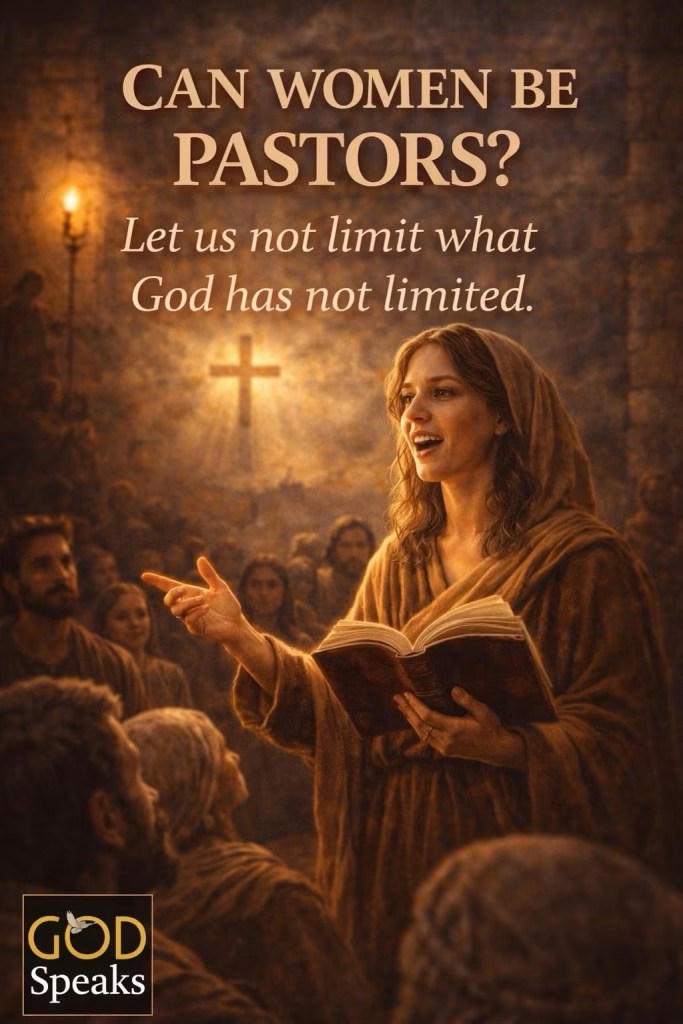
The attached photo caption reads, “Can women be pastors? Let us not limit what God has not limited.” It’s a captivating phrase, but we should also remember that we shouldn’t attribute to anyone what God hasn’t given.
Discussions about whether women can be pastors should also consider the biblical framework in discussion. Women like Priscilla faithfully taught and explained the gospel (Acts 18:24-26), yet Scripture does not title her as a pastor. Respect and honor are due to all Christian leaders and faithful women, as Paul reminds in 1 Timothy 5:19-20 and Philippians 4:2-3.
Hebrews 13:7,17 exhorts believers to remember, imitate, obey, and support leaders who watch over their souls, for they will give an account to God.
Ultimately, earthly titles mean little if Christ Himself does not commend our labor. There’s vanity in human titles. Let our aim be His approval as we work in His vineyard.
Peter, in the words of Acts 3:6, declared, “I possess neither silver nor gold, but in the name of Jesus Christ, I offer you what I have.” Share this article freely, for you freely receive. Take note, underlines and highlights are clickable links for definitions or Bible references. Stay updated by heading to our about page and subscribe directly to receive notifications in your inbox. Blessings!
One of the most debated question is about the arrival of God’s kingdom. In our passage today, Scripture says, “Now after John was arrested, Jesus came into Galilee, proclaiming the Gospel of God, and saying, ‘The time is fulfilled, and the kingdom of God is at hand; repent and believe in the Gospel.’” (Mark 1:14-15)
Scripture translators observe that the phrase “is fulfilled” in this passage appears in the Greek perfect, passive, indicative form. This construction presents the event as a completed and established reality, underscoring its certainty and unchangeable nature. In other words, without a doubt, “the appointed time” (kairos, in Greek) of God’s kingdom has indeed arrived.
Why then is there so much debate within the Christian community about whether God’s kingdom has arrived? Certainly, Jesus cannot be wrong, as He did indeed announce its arrival. The error must lie with biblical scholars. They have overlooked textual time statements and ignored declarations from Scripture.
Mark states, “Now after John was arrested, Jesus came into Galilee, proclaiming the Gospel of God, and saying, ‘The time is fulfilled, and the kingdom of God is at hand; repent and believe in the gospel.’” (Mark 1:14-15) John the Baptist was the last of the Old Testament prophets. Jesus said, “The Law and the Prophets— that’s the Mosaic Covenant— were until John; since then the good news of the kingdom of God is preached …” (Luke 16:16). John the Baptist serves as the last prophet under the Old Covenant, heralding the impending arrival of God’s kingdom or New Covenant. Paul declares, “If anyone is in Christ, he is a new creation. The old (covenant) has passed away; behold, the new has come.” (2 Corinthians 5:17)
A simple look at God’s pronouncement in Daniel regarding the arrival of God’s kingdom would prove true that scholars are in error. Scripture says there would be four gentiles kingdom, starting with Babylon, and during the time of the fourth kingdom God’s kingdom would appear.
Daniel 2:37-38 clearly identifies Nebuchadnezzar of Babylon as the 1st gentile kingdom. Daniel 2:39 spoke of the second and third kingdoms. Daniel 8:20-21 revealed the identity of the second and third kingdoms—Persia and Greece. Daniel 2:40-43 referred to the fourth kingdom as a mixed marriage between iron and clay. John, in Revelation 17, unveiled the mystery of the unholy marriage between Rome (identified by Revelations 17:9-10 as the Caesars of Rome) and Jerusalem (referred to as the clay in Romans 9:1-4,21; Isaiah 64:8; and Jeremiah 18:3-6). Then Daniel declared, “And in the days of those kings – that’s the iron mixed with clay – the God of heaven will set up a kingdom that shall never be destroyed (kingdom of God), nor shall the kingdom be left to another people. It shall break in pieces all these kingdoms and bring them to an end (Revelation 11:15), and it shall stand forever, just as you saw that a stone was cut from a mountain by no human hand, and that it broke in pieces the iron (Rome), the bronze (Greece), the clay (Israel), the silver (Persia), and the gold (Babylon, see Daniel 2:32-33). A great God has made known to the king what shall be after this. The dream is certain, and its interpretation sure.” (Daniel 2:44-45)
Jesus Christ was the stone cut from a mountain by no human hand, Scripture states, “Therefore thus says the Lord GOD, ‘Behold, I am the One who has laid as a foundation in Zion, a stone, a tested stone, a precious cornerstone, of a sure foundation: Whoever believes will not be in haste’” (Isaiah 28:16). Peter, testifying before the Jewish Council states, “This Jesus is the stone that was rejected by you, the builders, which has become the cornerstone. And there is salvation in no one else, for there is no other name under heaven given among men by which we must be saved.” (Acts 4:11-12)
Add to that, when challenged by the Pharisees when the kingdom of God would come, Jesus declared, “The kingdom of God is not coming in ways that can be observed, nor will they say, ‘Look, here it is!’ or ‘There!’ for behold, the kingdom of God is in the midst of you.” (Luke 17:20-21)
God’s kingdom has indeed arrived. John the Baptist heralded the arrival of the kingdom of heaven. Jesus fulfilled Scriptures with His triumphant entry to Jerusalem (Zechariah 9:9; Matthew 21:1-10; Mark 11:1-9). Both Luke and John clearly states that the triumphant entry was a declaration of Jesus Christ as the coming King:
“And they brought the colt to Jesus, and throwing their cloaks on the colt, they set Jesus on it. And as He rode along, they spread their cloaks on the road. As Jesus was drawing near—already on the way down the Mount of Olives—the whole multitude of His disciples began to rejoice and praise God with a loud voice for all the mighty works that they had seen, saying, “Blessed is the King who comes in the name of the Lord! Peace in heaven and glory in the highest!”” (Luke 19:35-38)
“The next day the large crowd that had come to the feast heard that Jesus was coming to Jerusalem. So they took branches of palm trees and went out to meet Him, crying out, “Hosanna! Blessed is He who comes in the name of the Lord, even the King of Israel!” And Jesus found a young donkey and sat on it, just as it is written, “Fear not, daughter of Zion; behold, your king is coming, sitting on a donkey’s colt!” His disciples did not understand these things at first, but when Jesus was glorified, then they remembered that these things had been written about him and had been done to him.” (John 12:12-16)
A careful study of the Scriptures would prove that God’s kingdom indeed has arrived. But contemporary Christianity doubts, because they expect a utopia would happen. Because that’s what they have been told and taught. Looking around, we indeed don’t see any changes in our world. War, hunger, injustice, and many other chaotic occurrences are still present. But Christians forget; Jesus says, “The kingdom of God is not coming in ways that can be observed, nor will they say, ‘Look, here it is!’ or ‘There!’ for behold, the kingdom of God is in the midst of you.” (Luke 17:20-21)
Jesus told the Samaritan woman, “Woman, believe Me, the hour is coming when neither on this mountain nor in Jerusalem will you worship the Father. You worship what you do not know; we (Jews) worship what we know, for salvation is from the Jews. But the hour is coming, and is now here, when the true worshipers will worship the Father in spirit and truth, for the Father is seeking such people to worship Him. God is spirit, and those who worship Him must worship in spirit and truth.” (John 4:22-24)
The woman then said to Jesus, “I know that Messiah is coming (He who is called Christ). When He comes, He will tell us all things.” Jesus said to her, “I who speak to you am He.” (John 4:25-26)
How can God’s kingdom not have arrived since Jesus came? Oh, some may say the kingdom was postponed because the Jews rejected it. But Scripture says otherwise: “Jesus said to them, ‘Have you never read in the Scriptures: The stone (Isaiah 28:16; Daniel 2:44-45) that the builders rejected has become the cornerstone; this was the Lord’s doing, and it is marvelous in our eyes’? Therefore I tell you, the kingdom of God will be taken away from you and given to a people producing its fruits. And the one who falls on this stone will be broken to pieces; and when it falls on anyone, it will crush him.” When the chief priests and the Pharisees heard His parables, they perceived that He was speaking about them.” (Matthew 21:42-45)
God’s kingdom is here, a present and living reality that dwells in the hearts and minds of those who believe His Word. Because of this truth, Christians do not fear death, fully trusting in the promise of Jesus Christ. This same reality moves believers to release their hold on wealth in order to advance the Gospel. It is also this truth that leads Christians to turn away from the patterns of the world and choose to walk by faith. In light of this, we must ask ourselves: Are we truly living as people of the kingdom?
It’s ironic that Christ’s words remain true today: “Seeing they do not see, and hearing they do not hear, nor do they understand.” (Matthew 13:13) Despite having the complete Scriptures, the Bible, we still face this challenge.
Are Christian scholars, early church fathers, or even the Reformers more credible than the Bible itself? The decision is yours. As for me and my household, we will always adhere to and follow the teachings of God’s Word. If you seek further enlightenment, we warmly invite you to join our Bible study. Please send us a private message or an email through this blog site.
Peter, in the words of Acts 3:6, declared, “I possess neither silver nor gold, but in the name of Jesus Christ, I offer you what I have.” Share this article freely, for you freely receive. Take note, underlines and highlights are clickable links for definitions or Bible references. Stay updated by heading to our about page and subscribe directly to receive notifications in your inbox. Blessings!
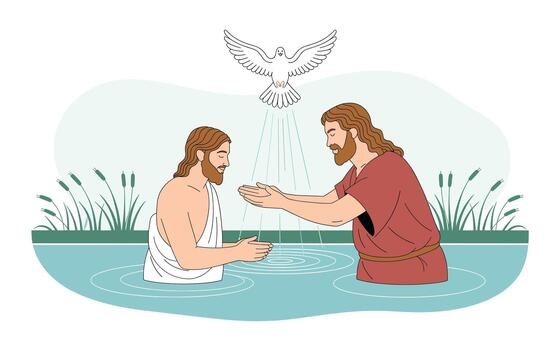
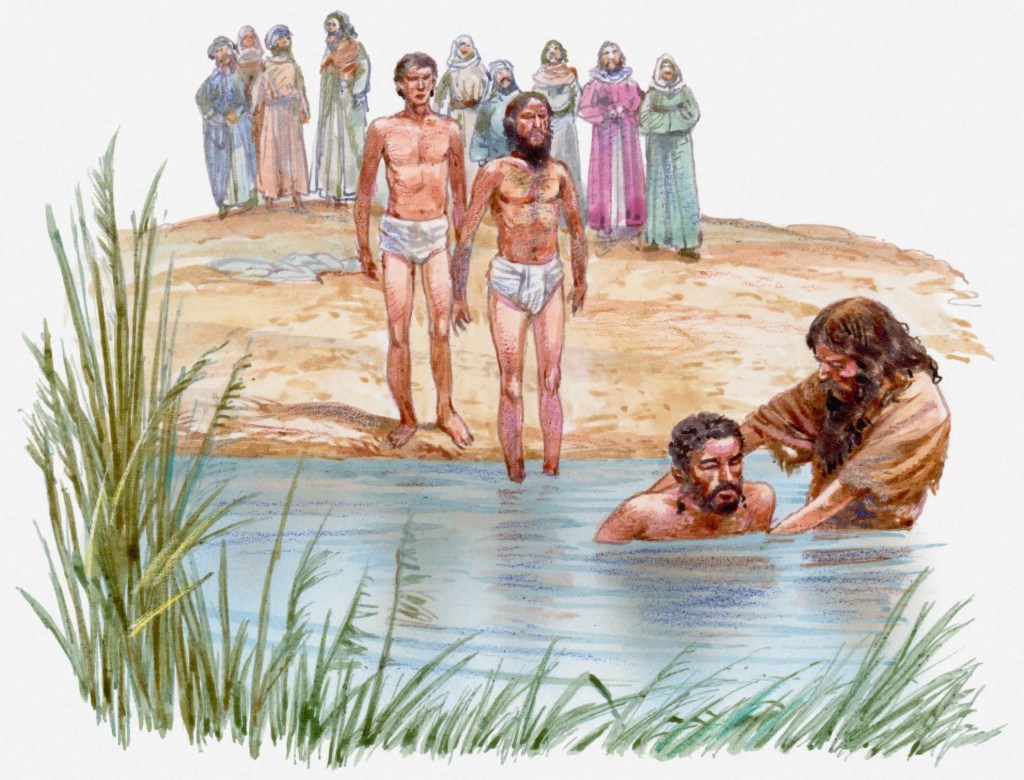
Our passage begins with the baptism of Jesus in the Jordan River. “In those days Jesus came from Nazareth of Galilee and was baptized by John in the Jordan. And when He came up out of the water, immediately He saw the heavens being torn open and the Spirit descending on Him like a dove. And a voice came from heaven, ‘You are My beloved Son; with You I am well pleased.’” (Mark 1:9-11)
Mark situates this moment during the ministry of John the Baptist, who was calling people to repentance and baptizing in the Jordan. Matthew’s Gospel provides more detail, showing John’s initial reluctance: “I need to be baptized by You, and do You come to me?” (Matthew 3:14). Jesus responded, “Let it be so now, for thus it is fitting for us to fulfill all righteousness,” and John consented (Matthew 3:15).
Though Jesus was sinless, He submitted to baptism to fulfill God’s plan. That’s what it means when Jesus said, “to fulfill all righteousness.” John the Baptist explained the purpose of his ministry: “I myself did not know Him, but for this purpose I came baptizing with water, that He might be revealed to Israel.” (John 1:31) Through His baptism, Jesus was publicly revealed as the Messiah, in line with the prophecies of Isaiah 40:3-5 and Malachi 3:1.
This event was divinely affirmed. The Spirit descended upon Jesus like a dove, and God the Father declared from heaven, “You are My beloved Son; with You I am well pleased” (Mark 1:10-11). The same confirmation came from God the Father at the transfiguration of Jesus (Mark 9:7; Matthew 17:5; Luke 9:35). This confirmed Jesus’ identity and His mission.
Immediately after, the Spirit led Jesus into the wilderness and fasted for forty days (Mark 1:13; Matthew 4:2), where He was tempted by Satan (Mark 1:12-13; Matthew 4:3-10). Unlike Adam, who fell into temptation, Jesus overcame all of Satan’s attacks, remaining sinless and faithful to God, while angels ministered to Him. (Matthew 4:11)
The apostle Paul writes, “For our sake God made Jesus to be sin who knew no sin, so that in Him we (the church) might become the righteousness of God.” (2 Corinthians 5:21)
He also declares, “For as by the one man’s disobedience the many were made sinners, so by the one man’s obedience the many will be made righteous.” (Romans 5:19) This is the grace of God, received through faith in Christ alone.
Scripture teaches us that Abraham’s unwavering faith in God was considered righteousness (Romans 4:3). Let us be encouraged to live in obedience to God’s will, trusting in Christ, who has triumphed over sin and temptation for us. By doing so, we can also be counted as righteous, which is the essence of being followers of Jesus Christ.
Peter, in the words of Acts 3:6, declared, “I possess neither silver nor gold, but in the name of Jesus Christ, I offer you what I have.” Share this article freely, for you freely receive. Take note, underlines and highlights are clickable links for definitions or Bible references. Stay updated by heading to our about page and subscribe directly to receive notifications in your inbox. Blessings!
John the Baptist declared, “I have baptized you with water, but the Lord will baptize you with the Holy Spirit.” (Mark 1:8) After His resurrection, Jesus appeared for forty days, proving His resurrection and teaching about the kingdom of God. (Acts 1:3) He said, “You heard from Me; for John baptized with water, but you will be baptized with the Holy Spirit not many days from now.” (Acts 1:4–5) This was fulfilled in the outpouring of the Spirit at Pentecost (Acts 2:1–4):
> “When the day of Pentecost arrived, they were all together in one place. And suddenly there came from heaven a sound like a mighty rushing wind, and it filled the entire house where they were sitting. And divided tongues as of fire appeared to them and rested on each one of them. And they were all filled with the Holy Spirit and began to speak in other tongues as the Spirit gave them utterance.”
Peter, filled with the Holy Spirit, identified this event as the fulfillment of Joel’s prophecy (Acts 2:14–21), declaring that God’s Spirit would be poured out on all flesh, culminating in salvation for “everyone who calls upon the name of the Lord” (Acts 2:21).
Jesus had earlier told Nicodemus that a person must be “born of water and the Spirit” to enter God’s kingdom (John 3:5). He later told His disciples, those who had stayed with Him, saying, “The words that I have spoken to you are spirit and life” (John 6:63), showing the deep connection between the Spirit and the Word of God. Paul affirms this in Ephesians 5:25–26, saying Christ sanctifies the Church by “the washing of water with the Word.”
John’s baptism was a baptism of repentance, pointing forward to Christ (Acts 19:1–7). But the true baptism that saves is the baptism of Jesus—by the Word, which is the Spirit. As John himself said, “He must increase, but I must decrease” (John 3:30w). When the Gospel is proclaimed, the Spirit comes with it, as seen in Acts 10:44–46, where the Holy Spirit fell on Gentiles simply by hearing the Word, without any laying on of hands.
Scripture also clearly states that Jesus Himself never baptized with water (John 4:1–2). Paul declared, “For Christ did not send me to baptize but to preach the gospel, and not with words of eloquent wisdom, lest the cross of Christ be emptied of its power.” (1 Corinthians 1:17) Salvation, therefore, is by grace through faith (Ephesians 2:8–22), with the Spirit and the Word working as one. Peter confirms that Scripture is Spirit-inspired (2 Peter 1:20–21), and Paul affirms that the Gospel—the law of the Spirit of life (i.e., the Gospel)—frees believers from the law of sin and death (Genesis 2:16-17; Romans 8:1–4).
In essence, the baptism of the Holy Spirit is the cleansing and life-giving work of God through His Word, fulfilling John’s prophecy about Jesus Christ and securing eternal life for all who believe in His Word.
The Bible declares:
“In the beginning was the Word, and the Word was with God, and the Word was God.” (John 1:1)
“And the Word became flesh and lived among us. We have seen His glory, the glory as of the only Son from the Father, full of grace and truth.” (John 1:14)
“For from His fullness we have all received, grace upon grace. For the law was given through Moses; grace and truth came through Jesus Christ.” (John 1:16-17)
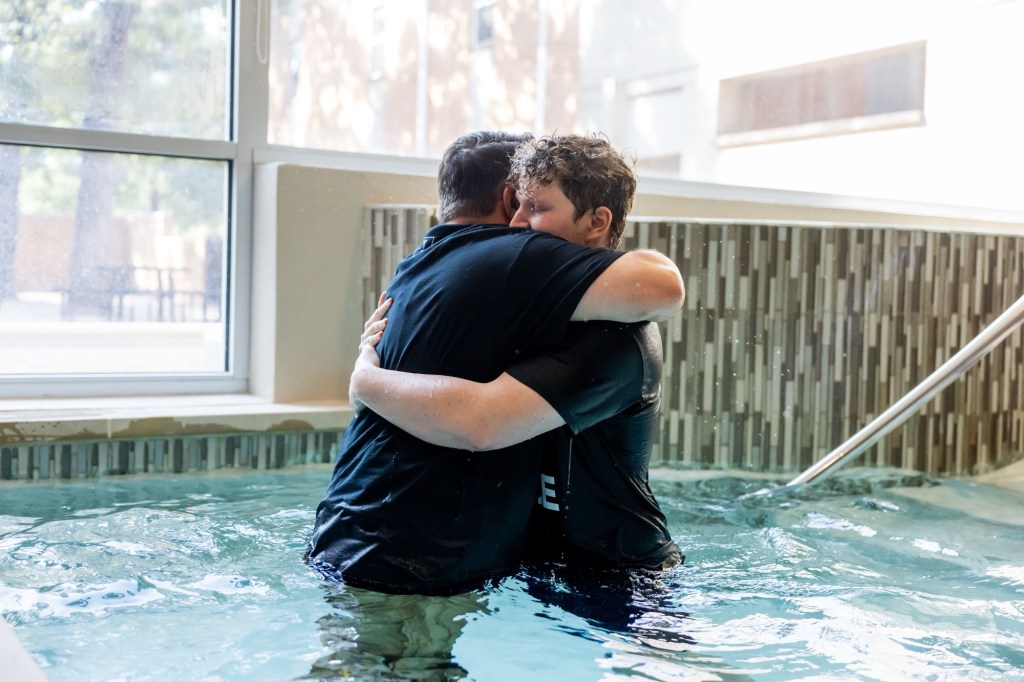
Here’s an honest question then: Why do some pastors imply there’s something special to be baptized at the Jordan River? Isn’t baptism at the Jordan River the epitome of John’s baptism, which cannot save one who has not received the Holy Spirit? If we have been baptized as Christians, is it not then a regression to submit ourselves for baptism at the Jordan River?
Christ’s Great Commission in Matthew 28:19-20 calls us not only to baptize but also to teach believers to obey all that He has commanded. While water baptism is an outward sign of faith and an important act of obedience, the mission of the Church goes beyond this initial step. If we recognize that the Holy Spirit works through the Word of God, then the emphasis must be on guiding Christians to live according to His Word—allowing the Spirit to transform their hearts and actions. Assurance of salvation is vital, but it should be coupled with ongoing discipleship, where believers are taught, challenged, and equipped to follow the commands of Christ daily. True discipleship involves a life shaped by the Word, not just a moment of ritual.
The parable of the sower, as taught by Jesus Christ, affirms that genuine Christian transformation occurs when one hears and truly understands the Word of God (Matthew 13:23). In harmony with this, Paul teaches in Romans that faith is born through hearing—specifically, by hearing the words of Christ (Romans 10:17).
Here’s the call for all of us Christians: If we truly desire to improve the church, we must return to the Bible. Let us relearn the authentic teachings of Scripture and let go of traditions that have, over time, weakened the church. Together, we can make the church shine as the true light of the world by faithfully reflecting the teachings of Jesus Christ.
Peter, in the words of Acts 3:6, declared, “I possess neither silver nor gold, but in the name of Jesus Christ, I offer you what I have.” Share this article freely, for you freely receive. Take note, underlines and highlights are clickable links for definitions or Bible references. Stay updated by heading to our about page and subscribe directly to receive notifications in your inbox. Blessings!
In our Bibles, the Old Testament ends with Malachi, and the New Testament begins with Matthew. Malachi is often regarded as the last prophet to speak directly to Israel, and after his prophecy, there was a span of roughly four hundred years before John the Baptist appeared. This period mirrors the time between Joseph’s passing (Genesis 50:26) and the rise of Moses, when Israel endured four centuries of slavery in Egypt. God’s words to Abraham were fulfilled, as stated in Genesis 15:13-14:
> “Then the LORD said to Abram, ‘Know for certain that your offspring will be sojourners in a land that is not theirs and will be servants there, and they will be afflicted for four hundred years. But I will bring judgment on the nation that they serve, and afterward they shall come out with great possessions.’”
During those four hundred silent years in Egypt, Scripture records nothing new, and God seemed silent. It was only in Exodus 2:24 that we read:
> “And God heard their groaning, and God remembered His covenant with Abraham, with Isaac, and with Jacob.”
From the time of Malachi to the ministry of John the Baptist, history repeated itself with another four hundred years of silence. The arrival of Jesus Christ signified the culmination of this period, a moment that could be called the Second Exodus. Luke 9:30-31 affirms this during the transfiguration:
> “And behold, two men talked with Jesus, who were Moses and Elijah, who appeared in glory and spoke of His exodus, which He was about to accomplish at Jerusalem.”
For the second time, Jesus Christ was leading Israel out of bondage—this time from the law into grace (John 1:14-17). Paul highlights this transition in Galatians 3:23: “Before faith came, we were held captive under the law, imprisoned until the coming faith would be revealed.” Understanding this backdrop is crucial to grasping the Gospel of Mark.
The first instance of this is mentioned by Paul in his letter to the Corinthians, describing the exodus. He emphasizes that the ancestors of the Jews were all under the cloud, passed through the sea, and were baptized into Moses in both the cloud and the sea. They shared the same spiritual nourishment and drank from the spiritual Rock that accompanied them, which was Christ. (1 Corinthians 10:1-4)
Now, Mark begins by declaring Jesus Christ as the Son of God and the beginning of the Gospel. He cites two Old Testament prophecies, though he attributes them to Isaiah alone:
> “As it is written in Isaiah the prophet, ‘Behold, I send My messenger before Your face, who will prepare Your way, the voice of one crying in the wilderness: “Prepare the way of the Lord, make His paths straight.”’”
The two referenced prophets are Isaiah (40:3) and Malachi (3:1). John the Baptist, therefore, is presented as the partial fulfillment of these prophecies, with the complete fulfillment through the coming of Jesus Christ.
Malachi 3:1 foretold:
> “Behold, I send My messenger, and he will prepare the way before Me. And the Lord whom you seek will suddenly come to His temple; and the messenger of the covenant in whom you delight, behold, He is coming, says the LORD of hosts.”
Mark then introduces John the Baptist:
> “John appeared, baptizing in the wilderness and proclaiming a baptism of repentance for the forgiveness of sins. And all the country of Judea and all Jerusalem were coming to him and were being baptized by him in the river Jordan, confessing their sins. Now John was clothed with camel’s hair and wore a leather belt around his waist and ate locusts and wild honey. And he preached, saying, ‘After me comes He who is mightier than I, the strap of whose sandals I am not worthy to stoop down and untie. I have baptized you with water, but He will baptize you with the Holy Spirit.’” (Mark 1:2-8)
John’s message, “Repent, for the kingdom of heaven is at hand” (Matthew 3:2), puzzled many. The Jews knew Old Testament prophecy well, and Daniel had foretold that God’s kingdom would appear during the reign of the Fourth Gentile Kingdom—Rome—following Babylon, Medo-Persia, and Greece. With John and Jesus’ arrival, the kingdom of God had indeed come.
Yet, as in John’s day, people today debate whether the kingdom truly arrived, expecting an earthly utopia. Many Jews back in the days of John and Jesus were also disheartened when political circumstances did not change, remaining under Roman rule. Judas Iscariot, a Zealot hoping for rebellion, betrayed Jesus when his expectations were unmet. Despite spending three years with Jesus, Judas never abandoned his own agenda.
Jesus confirmed John’s role as the Elijah who was to come:
> “From the days of John the Baptist until now, the kingdom of heaven has suffered violence, and the violent take it by force. For all the Prophets and the Law prophesied until John, and if you are willing to accept it, he is Elijah who is to come.” (Matthew 11:12-14)
Understanding these truths lays the proper foundation for studying the Gospel of Mark, which shows Jesus as the fulfillment of the Law and Prophets (Matthew 5:17; Luke 24:25-27) and the dawn of God’s kingdom.
Peter, in the words of Acts 3:6, declared, “I possess neither silver nor gold, but in the name of Jesus Christ, I offer you what I have.” Share this article freely, for you freely receive. Take note, underlines and highlights are clickable links for definitions or Bible references. Stay updated by heading to our about page and subscribe directly to receive notifications in your inbox. Blessings!
The Gospel writers started their narrative differently. Matthew begins with the genealogy of Jesus Christ. Luke started with the birth of John the Baptist. John, on the other hand, took off from the opening phrase of Genesis “in the beginning”. Mark announced with a bang, “Jesus Christ is the Son of God.”
The church at that time had been facing a lot of challenges. False gospel (Galatians 1:6-7; 2 Corinthians 11:3-4) and false Christ (1 John 5:1-6) had been introduced into mainstream Christianity of those days. Well, not surprisingly, because Jesus had told the disciples ahead that “false christs and false prophets will arise” (Mark 13:22).
Mark wasn’t an apostle of Jesus Christ. John Mark was first mentioned in Acts 12:12. He initially travelled with Paul and Barnabas. An argument ensued between Paul and Barnabas because of Mark. Paul refused to take him along in their next missionary journey because Mark abandoned them midway in their previous journey (Acts 13:13; 15:37-39). Colossians revealed that Barnabas and Mark were related, some translations say cousins, others Mark was Barnabas’ nephew. (Colossians 4:10) Paul and Mark had evidently reconciled as can be seen in Colossians. On his farewell letter, Paul states that Mark is very useful to him for ministry. (2 Timothy 4:11) John Mark, a young man, followed Jesus after His arrest. However, he had to flee because he was about to be seized (Mark 14:51-52).
1 Peter, written after the events of Acts 12, 13, and 15, reveals that Mark was now accompanying Peter (1 Peter 5:13). Peter gestured that they were at Babylon. Early Christians understood Babylon as Jerusalem, not Rome, the Great City where Jesus was crucified (Revelation 11:8; Revelation 18:21). Revelation 18:20-21 announced the fulfillment of God’s judgment against the Great City, as prophesied by Jesus Christ (Matthew 23:36-38).
Mark’s Gospel was generally accepted to be dated in the mid-50s AD, written after the events of Acts 13 (48 AD) and 15 (48-49 AD), and before Mark wrote on behalf of Peter around 64 AD (1 & 2 Peter; 1 Peter 5:13). Consequently, Peter holds the authority behind the Gospel of Mark.
So, why did Mark open his Gospel with the statement “The beginning of the Gospel of Jesus Christ” and emphatically declare that Jesus is the Son of God?
Perhaps 1 John could shed some light. Believed to be written by John, while exiled at Patmos (Revelation 1:9). Seven times 1 John refers to Jesus Christ as the Son of God (1 John 3:8; 4:15; 5:5; 5:10; 5:12; and 5:20). And here are the statements that stand out:
> “Whoever confesses that Jesus is the Son of God, God abides in him, and he in God.” (1 John 4:15)
> “Who is it that overcomes the world except the one who believes that Jesus is the Son of God?” (1 John 5:5)
> “If we receive the testimony of men, the testimony of God is greater, for this is the testimony of God that he has borne concerning his Son. Whoever believes in the Son of God has the testimony in himself. Whoever does not believe God has made him a liar, because he has not believed in the testimony that God has borne concerning his Son. And this is the testimony, that God gave us eternal life, and this life is in his Son. Whoever has the Son has life; whoever does not have the Son of God does not have life.” (1 John 5:9-12)
> “I write these things to you who believe in the name of the Son of God, that you may know that you have eternal life.” (1 John 5:13)
> “And we know that the Son of God has come and has given us understanding, so that we may know him who is true; and we are in him who is true, in his Son Jesus Christ. He is the true God and eternal life.” (1 John 5:20)
Clearly, 1 John and Mark’s Gospel were written to defend the truth that Jesus is the Son of God. 1 John was written about a decade later, indicating that false teachings about Christ Jesus were widespread and persistent. Mark practically opened and closed his Gospel with the declaration that Jesus is the Son of God.
It is best, therefore, to keep that in mind as we study the Gospel of Mark. It’s a defense of Christ’s divinity.
Peter, in the words of Acts 3:6, declared, “I possess neither silver nor gold, but in the name of Jesus Christ, I offer you what I have.” Share this article freely, for you freely receive. Take note, underlines and highlights are clickable links for definitions or Bible references. Stay updated by heading to our about page and subscribe directly to receive notifications in your inbox. Blessings!
Paul’s teaching in Romans 8:6 presents a direct contrast between life in the flesh and life in the Spirit. The Spirit reflects the life-giving reality of the Gospel, while the flesh signifies the law of sin and death, first introduced in Genesis 2:16-17. To set one’s mind on the flesh results in spiritual death, but to embrace the Spirit leads to life and peace.
See story in Genesis:
> “The LORD God took the man and put him in the garden of Eden to work it and keep it. And the LORD God commanded the man, saying, ‘You may surely eat of every tree of the garden, but of the tree of the knowledge of good and evil you shall not eat, for in the day that you eat of it you shall surely die.’” (Genesis 2:15-17)
> “Now the serpent was more crafty than any other beast of the field that the LORD God had made. He said to the woman, “Did God actually say, ‘You shall not eat of any tree in the garden’?” And the woman said to the serpent, “We may eat of the fruit of the trees in the garden, but God said, ‘You shall not eat of the fruit of the tree that is in the midst of the garden, neither shall you touch it, lest you die.’” But the serpent said to the woman, “You will not surely die. For God knows that when you eat of it your eyes will be opened, and you will be like God, knowing good and evil.” So when the woman saw that the tree was good for food, and that it was a delight to the “Now the serpent was more crafty than any other beast of the field that the LORD God had made. He said to the woman, “Did God actually say, ‘You shall not eat of any tree in the garden’?” And the woman said to the serpent, “We may eat of the fruit of the trees in the garden, but God said, ‘You shall not eat of the fruit of the tree that is in the midst of the garden, neither shall you touch it, lest you die.’” But the serpent said to the woman, “You will not surely die. For God knows that when you eat of it your eyes will be opened, and you will be like God, knowing good and evil.” So when the woman saw that the tree was good for food, and that it was a delight to the eyes, and that the tree was to be desired to make one wise, she took of its fruit and ate, and she also gave some to her husband who was with her, and he ate.” (Genesis 3:1-6)
If you asked why God allowed the Serpent to be in the Garden of Eden? Click here for explainer: Fall of the Cherub
Paul calls believers to leave behind the bondage of sin and step into the freedom and renewal that the Spirit of Christ offers.
In Colossians 3:1-2, Paul emphasizes the transformation that takes place when one fully embraces the Gospel rather than clinging to the Mosaic Law— an annex to a temporary remedy for the violation of the First Covenant (i.e., Genesis 2:16-17). He urges believers to lift their focus from earthly concerns to heavenly priorities, drawing a distinction between those trapped in worldly fears and those living by faith in Christ.
The religious leaders in John 11:47-48 illustrate the mindset of those bound to the world and the law. Their fear of losing their power and nation kept them from recognizing the Messiah before them. In contrast, the repentant thief in Luke 23:42 reflects a heart that had released earthly attachments to place hope entirely in Christ’s kingdom.
Paul’s exhortation is to maintain a heavenly perspective even while fulfilling earthly duties. Though life’s responsibilities persist, the believer’s central pursuit should be God’s kingdom and righteousness (Matthew 6:33). By living in the Spirit, believers experience genuine life and peace, as the Gospel reorients the heart from the temporary and visible to the eternal and unseen.
Ultimately, Paul invites believers to self-examination: Are we still consumed by the world, or have we truly set our minds on the things above where Christ reigns?
Peter, in the words of Acts 3:6, declared, “I possess neither silver nor gold, but in the name of Jesus Christ, I offer you what I have.” Share this article freely, for you freely receive. Take note, underlines and highlights are clickable links for definitions or Bible references. Stay updated by heading to our about page and subscribe directly to receive notifications in your inbox. Blessings!
The Serpent, identified in Revelation 12:9 as Satan, first appears as the tempter in Eden (Genesis 3). In Ezekiel 28:12–15, he is described as a fallen guardian cherub. God uses the fall of this angel to illustrate the pride and arrogance of the king of Tyre:
“Son of man, raise a lamentation over the king of Tyre, and say to him, Thus says the Lord GOD: You were the signet of perfection, full of wisdom and perfect in beauty. You were in Eden, the garden of God; every precious stone was your covering, sardius, topaz, and diamond, beryl, onyx, and jasper, sapphire, emerald, and carbuncle; and crafted in gold were your settings and your engravings. On the day that you were created they were prepared. You were an anointed guardian cherub. I placed you; you were on the holy mountain of God; in the midst of the stones of fire you walked. You were blameless in your ways from the day you were created, till unrighteousness was found in you.” (Ezekiel 28:12-15)
This passage reveals that the Serpent was not created to tempt. He began as a perfect guardian cherub but later rebelled against God and deceived Eve.
Humanity’s Choice
Adam, created in God’s image (Genesis 5:1), ultimately chose disobedience. Like the fallen cherub, he turned away from God. Yet here lies the great difference: while fallen angels were not offered redemption, humanity received an invitation to reconciliation. Sin did not end the story—God’s mercy opened the path to hope.
The Wonder of Salvation
The mystery of salvation is so profound that even angels long to understand it. 1 Peter 1:12 declares:
> It was revealed to the Old Testament prophets that they were serving not themselves but you— the church— in the things that have now been announced to you through those who preached the good news to you by the Holy Spirit sent from heaven, things into which angels long to look.
Paul echoes this in Ephesians 3:10:
> So that through the church the manifold wisdom of God might now be made known to the rulers and authorities in the heavenly places.
The fall of angels highlights the tragedy of rebellion, while the redemption of humanity showcases the glory of God’s salvation—a story that moves heaven to awe and calls us to worship.
God’s Answer to Human Suffering
We must stop blaming God for the world’s suffering, for He gave humanity the freedom to choose. Through Adam, sin entered the world, and with it, suffering. But in Christ, redemption is offered:
> “For as in Adam all die, so also in Christ shall all be made alive.” (1 Corinthians 15:22)
God’s blessings are not only spiritual. Paul reminds us:
> “What then shall we say to these things? If God is for us, who can be against us? He who did not spare His own Son but gave Him up for us all, how will He not also with Him graciously give us all things?” (Romans 8:31-32)
And he reassures us:
> “Who shall separate us from the love of Christ? Shall tribulation, or distress, or persecution, or famine, or nakedness, or danger, or sword?… No, in all these things we are more than conquerors through Him who loved us.” (Romans 8:35-37)
Through Christ, suffering has meaning and victory is assured.
The Church’s Call to Renewal
The modern church, at times, has failed to fully embrace Paul’s revelation of God’s manifold wisdom. Too often, deep theology is avoided, and the church is reduced to the image of a sanctuary for the imperfect, rather than a community of people being actively transformed. We are familiar with the common saying: “The church is a hospital for the sick.” Yet Paul’s exhortation challenges this limited view:
> “Cleanse out the old leaven that you may be a new lump, as you really are unleavened. For Christ, our Passover lamb, has been sacrificed…” (1 Corinthians 5:7-8)
Paul also instructs the believers in Colossians 3:5-17 to put away the old self, embracing the life of Christ through love, forgiveness, and thanksgiving. Likewise, Peter reminds the church:
Peter states, > “As obedient children, do not be conformed to the passions of your former ignorance, but as God who called you is holy, you also be holy in all your conduct, since it is written, ‘You shall be holy, for I am holy.’” (1 Peter 1:14-16)
The message is unmistakable: the church is called to be a visible testimony of transformation, embodying God’s holiness and love for the world to see.
Credit: Photo owned by Alexandre Cabanel — Fallen Angel
Conclusion
It all began with the fall of a cherub. Followed by the fall of Adam. Yet, Jesus reminds us of a profound truth:
> “Truly, truly, I say to you, unless a grain of wheat falls into the earth and dies, it remains alone; but if it dies, it bears much fruit. Whoever loves his life loses it, and whoever hates his life in this world will keep it for eternal life. If anyone serves Me, he must follow Me; and where I am, there will My servant be also. If anyone serves Me, the Father will honor him.” (John 12:24-26)
Credit: Photo owned by Scott Roberts
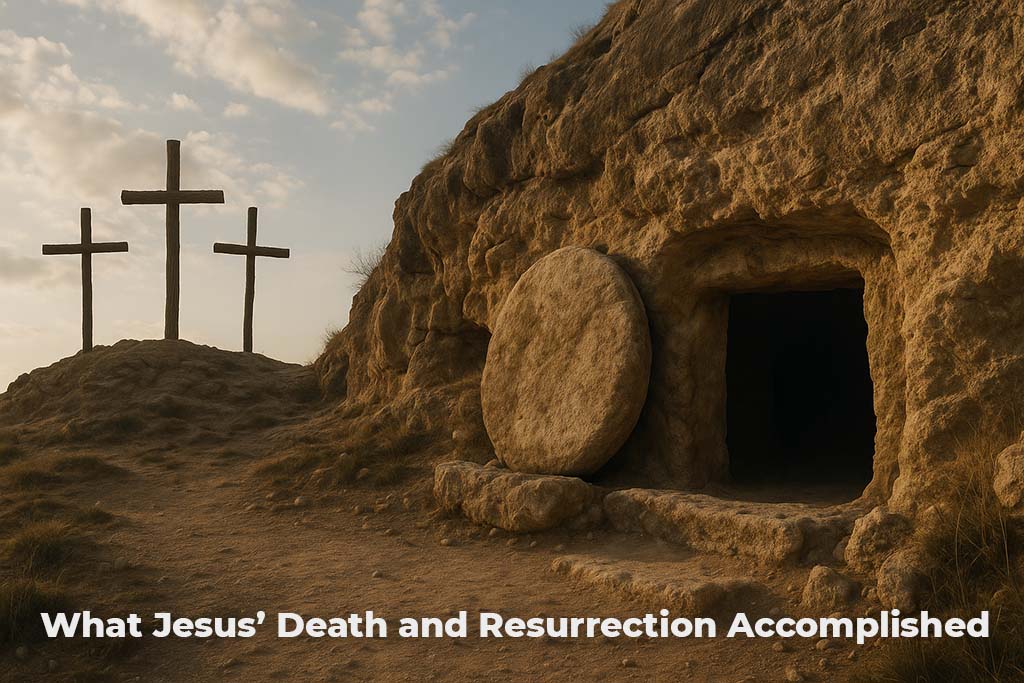
In this passage, Jesus reveals His death and resurrection, was the ultimate act of sacrifice and fruitful surrender. It highlights the contrast between the pride of the fallen cherub and the humble journey of those who choose to follow Christ. By fully submitting to the will of the Father and dying on the cross, Jesus shows the path to true life. Likewise, when we die to ourselves, we gain eternal life, and in faithfully serving our Lord Jesus, we receive the honor that comes from the Father.
Peter, in the words of Acts 3:6, declared, “I possess neither silver nor gold, but in the name of Jesus Christ, I offer you what I have.” Share this article freely, for you freely receive. Take note, underlines and highlights are clickable links for definitions or Bible references. Stay updated by heading to our about page and subscribe directly to receive notifications in your inbox. Blessings!
I’ve come to realize that many pastors are hesitant to discuss money because they’ve been taught and told not to speak on the topic. However, Paul addressed this issue on several occasions. Are pastors inferior to an apostle? Paul made it clear in Ephesians that both are mandated by Christ Jesus for His ministry. (Ephesians 4:11-14) While I understand that some people assume the role of a pastor but lack the necessary skills or love for God’s ministry. Some view the ministry not as a calling but as a profession, even worse, as an opportunity to gain wealth. (1 Timothy 6:3-5)
No wonder Paul said, “For we are not, like so many, peddlers of God’s word, but as men of sincerity, commissioned by God, in the sight of God we speak in Christ.” (2 Corinthians 2:17) This article applies only to the latter group: people who are genuinely committed to doing God’s work.
Here’s the silent truth: Pastors are even ridiculed when people discover that someone has been supporting them, despite the clear biblical teaching that it’s the right of the pastor to receive support.
For example, Paul said, “In the same way, the Lord commanded that those who proclaim the Gospel should get their living by the Gospel.” (1 Corinthians 9:14) It’s the right of pastors to receive their living from the Gospel, because it’s commanded by Jesus Christ (Luke 10:2-8).
Paul also said, “Let the one who is taught the word share all good things with the one who teaches.” (Galatians 6:6) This clearly teaches that the giving and receiving of ministry support is directly between the teacher and the learner.
Furthermore, Jesus instructed His disciples, “The harvest is abundant, but the laborers are few. Go your way; behold, I am sending you out as lambs in the midst of wolves. Carry no moneybag, no knapsack, no sandals, and greet no one on the road. Whenever you enter a house, first say, ‘Peace be to this house!’ If a son of peace is there, your peace will rest upon him. But if not, it will return to you. Stay in the same house, eating and drinking what they provide, for the laborer deserves his wages. Do not go from house to house.” (Luke 10:2-7)
Despite these clear teachings, God’s workers often face little support and are subjected to ridicule and accusations of wrongdoing. Paul himself expressed his frustration, stating, “Did I commit a sin in humbling myself so that you might be exalted? Because I preached God’s Gospel to you without charge? I robbed other churches by accepting support from them in order to serve you. And when I was with you and in need, I did not burden anyone. The brothers who came from Macedonia supplied my need. So I refrained and will refrain from burdening you in any way.” (2 Corinthians 11:7-9)
The Corinthian church was biblically obligated to actively support Paul’s ministry in their midst. Scripture emphasizes the responsibility of believers to help God’s workers, declaring, “Therefore, we ought to support God’s workers like these, so that we may be fellow workers for the truth.” (3 John 1:8)
Despite this clear mandate, Paul did not receive the support that was rightfully due him from the Corinthians. Instead, he endured their criticisms. In response, he wrote:
“I am here for the third time, ready to come to you. I will not be a burden because I seek not what is yours but you. Children are not obligated to save for their parents, but parents for their children. I will gladly spend and be spent for your souls. If I love you more, am I to be loved less? But since I did not burden you, you say, I was crafty and got the better of you by deceit.” (2 Corinthians 12:14‑16)
Paul’s words reveal his profound love for the Corinthians and his willingness to sacrifice for their spiritual growth, even without receiving the support that was biblically warranted. This passage serves as a reminder to recognize, honor, and assist those who faithfully labor in God’s work, fulfilling the partnership that Scripture envisions between God’s servants and His people.
God designed it that way. Both God’s workers and Christians who support them are considered workers in the Gospel. (3 John 1:8) God intended it to be a partnership. Therefore, Paul expressed his gratitude to the Philippians, saying, “I thank my God in all my remembrance of you, always in every prayer of mine for you all, making my prayer with joy, because of your partnership in the Gospel from the first day until now.” (Philippians 1:3-5) The Macedonians and the Philippians are essentially the same people. Paul revealed that they are his sole supporters, stating, “And you Philippians yourselves know that in the beginning of the gospel, when I left Macedonia, no church entered into partnership with me in giving and receiving, except you only.” (Philippians 4:15)
John teaches that those who prevent people from directly supporting God’s workers are considered evildoers. (3 John 1:9-11)
Demetrius, who welcomes and supports God’s workers, contrasts sharply with Diotrephes, who refuses and hinders others from doing the same. It is crucial to discern who you listen to and follow.
Shame on you, Diotrephes! You are wrongfully accusing God’s workers of wrongdoing by denying them support and hindering others from doing so. Let’s not be deceived by the cunning and deceitful reasoning of some people who exploit your ignorance of Bible teachings. Regrettably, some have accused God’s workers of wrongdoing while neglecting accountability in their own collections of donations from God’s people.
I am simply stating the truth. I have received an unusual call from God. My mission is to study the Bible, explain its teachings clearly and without restraint, and share them with others. God’s people should not be offended by God’s Word. If you have any doubts, I encourage or even challenge you to study the Bible thoroughly. Discover for yourself the authentic teachings of the Scriptures.
P.S. This is a follow through to my previous posting “Supporting Christian Workers: A Biblical Approach”
Peter, in the words of Acts 3:6, declared, “I possess neither silver nor gold, but in the name of Jesus Christ, I offer you what I have.” Share this article freely, for you freely receive. Take note, underlines and highlights are clickable links for definitions or Bible references. Stay updated by heading to our about page and subscribe directly to receive notifications in your inbox. Blessings!