This morning, I was listening to some music, then a cover song on Michael Jackson’s “Heal the World” started to play. I was immediately reminded by its message, which I summarized as “love is all that is needed to make the world a better place for everyone”. True enough, don’t you think?
Christ Jesus came to the world to redeem people for Himself. He’s not in the business of picking and choosing, but an honest offer for salvation. However, along with salvation, His aim is for us Christians to be bearers of the Gospel, precisely with the goal of making His created world a place of joy and gladness. (Isaiah 65:17-25)
However, the irony is, and it cannot be denied, that there are people who claim to be Christians and yet, they didn’t live in love. They didn’t care for each other, or do God’s work without selfish motivations. Scripture said, “Love is patient and kind; love does not envy or boast; it is not arrogant or rude. It does not insist on its own way; it is not irritable or resentful; it does not rejoice at wrongdoing, but rejoices with the truth. Love bears all things, believes all things, hopes all things, endures all things.” (1 Corinthians 13:4-7)
I have known people who have always been part of missions work, presenting themselves as loving, faithful servants of the Lord. Yet, they connived to demean people that call for accountability. Churches collect people’s money; hence, every cent given ought to be accounted for. Nobody is outright accused of any wrongdoing. But why so secretive about money collected and left unused? Is there anything wrong with calling for accountability?
Without kindness, selflessness, and truth, there can be no real love. What is the best testament of a Christian? James explained, “What good is it, my brothers, if someone says he has faith but does not have works? Can that faith save him? If a brother or sister is poorly clothed and lacking in daily food, and one of you says to them, ‘Go in peace, be warmed and filled,’ without giving them the things needed for the body, what good is that? So also faith by itself, if it does not have works, is dead. But someone will say, ‘You have faith and I have works.’ Show me your faith apart from your works, and I will show you my faith by my works.” (James 2:14-18)
Christ Jesus has done His redemptive work, offering everyone an opportunity to be His people. And yet, some have claimed faith and yet remained unconverted. They loved the world more than people. They loved riches more than truth. They loved fame more than Jesus Christ. Hence, Scripture said, “For people will be lovers of self, lovers of money, proud, arrogant, abusive, disobedient to their parents, ungrateful, unholy, heartless, unappeasable, slanderous, without self-control, brutal, not loving good, treacherous, reckless, swollen with conceit, lovers of pleasure rather than lovers of God, having the appearance of godliness, but denying its power. Avoid such people.” (2 Timothy 3:2-5)
Anyone who finds themselves identified in 2 Timothy 3:2-5 ought to repent and change. Verbal confession of faith does not count; real change involves the heart, mind, and action. The last commandment of Jesus Christ to His disciples before crucifixion was to “love one another”. See Scripture, Jesus Christ told His disciples, “A new commandment I give to you, that you love one another: just as I have loved you, you also are to love one another. By this all people will know that you are My disciples, if you have love for one another.” (John 13:34-35)
Israel was called to be God’s people so that they may be the light and salt of the world. They were supposed to bring all nations to God. Yet, they failed miserably due to self-righteousness. Do you not see people who professed to be Christians doing the same? Of course, I do not mean everyone. But it has become hard to distinguish real Christians from pretenders unless you spend time with them. However, by the time you discover who’s who, controversy would have already erupted. That’s the sad reality of our present Christianity.
In my almost three decades of being a Christian, it’s ironic, but sometimes I have found people outside our faith to be more loving, caring, and understanding. If my personal experience reflects the true state of modern Christianity, how then can the church be effective in bringing people to the faith, and not be a stumbling block later?
I thank God for His grace, that despite all the ugly experiences we’ve had as Christians, my children didn’t stumble in their faith. But how many have been similarly hurt and have left the faith? Shouldn’t those who caused it be accountable to Christ Jesus? Jesus Christ said, “But whoever causes one of these little ones who believe in Me to sin, it would be better for him to have a great millstone fastened around his neck and to be drowned in the depth of the sea.” (Matthew 18:6)
Sadly, I don’t see such people repentant. Instead, they continue with their lies and propaganda just to make themselves right in their own eyes. Reminiscence of Judges, don’t you think? (Judges 17:6) I sincerely hope they one day repent and change.
So I found Christianity today falling short on two fronts: first, they teach a lot of traditions but not necessarily doctrines of the Bible; second, it’s difficult to find true and honest love among Christians. Both shortcomings are condemned by Jesus Christ in Revelation 2-3.
My family and I are always thankful to Christians we encountered at our home church. Not that everyone is true. But we have experienced unconditional love from some brethren then and even today.
The same may be said of some Christians here who have become our friends. We are forever grateful for their love, most especially when times are rough for us.
However, I dare not make a ratio of who’s who; else I find it discouraging. Instead, I remain hopeful that God indeed has His people everywhere.
Same as in life, we get to know real friends only when we’re down and alone. That’s also the sad reality of modern Christianity. But to be fair, an honest evaluation of the church post-apostles’ time would reveal it’s no different from today. But should Christians be complacent and make that an excuse and remain lacking?
This blog is not meant to condemn or rebuke anyone. Rather, I hope to awaken people to the reality that confession of faith should come with a change of heart, mind, and action. How can the church truly be agents to heal the world if there is no real love and compassion for the suffering and lost? The real essence of love is God and Christ Jesus. The Bible said, “God shows His love for us in that while we were still sinners, Christ died for us.” (Romans 5:8) The Bible in 1 John 4:19 declares, “We love because God first loved us”.
Peter, in the words of Acts 3:6, declared, “I possess neither silver nor gold, but in the name of Jesus Christ, I offer you what I have.” Share this article freely, for you freely receive. Take note, underlines and highlights are clickable links for definitions or Bible references. Stay updated by heading to our about page and subscribe directly to receive notifications in your inbox. Blessing!
One clear principle we learned from Christ Jesus and His call to His apostles is that it involves individuals, not the entire family. While some of the disciples were siblings, each chose to follow Jesus Christ by their own volition. Christ even warned His disciples, saying, “And a person’s enemies will be those of his own household.” (Matthew 10:36) As we can see, even His own human family was not supportive of His work at the onset of Christ’s ministry (see Mark 3:20-21; John 7:2-5).
In our modern times, we witness couples who actively partner in ministry, each having made a conscious decision to serve Christ Jesus. Another notable example is when children later follows in the footsteps of their pastor-father. This is commendable if they have received proper guidance and have embraced God’s calling. However, it is crucial to emphasize that coercing children into joining our ministry is not advisable. They should serve Christ Jesus willingly, not because we pastor-fathers have imposed it upon them. As Christ reminds us, “Come, follow Me.” It is Jesus who calls, not through coercion of men.
Scripture proclaims, “Jesus is the same yesterday, today, and forever” (Hebrews 13:8). God’s methodology for ministry remains unchanged; it’s Christians who have reinvented new concepts of ministry work.
Jesus Christ commanded, “You received without paying; give without pay. Acquire no gold, silver, or copper for your belts, no bag for your journey, or two tunics or sandals or a staff, for the laborer deserves his food. And wherever you enter a town or village, find out who is worthy and stay there until you leave” (Matthew 10:8-11).
Have you noticed the phrase “the laborer deserves his food”? This principle was emphasized in Paul’s letters, particularly in 1 Corinthians 9:4-14, Galatians 6:6-7, and 1 Timothy 5:17-18. Christians who understand the Lord’s ministry support God’s servants willingly. As servants of the Word, we should uphold the same principles and procedures. Go forth and perform God’s work with confidence in His unwavering truthfulness to His Word. Just as God demonstrated His faithfulness through acts like providing for Elijah during the famine, offering Abraham a sacrifice to spare Isaac’s life, and countless other acts, we too can trust in God’s provision.
If servants of the Word cannot trust God’s Word for sustenance, how can we effectively teach people about faith?
So, I challenge God’s workers who are struggling to embark on God’s ministry, because they fear the lack of provision. In Joshua 3, the Israelites carrying God’s ark of the covenant reached the Jordan River. The water receded, allowing the priest and all of Israel to cross over. However, before the water receded, God’s people ought to trust His Word that it would happen. As He had stipulated, they should take – that step of faith – so as soon as they stepped into the water, and it immediately receded. See Joshua 3:7-17.
“The LORD said to Joshua, ‘Today I will begin to exalt you in the sight of all Israel, that they may know that, as I was with Moses, so I will be with you. And as for you, command the priests who bear the ark of the covenant, “When you come to the brink of the waters of the Jordan, you shall stand still in the Jordan.” And Joshua said to the people of Israel, ‘Come here and listen to the words of the LORD your God.’ And Joshua said, “Here is how you shall know that the living God is among you and that He will without fail drive out from before you the Canaanites, the Hittites, the Hivites, the Perizzites, the Girgashites, the Amorites, and the Jebusites. Behold, the ark of the covenant of the Lord of all the earth is passing over before you into the Jordan. Now therefore take twelve men from the tribes of Israel, from each tribe a man. And when the soles of the feet of the priests bearing the ark of the LORD, the Lord of all the earth, shall rest in the waters of the Jordan, the waters of the Jordan shall be cut off from flowing, and the waters coming down from above shall stand in one heap.” So when the people set out from their tents to pass over the Jordan with the priests bearing the ark of the covenant before the people, and as soon as those bearing the ark had come as far as the Jordan, and the feet of the priests bearing the ark were dipped in the brink of the water (now the Jordan overflows all its banks throughout the time of harvest), the waters coming down from above stood and rose up in a heap very far away, at Adam, the city that is beside Zarethan, and those flowing down toward the Sea of the Arabah, the Salt Sea, were completely cut off. And the people passed over opposite Jericho. Now the priests bearing the ark of the covenant of the LORD stood firmly on dry ground in the midst of the Jordan, and all Israel was passing over on dry ground until all the nation finished passing over the Jordan.”
Remember this from the moment you start serving God: “It is God who calls, and He alone provides.” Therefore, instead of asking for pledges for ministry support, trust in God’s timely provision.
You might wonder, “How can people support my ministry if they do not know who I am or what I do?” Christ Jesus teaches His disciples by saying, “Whenever you enter a house, first say, ‘Peace be to this house!’ If a person of peace is there, your peace will rest upon them; if not, it will return to you. Stay in that same house, eating and drinking what they provide, for the laborer deserves their wages. Do not move from house to house. When you enter a town and are welcomed, eat whatever is set before you.” (Luke 10:5-8)
Let me be clear: Christ does not teach us, pastors, to take advantage of gracious Christians. Instead, Jesus imparts His principles of serving and giving. Paul articulates this clearly in Galatians 6:6-7: “Let the one who is taught the word share all good things with the one who teaches. Do not be deceived: God is not mocked, for whatever one sows, that will he also reap.”
It’s important to express gratitude to those who support our ministry. However, we must remember that it is God who inspires them to give. Just as we are called to be God’s servants, they are also fulfilling their role in the act of grace. Ultimately, all good things come from Him!
As evident in John’s letter to the church, “Dear friend, you are being faithful to God when you care for the traveling teachers who pass through, even though they are strangers to you. They have told the church here of your loving friendship. Please continue providing for such teachers in a manner that pleases God. For they are traveling for the Lord, and they accept nothing from people who are not believers. So we ourselves should support them so that we can be their partners as they teach the truth.” (3 John 1:5-8 NLT)
If you read the entirety of 3 John, it is clear that those who hinders Christians from extending aids to God’s workers were deemed evil workers (3 John 9-12).
Paul taught Christian about giving, which he referred to as the act of grace (2 Corinthians 8:1-7). We should likewise teach this to others, but I want to emphasize that we should teach, not demand or worse, scare them into giving.
Christ Jesus Himself did not always multiply bread and fish. In fact, He never did it for His own sustenance, even during the 40 days of temptation by the devil. Instead, He demonstrated unwavering trust in God. Jesus Christ exemplified His principle on serving God and giving, as He had taught, as seen in Luke 8:1-3.
“Soon afterward Jesus went on through cities and villages, proclaiming and bringing the good news of the kingdom of God. And the twelve were with Him, and also some women who had been healed of evil spirits and infirmities: Mary, called Magdalene, from whom seven demons had gone out, and Joanna, the wife of Chuza, Herod’s household manager, and Susanna, and many others, who provided for them out of their means.”
Hence, Paul teaches the same, saying, “So we, though many, are one body in Christ, and individually members one of another. Having gifts that differ according to the grace given to us, let us use them: if prophecy, in proportion to our faith; if service, in our serving; the one who teaches, in his teaching; the one who exhorts, in his exhortation; the one who contributes, in generosity; the one who leads, with zeal; the one who does acts of mercy, with cheerfulness.” (Romans 12:5-8)
As the body of Christ, Christians are called to endure and work together for the advancement of the Gospel. Each of us should faithfully fulfill our calling, gift, or role. We are all in this together, as the Bible teaches us about the ministry of partnerships.
According to the Bible, God not only calls individuals to the ministry but He also inspires others to give, making them partners in His work—fellow workers for the truth (3 John 5-8). Therefore, responding to God’s calling and the act of grace or giving both require trust in Him.
In Scripture, giving to God’s workers is intended to be a direct act rather than a process where funds are collected and then distributed, a concept that has emerged only in modern Christianity. Unfortunately, this contemporary approach can sometimes be exploited to control and manipulate pastors for coercive or political purposes. It’s also not a secret that some organizations that collect funds for mission work have been associated with irregularities. The Bible teaches us to give directly to God’s workers (Galatians 6:6-7; 1 Corinthians 9:14; 3 John 5-8; 2 Corinthians 8:23-24).
In the book of Philippians, Paul expressed his gratitude to the Philippians for the gift they sent him. At the time, he was imprisoned in Rome, and their support was delivered by an emissary. Paul described their contributions as a fragrant offering to God and, in response, offered them a prayer for God’s blessings. ( see Philippians 4:10-20)
Therefore, everything should be done with confidence in God, in accordance with the Scriptures’ teachings. Christian workers respond to God’s call to glorify Him. Those who participate in the act of grace do so to glorify God’s work. So borrowing from Paul’s words, “So, whether you eat or drink, or whatever you do, do all to the glory of God.” (1Co 10:31)
Christians, let us all adhere to the principles taught in Scripture. God’s ministry is sacred, and the sanctity of His work is of utmost importance to Him and to us as well.
This is the first and only article I wrote that deals with the act of grace. Take it as a teaching on God’s call and giving, and not for the purpose of solicitation, but for God’s glory. Peter, in the words of Acts 3:6, declared, “I possess neither silver nor gold, but in the name of Jesus Christ, I offer you what I have.” Share this article freely, for you freely receive. Take note, underlines, and highlights are clickable links for definitions or Bible references. Stay updated by heading to our about page and subscribe directly to receive notifications in your inbox. Blessing!
One of the remarkable prophecies in the Bible pertains to the arrival of the Son of God. Scripture proclaims, “For to us a child is born, to us a Son is given; and the government shall be upon His shoulder, and His name shall be called Wonderful Counselor, Mighty God, Everlasting Father, Prince of Peace. From the increase of His government and of peace there will be no end, on the throne of David and over His kingdom, to establish it and to uphold it with justice and with righteousness from this time forth and forevermore. The zeal of the LORD of hosts will do this.” (Isaiah 9:6-7)
Christ, the incarnate Jesus, was born and lived a life much like ours—fully human yet free from sin, and, unlike us, fully divine. He shared wisdom inspired by God the Father, accomplished His mission, and willingly went to the cross for the redemption of our sins. He died and stayed in the tomb for three days and three nights, as He had prophesied (Matthew 12:40) and as foretold in Hosea 6:2. On the third day, He was resurrected (1 Corinthians 15:4). For forty days, He appeared alive (Acts 1:3) before being taken up into glory (1 Timothy 3:16)—not in a bodily form, as many had assumed. Stephen saw Him standing at the right hand of the throne of God (Acts 7:56) just before his martyrdom, indicating His reign. This fulfills the prophecy in Isaiah 9:6-7. Therefore, Jesus reigns now and forevermore.
Scripture declared: “Thus says the LORD: ‘Heaven is My throne, and the earth is My footstool; what is the house that you would build for Me, and what is the place of My rest?’” (Isaiah 66:1) The idea of the third Jerusalem temple isn’t a Christian teaching, because God’s throne is in heaven, not earth. He reigns over all creation in heaven. Yet, God now dwells among us Christians; hence, Scripture said Jesus Christ and His Church is the New Temple (Ephesians 2:19-22). Temple means to dwell, same with tabernacle. In other words, it means God dwells with His people, the church; hence, God’s people is the New temple.
The church then isn’t a place, neither is it an organization or institution, but an assembly of Christians. When would Christians, especially pastors, correct that misunderstanding? I hope it’s not due to the fact that you want and need to keep Christians coming into your congregation? Don’t get me wrong. I am not against collective gatherings of the church, for as long as the integrity of the church isn’t compromised. However, the question often asked “Where do you go to church?” is a misrepresentation of the true meaning of the church.
Christians invite people to embrace the Gospel, so it is wrong to say we can invite anyone to the church. It’s only after they have repented and believe, then they become a part of God’s church. Contrary to popular belief, God’s church is not a hospital. Instead, it is the gathering of the redeemed, who have been healed by the grace of God. Their perfection lies not in themselves but in the blood of Christ Jesus. Hence, Paul instructing Christians said: “But now I am writing to you not to associate with anyone who bears the name of brother if he is guilty of sexual immorality or greed, or is an idolater, reviler, drunkard, or swindler—not even to eat with such a one. For what have I to do with judging outsiders? Is it not those inside the church whom you are to judge? God judges those outside. ‘Purge the evil person from among you.’” (1 Corinthians 5:11-13)
Again, Paul declared: “Do you not know that your bodies (i.e. the individual Christian) are members of Christ? Shall I then take the members of Christ and make them members of a prostitute? Never! Or do you not know that he who is joined to a prostitute becomes one body with her? For, as it is written, “The two will become one flesh.” But he who is joined to the Lord becomes one spirit with Him. Flee from sexual immorality. Every other sin a person commits is outside the body, but the sexually immoral person sins against his own body. Or do you not know that your body is a temple of the Holy Spirit within you, whom you have from God? You are not your own, for you were bought with a price. So glorify God in your body.” (1 Corinthians 6:15-20)
Once more, Paul declared: “Do you not know that you (“you” Greek plural, i.e. the church) are God’s temple and that God’s Spirit dwells in you (“you” Greek plural, i.e. the church)? If anyone destroys God’s temple, God will destroy him. For God’s temple is holy, and you are that temple.” (1 Corinthians 3:16-17)
Christians have overlook their responsibility to evangelize and disciple individuals before welcoming them into the church, the body of Christ. This oversight can lead to confusion and challenges when believers interact with those who do not understand the faith. In 2 Corinthians 6:14, Paul advises the church, “Do not be unequally yoked with unbelievers. For what partnership has righteousness with lawlessness? Or what fellowship has light with darkness?” It is a serious error to allow a predator to infiltrate and prey on the flock.
This leads to the conclusion that launching discipleship programs within the church, which include both believers and non-believers, is akin to putting the cart before the horse. Such an approach simply won’t be effective.
Let’s be honest: do you often see familiar faces joining one discipleship program after another? There aren’t many new faces, are there? Evangelism and discipleship go hand in hand; they are intrinsically linked. One cannot truly exist without the other. However, it’s never too late to make a change. In John 6, many disciples followed Jesus, but when He began to teach the truth about Himself, the Scriptures say, “Many of His disciples turned back and no longer walked with Him” (John 6:66). We must be willing to face the consequences of change.
But of course, that’s unacceptable, epecially since the mindset of ROI (return of investment) has been instituted into the leadership. Therefore, the reality of the present-day churches would just persist, like a spinning carousel without stop, increasing its speed, until something gets detached, damaging its structure.
Like any God-fearing Christians in conventional churches, I also desire to see the church healthy and effective for evangelism and discipleship. But how can the church do her role, if Christians among yourselves are the ones receiving discipleship without end?
I have seen Christians leaving a congregation then starting a new one. They may have successfully drawn people into their congregation, but by repeating the same mistakes – bringing people to church without first evangelism and discipleship – in time they are back to square one. They intended to do a 180 degree change but ended up with a 360, finding themselves right where they left. Frustrating and disappointing, I can relate.
Stop concentrating only on numbers and instead adopt the methodology of Christ Jesus. Begin small and exclude those who are not ready. As we see in Scripture, the small group—including Paul, who was specifically called for missions outside of Judea—became the catalyst that, within forty years, reached the far corners of the then-known world – Rome. Ultimately, that was where Paul ended up, as we read in the book of Acts, wasn’t it?
Many have not noticed, but Paul had repeatedly declared the Gospel reaching the end of the world. See passages below:
(1) “But I ask, have they not heard? Indeed they have, for ‘Their voice has gone out to all the earth, and their words to the ends of the world.’” (Romans 10:18)
(2) “but declared first to those in Damascus, then in Jerusalem and throughout all the region of Judea, and also to the Gentiles, that they should repent and turn to God, performing deeds in keeping with their repentance.” (Acts 26:20) The Gentiles receiving the Gospel also implied the ends of the world. No one was excluded anymore. And that’s exactly what Israel refused to do, though it should have been their mandate from the beginning of their creation as God’s people. See Genesis 12:1-3, “Now the LORD said to Abram, ‘Go from your country and your kindred and your father’s house to the land that I will show you. And I will make of you a great nation, and I will bless you and make your name great, so that you will be a blessing. I will bless those who bless you, and him who dishonors you I will curse, and in you all the families of the earth shall be blessed.’”
(3) “This is the reason why I have so often been hindered from coming to you. But now, since I no longer have any room for work in these regions, and since I have longed for many years to come to you, I hope to see you in passing as I go to Spain, and to be helped on my journey there by you, once I have enjoyed your company for a while.” (Romans 15:22-24) Rome, clearly represents the ends of the then known world.
(4) “We always thank God, the Father of our Lord Jesus Christ, when we pray for you, since we heard of your faith in Christ Jesus and of the love that you have for all the saints, because of the hope laid up for you in heaven. Of this you have heard before in the word of the truth, the gospel, which has come to you, as indeed in the whole world it is bearing fruit and increasing—as it also does among you, since the day you heard it and understood the grace of God in truth.” (Colossians 1:3-6)
Again, it’s not too late to make the change, and do it properly. But sacrifices ought to be done. The first step, however, is recognizing that it’s been done wrong.
Jesus shared a parable saying, “For it will be like a man going on a journey, who called his servants and entrusted to them his property” (Matthew 25:14). In this parable, Jesus represents the man who goes on a journey, which symbolizes His death, resurrection, and ascension. He entrusted His property—the church—to His servants.
In the parable, each servant was given talents according to their ability (Matthew 25:15-18). These talents represent Jewish money or resources. Therefore, when the master returned and discovered that one servant had buried his single talent in the ground, he rebuked him, saying, “Then you ought to have invested my money with the bankers, and at my coming, I should have received what was my own with interest” (Matthew 25:27).
The command of Jesus Christ is, and has always been, to make disciples of all nations (Matthew 28:19-20)—not just to construct buildings and label them as churches. Christians are given different talents for evangelism and discipleship. However, many have wasted their talents by focusing on activities unrelated to these missions.
Concerning God’s church, Paul explained, “I planted, Apollos watered, but God gave the growth. So neither he who plants nor he who waters is anything, but only God who gives the growth. He who plants and he who waters are one, and each will receive his wages according to his labor. For we are God’s fellow workers. You are God’s field, God’s building (i.e., the church). According to the grace of God given to me, like a skilled master builder I laid a foundation, and someone else is building upon it. Let each one take care how he builds upon it. For no one can lay a foundation other than that which is laid, which is Jesus Christ.” (1Co 3:6-11)
The sole and true foundation of the church is Christ Jesus and His Word. Paul here called on Christians to be concerned and faithful to God’s Word. The ultimate goal of the church, God’s people, is to build a community of Christians. This is what Jesus mandates us to do. Unfortunately, some Christians, perhaps misled by tradition and practice, have prioritized physical structures over people.
So, ask yourselves, according to the parable of Jesus in Matthew 25:14-30: how will you be received by Him—faithful or unfaithful?
Note: Click on underlines and highlights for definitions or Bible references.
Peter , in the words of Acts 3:6, declared, “I possess neither silver nor gold, but in the name of Jesus Christ, I offer you what I have.” Share freely, for you freely receive. Stay updated by heading to our about page and subscribe directly to receive notifications in your inbox. Blessing!
The immediate consequences of Adam’s fall, the representative of all humanity, were evident in the story of Cain and Abel. Cain, acted like the devil, he murdered his brother Abel. Jesus Christ condemned the unbelieving Old Testament Jews, declaring, “You are of your father the devil, and your will is to do your father’s desires. He was a murderer from the beginning and does not stand in the truth, for there is no truth in him. When he lies, he speaks out of his own character, for he is a liar and the father of lies.” (John 8:44)
We may therefore say, anyone who destroys Christ’s body, His church, is the same. Hence, Christ’s command to the apostles, in John 13, was to love one another. And it is echoed throughout the NT Scripture.
Consequently, the notion that humanity has become utterly depraved, lacking the capacity to please God, can be challenged by the same narrative. The story of Abel’s offerings, which were pleasing and acceptable to God, exemplifies this. However, it is crucial to acknowledge that Abel did not attain salvation for himself. After the fall of Adam, mankind retains the ability to choose between good and evil. Nevertheless, they have lost the ability to return to the original condition of God’s creation—in His image and likeness. Refer to Genesis 5:1-3, and compare Adam’s condition when God created him to that of Adam having Shem. After the fall, Shem no longer reflects God’s likeness, but Adam’s.
Here’s one reason, among many others, why I didn’t embrace the Reformed perspective of the Bible. I believe we should study the Bible without the bias of history, whether from the early church fathers or the Reformation, but only from the historical context of the biblical church, which is covered in the Gospels, Acts, and Revelation.
The letters of Paul were apologetic, serving as a defense of the faith against the prevalent false teachings, particularly targeting Judaism and Judaizers. These principles remain relevant today. Just as comparing counterfeit money to genuine money requires learning, understanding, and intimate knowledge of the genuine ones, so too does it require learning, understanding, and intimate knowledge of the genuine teachings of the Bible. So, even if the counterfeit money continues to evolve and appear like the genuine money, it will still be distinguishable to you. The same may be said for the Christian teachings.
Scripture is timeless, but it has cultural nuisances that needed to be understood, learned and correlated to today. So Paul’s words continue to resonate now, he said: “Do your best to present yourself to God as one approved, a worker who has no need to be ashamed, rightly handling the word of truth.” (2 Timothy 2:15)
And again Paul instructed, “Keep a close watch on yourself and on the teaching. Persist in this, for by so doing you will save both yourself and your hearers.” (1 Timothy 4:16)
Note: Click on underlines and highlights for definitions or Bible references.
Peter , in the words of Acts 3:6, declared, “I possess neither silver nor gold, but in the name of Jesus Christ, I offer you what I have.” Share freely, for you freely receive. Stay updated by heading to our about page and subscribe directly to receive notifications in your inbox. Blessing!
The book of Proverbs warns us twice, saying, “There is a way that seems right to a man, but its end is the way to death” (Proverbs 14:12; 16:25). This highlights the tendency of humans to follow their own paths instead of adhering to biblical teachings. Sad to say, this behavior is also evident among many who claim to be Christians.
The Christian walk is filled with challenges. There’s a reason Christ said, “And a person’s enemies will be those of his own household” (Matt. 10:36). Family and loved ones have a significant impact—both positive and negative—on our journey with Christ Jesus.
In Matthew 12:46-50, while Jesus was speaking to a crowd, He was interrupted by someone who told Him, “Your mother and brothers are outside wanting to speak to you.” This raises some questions: Why weren’t Jesus’ mother and brothers listening to Him? Didn’t they realize that His ministry was far more important than what they wanted to say? Couldn’t they wait until later to talk to Him?
Some suggest that His earthly family was simply concerned for His well-being, which we’ll explore further. However, from within its context, Jesus responded, “Who is My mother, and who are My brothers?” He then pointed to His disciples and said, “Here are My mother and My brothers! For whoever does the will of My Father in heaven is My brother and sister and mother” (Matt. 12:48-50).
Did Jesus suggest that His earthly mother, Mary, and His siblings by Joseph were not acting according to the will of God the Father? This raises questions about whether their actions were solely motivated by concern for His well-being. At least, that doesn’t seem to be the main point of the narrative. Additionally, John noted, “For not even His brothers believed in Him” (John 7:5).
When Jesus was twelve years old, Mary and Joseph realized He was missing. After finding Him in the temple, where He was discussing matters with the teachers, Jesus asked them, “Why were you looking for Me? Did you not know that I must be in My Father’s house?” At this moment, Luke made a notable remark: they did not understand what He was saying to them (Luke 2:49-50).
This is not to say that Christ was against His earthly family; on the contrary, He valued family. Paul’s teaching in 1 Timothy 5:8 states, “But if anyone does not provide for his relatives, and especially for members of his household, he has denied the faith and is worse than an unbeliever.” This, among many other messages, emphasizes the importance of caring for your family. As Christians, our family is our first ministry—we should share the message of Jesus Christ with them. However, we must be cautious; if our family does not follow Christ, they can become a hindrance to our spiritual walk with Him.
In John 15, Jesus told His disciples, “Abide in Me, and I in you. As the branch cannot bear fruit by itself unless it abides in the vine, neither can you unless you abide in Me” (John 15:4). This means that no Christian can bear fruit without being connected to Christ Jesus. Jesus went on to say, “If anyone does not abide in Me, he is thrown away like a branch and withers; and the branches are gathered, thrown into the fire, and burned” (John 15:6). This language indicates judgment; for more insight, refer to Matthew 3:7-10.
True disciples of Christ Jesus bear much fruit, thereby glorifying God the Father. In John 15:7-8, Jesus declared, “If you abide in Me, and My words abide in you, ask whatever you wish, and it will be done for you. By this, My Father is glorified—that you bear much fruit and prove to be My disciples.”
Jesus’ statement, “Ask whatever you wish, and it will be done for you,” should not be interpreted as a simple promise of “claim and receive,” as some professing Christians suggest. Instead, it is meant for Christians who genuinely aspire to bear fruit and become true disciples of Jesus Christ.
True disciples of Christ Jesus remain in Him and in His Word. This serves as a warning to us Christians who believe we can stay connected to Christ without engaging with His Word. Believing in Christ cannot be separated from knowing His teachings. In other words, if we claim to have faith in Jesus Christ, we must also honor His Word. To honor Christ’s Word, we should be doers of it, not just hearers.
It’s important to remember that, in Christ’s parable, only the good soil—the one who hears the Word and understands it—will bear fruit (see Matthew 13:23). When tempted by the devil, Jesus responded, “It is written, ‘Man shall not live by bread alone, but by every word that comes from the mouth of God’” (Matthew 4:4).
Not all Christians have the privilege of having a family that shares their faith. Some must navigate the complex relationship between their family ties and their commitment to Christ, as well as their fellowship with other believers. Scripture warns that consistently associating with those who live in opposition to God’s teachings can lead to spiritual decline, causing one’s love for Christ to diminish (see James 4:4).
No one can remain a Christian without God’s Word. Just as food is essential for our daily sustenance, God’s Word is crucial for maintaining our relationship with Christ Jesus. As Christians, we are called to lead others to Christ, not to allow ourselves to be led away from His Word.
In the story of Martha and Mary, Martha expresses her frustration to Jesus because she feels overwhelmed with her many tasks, while Mary does not help her. Jesus responds to Martha, saying, “Martha, Martha, you are anxious and troubled about many things, but only one thing is necessary. Mary has chosen the good portion, which will not be taken away from her” (Luke 10:41-42). What is the good portion? The Bible explains that Mary sat at the Lord’s feet and listened to His teaching (Luke 10:39).
Have you chosen the better portion, like Mary did? Has anything distracted you from hearing God’s words? Christ Jesus commended Mary for choosing the good portion. What about us? Isn’t the purpose of our weekly gatherings to keep us focused on His word? Isn’t that also the goal of our Bible study meetups — to engage everyone and foster learning from God’s Word? Is there anything so significant that it should prevent us from learning from Scripture? Complacency is a dangerous path for us as Christians.
At one point, Christ’s earthly family—His mother and brothers—struggled to understand His actions and words. This is illustrated in the Gospel of Mark: “Then Jesus went home, and the crowd gathered again, so much so that He and His apostles could not even eat. When His family heard about this, they went out to take charge of Him, saying, ‘He is out of His mind.’” (Mark 3:20-21)
That’s why Christ said, as we read earlier: “And a person’s enemies will be those of his own household. Whoever loves father or mother more than Me is not worthy of Me, and whoever loves son or daughter more than Me is not worthy of Me. And whoever does not take up his cross and follow Me is not worthy of Me. Whoever finds his life will lose it, and whoever loses his life for My sake will find it.” (Matthew 10:36-39)
Christ Jesus personally experienced how His earthly family briefly became a hindrance to His ministry. Therefore, we may say that He spoke from both personal experience and from God’s perspective.
Lot serves as a notable example in this context. When God called Abraham to follow His path, Lot chose to accompany him willingly. As their journey continued, their flocks grew so large that they needed to part ways. Lot settled in Sodom, a city notorious for its rampant sexual immorality. The Scriptures indicate, “Now the men of Sodom were wicked and great sinners against the LORD” (Genesis 13:13). When God decided to punish Sodom, Lot hesitated to leave and had to be forcefully evacuated (Genesis 19:16). This story illustrates how our surroundings and the people we interact with can significantly influence us. Consequently, Christ warns, “And because lawlessness will be increased, the love of many will grow cold” (Matthew 24:12).
Always keep in mind the words of Christ. We all desire for our families and loved ones to know Christ Jesus and attain salvation. However, this can only be accomplished through God’s Word. Essentially, this is what Christ meant when He told His disciples, “With man this is impossible, but with God all things are possible” (Matthew 19:26).
Be discerning and avoid falling into the trap of Satan’s malevolent activities, which are not necessarily the devil himself but his equivalent evil works.
Much like the story of Adam and Eve, the devil takes advantage of human emotions to exploit our weaknesses. Throughout history, the human heart has often served as the devil’s playground. This was demonstrated by Christ Jesus Himself when, for a brief moment, Peter acted as an adversary. By trying to deter Christ from His mission, Peter was hindering Him from dying on the cross—the very act meant for the salvation of all who believe in Him (see Matthew 16:21-23).
As you can see, even Peter became a hindrance to God’s work for salvation. The same goes for Mary and Jesus’ siblings, as I explained earlier. Many times, we fail to recognize that people within our own social circle could act as obstacles, hindering us from following Jesus Christ.
The basic meanings of “Satan” and “the devil” are as follows:
“Satan” means “adversary” or “accuser.” In the Book of Job, Satan accuses God of favoring Job, claiming that Job’s only reason for devotion to God is the divine guidance and care he receives.
On the other hand, “the devil” refers to a “slanderer” and represents the arch-enemy of humanity’s spiritual well-being. Jesus described the unbelieving Jews as “sons of the devil” because they continually distorted God’s word, preventing people from attaining salvation. In this way, they acted like murderers and liars, similar to the devil.
Both definitions are taken from the Easton Bible Dictionary.
God’s design for the family was intended to be a blessing for humanity. However, the devil corrupted this original creation, leading to strife within families. After the fall of Adam, the first murder occurred when Cain killed his brother, Abel. Joseph’s brothers plotted to kill him but ultimately sold him into slavery, causing immense grief for their father, Jacob. Jesus Christ was betrayed by his own disciple, Judas, and by his people, the Jews, who handed him over to be crucified.
Just as Eve became a temptation to Adam by offering him the forbidden fruit, Adam also failed Eve by not protecting her from Satan’s lies. The fall of Adam and Eve occurred because they loved each other more than they loved God, valuing created things more than the Creator Himself. This aligns with Paul’s argument in Romans 1:18-32. Although this passage references Old Covenant Jews, it applies to both Adam and Eve as well as Israel, all of whom had knowledge of God.
Christians should be discerning when faced with temptation and remain committed to the teachings of Christ Jesus, regardless of what may hinder their ability to truthfully follow Him. As Christ said, “Whoever does not take his cross and follow Me is not worthy of Me. Whoever finds his life will lose it, and whoever loses his life for My sake will find it.” (Matthew 10:38-39)
In Jewish tradition, the phrase “to lose one’s life” goes beyond just the concept of death; it encompasses a variety of life’s tragedies. This includes experiences such as bankruptcy, a broken marriage, family conflicts, or any unfortunate events and suffering. A prominent example of this is the story of Job, who endured the loss of his family, wealth, and health during his trials. In his despair, Job lamented, “Why did I not die at birth, come out from the womb and expire? Why did the knees receive me? Or why the breasts, that I should nurse? For then I would have lain down and been quiet; I would have slept; then I would have been at rest” (Job 3:11-13). Essentially, Job was expressing that he would be content with death, not because he wished to die, but because in death, he would no longer experience pain and suffering.
In contrast, Jesus’ reference to finding one’s life pertains to the privileges of existence—such as wealth and family—even if these privileges come at the expense of contradicting God’s will; see Luke 12:16-21 as an example.
Again, Jesus Christ said, “If anyone comes to Me and does not hate his own father and mother and wife and children and brothers and sisters, yes, and even his own life, he cannot be My disciple. Whoever does not bear his own cross and come after Me cannot be My disciple. For which of you, desiring to build a tower, does not first sit down and count the cost, whether he has enough to complete it? Otherwise, when he has laid a foundation and is not able to finish, all who see it begin to mock him, saying, ‘This man began to build and was not able to finish.’ Or what king, going out to encounter another king in war, will not sit down first and deliberate whether he is able with ten thousand to meet him who comes against him with twenty thousand? And if not, while the other is yet a great way off, he sends a delegation and asks for terms of peace. So therefore, any one of you who does not renounce all that he has cannot be My disciple.” (Luke 14:26-33)
Christ’s instruction and warning in Matthew 10:34-39 align with the passage in Luke 14:26-33 that you just read. These teachings are not isolated; they are significant and deserve our serious reflection. It’s important to clarify that Jesus is not anti-family. However, our natural inclination towards family can complicate our faith.
Throughout Christian history, many individuals have chosen to follow Christ but not always with their families. Recognizing this dilemma, Paul offered some advice: “To the rest, I say (I, not the Lord) that if any brother has a wife who is an unbeliever and she consents to live with him, he should not divorce her. And if any woman has a husband who is an unbeliever and he consents to live with her, she should not divorce him. For the unbelieving husband is made holy because of his wife, and the unbelieving wife is made holy because of her husband. Otherwise, your children would be unclean, but as it is, they are holy. If the unbelieving partner separates, let it be so. In such cases, the brother or sister is not bound. God has called you to peace. For how do you know, wife, whether you will save your husband? Or how do you know, husband, whether you will save your wife? Let each person lead the life that the Lord has assigned to them, and to which God has called them. This is my rule in all the churches.” (1 Corinthians 7:12-17)
Paul did not contradict Jesus’ teachings or support divorce. Instead, he encouraged couples to live in harmony and to maintain mutual respect for one another, even if they held differing beliefs. He emphasized that Christians should never compromise their faith and must remain steadfast in their relationship with Christ Jesus. This is what Paul meant when he said, “God has called you to peace.” Similarly, in his instructions in Philippians, Paul urged believers to submit to God’s peace in the midst of inconsequential conflict. This can be seen in Philippians 4:1-7.
Terah, the father of Abraham, decided to live in Haran until his death (Genesis 11:31-32). In Joshua 24:2, it is noted that Terah worshipped other gods. This suggests that one of the reasons Abraham was called to leave Haran was to follow God’s guidance more freely and distance himself from idol worship. Similarly, just as Abraham was called, we too are called to follow Jesus Christ.
It’s ironic, isn’t it? The same tactic has been used against Christians, taking advantage of our natural social connections, yet many still give in to the same temptations. This underscores the frailty of humanity and, unfortunately, reveals that many have never fully understood the profound teachings of God.
Do you understand Christ’s response to Peter’s question: “See, we have left everything to follow you. What, then, will we receive?” (Matthew 19:27)? Jesus replied, “Everyone who has left houses, brothers, sisters, father, mother, children, or lands for My name’s sake will receive a hundredfold and will inherit eternal life.” (Matthew 19:29)
Once again, let me reiterate that Christ Jesus isn’t anti-family. He understands the plight of those wanting to follow Him, which comes with a cost. Are you willing and ready to follow Jesus at all costs?
This message is for those navigating complex family dynamics. Not everyone shares the same faith, and the Apostle Paul encourages us to find peace in God. Abraham found his peace by trusting in and following God’s guidance. Paul also provided advice for couples with differing faiths. Shouldn’t we learn from the examples of Jesus Christ, Abraham, and Paul and apply those principles in our own lives?
Note: Click on underlines and highlights for definitions or Bible references.
Peter , in the words of Acts 3:6, declared, “I possess neither silver nor gold, but in the name of Jesus Christ, I offer you what I have.” Share freely, for you freely receive. Stay updated by heading to our about page and subscribe directly to receive notifications in your inbox. Blessing!
Passage this morning: “Jesus said to them, “Have you never read in the Scriptures: “‘The stone that the builders rejected has become the cornerstone; this was the Lord’s doing, and it is marvelous in our eyes’? Therefore I tell you, the kingdom of God will be taken away from you and given to a people producing its fruits. And the one who falls on this stone will be broken to pieces; and when it falls on anyone, it will crush him.” When the chief priests and the Pharisees heard His parables, they perceived that He was speaking about them.” (Matthew 21:42-45)
Conclusion: Faith is a prerequisite to be kingdom people (Matt. 8:10). Scripture states, “Without faith, no one can please God (Hebrews 11:6).” To develop faith, we must understand and believe that Jesus Christ is the Word and that they are one. No Christian can claim to believe in Jesus Christ and yet doubt His Word. The Bible is then the centerpiece of how we learn to live as Christians and be kingdom people.
Jesus, in John 15, emphasized that unless we abide in Him and His Word, we cannot bear fruits. Israel, however, failed to bear fruits because they rejected the True Vine, Jesus Christ. Due to their pride and desire to rule over God’s vineyard, they failed to produce any fruit. Tragically, they even killed Jesus Christ, the true heir of the vineyards, as revealed in Matthew 21:33-45.
We Christians should learn from the Scriptures’ teachings and avoid repeating Israel’s mistakes. Consider John 11:45-50, Scripture said: “Many of the Jews who had come with Mary and witnessed what Jesus did believed in Him, but some went to the Pharisees and reported what Jesus had done. Consequently, the chief priests and Pharisees convened a council and asked, ‘What should we do? For this man performs numerous signs. If we allow Him to continue in this manner, everyone will believe in Him, AND THE ROMANS WILL SEIZE BOTH OUR POSITIONS AND OUR NATION.’ However, one of them, Caiaphas, the high priest that year, responded, ‘You are completely ignorant. You do not comprehend that it is better for one person to die for the people than for the entire nation to perish.’” (John 11:45-50)
The religious leaders of Jesus’ time, defended the institution they had established, fearing to lose their authority, they ultimately killed Jesus Christ and later the people who had come to believe in His teachings.
Destiny has nothing to do with history repeating itself; rather, it’s because people failed to learn from history. The Bible provides historical accounts of Old Covenant Israel and the early church to illustrate the mistakes of the past. Learning from the past should guide us not to repeat their mistakes. Christians, we cannot preserve the sanctity of the church through human means or ideas. Instead, we must learn from the Bible to avoid the mistakes of the past and follow the word of God. By abiding in Christ Jesus and His Word, we will bear fruits for Him.
Note: Click on underlines and highlights for definitions or Bible references.
Peter , in the words of Acts 3:6, declared, “I possess neither silver nor gold, but in the name of Jesus Christ, I offer you what I have.” Share freely, for you freely receive. Stay updated by heading to our about page and subscribe directly to receive notifications in your inbox. Blessing!
“In the meantime, when so many thousands of the people had gathered together that they were trampling one another, He (Jesus) began to say to His disciples first, “Beware of the leaven of the Pharisees, which is hypocrisy. Nothing is covered up that will not be revealed, or hidden that will not be known.” (Luke 12:1-2)
The Bible, due to the hypocrisy of supposedly religious people, narrated these words of Jesus Christ: “Nothing is concealed that will not be revealed, nor is anything hidden that will not be known.” This phrase was recorded twice in Luke’s Gospel. In Luke 8, Jesus used this phrase after explaining the Parable of the Sower to His disciples (Luke 8:11-15). He then went on to say, “No one after lighting a lamp covers it with a jar or puts it under a bed, but puts it on a stand so that those who enter may see the light. For nothing is hidden that will not be made manifest, nor is anything secret that will not be known and come to light. Therefore, take care how you hear, for to the one who has, more will be given, and from the one who has not, even what he thinks he has will be taken away.” (Luke 8:16-18)
Jesus Christ in this instance cautioned the disciples that if they had truly understood what He had taught them, then they were good soils, and they should live up to what they had learned and remained as such. However, if not, perhaps they were just pretentious, like the Pharisees. Jesus then assured them that whatever they thought they knew, had, or gained would be taken away from them. Clearly, this is judgment language. Conversely, if they had remained faithful to His Word, Jesus assured them that more would be given to them.
Life’s challenges can either make or break an individual. As the saying goes, “The true color of the paint is only revealed after being stirred.” Similarly, our Christian walk would only be evident after we have steadfastly adhered to God’s word, even amidst hardships or blessings that life may bring.
The Book of Proverbs emphasizes that every word of God is true and serves as a shield for those who seek refuge in Him. However, it cautions against adding to His words, as this may lead to God’s rebuke and be found a liar. The author of Proverbs presents two requests: to deny them not during his lifetime; that is, to remove falsehood and lying from his life. He also asks for neither poverty nor riches but only the food that is necessary for him, lest he become excessively satisfied and deny God or, conversely, become impoverished and resort to stealing, profaning the name of his God.(Proverbs 30:5-9)
This proverb has been a guiding principle in my life since I became a Christian, especially now that I am a servant of God’s Word.
The true blessing in life is to know Jesus Christ. Once we have known Him, we should yearn for an intimate relationship with Him. This intimacy is not achieved through our imagination or second-guessing of who Jesus is. Instead, we have the Bible, God’s revelation of Himself, Jesus Christ, and the Holy Spirit, which teach us about Him.
In John’s Gospel, Jesus said to Thomas, “I am the way, the truth, and the life. No one comes to the Father except through Me. If you had known Me, you would have known My Father also. From now on, you do know Him and have seen Him.” (John 14:6-7)
If it weren’t for the Scriptures, we would be left questioning or debating without end about Jesus or the path to God the Father. We wouldn’t have the correct theology, knowing that the only way to the Father is through Christ Jesus, not through Mary or any other individual who was made a saint by a religious order. The Bible twice states, “There is a way that seems right to a man, but its end is the way to death” (Proverbs 14:12; 16:25). Wouldn’t it be ironic to discover the truth only after it was too late? This is the story of the Rich Man and Lazarus; check out Luke 16:19-31.
In the Gospel of John, Thomas, at one point, did not have a proper theology of God and of Jesus Christ. He was confused, unable to relate to the circumstances at hand, after Jesus told them He alone is the way to the Father. Wouldn’t it be much more confusing today, now that Jesus no longer physically walks on Earth? No wonder we have different sects or denominations today. How would anyone desiring to believe in Jesus Christ discern which teachings are true? Isn’t proper theology then a must?
Scripture affirms that God continues to communicate with us, but only through His Son, Jesus Christ (Hebrews 1:1-2). However, this communication is no longer in His incarnated state or manifested in a theophany, but rather through His Word, the Bible. Scripture declares, “In the beginning was the Word, and the Word was with God, and the Word was God.” (John 1:1)
If Thomas, who had the privilege of directly seeing and hearing from Jesus Christ, found it so difficult to comprehend, certainly wouldn’t it be so much more today without theology or proper teachings of the Bible? Especially in today’s digital age, where both true and false narratives are prevalent, how can we discern which one to believe? Isn’t it paramount that we grasp the fundamental principles of our faith? Paul emphasized that the sole foundation of Christianity lies in Christ Jesus (1 Corinthians 3:11), and this should be the guiding principle in building His church (1 Corinthians 3:9-10; Matthew 16:18; Ephesians 2:19-22).
In Luke 12, the second time Jesus used the phrase, “Nothing is covered up that will not be revealed, or hidden that will not be known (Luke 12:2)”, it can be interpreted in two ways. First, in conjunction with its immediate preceding context, Luke 12:1, Jesus was reassuring the disciples that the pretentious religiosity of the Pharisees, which they should avoid, would be exposed. On the other hand, it could also be that the disciples’ accurate proclamations of His Gospel would not be in vain (Luke 12:2-3). Consequently, although they might be in danger due to the Pharisaic evil influence and plots, they need not fear man (Luke 12:4-7).
As Christians, especially those who have the responsibility of sharing Christ Jesus full-time, we should not be hesitant or uncertain about what we confess, share, and teach. The reality of our faith and ministry profoundly impacts our eternity, and those who listens to us (1 Timothy 4:16). God is not a man who judges from a distance; He witnesses everything and comprehends the true state of our hearts. While some may deceive, as the Pharisees did during Jesus’ time, no one can outsmart God.
Being a doctor, engineer, architect, judge, or any other profession is a serious matter because it can be critical to one’s health or life. This is especially true for Christians, especially pastors or teachers of the Bible, because it involves not just this temporal existence but eternity. The Christian life and ministry are not just fancy things to do and discard without consequences. God judges our intentions, and He knows the true condition of our hearts, whether we are doing it for Him or for some other worldly reason. Paul declared, “Do you not know that you are God’s temple (i.e., the church) and that God’s Spirit dwells in you? If anyone destroys God’s temple, God will destroy him. For God’s temple is holy, and you are that temple. Let no one deceive himself. If anyone among you thinks that he is wise in this age, let him become a fool that he may become wise. For the wisdom of this world is folly with God. For it is written, ‘He catches the wise in their craftiness,’ and again, ‘The Lord knows the thoughts of the wise, that they are futile.’” (1 Corinthians 3:16-20)
There’s a reason why Jesus advised His disciples to be wary of the influence of the Pharisees. It’s contagious and can spread rapidly, like a virus. Any professing Christian who has fallen into that state should seek God’s mercy and grace, hoping to be awakened before it’s too late. Yet, the irony of life is that regret is always too late.
Christians who are burdened to bring back their sliding brethren should do so with caution. Scripture said, “If another believer is overcome by some sin, you who are godly should gently and humbly help that person back onto the right path. And be careful not to fall into the same temptation yourself.” (Gal 6:1, NLT)
Christians who have remained steadfast in God’s word should always be watchful, like in the pandemic days. We armed ourselves with preventive measures and distanced from those who have contracted COVID-19, especially the vulnerable. Since it’s easily transmissible, likewise Pharisaic trends, pretentious as they are, can be persuasive and pervasive, catching you flat-footed, compromising your faith and eternity.
Once again, I wrote this article in the spirit of Paul’s words in 2 Corinthians 2:4, with affliction, pain, and love for whoever it may concern.
Peter, in the words of Acts 3:6, declared, “I possess neither silver nor gold, but in the name of Jesus Christ, I offer you what I have.” Share freely, for you freely receive. Stay updated by heading to our about page and subscribe directly to receive notifications in your inbox. Blessing!
Note: All underlined or highlighted words can be clicked for definitions or Scripture references.
Quoting Paul’s words, “For I wrote to you out of much affliction and anguish of heart and with many tears, not to cause you pain but to let you know the abundant love that I have for you.” Speaking God’s truth in love, as taught in 2 Corinthians 2:4, so I share out of love for God’s church.
Without a doubt, no one can truly be a Christian without doctrine. Doctrine refers to a set of beliefs or teachings that define one’s faith. In the context of Christianity, doctrine encompasses the fundamental truths about Jesus Christ, His salvation, His kingdom, and other related matters. Consequently, no Christian can claim to believe in Christ Jesus without being deeply concerned about the doctrine. Paul emphasized the significance of vigilance and perseverance in one’s life and doctrine, stating, “Be vigilant about your life and doctrine. Persevere in them, for if you do, you will save both yourself and your listeners.” (1 Timothy 4:16)
Clearly, doctrine and faith are closely intertwined; it’s impossible to claim one without the other. The Christian faith is a set of doctrines centered on Christ Jesus. It’s no wonder that twice Paul condemned those who distorted the Gospel (see Galatians 1:6-7; 2 Corinthians 11:2-4). The Gospel is God’s doctrine for salvation. Ignorance and arrogance are dangerous predicaments for individuals claiming to be Christians. Be discerning and avoid falling for such lies.
The Bible alone holds the authority to definitively speak about God’s doctrine for salvation. When read and taught in its context, Scripture remains inspired and inerrant. Consequently, Christians must be aware of potential errors, human influences, or biases that may arise when they read and listen to extra-biblical literatures. Scripture quotes must always be consistent with the biblical teaching of their text. The apostle taught Christians, saying, “I have applied all these things to myself and Apollos for your benefit, brothers, that YOU MAY LEARN BY US NOT TO GO BEYOND WHAT IS WRITTEN, that none of you may be puffed up in favor of one against another.” (1 Corinthians 4:6)
Lately, with the recent events in Israel, many Christians have been making predictions about the future, claiming they are based on biblical prophecy. However, a closer look at their approach reveals that they have been quoting Scriptures without considering their context. I challenge anyone who claims to have found a prophecy about a third rebuilding of the Jewish temple in the Scriptures to provide the specific passage.
Paul gave a warning to the church, saying, “For the time is coming when people will not endure sound teaching, but having itching ears they will accumulate for themselves teachers to suit their own passions, and will turn away from listening to the truth and wander off into myths.” (2 Timothy 4:3-4)
That time occurred during Paul’s era, and unfortunately, it persists to this day. As I mentioned in my article “A Love Letter to the Church,” “since the decline in doctrinal standards has been ongoing for decades, if not centuries, defective doctrines have become the norm. Consequently, truthful biblical teachings have become indistinguishable to most Christians.” We don’t require another reformation; instead, we need a renewed interest in biblical truth. We can’t find it unless we revisit the writings of the first-century church, the Bible, and learn from there. That’s why our ministry is named “Unlearning Tradition, Relearning Scripture.” May God grant us grace to make time for this, even amidst our busy schedules. If securing our future here is important to you, I emphasize that our spiritual well-being is of utmost importance cause it’s about now and forevermore.
Paul emphasized this in his letter to the church, “Let us focus on the unseen rather than the visible. The visible is fleeting, while the unseen is eternal.” (2 Corinthians 4:18)
P.S. After encountering contradictions in the traditional teachings of the church, I made an effort to relearn Scripture. Despite knowing that Scripture is a unity, I couldn’t reconcile the traditional teachings. With the help of my seminary training, I embarked on a journey of restudying the Bible. As God promised in Proverbs 2:1-5, if we receive God’s words, treasure its commandments, and make ourselves attentive to its wisdom, yearning for understanding like that of hidden treasures, we will be given understanding and knowledge.
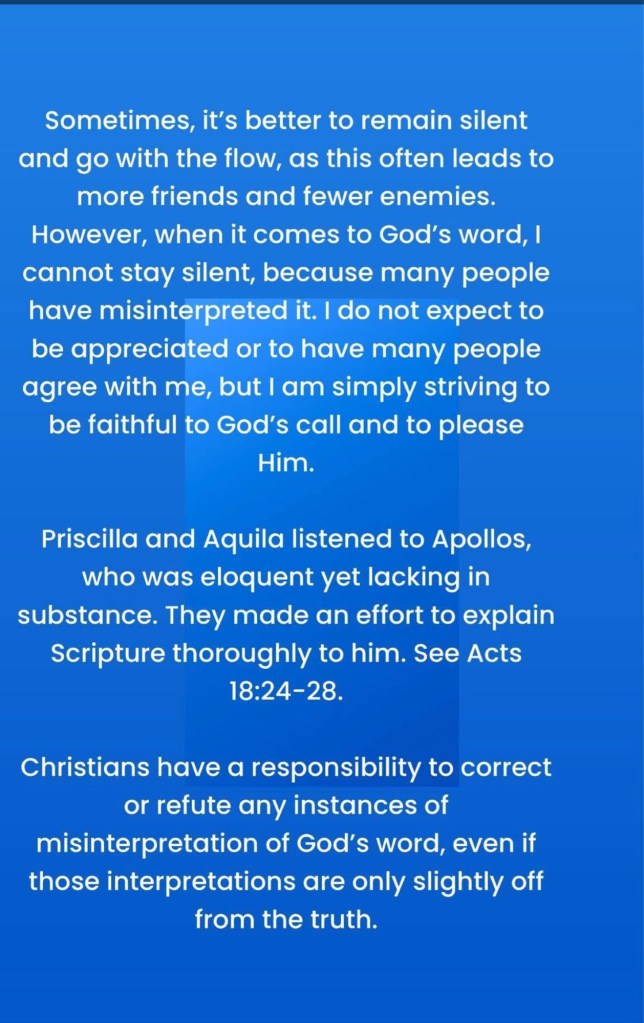
With utmost humility and confidence in the Lord, I share that my understanding of the Scripture has grown. By God’s grace, I have found the courage to teach and explain it in my Bible study groups. If I were solely concerned with gaining acceptance and personal benefits, would I risk challenging the prevailing popular beliefs? However, driven by concern for my own salvation and the hope of reuniting with my departed son, I could not remain silent and continue adhering to conventional Bible teachings. Recognizing that my ultimate reward lies with the Lord Jesus Christ, I have chosen to openly share the Word to honor God and out of love for His church. Ultimately, God alone is the ultimate arbiter of truth, as revealed in His sacred Bible.
Keep in mind that back in the days of Jesus Christ and the early church, the Sanhedrin, the Jewish religious order, was the recognized authority of Scripture. However, they led the people astray. Therefore, titles alone do not signify authority in conveying the truthful teachings of God’s word; correct exposition does. Hence, Paul emphasized, “Do your utmost to present yourself to God as one approved, a worker who has no need to be ashamed, rightly handling the word of truth.” (2 Timothy 2:15) Didn’t Paul uphold the doctrines of the Bible?
Peter , in the words of Acts 3:6, declared, “I possess neither silver nor gold, but in the name of Jesus Christ, I offer you what I have.” Share freely, for you freely receive. Stay updated by heading to our about page and subscribe directly to receive notifications in your inbox. Blessing!
Since June is an occasion for fathers, I am writing this letter to call on the attention of Christian fathers. Many Christian fathers are unable to minister to their families these days, perpetuating a cycle of decline. Since most Christian churches grow through birth rather than evangelism, it’s no surprise that we’re witnessing a decline in Christian leadership over time. To address this present dilemma, we must train the next generation in biblical interpretation. We should teach them how to properly explain Scripture, as people have been prioritizing communication skills over faithfulness to the content. Consequently, we see Christians adopting diverse and peculiar doctrines.
However, since the deterioration in doctrine has been occurring for decades, if not centuries, defective doctrines have become the norm. Consequently, truthful biblical teaching has become indistinguishable to most Christians.
The sanctity of the church hinges on two key aspects: right doctrine and Christian living, and these two aspects are intrinsically linked. How can we discern true Christian living if our doctrines are flawed? How can the church remain unified if each individual has their own interpretation of the church or its doctrine? Remember that Paul emphasized that true Christian unity rests on its doctrine. See Scripture below:
“As a prisoner for the Lord, I urge you to walk in a manner befitting your calling. Be humble and gentle, patient, and loving towards one another. Let us strive to maintain the unity of the Spirit in the bond of peace. We are one body and one Spirit, just as you were called to the ONE hope that belongs to your calling. We have ONE Lord, ONE faith, ONE baptism, ONE God and Father of all, who is over all, through all, and in all.
Grace has been given to each of us according to the measure of Christ’s gift. Therefore, it says, “When He ascended on high, He led a host of captives and gave gifts to men.” (In saying “He ascended,” what does it mean but that He also descended into the lower regions, the earth? He who descended is the one who also ascended far above all the heavens, so that He might fill all things.)
He gave the apostles, the prophets, the evangelists, the pastors, and the teachers to EQUIP the saints for the work of ministry and to BUILD UP the body of Christ, the church. Until we all attain to the UNITY OF FAITH (i.e. beliefs or doctrines) and knowledge of the Son of God, we will mature into men, reaching the measure of the fullness of Christ. Then we will no longer be children, tossed to and fro by the waves and carried about by every wind of doctrine, human cunning, and deceitful schemes.” Rather than SPEAKING THE TRUTH IN LOVE, we are to grow up in every way into Christ, the head of the church, from whom the whole body (i.e. the church), joined and held together by every joint, when each part works properly, makes the body grow so that it builds itself up in love. (Ephesians 4:1-16)
Love, as defined in Scripture, encompasses, rather centers on, right doctrines. So, why has the church chosen to prioritize protecting its aesthetics over its inner self or constitution (i.e., its doctrines)? Until when will Christians continue to be pretentious, claiming that everything is well with the church?
Lies, deceptions, or prosthetics can only keep those who are indifferent, naive in Scripture, or fatally attached due to relational bonds, but not the thinking, intellectually inclined, and truth-seeking Christians. Are you truly not aware of the reasons behind the church’s failures? The church has long ceased to effectively fulfill its mandate from Christ.
If you claim ignorance, then you don’t deserve to lead the church (1Timothy 3:1-13; Titus 1:5-9) . However, if you are aware of the situation, your silence and indifference are harming God’s church. Let me remind everyone of Paul’s words: “If anyone destroys God’s temple (i.e., the church), God will destroy him. For God’s temple is holy, and you are that temple.” (1 Corinthians 3:17)
Each Christian is obligated to uphold the sanctity of God’s church, particularly ministers, pastors, elders, deacons, and those who claim to be reverends.
Quoting Paul’s words: “For I wrote to you out of much affliction and anguish of heart and with many tears, not to cause you pain but to let you know the abundant love that I have for you.” (2 Corinthians 2:4)
As the saying goes, “Sharing is caring.” Let’s consider this article in the context of loving and caring for God’s church.
Peter , in the words of Acts 3:6, declared, “I possess neither silver nor gold, but in the name of Jesus Christ, I offer you what I have.” Share freely, for you freely receive. Stay updated by heading to our about page and subscribe directly to receive notifications in your inbox. Blessing!
Peter, in the words of Acts 3:6, declared, “I possess neither silver nor gold, but in the name of Jesus Christ, I offer you what I have.” Share freely, for you freely receive. Stay updated by heading to our about page and subscribe directly to receive notifications in your inbox. Blessing!










 Unlearning Tradition, Relearning Scripture