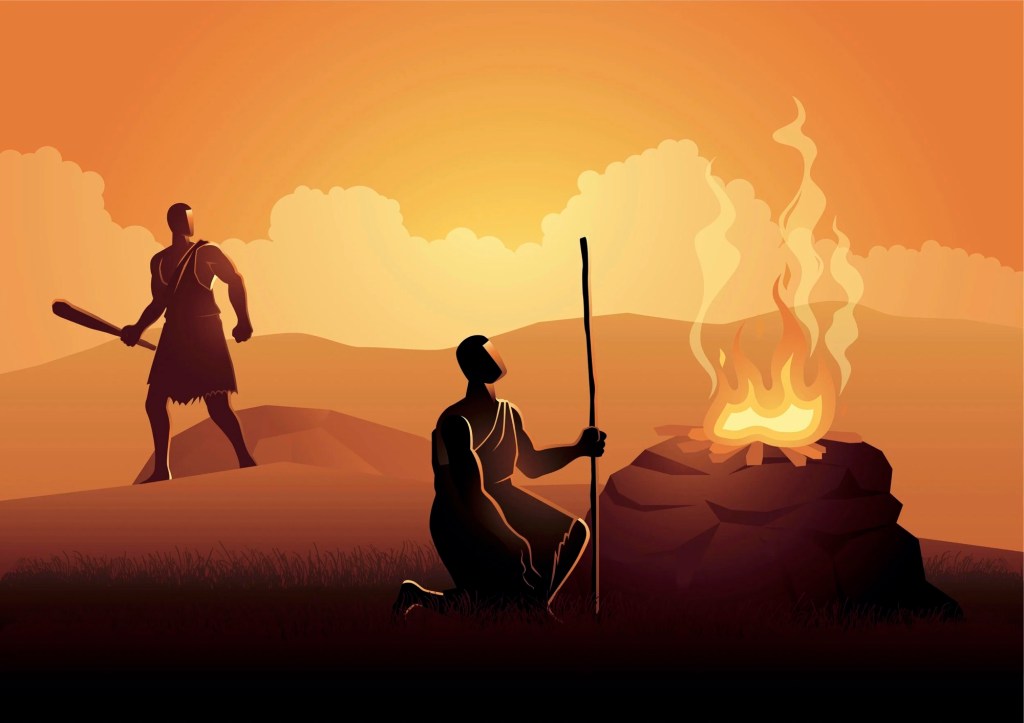
Reflecting on God’s desire for us who claim to follow Jesus Christ, let us consider the story of Cain and Abel as a case study. Why was Abel’s offering acceptable to God, while Cain’s was not?
Abel’s offering pleased God because it reflected a heart that honored Him first. In Genesis 4:3-7, we see that Abel offered the firstborn of his flock, signifying that he gave first to God. Cain, on the other hand, “in the course of time” offered some of the produce of the ground, but not the first fruits, indicating a lack of priority or wholehearted devotion.
Some interpret Abel’s offering as acceptable because it resembled the later Mosaic Law requirement to offer the fat portions to the Lord (Leviticus 3:16). However, the Law was established long after Cain and Abel, so their actions were not legally obligatory. Instead, God’s demand for the fat portions of all animal offerings reflected Abel’s genuine heart of giving to God first, not the other way around.
See God’s response to Cain—“If you do well, will you not be accepted?”—reveals that the real issue was the heart and attitude behind the offering. The act of giving must come from a place of surrender and prioritizing God above all.
This principle is echoed throughout Scripture. The story of Elijah and the widow shows the same heart condition: the widow gave the first portion of her last meal to God’s servant, demonstrating trust and putting God first. As a result, she and her son were sustained throughout the famine. (1 Kings 17:8-16)
Similarly, Paul commended the Macedonians in 2 Corinthians 8:1-6 because they gave themselves first to the Lord before giving their material support, even in extreme poverty. Their offering was accepted because it flowed from a surrendered heart.
The lesson is clear: God delights in offerings given with a heart that honors Him first. Gifts that are leftovers or given without full surrender do not please Him. True worship and acceptable giving are rooted in putting God above all else, both in life, in our ministry for God, and in offerings.
Consequently, Paul quoted Jesus saying, “It is more blessed to give than to receive (Acts 20:35),” a statement Jesus spoke before sending out His disciples. For us who serve the Lord Jesus Christ, this means we are called to share the Gospel without seeking payment. Yet, in the same context, the Lord also said, “The laborer deserves his food.” (Matthew 10:8-10) This reminds us that those who labor in the Word of God, as well as those who support them, should do so willingly and freely, without compulsion. In doing this, we reflect the heart of Abel, who offered the first and best of what he had to God, giving with a heart of faith and devotion.
Peter, in the words of Acts 3:6, declared, “I possess neither silver nor gold, but in the name of Jesus Christ, I offer you what I have.” Share this article freely, for you freely receive. Take note, underlines and highlights are clickable links for definitions or Bible references. Stay updated by heading to our about page and subscribe directly to receive notifications in your inbox. Blessings!
I’ve come to realize that many pastors are hesitant to discuss money because they’ve been taught and told not to speak on the topic. However, Paul addressed this issue on several occasions. Are pastors inferior to an apostle? Paul made it clear in Ephesians that both are mandated by Christ Jesus for His ministry. (Ephesians 4:11-14) While I understand that some people assume the role of a pastor but lack the necessary skills or love for God’s ministry. Some view the ministry not as a calling but as a profession, even worse, as an opportunity to gain wealth. (1 Timothy 6:3-5)
No wonder Paul said, “For we are not, like so many, peddlers of God’s word, but as men of sincerity, commissioned by God, in the sight of God we speak in Christ.” (2 Corinthians 2:17) This article applies only to the latter group: people who are genuinely committed to doing God’s work.
Here’s the silent truth: Pastors are even ridiculed when people discover that someone has been supporting them, despite the clear biblical teaching that it’s the right of the pastor to receive support.
For example, Paul said, “In the same way, the Lord commanded that those who proclaim the Gospel should get their living by the Gospel.” (1 Corinthians 9:14) It’s the right of pastors to receive their living from the Gospel, because it’s commanded by Jesus Christ (Luke 10:2-8).
Paul also said, “Let the one who is taught the word share all good things with the one who teaches.” (Galatians 6:6) This clearly teaches that the giving and receiving of ministry support is directly between the teacher and the learner.
Furthermore, Jesus instructed His disciples, “The harvest is abundant, but the laborers are few. Go your way; behold, I am sending you out as lambs in the midst of wolves. Carry no moneybag, no knapsack, no sandals, and greet no one on the road. Whenever you enter a house, first say, ‘Peace be to this house!’ If a son of peace is there, your peace will rest upon him. But if not, it will return to you. Stay in the same house, eating and drinking what they provide, for the laborer deserves his wages. Do not go from house to house.” (Luke 10:2-7)
Despite these clear teachings, God’s workers often face little support and are subjected to ridicule and accusations of wrongdoing. Paul himself expressed his frustration, stating, “Did I commit a sin in humbling myself so that you might be exalted? Because I preached God’s Gospel to you without charge? I robbed other churches by accepting support from them in order to serve you. And when I was with you and in need, I did not burden anyone. The brothers who came from Macedonia supplied my need. So I refrained and will refrain from burdening you in any way.” (2 Corinthians 11:7-9)
The Corinthian church was biblically obligated to actively support Paul’s ministry in their midst. Scripture emphasizes the responsibility of believers to help God’s workers, declaring, “Therefore, we ought to support God’s workers like these, so that we may be fellow workers for the truth.” (3 John 1:8)
Despite this clear mandate, Paul did not receive the support that was rightfully due him from the Corinthians. Instead, he endured their criticisms. In response, he wrote:
“I am here for the third time, ready to come to you. I will not be a burden because I seek not what is yours but you. Children are not obligated to save for their parents, but parents for their children. I will gladly spend and be spent for your souls. If I love you more, am I to be loved less? But since I did not burden you, you say, I was crafty and got the better of you by deceit.” (2 Corinthians 12:14‑16)
Paul’s words reveal his profound love for the Corinthians and his willingness to sacrifice for their spiritual growth, even without receiving the support that was biblically warranted. This passage serves as a reminder to recognize, honor, and assist those who faithfully labor in God’s work, fulfilling the partnership that Scripture envisions between God’s servants and His people.
God designed it that way. Both God’s workers and Christians who support them are considered workers in the Gospel. (3 John 1:8) God intended it to be a partnership. Therefore, Paul expressed his gratitude to the Philippians, saying, “I thank my God in all my remembrance of you, always in every prayer of mine for you all, making my prayer with joy, because of your partnership in the Gospel from the first day until now.” (Philippians 1:3-5) The Macedonians and the Philippians are essentially the same people. Paul revealed that they are his sole supporters, stating, “And you Philippians yourselves know that in the beginning of the gospel, when I left Macedonia, no church entered into partnership with me in giving and receiving, except you only.” (Philippians 4:15)
John teaches that those who prevent people from directly supporting God’s workers are considered evildoers. (3 John 1:9-11)
Demetrius, who welcomes and supports God’s workers, contrasts sharply with Diotrephes, who refuses and hinders others from doing the same. It is crucial to discern who you listen to and follow.
Shame on you, Diotrephes! You are wrongfully accusing God’s workers of wrongdoing by denying them support and hindering others from doing so. Let’s not be deceived by the cunning and deceitful reasoning of some people who exploit your ignorance of Bible teachings. Regrettably, some have accused God’s workers of wrongdoing while neglecting accountability in their own collections of donations from God’s people.
I am simply stating the truth. I have received an unusual call from God. My mission is to study the Bible, explain its teachings clearly and without restraint, and share them with others. God’s people should not be offended by God’s Word. If you have any doubts, I encourage or even challenge you to study the Bible thoroughly. Discover for yourself the authentic teachings of the Scriptures.
P.S. This is a follow through to my previous posting “Supporting Christian Workers: A Biblical Approach”
Peter, in the words of Acts 3:6, declared, “I possess neither silver nor gold, but in the name of Jesus Christ, I offer you what I have.” Share this article freely, for you freely receive. Take note, underlines and highlights are clickable links for definitions or Bible references. Stay updated by heading to our about page and subscribe directly to receive notifications in your inbox. Blessings!
In the last 2000 years, the world remained as chaotic as before. Perhaps it’s true that with the advancement of medicine, technology, and civil society, living standards today are far better than the barbaric days of humanity. Yet, a quick look at world events would tell us it isn’t so. In the West, people have been shot dead by random shooters. In some other parts of the world, dictators continue to reign over its people. Hunger remains to be a problem all over the world and many more issues. With that, we Christians are left grasping for answers because many times we have been asked, “When would God rectify the wrongs in the world?”
God had done His part by sending His Son Jesus Christ to redeem people from the fall of humanity. Yes, I’m referring to Genesis 3, the fall of Adam and Eve. Jesus Christ came proclaiming, “Repent, for the kingdom of heaven is at hand (Matthew 4:17).” It is sad though that most of present-day Christianity fails to see the reality of Christ’s pronouncement. Consequently, they also fail to communicate the true reality of God’s Word. See Revelation 11:15.
“Then the seventh angel blew his trumpet, and there were loud voices in heaven, saying, “The kingdom of the world has become the kingdom of our Lord and of His Christ, and He shall reign forever and ever.””
The Book of Revelation was prophetic, not historical. It was written before the fall of Jerusalem in 70 A.D. Contrary to the popular view it was sometime in 90 A.D. Click and read my blog on “Dating of Revelation”. Notice that I present it in the past tense because the prophecy of Revelation 11 has been fulfilled. Revelation cannot be a historical narrative simply because it’s an “apokalupsis” (Greek for revelation). It’s a disclosure or unveiling of events to come in John’s time. See Revelation 1:9-10.
“I, John, your brother and partner in the tribulation and the kingdom and the patient endurance that are in Jesus, was on the island called Patmos on account of the word of God and the testimony of Jesus. I was in the Spirit on the Lord’s day, and I heard behind me a loud voice like a trumpet”
Next, see Revelation 1:19. “Write therefore the things that you have seen, those that are and those that are to take place after this.”
Take note that in Revelation 1:19, John was told the things that he was to see would take place after Christ’s revelation. In other words, it’s happening soon – soon to John, not to us living millennia after the writing of Revelation.
See further Christ’s warning regarding the time and any attempt to alter His word. See Revelation 22:16-20.
““I, Jesus, have sent My angel to testify to you (John) about these things for the churches. I am the root and the descendant of David, the bright morning star.” The Spirit and the Bride say, “Come.” And let the one who hears say, “Come.” And let the one who is thirsty come; let the one who desires take the water of life without price. I warn everyone who hears the words of the prophecy of this book: if anyone adds to them, God will add to him the plagues described in this book, and if anyone takes away from the words of the book of this prophecy, God will take away his share in the tree of life and in the holy city, which are described in this book. He who testifies to these things says, “Surely I am coming soon.” Amen. Come, Lord Jesus!”
Now, what is the context of Revelation 11:15? It speaks of the judgment against Old Covenant Jewish Temple, see Revelation 11:1-2.
“Then I was given a measuring rod like a staff, and I was told, “Rise and measure the temple of God and the altar and those who worship there, but do not measure the court outside the temple; leave that out, for it is given over to the nations, and they will trample the holy city for forty-two months.”
So John foresaw the fulfillment of Jesus Christ’s words against Old Covenant Israel, see Luke 21:20-27.
““But when you see Jerusalem surrounded by armies, then know that its desolation has come near. Then let those who are in Judea flee to the mountains, and let those who are inside the city depart, and let not those who are out in the country enter it, for these are days of vengeance, to fulfill all that is written. Alas for women who are pregnant and for those who are nursing infants in those days! For there will be great distress upon the earth (in the Greek, it could alternately be translated as “land”) and wrath against this people. They will fall by the edge of the sword and be led captive among all nations, and Jerusalem will be trampled underfoot by the Gentiles, until the times of the Gentiles are fulfilled. “And there will be signs in sun and moon and stars, and on the earth distress of nations in perplexity because of the roaring of the sea and the waves, people fainting with fear and with foreboding of what is coming on the world. For the powers of the heavens will be shaken. And then they will see the Son of Man coming in a cloud with power and great glory.”
What was the sin of Old Covenant Israel? They rejected the Lord Jesus Christ and killed His prophets and apostles. But how do we know Revelation 11 was about Old Covenant Israel? First, the introduction of chapter eleven spoke clearly of the destruction, (i.e., trample) of the Jewish Temple. Then, in verses 7 and 8, the murderers of God’s witnesses were inhabitants of the “great city” where Jesus Christ was crucified – so that’s none other but Jerusalem.
The “times of the Gentiles” pertain to the four Gentile empires ruling over Israel as prophesied and made clear in the Book of Daniel. Daniel identified the first three empires as Babylon, Mede Persia, and Greece (Daniel 2 & 8). John, on the other hand, prophesied about the events happening in the fourth and last Gentile empire ruling over Jerusalem, and that’s Rome (Revelation 13 &17).
The kingdom of the world of Revelation 11:15 pertains to the Old Covenant Jewish world, while the kingdom of our Lord and His Christ though spiritual is real and everlasting. Years before the fall of Old Covenant Jerusalem, the apostle Paul declared, “From now on, therefore, we regard no one according to the flesh. Even though we once regarded Christ according to the flesh, we regard Him thus no longer. Therefore, if anyone is in Christ, he is a new creation. The old has passed away; behold, the new has come.” (2 Corinthians 5:16-17)
God never neglects on His word and promises. Many like to suggest that Jesus Christ is yet to return fulfilling His word and promise. God forbid, but by their claim, they have made Jesus Christ to be a liar, not true to His word. For as long as our present world rejects Jesus Christ as Lord and Savior, then it will always be chaotic because it is ruled by man, not God. Christians, on the other hand, should keep in mind that our citizenship is with heaven (Philippians 3:20). So indeed, we ought to walk by faith, not by sight (2Co. 5:7). We are troubled by the things around us, so we fail to see the reality that God is indeed with us.
Learn to see beyond the thorns then we will see the beauty of the Rose. That’s the reality of our Christian walk. The psalm below, written by David, is a Messianic Psalm. Memorized this psalm cause that’s the reality of living under Christ’s New Covenant.
“A Psalm of David. The LORD is my Shepherd; I shall not want. He makes me lie down in green pastures. He leads me beside still waters. He restores my soul. He leads me in paths of righteousness for His name’s sake. Even though I walk through the valley of the shadow of death, I will fear no evil, for You are with me; Your rod and your staff, they comfort me. You prepare a table before me in the presence of my enemies; You anoint my head with oil; my cup overflows. Surely goodness and mercy shall follow me all the days of my life, and I shall dwell in the house of the LORD forever.” (Psalms 23:1-6)
Blessings!
If you want to follow our journey of unlearning tradition and relearning Scripture, you can stay updated just head to our about page and subscribe directly to receive notifications in your inbox. Subscription is free.