
Tag: Second Coming

  • Scripture vs. Assertion: The Truth About the Second Coming

    Photo taken from a FB posting of Emily Madrigal

    Franklin Graham is the son of the celebrated evangelist Billy Graham, who gained prominence in the late 40s and was credited with a resurgence of Christianity during the 1960s and 1970s. Following in his father’s footsteps, Franklin has become a prominent religious figure in his own right, often speaking on contemporary issues.

    Ironically, Franklin Graham’s assertion regarding the imminent arrival of Jesus Christ is inaccurate. People tend to accept and believe what they are told rather than what the Bible states. John lived during the era of Revelation. Scripture notes in Revelation 1:9, “I, John, your brother and partner in the tribulation and the kingdom and the patient endurance that are in Jesus, was on the island called Patmos on account of the word of God and the testimony of Jesus.”

    John was evidently living during the period of tribulation described by Jesus in Matthew 24:9–22. Jesus spoke of only one tribulation, and He never said it would be stretched to today.

    Jesus stated in Revelation 1:19, “Write therefore the things that you have seen, those that are and those that are to take place after this.” John was directed to record what was shown to him; know that the Greek tense in the whole statement is consistently present.

    Here is the verse with its tenses: “Write therefore the things that you have seen (TVM 5748, Present, Indicative), those that are (TVM 5719, Present, Active, Indicative) and those that are to take place (TVM 5738, Present, Passive, Infinite) after this.” This suggests that the events John observed occurred within his lifetime—his present and future, not ours.

    John’s visions therefore act as immediate warnings to the recipient churches. Consequently, Jesus declares in all of His letters with the phrase: “He who has an ear, let him hear what the Spirit says to the churches.”

    In one church, Jesus offers assurance:“I am coming soon. Hold fast what you have, so that no one may seize your crown.” (Revelation 3:11)

    Jesus warns about false prophets, stating, “For false christs and false prophets will arise and perform great signs and wonders, so as to lead astray, if possible, even the elect. See, I have told you beforehand. So, if they say to you, ‘Look, he is in the wilderness,’ do not go out. If they say, ‘Look, he is in the inner rooms,’ do not believe it.” (Matthew 24:24–26)

    Do you grasp the warning of Jesus Christ? Be cautious of those who say “look,” which suggests claims about his physical and visible arrival.

    This confusion often stems from a misunderstanding of Acts 1:11, where the angels state, “Men of Galilee, why do you stand looking into heaven? This Jesus, who was taken up from you into heaven, will come in the same way as you saw him go into heaven.”

    The passage didn’t say Jesus would return in physical form. Let’s let Scripture speak on this matter, 1 Timothy 3:16 states, “Great indeed, we confess, is the mystery of godliness: Jesus was manifested in the flesh, vindicated by the Spirit, seen by angels, proclaimed among the nations, believed on in the world, TAKEN UP IN GLORY.

    Acts 1:9 says, Jesus was taken up in a cloud. That’s the expression of glory, like in Exodus, God appears to Israel in the pillar of cloud by day, and pillar of fire by night (Exodus 13:21-22).

    In Exodus 19:9, “The LORD said to Moses, ‘Behold, I am coming to you in a thick cloud, that the people may hear when I speak with you, and may also believe you forever.” Scripture made clear Israel may only hear but not see.

    In Exodus 34:5–8, the text describes the LORD descending in the cloud and passing before Moses, prompting worship; however, Scripture does not indicate that God was visible to him.

    At Damascus, when Jesus appeared to Saul—later called Paul—the biblical record indicates that Saul and his companions heard only a voice; no one saw Jesus, because at His ascension, carried away by the cloud, He had returned to His glory (Acts 9:1–7).

    This same expression of glory is what is meant in Luke 21:27, “And then they will see the Son of Man coming in a cloud with power and great glory.”

    Now compare the next verse, Matthew 24:27, with Zechariah 9:14: “Then the LORD will appear over them, and His arrow will go forth like lightning; the Lord GOD will sound the trumpet and will march forth in the whirlwinds of the south.”

    Was Jesus not quoting Zechariah 9:14 regarding His return? “For as the lightning comes from the east and shines as far as the west, so will be the coming of the Son of Man.” (Matthew 24:27)

    Keep in mind the context of Zechariah 9, it’s about the coming of the King riding on a colt or donkey (Zechariah 9:9). This was fulfilled by Jesus’ Triumphant Entry to Jerusalem (Matthew 21:1-5).

    Now, see Jesus’ teaching on the Wedding Feast:

    Matthew 22:2-10 “The kingdom of heaven may be compared to a King who gave a wedding feast for His Son, and sent His servants to call those who were invited to the wedding feast, but they would not come. Again He sent other servants, saying, ‘Tell those who are invited, “See, I have prepared My dinner, My oxen and My fat calves have been slaughtered, and everything is ready. Come to the wedding feast.”’ But they paid no attention and went off, one to his farm, another to his business, while the rest seized His servants, treated them shamefully, and killed them. The King was angry, and He sent His troops and destroyed those murderers and burned their city. Then He said to His servants, ‘The wedding feast is ready, but those invited were not worthy. Go therefore to the main roads and invite to the wedding feast as many as you find.’ And those servants went out into the roads and gathered all whom they found, both bad and good. So the wedding hall was filled with guests.

    Jesus Christ is the Son who was crucified by the Jewish Religious Leaders. They rejected His reign, but the wedding feast went on. Their rejection didn’t stop the kingdom of heaven from advancing, as supposed by contemporary teachings and beliefs.

    This advancement involves both the gathering of the faithful and the judgment of those who oppose it, a theme that continues in Jesus’ later warnings. Look at the verses following Jesus’ warning about false prophets (Matthew 24:24–26), Matthew 24:27–28: “For as the lightning comes out of the east and shines even to the west, so also will be the coming of the Son of Man. For wherever the carcass is, there the eagles will be gathered.”

    Matthew 24:28 echoes Deuteronomy 28:49: “The LORD will bring a nation against you from far away, from the end of the earth, swooping down like the eagle, a nation whose language you do not understand.”

    Matthew 24:28’s vultures should be rendered “eagles, G105.” The foreign nation—linked biblically to Matthew 22:7 and historically to Rome—descended like the eagle upon Old Covenant Israel, ending the Jewish rebellion and burning the temple in 70 AD.

    This judgment on Jerusalem sets the stage for understanding the timeline of Jesus’ return. Jesus in Matthew 23:36-38 states:

    “Truly, I say to you, all these things will come upon this generation. O Jerusalem, Jerusalem… See, your house is left to you desolate.” (Matthew 23:36-38)

    Ironically, nobody seems to take seriously Jesus’ words in John 21. The passage focused on the restoration of Peter. Peter learned from Jesus about his martyr death for the Gospel. He then asked Jesus about John. Jesus replied, “If it is My will that John remain until I come, what is that to you? You follow Me!” (John 21:22)

    Scripture made clear that Jesus didn’t say John wouldn’t die, but that he would still be alive when Jesus comes (John 21:23). This aligns perfectly with what Jesus tells His apostles about His return.

    “Truly, I say to you, there are some standing here who will not taste death until they see the Son of Man coming in his kingdom.” (Matthew 16:28) Mark 9:1 and Luke 9:27 reflect the same point.

    Peter, Paul, and James, writing to their contemporary Christians, say, “The Lord is at hand” (1 Peter 1:13; Philippians 4:5; James 5:7-8) They all understood the coming of Jesus to be at hand, or in their era, not in our future, as many pastors and preachers propose today.

    The Bible is not overly difficult to understand. Yet we must study from the Scriptures rather than human writings, or their mistakes may become ours. That is why I encourage focusing on the Scriptures rather than relying on Bible commentaries, creeds, and confessions.

    Studying the Bible resembles assembling a jigsaw puzzle. If a piece is misplaced or lost, finishing the narrative or image becomes impossible. This challenge faces modern Christianity, producing conflicting interpretations of the Scriptures.

    A careful review of the Reformers’ writings—such as John Gill’s commentary from a Reformed viewpoint—shows they viewed themselves as the elect of the last days and the pope and Roman Catholic Church as the beast. This approach reflects eisegesis rather than exegesis of the Bible. Eisegesis contrasts with exegesis because it involves projecting a pre-existing belief system onto the Scriptures. By contrast, exegesis lets the Scriptures guide us toward biblical truths.

    Paul instructed us pastors, “Do your best to present yourself to God as one approved, a worker who has no need to be ashamed, rightly handling the word of truth.” (2 Timothy 2:15)

    Again, Paul warned, “Keep a close watch on yourself and on the teaching. Persist in this, for by so doing you will save both yourself and your hearers.” (1 Timothy 4:16)

    We who teach the Bible are accountable for what we teach. James warned, “Not many of you should become teachers, my brothers, for you know that we who teach will be judged with greater strictness.” (James 3:1)

    Teach only what you have personally studied and learned from the Scriptures. Jesus is the Word; hence, only then may we truly learn from the Bible.

    In the course of my journey teaching the Bible, I decided to learn and teach only from the Bible. I then saw the inconsistencies of contemporary Christian teachings and beliefs. With this foundation, I was led to a new resolve: to let the Scriptures speak for themselves.

    I share my insights with my family first, then with my current Bible studies and beyond. Is it simple? Not really, since Paul warned that “People will not endure sound teaching, but having itching ears they will accumulate for themselves teachers to suit their own passions.” (2 Timothy 4:3).

    As the Chinese proverb suggests, “It takes three days to learn mistakes, but three years to learn good virtues.” Regrettably, the biblical warning holds: “Do not be deceived: ‘Bad company ruins good morals.’” (1 Corinthians 15:33)

    People often follow the crowd, seeking comfort in numbers rather than truth. Yet Scripture commends the Bereans, who received the word with eagerness and examined the Scriptures daily to confirm its truth (Acts 17:11). Many forget the very teachings of Jesus:

    > “Enter by the narrow gate. For the gate is wide and the way is easy that leads to destruction, and those who enter by it are many. For the gate is narrow and the way is hard that leads to life, and those who find it are few.” (Matthew 7:13-14)

    True discipleship calls for careful study of God’s Word and a commitment to follow Christ, even when the path is difficult and unpopular. The majority may choose the wide road, but life is found only in the narrow way through Jesus Christ.

    > “I am the way, and the truth, and the life. No one comes to the Father except through me.” (John 14:6)

    The truth is: People ought to seek the salvation of Jesus Christ. The church, on the other hand, must return to the true teachings of the Bible. Preaching and sharing the Gospel is a mandate to us Christians. The Bible states:

    “Then I saw another angel flying directly overhead, with an Eternal Gospel to proclaim to those who dwell on earth, to every nation and tribe and language and people.” (Revelation 14:6)

    Eternity is with Jesus Christ. He desires everyone to be saved and have an abundant life (John 10:10). Abundant means to be rich towards God, see Luke 12:13-21. Jesus told us not to worry about our day-to-day needs, nor tomorrow. But to seek His kingdom and all these things will be added to us. (Luke 12:22-31)

    The “last days” are a thing of the past; they belong to Old Covenant Israel. We are living past that period, Scripture states, “Therefore, if anyone is in Christ, he is a new creation. The old has passed away; behold, the new has come.” (2 Corinthians 5:17)

    With the New Creation, the age of grace—eternal because the Gospel is eternal—requires only that we live and believe in Jesus Christ. The world’s clamor is merely temporary. Like any other event, it will soon pass.

    So, believe the Gospel. Live for Jesus Christ. Share His Word. This is our joyful calling, Jesus states, “faith begins like a mustard seed, which is small,” but if we nurture our faith, it will grow and carry people into His grace.

    In Matthew 17:20, “Jesus said to His disciples, ‘Because of your little faith. For truly, I say to you, if you have faith like a grain of mustard seed, you will say to this mountain, ‘Move from here to there,’ and it will move, and nothing will be impossible for you.’”

    Take note that Jesus uttered the same promise in Luke 18:27, “What is impossible with man is possible with God.” The context of which is leading someone into His grace, the salvation in Jesus Christ.

    Jesus Christ came, and we are now in the era of grace, His New Covenant. There are a lot of people still living outside His grace; let’s not be bothered by all the noises, but realize that the noises provide an opportunity for us to tell people about Jesus Christ and His grace. But be careful not to engage in scare tactics that coerce people into confessing their faith. That kind of evangelism is never the way of Jesus, His apostles, or the Scriptures.

    P.S. Anyone interested in the topic here might also look at earlier work on comparable or related themes: “Rethinking the Church: A Call to Biblical Priorities”; “Take Heart! Jesus said, ‘I Have Overcome the World’”; “Sharing Insights from Scripture (Temple & Sabbath)”; “It’s a Matter of the Heart”; “Not by Water but by Fire”; “A War Based on a Lie”; “It Is Done! (Revelation 21:6)”; “Great Power comes with Great Responsibility”; “Is Hebrews 10:25 Truly about Sunday Gatherings of Christians?”; “Confusion Is Not Of God”; “Was Salvation Completed at the Cross?”; “Are there Minor and Major Doctrines in the Bible”; “Does God Elect People to Salvation?”; “The Gospel Heralds God’s Kingdom and the Time of the End”; “End Times Brouhaha”; “Parousia Myths”; “Hallucinations of a Rapture”; “Delusions of Rebuilding the Temple”; “Confused Christianity”; “Oops! They Did It Again”; “Utopia”; “The Unending Last Days”; “Dating the Book of Revelation”; “The Eternal Gospel”; “The Eschatological Divide”; “The Runaway Bridegroom”; “Scripture vs. Tradition”; and many more.

    Peter, in the words of Acts 3:6, declared, “I possess neither silver nor gold, but in the name of Jesus Christ, I offer you what I have.” Share this article freely, for you freely receive. Take note, underlines and highlights are clickable links for definitions or Bible references. Stay updated by heading to our about page and subscribe directly to receive notifications in your inbox. Blessings!


  • Change for the Better

    As I study the Bible, I realized Christians have misunderstood the doctrine of “election” as the selective picking and choosing act of God, rather than God’s mercy and grace. Let us take a look at Paul’s words in Romans regarding the fate of Old Covenant Israel.

    “But it is not as though the word of God has failed. For not all who are descended from Israel belong to Israel, and not all are children of Abraham because they are his offspring, but ‘Through Isaac shall your offspring be named.’ This means that it is not the children of the flesh who are the children of God, but the children of the promise are counted as offspring. For this is what the promise said: ‘About this time next year I will return, and Sarah shall have a son.’ And not only so, but also when Rebekah had conceived children by one man, our forefather Isaac, though they were not yet born and had done nothing either good or bad—in order that God’s purpose of election might continue, not because of works but because of him who calls— she was told, ‘The older will serve the younger.’ As it is written, ‘Jacob I loved, but Esau I hated.’ What shall we say then? Is there injustice on God’s part? By no means! For He says to Moses, ‘I will have mercy on whom I have mercy, and I will have compassion on whom I have compassion.’ So then it depends not on human will or exertion, but on God, who has mercy.” (Romans 9:6-18)

    Paul’s quotation from Exodus 33:19, “I will have mercy on whom I have mercy, and I will have compassion on whom I have compassion (Romans 9:15),” provides context for explaining God’s election. The Old Testament stories serve as narratives that illustrate God’s redemptive works. Recall that Israel was destined for destruction at Mount Sinai, and God’s presence should no longer be with them (Exodus 32:30-33:3). However, upon Moses’ pleas, God extended grace and mercy to Israel through His election. See Paul’s confirmation on Romans 9:16, “So then it depends not on human will or exertion, but on God, who has mercy.”

    The doctrine of election has caused considerable division, confusion, and arrogance among its followers. However, election was an act of God’s mercy and grace, not a selective process of choosing individuals for salvation, as it has been misinterpreted in modern Christianity. How did God’s mercy manifest in Old Covenant Israel?

    Paul asserts, “For Christ is the end of the (i.e., Mosaic) law for righteousness to everyone (i.e., both Jew and Gentile) who believes.” (Romans 10:4) In Galatians, Paul further explains, “So then, the law was our (i.e., Israel’s) guardian until Christ came, in order that we might be justified by faith.” (Galatians 3:24) Finally, Paul concludes, “Therefore, faith comes from hearing, and hearing through the word of Christ.” (Romans 10:17) So he went on to state, “Their voice has gone out to all the earth, and their words to the ends of the world.” (Romans 10:18)

    The Book of Acts proves the Gospel reached the end of the then-known world of the Jew-the Empire of Rome. Paul was imprisoned in Rome preaching the Gospel to both Jew and Gentile (Acts 28:17-31). Doubtless then, God’s declaration in Acts 1:8 was fulfilled and documented by Luke, bringing to a conclusion, therefore, Christ’s Word concerning the end of Old Covenant Israel. Jesus Christ states:

    “And this gospel of the kingdom will be proclaimed throughout the whole world as a testimony to all nations, and then the end will come. ‘So when you see the abomination of desolation spoken of by the prophet Daniel, standing in the holy place (let the reader understand), then let those who are in Judea flee to the mountains. Let the one who is on the housetop not go down to take what is in his house, and let the one who is in the field not turn back to take his cloak. And alas for women who are pregnant and for those who are nursing infants in those days! Pray that your flight may not be in winter or on a Sabbath. For then there will be great tribulation, such as has not been from the beginning of the world until now, no, and never will be.’” (Matthew 24:14-21)

    If there’s any disagreement with Christ’s declaration and its fulfillment, let the Word of God stand as a witness, not man. Luke, in writing a parallel account of Christ’s declaration, states:

    “But when you see Jerusalem surrounded by armies, then know that its desolation has come near. Then let those who are in Judea flee to the mountains, and let those who are inside the city depart, and let not those who are out in the country enter it, for these are days of vengeance, to fulfill all that is written. Alas for women who are pregnant and for those who are nursing infants in those days! For there will be great distress upon the earth and wrath against this people. They will fall by the edge of the sword and be led captive among all nations, and Jerusalem will be trampled underfoot by the Gentiles, until the times of the Gentiles are fulfilled.” (Luke 21:20-24)

    “Times of the Gentiles” refers to the end of Gentiles lording over God’s people. God told Daniel about this:

    “And in the days of those kings (i.e. fourth kingdom of “iron and clay”, see Daniel 2:40-43) the God of heaven will set up a kingdom that shall never be destroyed, nor shall the kingdom be left to another people. It shall break in pieces all these kingdoms and bring them to an end, and it shall stand forever, just as you saw that a stone was cut from a mountain by no human hand, and that it broke in pieces the iron, the bronze, the clay, the silver, and the gold. A great God has made known to the king what shall be after this. The dream is certain, and its interpretation sure.”” (Daniel 2:44-45)

    Jesus Christ fulfilled Daniel’s prophecy and is the cornerstone upon which the church is built. As stated in Matthew 16:18, “the gates of hades shall not prevail upon it.” John asserts “whoever believes in the Son has eternal life; whoever does not obey the Son shall not see life, but the wrath of God remains on him” (John 3:36).

    Christ Jesus did not come to establish a physical kingdom, but rather a spiritual one. He declared, “God is spirit, and those who worship Him must worship in spirit and truth.” (John 4:24) On another occasion, when the Pharisees inquired about the kingdom of God’s arrival, Jesus responded, “The kingdom of God is not coming in a manner that can be observed, nor will they proclaim, ‘Look here!’ or ‘There!’ for behold, the kingdom of God is already within you.” (Luke 17:20-21) The advent of Jesus, the Christ, signifies the manifestation of God’s kingdom. Initially, it is an “already but not yet” until Jerusalem was destroyed with finality in 70 A.D.

    God’s grace upon Old Covenant Israel was manifested through the Gospel proclamation. Paul’s quotation in Romans 10:15 declaring God’s grace and mercy on everyone who believes the Gospel was cited from Isaiah 52:7, and Nahum 1:15 which says, “How beautiful upon the mountains are the feet of Him who brings good news, who publishes peace, who brings good news of happiness, who publishes salvation, who says to Zion, ‘Your God reigns.’” Same as in Nahum, Isaiah states, “Behold, upon the mountains, the feet of Him who brings good news, who publishes peace! Keep your feasts, O Judah; fulfill your vows, for never again shall the worthless pass through you; he is utterly cut off.”

    In both Old Testament passages, the Scripture refers to Christ—”the feet of Him”—as the bearer of the Gospel. Both Isaiah and Nahum preached of a coming period of grace and mercy in the midst of God’s judgment. Paul’s quotation of Isaiah 52:7 and Nahum 1:15 was changed from “Him” to “those” because the disciples of Jesus—that’s Paul and everyone else who preaches the Gospel—preach nothing else but the Words of Christ Jesus. They are the extension and messengers of the Gospel, for as long as the Gospel was preached precisely according to Christ’s Word. See Isaiah 49:5-6:

    “And now the LORD says, He who formed Me (i.e. Jesus) from the womb to be His servant, to bring Jacob back to Him; and that Israel might be gathered to Him— for I am honored in the eyes of the LORD, and My God has become My strength— He says: “It is too light a thing that You should be My servant to raise up the tribes of Jacob and to bring back the preserved of Israel; I will make you as a light for the nations, that My salvation may reach to the end of the earth.””

    Isaiah obviously was speaking about Jesus Christ, and His Gospel is for everyone, Jew and Gentile alike. After the death, resurrection and ascension of Jesus, Paul and Barnabas applied Isaiah 49:6 to themselves, see Acts 13:46-47:

    “And Paul and Barnabas spoke out boldly, saying, ‘It was necessary that the word of God be spoken first to you (i.e. the Jews). Since you thrust it aside and judge yourselves unworthy of eternal life, behold, we are turning to the Gentiles. For so the Lord has commanded us, saying, “I have made you a light for the Gentiles, that you may bring salvation to the ends of the earth.”‘”

    The same application was done for Paul’s change from “Him” to “those” in his quotation of Isaiah 52:7 and Nahum 1:15.

    Does God still elect people to salvation? Old Covenant Israel has ceased. Hebrews 8:13 states, “In speaking of a new covenant, He makes the first one obsolete. And what is becoming obsolete and growing old is ready to vanish away.” (Hebrews 8:13) Israel today is just like any other person on Earth. They ceased to be God’s people without Christ. Paul states, “From now on, therefore, we regard no one according to the flesh (i.e. circumcision, sign under the Mosaic Covenant). Even though we once regarded Christ according to the flesh, we regard Him thus no longer. Therefore, if anyone is in Christ, he is a new creation. The old has passed away; behold, the new has come.” (2 Corinthians 5:16-17)

    So does God elect people to salvation as it has been taught today? Such teaching simply has no basis in Scripture. Again, Paul asserts, “So faith comes from hearing, and hearing through the word of Christ.” (Romans 10:17) Consequently, Paul states as well, “For by grace you have been saved through faith. And this is not your own doing; it is the gift of God, not a result of works, so that no one may boast.” (Ephesians 2:8-9) The Gospel is the manifestation of God’s grace and mercy to everyone who believes. God does not arbitrarily decree some to salvation and others to damnation.

    I understand that most would find my exposition perplexing. But it is so mainly because we have been convinced to see, understand, and believe Christian teachings in its present form. True Christian doctrines are founded in the teachings of Jesus Christ, not of biblical scholars or renowned pastors or Christian figures. Paul states, “For when one says, ‘I follow Paul,’ and another, ‘I follow Apollos,’ are you not being merely human? What then is Apollos? What is Paul? Servants through whom you believed, as the Lord assigned to each. I planted, Apollos watered, but God gave the growth. So neither he who plants nor he who waters is anything, but only God who gives the growth. He who plants and he who waters are one, and each will receive his wages according to his labor. For we are God’s fellow workers. You are God’s field, God’s building. According to the grace of God given to me, like a skilled master builder I laid a foundation, and someone else is building upon it. Let each one take care how he builds upon it. For no one can lay a foundation other than that which is laid, which is Jesus Christ.” (1 Corinthians 3:4-11)

    I became a Christian and later on a pastor after the tragic passing of my only son. God amazingly turned our brokenness for His glory by turning my family and me to His Gospel. That is the reason I am seriously studying the Bible and willing to change my perspective when it’s contradicted by Scripture’s teachings. Yes, it comes with a cost. Fellow believers who hold to contemporary Christian teachings will ridicule and persecute you. But Christ did say that’s exactly what will happen once you faithfully follow Him. Jesus states, “A disciple is not above His teacher, nor a servant above His master. It is enough for the disciple to be like His teacher, and the servant like His master. If they have called the Master of the house Beelzebul, how much more will they malign those of His household” (Matthew 10:24-25). And we only have one true Teacher, no other than Jesus Christ. Isaiah prophesied His coming, saying:

    “Therefore the LORD waits to be gracious to you, and therefore He exalts Himself to show mercy to you. For the LORD is a God of justice; blessed are all those who wait for Him. For a people shall dwell in Zion, in Jerusalem; you shall weep no more. He will surely be gracious to you at the sound of your cry. As soon as He hears it, He answers you. And though the Lord give you the bread of adversity and the water of affliction, yet your Teacher will not hide Himself anymore, but your eyes shall see your Teacher. And your ears shall hear a word behind you, saying, “This is the way, walk in it,” when you turn to the right or when you turn to the left.” (Isaiah 30:18-21)

    Let us all learn from the Teacher, Jesus Christ, who is the Word (John 1:1, 14-18). During the transfiguration of Jesus Christ, God declares, “This is My beloved Son, with whom I am well pleased; listen to Him.” (Matthew 17:5; Mark 9:7; Luke 9:35) Have you been listening to Jesus or to the traditions of men?

    In conclusion, a change of perspective isn’t inherently negative, provided that the change aligns our faith and beliefs with Scripture. The Bible states:

    “And beginning with Moses and all the Prophets, Jesus interpreted to the disciples in all the Scriptures the things concerning Himself.” (Luke 24:27)

    “All Scripture is breathed out by God and profitable for teaching, for reproof, for correction, and for training in righteousness, that the man of God may be complete, equipped for every good work.” (2 Timothy 3:16-17)

    “Now these Jews were more noble than those in Thessalonica; they received the word with all eagerness, examining the Scriptures daily to see if these things were so.” (Acts 17:11)

    “And we impart this in words not taught by human wisdom but taught by the Spirit, interpreting spiritual truths to those who are spiritual.” (1 Corinthians 2:13)

    “Do your best to present yourself to God as one approved, a worker who has no need to be ashamed, rightly handling the word of truth.” (2 Timothy 2:15)

    Paul state, “I have applied all these things to myself and Apollos for your benefit, brothers, that you may learn by us not to go beyond what is written, that none of you may be puffed up in favor of one against another.” (1 Corinthians 4:6)

    The Reformation initiated by Martin Luther and others was a significant turning point in Christian history. However, it didn’t entirely restore the Bible’s teachings to its original state. We ought to make the change for the better and for good. This can only be achieved through the interpretation of Scripture by Scripture, reconciling the Old Covenant Scriptures with the New Covenant and vice versa.

    Peter, in the words of Acts 3:6, declared, “I possess neither silver nor gold, but in the name of Jesus Christ, I offer you what I have.” Share this article freely, for you freely receive. Take note, underlines and highlights are clickable links for definitions or Bible references. Stay updated by heading to our about page and subscribe directly to receive notifications in your inbox. Blessings!
  • A War Based on a Lie

    Let me warn Christians that anyone who claims and teaches that the present conflict in Iran is a prelude to the Second Coming of Jesus Christ is delusional and false. All the prophecies in the Old Testament were fulfilled in Christ Jesus.

    After His resurrection, Jesus Christ declared, “These are My words that I spoke to you (i.e., the disciples) while I was still with you. Everything written about Me in the Law of Moses, the Prophets, and the Psalms must be fulfilled.” (Luke 24:44) During His sermon on the mount, Jesus emphasized, “Do not think that I have come to abolish the Law or the Prophets; I have not come to abolish them but to fulfill them” (Matthew 5:17). In essence, Jesus Christ proclaimed that He was fulfilling Scriptures from the very beginning of His earthly ministry and even after His resurrection. It’s crucial to understand that if Jesus didn’t fulfill all Scriptures, He wouldn’t be true to His Word and couldn’t be the Christ. However, Jesus certainly is the Christ.

    Hebrews teaches that the coming of Jesus Christ signaled the last days. See Scripture, “Long ago, at many times and in many ways, God spoke to our fathers by the prophets, but in these last days He has spoken to us by His Son, whom He appointed the heir of all things, through whom also He created the world” (Hebrews 1:1-2). The Bible says “it’s the last days”, not millennia. Peter affirmed it’s the last days in Acts 2:16-40, same as Paul and other apostles (2 Timothy 3:1; James 5:3; 2 Peter 3:3).

    Contrary to contemporary Christian teachings, God’s kingdom cannot be postponed. Daniel prophesied that it will come during the reign of the fourth Gentile kingdom ruling over Israel, asserting that it’s certain and sure (Daniel 2:44-45). Rome was the fourth empire after Babylon (Daniel 2:36-38), Persia, and Greece (Daniel 8:20-21). The fact is, even the Jewish religious leaders, despite denying Christ, knew its time; hence, Jesus said they were forcing themselves into the kingdom. See Luke 16:16, “The Law and the Prophets were until John; since then the good news of the kingdom of God is preached, and everyone forces his way into it.”

    The teaching about a Revived Roman Empire was developed to circumvent God’s declarations. There are many more lies invented to justify their assertions, and sadly many Christians have fallen into their myths and deceptions.

    God’s kingdom is spiritual. The Bible nowhere teaches it would be physical. Jesus made clear it’s not coming in ways that can be observed. 

    Jesus Christ declared the arrival of God’s kingdom; see Luke 17:20-21, “Being asked by the Pharisees when the kingdom of God would come, Jesus answered them, ‘The kingdom of God is not coming in ways that can be observed, nor will they say, “Look, here it is!” or “There!” for behold, the kingdom of God is in the midst of you.’”

    See Christ’s conversation with the Samaritan woman: “Jesus said to her, ‘Woman, believe Me, the hour is coming when neither on this mountain nor in Jerusalem will you worship the Father. You worship what you do not know; we worship what we know, for salvation is from the Jews. But the hour is coming, and is now here, when the true worshipers will worship the Father in spirit and truth, for the Father is seeking such people to worship Him. God is spirit, and those who worship Him must worship in spirit and truth.’ The woman said to Him, ‘I know that Messiah is coming (He who is called Christ). When He comes, He will tell us all things.’ Jesus said to her, ‘I who speak to you am He.’” (John 4:21-26)

    Without a doubt, Jesus is the Christ, the Messiah who was to come. He came, therefore the Messianic kingdom was inaugurated; that’s the reason the temple was destroyed in 70 A.D. Take note, Jesus did say, with His coming, Jerusalem would cease to be the place for worship. Believers are no longer confined to spaces or a sanctuary, but are to worship God in truth and spirit. 

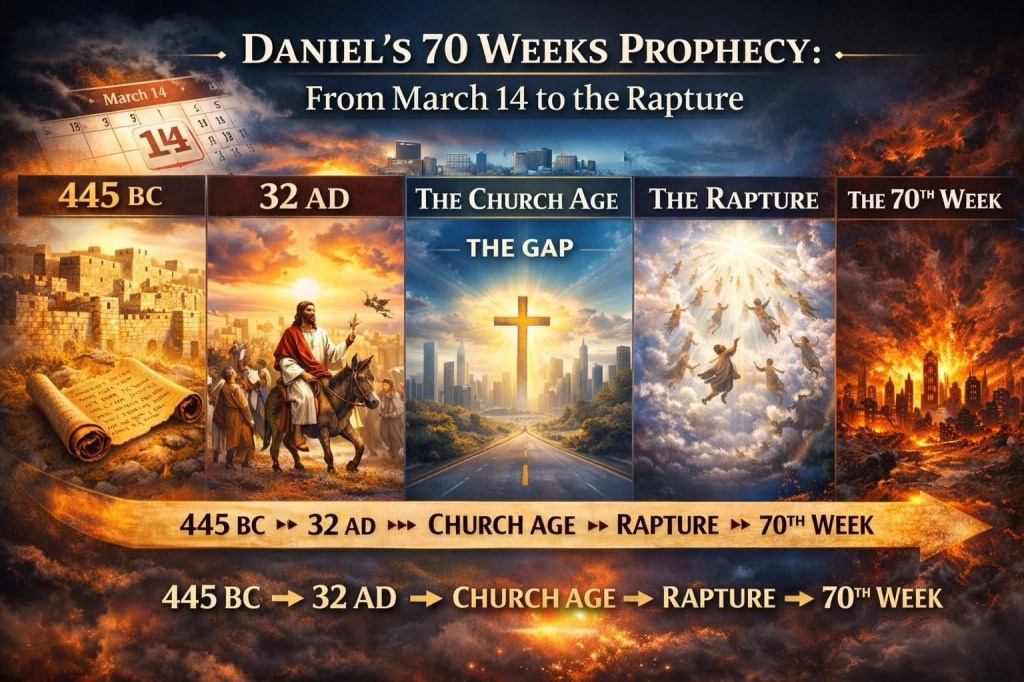
    The Messianic kingdom was spoken in Psalm 2. Jesus Christ is the King of Zion, a fulfillment of Isaiah 9:6-7 and Isaiah 7:14 as declared in Matthew 1:22-23. The Bible never spoke of a gap in the prophetic fulfillment of God’s kingdom. The talk of a rapture is nonsense. With the coming of Jesus, the Messianic kingdom has begun. Paul, in Acts, declared the fulfillment of Psalm 2, “And we bring you the good news that what God promised to the fathers, this He has fulfilled to us, their children, by raising Jesus, as also it is written in the second Psalm, ‘You are My Son, today I have begotten You’” (Acts 13:32-33). The Messianic kingdom is God’s kingdom – the kingdom of heaven – as heralded by John the Baptist (Matthew 3:1-2) and announced by Jesus Christ to have arrived (Matthew 4:17; 12:28; Luke 11:20).

    What is too hard to understand? It’s plain and simple. But contemporary Christianity resists the truth and insists on what they have been told and taught. Example of the lie below:

    Taken from Tony Campbell

    Now that another Middle East crisis is at hand, soothsayers once more are abound. But Jesus Christ alone is the true prophet of God, to whom we ought to listen. At the transfiguration of Jesus, God declared, “This is My beloved Son, with whom I am well pleased; listen to Him.” (Matthew 17:5) 

    Christians, let us not be alarmed by claims or teachings that supposedly the end of the world is coming. The Bible never spoke of the end of the world, but the end of the age. Jesus Christ taught about two ages only, the present age and the age to come, see Mark 10:29-30 and Luke 18:29-30. By “present age or in this age”, Jesus didn’t mean our time but the Old Covenant age – the period in which He came, lived, died, and resurrected, which consists of regulations, offerings, and animal sacrifices – see Hebrews 9:1-15. The Bible teaches that Christ Jesus has made it obsolete, with the passing of the Jewish temple (Hebrews 8:13). Making it impossible for the Mosaic regulations to be observed and practiced. The Bible declared Christ Jesus the mediator of the New Covenant (Hebrews 9:15; 12:24).

    Paul, in Ephesians, expounded on the mystery of God about the church also teaches only two ages (Ephesians 1:21-22).

    However, Jewish survivors of the A.D. 70 destruction of the temple continued in disbelief, so they came out with the Talmudic writings. Prominent on its declaration is a third rebuilding of the Jewish temple, which was nowhere taught in the Old or New Testament Scripture, but has been promoted by some Christians who hold dispensational theology. Beware of what you are learning, believing, and teaching. You might be disseminating falsehoods. 

    Study the Bible thoroughly with a clear mind, free from biases introduced by mainstream Christianity. Just a few decades after Jesus Christ’s resurrection, false gospels began spreading, prompting Paul to confront them by writing letters to various churches (Galatians 1:6-9; 2 Corinthians 11:1-4). Also, the writing of the gospels ensued— Matthew, Mark, Luke, and John. Today, it remains an issue even millennia later. The root cause seems to be Christianity’s tendency to rely on the writings of early church fathers, those of the Reformers, or modern scholars rather than the Bible itself.

    Peter, in the words of Acts 3:6, declared, “I possess neither silver nor gold, but in the name of Jesus Christ, I offer you what I have.” Share this article freely, for you freely receive. Take note, underlines and highlights are clickable links for definitions or Bible references. Stay updated by heading to our about page and subscribe directly to receive notifications in your inbox. Blessing!

  • True North of Life

    Blogging has faced criticism from some Christian ministers, particularly those in positions of authority. Some bloggers and vloggers have been accused of misrepresenting themselves and spreading false information, which is true, but not all. However, can we assert that all Christian ministers are truly faithful to God’s word? If so, we wouldn’t have diverse interpretations of the Bible. Similarly, some bloggers and vloggers may have been consistent with truthful facts, while others are not. Therefore, it would be unfair to categorize people based on their status. Instead, people are defined by their convictions and words. In Christian ministry, the Bible alone stands as the foundation of truth, but it must always be handled rightly and properly expounded.

    I started blogging during my seminary days. A professor introduced us to the concept, and I briefly began a few blogs before discontinuing them. Since English grammar wasn’t my strong suit, so I stopped writing altogether.

    When I transitioned to the pastorate, we were asked to contribute to the church’s quarterly magazine. I recall that for the next six years, I was required to write one article per quarter. However, I stopped writing when I began and was preoccupied with my independent Bible study ministry.

    It’s been eleven years since we began our ministry. I don’t recall the exact date I resumed writing, but this time, I created this blog website to reach a wider audience.

    The pandemic gave me more time to write, and it became more practical due to the social distancing health protocols. As a result, my ministry has expanded to include blogging, explaining God’s Word, and conducting online Bible studies.

    God certainly works in mysterious ways. I hope my writings will continue to be useful and relevant even after I’m gone.

    I believe it still would be, as Ecclesiastes declared, “What has been is what will be, and what has been done is what will be done. There is nothing new under the sun. Is there anything that is said, ‘See, this is new’? It has already existed in the ages that have passed.” (Ecclesiastes 1:9-10)

    The Christian endeavor to do better would not end. Contrary to popular beliefs, the Christian age would not end with the rapture. The Christian age, which commenced at the Pentecost of Acts 2, continues and will continue for eternity. God’s church is the manifestation of His kingdom, which I would like to detail next.

    The Book of Hebrews said, “Therefore let us be grateful for receiving – take note, it’s in the present, active, participle – a kingdom that cannot be shaken, and thus let us offer to God acceptable worship, with reverence and awe.” (Hebrews 12:28)

    Note: In Greek, the “present active participle” serves as a verbal adjective, signifying an action that is ongoing or repeated. It occurs simultaneously with the main verb in a sentence, providing additional context and detail to the action being described.

    Therefore, God’s unshakable kingdom is already at work, present yet awaiting its completion. Christ’s Church represents God’s kingdom on Earth, unlike the Davidic kingdom of the Old Covenant, which ended disastrously. The kingdom was initially split into two— Israel and Judah— due to the sins of Solomon and Rehoboam. Israel fell into the Assyrian Empire, Judah into Babylon, and finally Rome. In contrast, the New Covenant kingdom of Christ Jesus is eternal and unshakable, as evident in Hebrews 12:22-28.

    See Scripture: “But you have come – again take note it’s in the Second Perfect, Active, Indicative – to Mount Zion and to the city of the living God, the heavenly Jerusalem, and to myriads of angels, to the general assembly and church of the firstborn who are enrolled in heaven, and to God, the Judge of all, and to the spirits of the righteous made perfect, and to Jesus, the mediator of a new covenant, and to the sprinkled blood, which speaks better than the blood of Abel.” (Hebrews 12:22-24, NASB)

    Did you notice that Hebrews explicitly stated that God’s church is the new heavenly Jerusalem? This is synonymous with the New Heaven and New Earth as described by John in Revelation, who refers to her as the bride of Christ Jesus—the church (Revelation 21:1-2). It’s commendable that the NASB translation of the Bible faithfully retained the word “church,” unlike most modern English translations.

    Note: In Greek, the “second perfect active indicative” form is used to express a completed action that occurred in the past and carries lasting implications or a state that continues into the present.

    No wonder, in Luke 17:20-21, the Bible provides another proof that God’s kingdom is already present during Christ Jesus’ incarnation.

    The scripture states, “When the Pharisees asked Jesus about the kingdom of God, He replied, ‘The kingdom of God is not coming in a way that can be seen or heard. It is already among you.’”

    In Revelation, Scripture proclaims, “The kingdom of the world has become – that note, Second Aorist, Middle Deponent, Indicative – the kingdom of our Lord and of His Christ, and He will reign forever and ever.” (Revelation 11:15)

    Note: In Greek, a “second aorist middle deponent indicative” verb form shows a completed action from the past. It mainly uses the middle voice, but the verb is considered deponent. This means it has only middle (or middle and passive) forms, while still having an active meaning.

    Therefore, Since John had witnessed Christ Jesus, who proclaimed that the kingdom was present among them, John addressed his contemporary audience, the church of his era, in Revelation. He declared, “The kingdom of the world has become the kingdom of our Lord and of His Christ.” Consequently, God’s kingdom has permeated the world, and its fulfillment lies in the generation that first witnessed its arrival.

    Whether you believe Christ Jesus has returned fulfilling His promise to come in the lifetime of His apostles, as stated in Matthew 16:28; Matthew 10:23; Mark 9:1; Luke 9:27, and many other passages of the Bible or not, the fact remains that God’s kingdom has arrived as Jesus Christ Himself declared in Luke 17:20-21; Matthew 12:28; Luke 11:20; Romans 14:16-17; Colossians 1:13; Hebrews 12:28. Take time to carefully study those passages. Remember that if you unreasonably reject God’s word, you are not opposing me, but rather God. 

    As Gamaliel told the religious order of his time accusing Peter and John of falsehood, “So in the present case I tell you, keep away from these men and let them alone, for if this plan or this undertaking is of man, it will fail; but if it is of God, you will not be able to overthrow them. You might even be found opposing God!” (Acts 5:38-39)

    Do not be misled by teachings like that of the rapture and the likes. Popular as they may be, it does not mean they are true to the Bible. Unless you can defend it conclusively with Scriptures.

    Christ Jesus and His apostles confronted prevailing popular traditional beliefs and teachings. They went against the then recognized and accepted religious order. Who is in the right? If you know your Bible, you know the answer to that. 

    Keep in mind religious titles and positions do not count in the eyes of God, unless they uphold and honor God’s word (Hebrews 13:7; 1 Thessalonians 5:12-13). God’s truth can only be proven through faithful exposition of the Bible. 

    I write for two primary reasons: to preserve the sanctity of God’s word and to clarify theological concepts or ideas found in Scripture. My hope is to enrich the spiritual lives of Christians by revealing God’s truth. Isn’t theology then a means of edifying the church? Paul’s ecclesiology in Ephesians, which explains the doctrine of the church, wasn’t it for her edification? If a pastor, or someone in a Bible college or seminary, disagrees, perhaps they don’t understand Paul’s exhortation in Ephesians chapters one to two. If this is the case, then Christianity is certainly in danger of losing its identity.

    Compass, used for navigation, always points north, aligning with Earth’s magnetic field, guiding travelers on their journeys. Similarly, in life, we must learn from the sole source of truth, the Word of God. Preserving the sanctity of God’s Word, as it has been taught and explained in the Bible, is crucial. It should remain the True North in our life’s journey. If it were distorted, misinterpreted, or misbelieved, people would be misled and have misguided faith.

    Note: Click on underlines and highlights for definitions or Bible references.

    Peter, in the words of Acts 3:6, declared, “I possess neither silver nor gold, but in the name of Jesus Christ, I offer you what I have.” Share freely, for you freely receive. Stay updated by heading to our about page and subscribe directly to receive notifications in your inbox. Blessing!

  • Another Open Letter to the Church:

    Quoting Paul’s words, “For I wrote to you out of much affliction and anguish of heart and with many tears, not to cause you pain but to let you know the abundant love that I have for you.” Speaking God’s truth in love, as taught in 2 Corinthians 2:4, so I share out of love for God’s church.

    Without a doubt, no one can truly be a Christian without doctrine. Doctrine refers to a set of beliefs or teachings that define one’s faith. In the context of Christianity, doctrine encompasses the fundamental truths about Jesus Christ, His salvation, His kingdom, and other related matters. Consequently, no Christian can claim to believe in Christ Jesus without being deeply concerned about the doctrine. Paul emphasized the significance of vigilance and perseverance in one’s life and doctrine, stating, “Be vigilant about your life and doctrine. Persevere in them, for if you do, you will save both yourself and your listeners.” (1 Timothy 4:16)

    Clearly, doctrine and faith are closely intertwined; it’s impossible to claim one without the other. The Christian faith is a set of doctrines centered on Christ Jesus. It’s no wonder that twice Paul condemned those who distorted the Gospel (see Galatians 1:6-7; 2 Corinthians 11:2-4). The Gospel is God’s doctrine for salvation. Ignorance and arrogance are dangerous predicaments for individuals claiming to be Christians. Be discerning and avoid falling for such lies.

    The Bible alone holds the authority to definitively speak about God’s doctrine for salvation. When read and taught in its context, Scripture remains inspired and inerrant. Consequently, Christians must be aware of potential errors, human influences, or biases that may arise when they read and listen to extra-biblical literatures. Scripture quotes must always be consistent with the biblical teaching of their text. The apostle taught Christians, saying, “I have applied all these things to myself and Apollos for your benefit, brothers, that YOU MAY LEARN BY US NOT TO GO BEYOND WHAT IS WRITTEN, that none of you may be puffed up in favor of one against another.” (1 Corinthians 4:6)

    Lately, with the recent events in Israel, many Christians have been making predictions about the future, claiming they are based on biblical prophecy. However, a closer look at their approach reveals that they have been quoting Scriptures without considering their context. I challenge anyone who claims to have found a prophecy about a third rebuilding of the Jewish temple in the Scriptures to provide the specific passage.

    Paul gave a warning to the church, saying, “For the time is coming when people will not endure sound teaching, but having itching ears they will accumulate for themselves teachers to suit their own passions, and will turn away from listening to the truth and wander off into myths.” (2 Timothy 4:3-4)

    That time occurred during Paul’s era, and unfortunately, it persists to this day. As I mentioned in my article “A Love Letter to the Church,” “since the decline in doctrinal standards has been ongoing for decades, if not centuries, defective doctrines have become the norm. Consequently, truthful biblical teachings have become indistinguishable to most Christians.” We don’t require another reformation; instead, we need a renewed interest in biblical truth. We can’t find it unless we revisit the writings of the first-century church, the Bible, and learn from there. That’s why our ministry is named “Unlearning Tradition, Relearning Scripture.” May God grant us grace to make time for this, even amidst our busy schedules. If securing our future here is important to you, I emphasize that our spiritual well-being is of utmost importance cause it’s about now and forevermore.

    Paul emphasized this in his letter to the church, “Let us focus on the unseen rather than the visible. The visible is fleeting, while the unseen is eternal.” (2 Corinthians 4:18)

    P.S. After encountering contradictions in the traditional teachings of the church, I made an effort to relearn Scripture. Despite knowing that Scripture is a unity, I couldn’t reconcile the traditional teachings. With the help of my seminary training, I embarked on a journey of restudying the Bible. As God promised in Proverbs 2:1-5, if we receive God’s words, treasure its commandments, and make ourselves attentive to its wisdom, yearning for understanding like that of hidden treasures, we will be given understanding and knowledge.

    With utmost humility and confidence in the Lord, I share that my understanding of the Scripture has grown. By God’s grace, I have found the courage to teach and explain it in my Bible study groups. If I were solely concerned with gaining acceptance and personal benefits, would I risk challenging the prevailing popular beliefs? However, driven by concern for my own salvation and the hope of reuniting with my departed son, I could not remain silent and continue adhering to conventional Bible teachings. Recognizing that my ultimate reward lies with the Lord Jesus Christ, I have chosen to openly share the Word to honor God and out of love for His church. Ultimately, God alone is the ultimate arbiter of truth, as revealed in His sacred Bible.

    Keep in mind that back in the days of Jesus Christ and the early church, the Sanhedrin, the Jewish religious order, was the recognized authority of Scripture. However, they led the people astray. Therefore, titles alone do not signify authority in conveying the truthful teachings of God’s word; correct exposition does. Hence, Paul emphasized, “Do your utmost to present yourself to God as one approved, a worker who has no need to be ashamed, rightly handling the word of truth.” (2 Timothy 2:15) Didn’t Paul uphold the doctrines of the Bible? 

    Peter , in the words of Acts 3:6, declared, “I possess neither silver nor gold, but in the name of Jesus Christ, I offer you what I have.” Share freely, for you freely receive. Stay updated by heading to our about page and subscribe directly to receive notifications in your inbox. Blessing!

  • Focus on the Subject

    Some Christian pastors argue that the church vanished after Revelation 3, suggesting that this indicates the rapture of the church. However, consider the photo above: did everything around the mushroom disappear, or was the focus solely on the mushroom? This analogy suggests that the idea of a church rapture is not necessarily valid. Rather, John shifts his focus to the judgment of Old Covenant Israel. This is evident in Revelation 11:15, where the seventh angel blows his trumpet, and heavenly voices proclaim, “The kingdom of the world has become the kingdom of our Lord and of His Christ, and He shall reign forever and ever.”

    In John’s Gospel (the Book of Revelation was also written by him), Christ Jesus, confronted by the Sanhedrin, the religious order of the Jews, declared, “My kingdom is not of this world. If My kingdom were of this world, My servants would have been fighting so that I might not be handed over to the Jews. But My kingdom is not of this world.” (John 18:36)

    Therefore, the kingdom that Christ Jesus conquered was that of the Old Covenant Israel. In Matthew 21, when confronted by the chief priests and Jewish elders, questioning His signs and authority to teach, Jesus Christ responded, “Therefore I tell you, the kingdom of God will be taken away from you and given to a people producing its fruits” (Matthew 21:43). Now, let’s consider the language of imminence that Christ Jesus spoke to the seven churches in Revelation. 

    First, to Ephesus, “Remember therefore from where you have fallen; repent, and do the works you did at first. If not, I WILL COME TO YOU and remove your lampstand from its place, unless you repent. Yet this you have: you hate the works of the Nicolaitans, which I also hate. He who has an ear, let him hear what the Spirit says to the churches. To the one who conquers I WILL GRANT TO EAT OF THE TREE OF LIFE, which is in the paradise of God.” (Revelation 2:5-7)

    Repentance is only possible during one’s lifetime, not after death, as demonstrated by Christ’s teachings in the story of Lazarus and the rich man (Luke 16:19-31). Therefore, Jesus’ warning is directed at the living church of Ephesus, urging them to repent before His return. Isn’t it logical then that Jesus implied His return would be in their lifetime?

    Second, to Smyrna, “Don’t be afraid of what you’re about to endure. The devil is about to imprison some of you for ten days, testing your faith. Be steadfast until death, and I’ll give you the crown of life. He who has an ear, let him hear what the Spirit says to the churches. THE ONE WHO CONQUERS WON’T BE HARMED BY THE SECOND DEATH.” (Revelation 2:10-11)

    The second death occurred at the final judgment of Christ Jesus, as described in Revelation 20:11-15. Concerning Christ’s deliverance and justice, refer to Luke 18:1-8, where Christ delivers a parable about an unjust judge. Jesus emphasizes the swift and imminent nature of His justice, stating that it would be speedy. I doubt the faithful Christians of Smyrna understood a millennial as the idea of such swift justice. However, it’s important to note that Christ’s teachings in Luke 18:1-8 were delivered in the context of Luke 17:20-31, where Jesus speaks about the coming of His kingdom. More importantly, in Luke 18:8, Jesus implicitly assures His disciples that His swift justice would be with them during their lifetime. Jesus said “Nevertheless, when the Son of Man comes, will he find faith on earth?” (Luke 18:8)

    Third, to Pergamum, “Repent, or I’LL COME TO YOU SOON and wage war against them with the sword of my mouth. He who has an ear, let him hear what the Spirit says to the churches. To the one who conquers, I’ll give some of the hidden manna and a white stone with a new name written on it, a name known only to the one who receives it.” (Revelation 2:16-17)

    Jesus prophesied that His coming to Christians in Pergamum would be imminent, not a millennium later. Why do Christians choose to complicate the straightforward statements of Christ Jesus? Keep in mind that Jesus Christ warns not to add or deduct from His Words written in Revelation: “I warn everyone who hears the words of the prophecy of this book: if anyone adds to them, God will add to him the plagues described in this book, and if anyone takes away from the words of the book of this prophecy, God will take away his share in the tree of life and in the holy city, which are described in this book. He who testifies to these things says, ‘SURELY I AM COMING SOON.’ Amen. Come, Lord Jesus!” (Revelation 22:18-20)

    Fourth, to Tyatira, “HOLD ON TO WHAT YOU HAVE UNTIL I RETURN. The one who conquers and keeps My works until the end will receive authority over the nations and rule them with an iron rod, just as I received authority from My Father.” (Revelation 2:25-27)

    Isn’t “until I return” an assurance of imminent arrival? Jesus Christ, once again, assures churches of John’s lifetime that they should keep the faith because He is coming soon.

    Fifth, to Sardis, “remember what you received and heard. Keep it and repent. If you don’t wake up, I WILL COME LIKE A THIEF, and you won’t know when I will attack you again. However, there are still a few names in Sardis, people who haven’t defiled themselves, and they will walk with Me in white, for they are worthy. The one who conquers will be clothed in white garments, and I will never erase his name from the book of life. I will proclaim his name before My Father and before His angels. He who has an ear, let him hear what the Spirit says to the churches.” (Revelation 3:3-6)

    The phrase “coming like a thief” suggests that Jesus’ return will be an unexpected event. This underscores the significance of the church’s role during this momentous occasion. If no one is present to witness it, what purpose does it serve for Christ to emphasize to the church that His return will be like a thief in the night? It’s important to remember that this message was addressed to the church during John’s time. In other words, the church wouldn’t have a precise understanding of the exact time of Christ’s return, but it would certainly be within the lifetime of John and his immediate audience.

    Sixth, to Philadelphia, “I AM COMING SOON. Hold on to what you have so that no one can take away your crown. The one who conquers will become a pillar in the temple of My God. They will never leave it, and I will write on them the name of My God and the name of the city of My God, the new Jerusalem, which descends from My God from heaven, and My own new name.” (Revelation 3:11-12)

    I suppose this time, it’s quite straightforward to understand. Jesus Christ had promised Christians in Philadelphia that His return would be imminent, not in the distant future of churches during John’s lifetime, but even ours, as futurists have led many to believe.

    Lastly, the seventh, to Laodicea, “Behold, I STAND AT THE DOOR AND KNOCK. If anyone hears My voice and opens the door, I will come in to them and eat with them, and they will eat with Me. The one who conquers will be granted a place with Me on My throne, just as I conquered and sat down with My Father on His throne. He who has an ear, let him hear what the Spirit says to the churches.” (Revelation 3:20-22)

    Jesus Christ was speaking to the church of Laodicea, not to us. This is a recurring theme in John’s writings, referring to churches in his lifetime. Unless you believe that John would remain alive, as John clarified in his Gospel that this was not what Christ had told Peter. Instead, John wrote, “Jesus said to Peter, ‘If it is My will that he (John) remain until I come, what is that to you? You follow Me!’” See John 21:20-25. Can you comprehend Christ’s declaration to Peter? Or have you been blinded by tradition to the point where it seems incomprehensible to you? Jesus Christ implicitly communicated to Peter that His return would occur during John’s lifetime.

    Christ Jesus has fulfilled His purpose and promises. He declared that He alone would establish His church. The church is eternal, and even Hades has no power over it as seen in Matthew 16:18-19. The church is not just a parenthesis to Israel, its fulfillment signals the end of Old Covenant Israel. Keep in mind that “hades and death” were thrown to the lake of fire before John declared the passing of the first heaven and first earth and the coming of the new heaven and new earth (Revelation 21:1). Incidentally, the first heaven and the first earth refer to the Old Covenant, while the New Heaven and New Earth is the New Covenant. Consequently, Paul explained in 2 Corinthians 5:16-17, “From now on, therefore, we regard no one according to the flesh (that is, circumcision). Even though we once regarded Christ according to the flesh, we regard Him thus no longer. Therefore, IF ANYONE IS IN CHRIST, HE IS A NEW CREATION. The old has passed away; behold, the new has come.”

    See Galatians 6:11-15, for a parallel teaching of Paul on circumcision and flesh: “See with what large letters I am writing to you with my own hand. It is those who want to make a good showing IN THE FLESH WHO WOULD FORCE YOU TO BE CIRCUMCISED, and only in order that they may not be persecuted for the cross of Christ. For even those who are circumcised do not themselves keep the law, but they desire to have you circumcised that they may boast in your flesh. But far be it from me to boast except in the cross of our Lord Jesus Christ, by which the world has been crucified to me, and I to the world. FOR NEITHER CIRCUMCISION COUNTS FOR ANYTHING, NOR UNCIRCUMCISION, BUT A NEW CREATION.”

    I completely understand if my discussion here might have confused you. I was in a similar situation many years ago. However, after being persuaded by Christ’s words, I dedicated myself to a serious and sincere study of God’s word. Today, there is a resurgence of Christians embracing the authentic teachings of the Bible. If you want to understand, all you need to do is to keep your focus, read, and study the Bible. While reading the Bible, avoid getting sidetracked by unnecessary details and focus on the main subject. In God’s own time, you will fully comprehend Scripture.

    Peter, in the words of Acts 3:6, declared, “I possess neither silver nor gold, but in the name of Jesus Christ, I offer you what I have.” Share freely, for you freely receive. Stay updated by heading to our about page and subscribe directly to receive notifications in your inbox. Blessing!

  • Is it Sound Teaching?

    I’ve heard of many preachers and read devotionals that emphasize Peter’s conviction, love, and commitment to Jesus Christ in John 21. In this passage, Jesus asks Peter three times, “Do you love Me more than these?” (John 21:15-17). However, have we ever considered what Jesus meant by “these”?

    To clarify, let’s examine the context of the story. In John 20:21, Jesus commands Peter and the other apostles to go out and preach the Gospel, saying, “Peace be with you. As the Father has sent Me, so I am sending you.” This took place in Jerusalem soon after Christ’s resurrection.

    Jesus first appeared to His apostles twice in Jerusalem. The first time is detailed in John 20:19-23, and the second time, with Thomas present, is described in John 20:24-29. John 21 aligns with Matthew 28:9-10, which summarizes the events of John 20:19-29, where Jesus instructs them to leave Jerusalem and wait for Him in Galilee, promising another appearance. Acts 1:3 informs us that Jesus appeared to the apostles multiple times over forty days, teaching them about the kingdom of God, His last appearance being in Jerusalem before His ascension to heaven (Acts 1:3-11).

    The setting of John 21:1-3 is in Galilee, where Peter decided to go fishing with some of the other disciples, many of whom were fishermen by trade. This leads me to pose a few questions: Was Peter faithful to the words of Christ? Didn’t Peter and the other apostles receive the Holy Spirit when Jesus breathed on them in Jerusalem (John 20:19-22)? Hadn’t Jesus called Peter to follow Him even before His crucifixion, death, and resurrection (John 1:40-43)? Previously, when Jesus first called them, He said, “Follow Me, and I will make you fishers of men” (Matthew 4:18-19; Mark 1:16-17). Notice that John 21 begins by telling us that Peter and the others went fishing.

    Returning to the central question: When Jesus asked Peter, “Do you love Me more than these?”, was He referring to Peter’s former profession or perhaps his need for provision and food? Did Peter forget Jesus’ teaching on trusting God for provision when they were initially sent out in Matthew 10? Jesus instructed, “Acquire no gold or silver or copper for your belts, no bag for your journey, or two tunics or sandals or a staff, for the laborer deserves his food” (Matthew 10:9-10). Once more, it’s worth noting that Christ’s words address the apostles, urging them not to be concerned about food or provisions. Jesus is fully aware of their needs.

    In some ways, Peter seems to have faltered. So, did Peter prove himself faithful in John 21?

    Now, consider the remarkable catch of fish described in John 21:5-11. After fishing all night and catching nothing (John 21:3-4), it was only after Jesus told them to cast their net on the right side of the boat that they caught a large number of fish. Was it because they cast their net on the right side that they succeeded? I am convinced they tried both sides throughout the night without success. This substantial catch teaches us that it was ultimately Jesus’ work, reinforcing the lesson that God is our true provider, as emphasized in Matthew 6:24-33.

    Here are the highlights of Jesus’ teaching:

    • You cannot serve both God and money. Jesus urges us to let go of our anxieties about life—what we will eat or drink, and what we will wear. Is life not more than food and the body more than clothing? Consider the birds of the air: they neither sow, reap, nor gather into barns, yet our heavenly Father provides for them. Are we not of greater value than they?
    • Reflect on the lilies of the field and their effortless growth: they neither toil nor spin. Yet, Jesus assure us, even Solomon in all his glory was not adorned like one of these. If God so beautifully clothes the grass of the field, which flourishes today and is cast into the oven tomorrow, will He not care for us even more, O you of little faith?
    • Do not be anxious, asking, “What shall we eat?” or “What shall we drink?” or “What shall we wear?”, for those who do not believe chase after such things, yet our heavenly Father knows our needs. Instead, .

    David, in one of his Psalms, stated, “I have been young, and now am old, yet I have not seen the righteous forsaken or his children begging for bread” (Psalms 37:25).

    Peter, along with the other apostles and ourselves, must learn to have faith so that we may faithfully follow Jesus Christ and honor His Word.

    John’s narrative does not end here. For the third time, Jesus asked Peter, “Do you love Me?” (John 21:17). After Peter’s response, Jesus assured him that he would be faithful and would ultimately die a martyr’s death, reiterating His call to follow Him (John 17-19).

    Hold your horses! Haven’t we been told by preachers and devotionals that Jesus used the Greek word “agápē” (G25) for love on two occasions? However, on the third occasion, out of compassion for Peter’s inability to meet such a high standard of love, Jesus used “phileō” instead. A quick search using a lexicon reveals that when Jesus spoke of God’s love for Him, He also used “phileō.” This is evident in John 5:20: “For the Father loves (phileō) the Son and shows Him all that He Himself is doing. And greater works than these will He show Him, so that you may marvel.” Therefore, Jesus didn’t lower His demand for love from Peter; the same can be said for us. It is a myth to claim that God or Jesus Christ lowered His standard for humanity. If that were the case, then Jesus would not have needed to offer Himself and die on the cross to redeem those of us who believe, as stated in 2 Corinthians 5:21.

    Let’s revisit our discussion on John 21. No one can be truly faithful to Jesus Christ unless God performs a significant work in our hearts. Remember that God is the potter and we are His clay. Just as a potter sometimes destroys his creations to perfect them, Jesus—our potter—works on Peter and on us. Therefore, do not despair if you fail repeatedly. Instead, continue to heed Jesus’ call to follow Him.

    After Jesus revealed to Peter that he would soon be faithful, Peter remained anxious and impatient, eager to know about others. He asked Jesus about John, as seen in John 21:20-21:

    “Peter turned and saw the disciple whom Jesus loved (John) following them, the one who also had leaned back against him during supper and had asked, ‘Lord, who is it that is going to betray you?’ When Peter saw him, he said to Jesus, ‘Lord, what about this man?’”

    In response, Jesus lovingly rebuked Peter while encouraging him, revealing His timeline for return as stated in John 21:22-23:

    “Jesus said to him (Peter), ‘If it is My will that he (John) remain until I come, what is that to you? You follow Me!’ So the rumor spread among the brothers that this disciple was not to die; yet Jesus did not say to him that he was not to die, but, ‘If it is My will that he (John) remain until I come, what is that to you?’”

    This was not the only instance where Jesus assured that His return would be within the lifetime of John and perhaps some other disciples, as noted in Matthew 16:28.

    Jesus declared to His apostles, “Truly, I say to you, there are some standing here who will not taste death until they see the Son of Man coming in His kingdom” (Matthew 16:28).

    Are there any apostles of Jesus Christ still living today? Perhaps they are just hiding away, reminiscent of the conspiracies about Elvis Presley still being alive in some discreet location. Alternatively, should we trust Christ’s declaration to His apostles that He truly returned, which contradicts much of what is taught today?

    Additionally, in Matthew 10, before sending out His apostles to proclaim the imminent coming of His kingdom, Jesus said, “When they persecute you in one town, flee to the next, for truly, I say to you, you will not have gone through all the towns of Israel before the Son of Man comes” (Matthew 10:23).

    If you approach the scriptures with an open heart and set aside any preconceived notions about the Second Coming of Jesus Christ, you will find consistent affirmations from the apostles regarding this truth. While many people believe that Christ’s return is still in the future, Jesus has consistently stated that His coming is soon. However, “soon” was meant for His apostles, not for us.

    I want to highlight that John assured us his writing was truthful. In John 21:24, it states, “This is the disciple who is bearing witness about these things, and who has written these things, and we know that his testimony is true.”

    In John 20-21, John assures his readers that Jesus is truly alive. He emphasizes this in John 21:14, which states, “This was now the third time that Jesus was revealed to the disciples after He was raised from the dead.”

    This is the core message John conveys to his immediate audience and to everyone reading his Gospel today. Both Peter and John, along with all the followers of Jesus at that time, received the comforting assurance that Jesus’ return would happen within their lifetimes.

    As I conclude this sharing, I encourage you to consider a few questions: Could Jesus lie? Was He mistaken in telling His apostles that He would return in their lifetime? Or is it possible that biblical scholars, preachers, and pastors are wrong in asserting that the Second Coming is still to come?

    Your answers to these questions will reflect your understanding of Jesus Christ. Remember that Jesus is the promised prophet mentioned in Deuteronomy 18:15-22.

    Here are the highlights of Deuteronomy 18:15-22:

    • The LORD your God will raise up a prophet like Moses from among the Israelites—listen to Him. Peter, inspired by the Holy Spirit, testifies that Jesus Christ is the promised Great Prophet of God (Acts 3:19-23).
    • God will raise a prophet from among the Israelites, placing His words in His mouth. Those who do not listen will be held accountable. Jesus Christ is the fulfillment of this promised prophet (John 8:28; John 12:49-50; John 15:15).
    • A prophet who speaks in God’s name without His command or claims to speak in the name of other gods shall die. If you are wondering how to determine whether the word the LORD has not spoken, know that if a prophet’s predictions do not come true, that message is not from the LORD, and you need not fear such a prophet. So here is the thing: Anyone who insists that Christ Jesus did not return during the lifetime of His apostles is essentially accusing Jesus of being a false prophet or a liar. Isn’t that blasphemy?

    I understand that this topic can be confusing. If you choose to believe Christ’s declaration about His imminent return, you may be left with many questions. I empathize with your journey and assure you that sincere inquiry will lead to understanding. Keep in mind that this quest for truth is vital.

    In conclusion, the Gospels teach us the truth about Jesus Christ and serve as an apologetic against false teaching. We should hold preachers accountable for their messages. John 21 focuses on Jesus, not Peter, so let’s refrain from moralizing biblical characters like Peter, Paul, or others. Do not let yourself be shortchanged. Reject feel-good messages that do not contain God’s truth. Always ask, “Is it sound teaching?”

    Peter, in the words of Acts 3:6, declared, “I possess neither silver nor gold, but in the name of Jesus Christ, I offer you what I have.” Share freely, for you freely receive. Stay updated by heading to our about page and subscribe directly to receive notifications in your inbox. Blessing!

  • The Teachings of Jesus Christ is Life and Spirit (John 6:63)

    Our study this morning is from John 15:15-18.

    “The Jews therefore marveled, saying, “How is it that this man [Jesus Christ] has learning, when He has never studied?” So Jesus answered them, “My teaching is not Mine, but His who sent Me. If anyone’s will is to do God’s will, he will know whether the teaching is from God or whether I am speaking on My own authority. The one who speaks on his own authority seeks his own glory; but the one who seeks the glory of Him who sent Him is true, and in Him there is no falsehood.”

    So, how do we know that we are learning from Jesus Christ, the Father, and the Holy Spirit, not from men? The teaching should always be in sync with the Scripture. Unlike today, a lot of Christian doctrines are misaligned, opposing each other.

    Example: Christians teach that at the moment of death, believers would go to heaven, and yet they also say Jesus has yet to return. However, Jesus, in John 14:6, said, “I am the way, and the truth, and the life. No one comes to the Father except through Me.” Christ beforehand also said, “Let not your hearts be troubled. Believe in God; believe also in Me. In My Father’s house are many rooms. If it were not so, WOULD I HAVE TOLD YOU THAT I GO TO PREPARE A PLACE FOR YOU? AND IF I GO AND PREPARE A PLACE FOR YOU, I WILL COME AGAIN AND WILL TAKE YOU TO MYSELF, THAT WHERE I AM YOU MAY BE ALSO.” (John 14:1-3)

    We all know forty days after Jesus’ resurrection [Acts 1:3], He ascended to the Father, thereby fulfilling His promise to prepare and return to take the believers to be with Him in heaven. So, if the Christian teaching today is correct, and He has yet to return, then no one can go to the Father at the moment because Jesus promised and made clear He alone is the way to the Father, and He would return to take the believers to heaven. In other words, before Jesus’ return, heaven should be off-limits to us.

    That truth is reinforced by Hebrews 9:28: “So also Christ, having been offered once to bear the sins of many, WILL APPEAR A SECOND TIME, NOT TO BEAR SIN, BUT TO BRING SALVATION TO THOSE WHO ARE WAITING FOR HIM.”

    Christians today aren’t the only ones waiting for Christ’s return. The contemporaries of Paul and Peter, Christians before the destruction of the Jerusalem temple, were waiting as well. See passages below.

    “so that you are not lacking in any gift, as you wait for the revealing of our Lord Jesus Christ” (1Co 1:7)

    “But our citizenship is in heaven, and from it we await a Savior, the Lord Jesus Christ” (Php 3:20)

    “For not only has the word of the Lord sounded forth from you in Macedonia and Achaia, but your faith in God has gone forth everywhere, so that we need not say anything. For they themselves report concerning us the kind of reception we had among you, and how you turned to God from idols to serve the living and true God, and to wait for His Son from heaven, whom He raised from the dead, Jesus who delivers us from the wrath to come.” (1Th 1:8-10)

    Paul and his generation of Christians were waiting for Christ’s return. Peter made clear however, the return of Christ Jesus and His salvation would be consummated in his generation. See 1Peter 1:10-13.

    “CONCERNING THIS SALVATION, the prophets [OT prophets] who prophesied about the grace that was to be yours [Peter’s contemporary Christians] searched and inquired carefully, inquiring what person or time the Spirit of Christ in them was indicating when He [God] predicted the sufferings of Christ and the subsequent glories. IT WAS REVEALED TO THEM THAT THEY WERE SERVING NOT THEMSELVES [OT prophets] BUT YOU [Peter’s contemporary Christians], in the things that have now been announced to you [Peter’s contemporaries] through those who preached the good news to you [Peter’s contemporaries] by the Holy Spirit sent from heaven, things into which angels long to look. THEREFORE, PREPARING YOUR [Peter’s contemporary Christians] MINDS FOR ACTION, AND BEING SOBER-MINDED, SET YOUR HOPE [Peter’s contemporary Christians] FULLY ON THE GRACE THAT WILL BE BROUGHT TO YOU [Peter’s contemporary Christians] AT THE REVELATION [or appearing] OF JESUS CHRIST.”

    Peter, therefore rightly reiterated Jesus’ Word and promise. See Matthew 16:28. “Truly, I say to you [Peter and his fellow apostles], there are some standing here who will not taste death until they see the Son of Man coming in His kingdom.”

    Unless perhaps, the then apostles of Christ are still alive today – similar to the conspiracy theory about Elvis Presley being alive still and in hiding somewhere 😝.

    If somebody promised to meet you at a specific time then stood you up, what do you make of that person? Trustworthy or not? Oh, maybe you would say perhaps he has a legitimate reason for being remiss of his word? But that can’t be true with Christ Jesus. The promised great prophet of Deuteronomy 18:15-22; Acts 3:22-23; Acts 7:37.

    Do you understand the implications of such teaching? Asserting that Jesus Christ is yet to come; contrary to the claim of the Scripture. It opposes the very Word and promise of Christ Jesus. Therefore, futurist preachers today are actually – perhaps unknowingly but still by inference – saying Jesus failed in His Word and promise. The renowned, actually it should be infamous, C.S. Lewis said perhaps Jesus was hallucinating so He said those words to His apostles. Lewis even said, “Matthew 24:34 is the most embarrassing verse in the Bible” because Jesus promised to return to the generation of His apostles, but He did not. [https://www.behindthegospels.com/p/surprised-by-cs-lewis-the-most-embarrassing]

    I don’t know about most Christians, but I would always adhere to Jesus Christ and His infallible words. It cannot be that Christ remised on His Word. Rather, if the Bible says one thing and the contemporary teaching opposes it, the Bible being infallible would mean it is always right. It’s our Christian duty to study the Bible until we have reconciled with God’s Word, discerning the truth. If modern Christian teaching does not stand up to the scrutiny of Scripture, then it ought to be disputed and corrected – even if it would invite attacks from critics because they insist on their truth.

    Let me forewarn everyone though, back in the garden of Eden and with the temptation of Jesus Christ, it was the devil who had twisted God’s Word. No wonder, therefore, the unbelieving Jews opposed Christ’s Words, so Jesus refers to them as children of the devil (John 8:44-45). Certainly, we would not want to be in opposition to God’s Word.

    In conclusion, Scripture said,

    “He [Jesus Christ] was foreknown before the foundation of the world but was made manifest in the last times [last days] for the sake of you [Peter’s immediate audience or readers] who through Him are believers in God, who raised Him from the dead and gave Him glory, so that your faith and hope are in God. Having purified your souls by your obedience to the truth for a sincere brotherly love, love one another earnestly from a pure heart, since you have been born again, not of perishable seed but of imperishable, through the living and abiding word of God; for “All flesh is like grass and all its glory like the flower of grass. The grass withers, and the flower falls, but the word of the Lord remains forever.” And this word is the good news that was preached to you.” (1Pe 1:20-25)

    Scripture made clear, that no one was mysteriously born again, but by the unchanging imperishable Word of God. Would you rather trust in man’s teachings or only the Word of God? Seek and discern the source of your learnings. Was it from man’s imagination or the diligent and careful study of God’s Word? Truthful teaching of God’s Word should always adhere to, not oppose, clear and straightforward teachings of the Scripture.

    Jesus Christ said, “The Spirit is the one who gives life. The flesh doesn’t help at all. The words that I have spoken to you are spirit and are life.” (John 6:63)

    Peter, in the words of Acts 3:6, declared, “I possess neither silver nor gold, but in the name of Jesus Christ, I offer you what I have.” Share freely, for you freely receive. Stay updated by heading to our about page and subscribe directly to receive notifications in your inbox. Blessing!

  • Confused Christianity

    Without a doubt, 21st-century Christianity comes in many shapes and forms. Christians differ in doctrines, but they seem to be unified in believing that the return of Jesus Christ is still in the future, though it has been millennia since Jesus promised His apostles that He would be coming in their generation. See Matthew 16:27-28.

    “For the Son of Man is going to come with His angels in the glory of His Father, and then He will repay each person according to what he has done. Truly, I say to you, there are some standing here who will not taste death until they see the Son of Man coming in his kingdom.””

    The synoptic Gospels – Matthew, Mark, & Luke – have the same assurance concerning the imminent return of Christ:

    “And He (Jesus Christ) said to them (apostles), “Truly, I say to you, there are some standing here who will not taste death until they see the kingdom of God after it has come with power.”” (Mark 9:1)

    “For whoever is ashamed of Me (Jesus Christ) and of My words, of him will the Son of Man be ashamed when He comes in His glory and the glory of the Father and of the holy angels. But I tell you truly, there are some standing here who will not taste death until they see the kingdom of God.”” (Luke 9:26-27)

    Not only that, Jesus Christ sending out the twelve apostles, instructing them on His message, said, “And proclaim as you go, saying, ‘The kingdom of heaven is at hand.’” (Matthew 10:7)

    “At hand” in the original Greek language means “near,” and near cannot by any means be thousands of years and continuing, as suggested by the Futurists. Jesus Christ did not just give them the message to proclaim, but He reinforced the message with the assurance that it was indeed occurring soon. See Matthew 10:23.

    “When they persecute you (the apostles) in one town, flee to the next, for truly, I say to you, you will not have gone through all the towns of Israel before the Son of Man comes.”

    As I researched the validity of Jesus’ words, it’s sad, actually disgusting, to find known Bible scholars saying, “No, Jesus was confused or hallucinating when He uttered those words.” Some dismissed the passages saying, “There must be another meaning for that, but we just have to find out.”

    Funny that for as long as the passages or verses are convenient to their theological position, they adhere to the Words of Christ, but if it doesn’t, then it’s excuses after excuses. Scripture does not need affirmation from men; rather, the Bible is the dispenser of truth because it is the Word of God.

    One of the key disciplines in interpreting Scripture involves recognizing “time statements.” However, Futurists often overlook these time statements in the Bible, particularly in the New Testament, and instead suggest that they refer to the future. It’s important to remember that what the apostles considered “the future” is no longer future to us today.

    Hence, statements like “this generation” in Matthew 24:34 no longer make an impact on the readers, for time statements have been disregarded. See Matthew 24:29-34.

    “29 Immediately after the tribulation of those days the sun will be darkened, and the moon will not give its light, and the stars will fall from heaven, and the powers of the heavens will be shaken. 30 Then will appear in heaven the sign of the Son of Man, and then all the tribes of the earth will mourn, and they will see the Son of Man coming on the clouds of heaven with power and great glory. 31 And He will send out His angels with a loud trumpet call, and they will gather His elect from the four winds, from one end of heaven to the other. 32 “From the fig tree learn its lesson: as soon as its branch becomes tender and puts out its leaves, you know that summer is near. 33 So also, when you see all these things, you know that He is near, at the very gates. 34 Truly, I say to you, this generation will not pass away until all these things take place.

    So some have suggested “this generation” refers to the generation who saw the literal signs of Matthew 24:29-34. Yet, they miss out on John’s confession in Revelation that he was already in tribulation. See Revelation 1:9.

    “I, John, your brother and partner in the tribulation and the kingdom and the patient endurance that are in Jesus, was on the island called Patmos on account of the word of God and the testimony of Jesus.”

    Scripture is a unity. The apostles’ writings cannot be different from the Words of Jesus found in the Gospels, the Book of Acts, or the Book of Revelation. Jesus’ words have their foundation in the Old Testament Scripture. The entire Bible is a cohesive revelation concerning the declaration and fulfillment of God’s words.

    See Luke 24:44.

    Then He (Jesus Christ) said to them (The disciples), “These are My words that I spoke to you while I was still with you, that everything written about Me in the Law of Moses and the Prophets and the Psalms must be fulfilled.”

    In recent years, we have witnessed the rise of fake news online. Most people now get their news from the web, particularly from platforms like Facebook and YouTube. Unfortunately, fake news spreads easily because many individuals click to watch or read without considering the source or the intent of the uploader or poster.

    Even if a Facebook post or YouTube video contains factual information, ignoring the date it was published can severely affect its relevance today. The same principle applies when reading and studying the Bible. It is essential to recognize the audience’s relevance, the timing of statements, and their historical accuracy. Failing to do so can lead to misinterpretations of Scripture, whether by inexperienced readers or poorly informed pastors.

    Jesus Christ warned, “Can a blind man lead a blind man? Will they not both fall into a pit?” (Luke 6:39)

    Find someone who can teach you the disciplines of studying Scripture. Avoid using human-tailored Bible study materials, as they often reflect human influence. It’s important to recognize that even within different Bible translations, traces of human interpretation can be found. Let me be clear: the Bible itself is perfect, infallible, and without error; the issues arise with the translations.

    You don’t need to be a scholar of Greek, Hebrew, or Aramaic, but it is beneficial to read the Bible by comparing different translations. Additionally, learning to use language tools, such as lexicons, is essential for in-depth Bible study. There are many free lexicon tools available online or for download. You just need to find someone knowledgeable to guide you in using these tools effectively.

    It’s never too late to start studying Scripture and practicing proper exegesis. Ultimately, Scripture reveals truths about salvation that extend beyond our physical needs and concerns, addressing both our current lives and eternity. Don’t let yourself become part of confused Christianity.

    Peter, in the words of Acts 3:6, declared, “I possess neither silver nor gold, but in the name of Jesus Christ, I offer you what I have.” Share this article freely, for you freely receive. Take note, underlines and highlights are clickable links for definitions or Bible references. Stay updated by heading to our about page and subscribe directly to receive notifications in your inbox. Blessing!

  • Small Details May Say A Lot; The Conclusion (The True Sabbath Rest)

    As noted in my earlier post, the Sabbath serves as the central theme in John 5. The Gospel mentions the Sabbath ten times, with four occurrences in this chapter alone. This focus makes sense because the events in John 5 take place during the Jewish Fall Harvest Festival—the Feast of Booths—since the core of that celebration is Sabbath rest.

    This theme of rest is particularly meaningful when contrasted with the unrest of exile. As a young man, the prophet Daniel was taken into exile (Daniel 1:3–6). This Exile, also known as the Seventy Years of Babylonian Captivity, fulfilled God’s declared judgment on Judah, the southern kingdom and final remnant of David and Solomon’s monarchy. For context, see Jeremiah 25:3–14.

    For twenty-three years, from the thirteenth year of Josiah the son of Amon, king of Judah, to this day, the word of the LORD has come to me, and I have spoken persistently to you, but you have not listened. You have neither listened nor inclined your ears to hear, although the LORD persistently sent to you all His servants the prophets, saying, “Turn now, every one of you, from his evil ways and evil deeds, and dwell upon the land that the LORD has given to you and your fathers from of old and forever. Do not go after other gods to serve and worship them, or provoke Me to anger with the work of your hands. Then I will do you no harm.” Yet you have not listened to Me, declares the LORD, that you might provoke Me to anger with the work of your hands to your own harm.

    Therefore thus says the LORD of hosts: Because you have not obeyed My words, behold, I will send for all the tribes of the north, declares the LORD, and for Nebuchadnezzar the king of Babylon, My servant, and I will bring them against this land and its inhabitants, and against all these surrounding nations, I will devote them to destruction, and make them a horror, a hissing, and an everlasting desolation. Moreover, I will banish from them the voice of the mirth and the voice of gladness, the voice of the bridegroom and the voice of the bride, the grinding of the milestones and the light of the lamp. The whole land shall become a ruin and a waste, and these nations shall serve the king of Babylon seventy years. Then after the seventy years are completed, I will punish the king of Babylon and that nation, the land of the Chaldeans, for their iniquity, declares the LORD, making the land an everlasting waste. I will bring upon the land all the words that I have uttered against it, everything written in this book, which Jeremiah prophesied against all the nations. For many nations and great kings shall make slaves even of them, and I will recompense them according to their deeds and the work of their hands.

    By Daniel’s later years, he may have reached his eighties, since seventy years had passed after his exile to Babylon. See Daniel 9:1–2.

    In the first year of Darius the son of Ahasuerus, by descent a Mede, who was made king over the realm of Chaldeans – in the first year of his reign, I Daniel, perceived in the books the number of years that, according to the word of the LORD to Jeremiah the prophet, must pass before the end of the desolations of Jerusalem, namely, seventy years.

    After the seventy-year Babylonian captivity ended—the judgment God announced through Jeremiah—Daniel asked the LORD for mercy and restoration. The answer to Daniel’s prayer and request appears in Daniel 9:24–27. We can examine Daniel 9:24, which captures the full scope of God’s declaration:

    Seventy weeks are decreed about your people and your holy city, to finish the transgression, to put an end to sin, and to atone for iniquity, to bring in everlasting righteousness, to seal both vision and prophet, and to anoint a most holy place.

    Perhaps to Daniel’s surprise, God is not finished with Israel; he was informed of the final judgment, described as “to finish transgression, to put an end to sin.” The atonement was “to atone for iniquity, to bring in everlasting righteousness,” and finally, God’s dwelling presence—the tabernacle (booths)—was “to anoint a most holy place.” By the way, the themes in Daniel 9:24 align with elements in John 5.

    John 5:30, spoke of Judgment, which is the culmination of the Feast of Trumpets.

    I can do nothing of My own. As I hear, I judge, and My judgment is just, because I seek not My own will but the will of Him [God the Father] who sent Me.

    Next, John 5:21, spoke of Resurrection, the fulfillment of the Feast of Atonement.

    For as the Father raises the dead and gives them life, so also the Son gives life to whom He will.

    Finally, John 5:24, spoke of Eternal Life, the consummation of the Feast of Booths.

    Truly, truly, I say to you, whoever hears My word and believes Him who sent Me has eternal life. He does not come into judgment, but has passed from death to life.

    Daniel’s life spanned the era of the first Gentile kingdom, Babylon, and into the second, the Medo-Persian Empire. He understood this transition when he was called to interpret the dream of King Nebuchadnezzar (Daniel 2). In this dream, God revealed that four Gentile kingdoms would rule over Israel before the coming of the Son of Man—the Anointed One, the Deliverer of Israel (Daniel 2:44-45). This prophetic confirmation is further elaborated in Daniel 7.

    The fulfillment of God’s Messianic Kingdom, as foretold, would take place during the reign of the fourth Gentile kingdom (Daniel 2:40–45). Scripture names the first three kingdoms: Babylon (Daniel 2:37–38), Medo-Persia, and Greece (Daniel 8:20–21). The fourth kingdom remains unnamed, but Daniel 7:7 provides a vital clue about its identity.

    After this I saw in the night visions, and behold, a fourth beast, terrifying and dreadful and exceedingly strong. It had great iron teeth; it devoured and broke into pieces and stamped what was left with its feet. It was different from all the beasts that were before it, and it had ten horns.

    About 600 years later, the identity of the fourth kingdom was finally revealed by the apostle John. See Revelation 13:1 and 17:7-11.

    And I saw a beast rising out of the sea, with ten horns and seven heads, with ten diadems on its horns and blasphemous names on its heads. (Revelation 13:1)

    But the angel said to me [John], “Why do you marvel? I will tell you the mystery of the woman, and of the beast with seven heads and ten horns that carries her. The beast that you saw was, and is not, and is about to rise from the bottomless pit and go to destruction. And the dwellers on earth whose names have not been written in the books of life from the foundation of the world will marvel to see the beast, because it was and is not and it to come. This calls for a mind of wisdom: the seven heads are the seven mountains on which the woman is seated; they are also the seven kings, five of whom have fallen, one is, the other has not yet come, and when he does come he must remain only a little while. As for the beast that was and is not, it is an eight but it belongs to the seven, and it goes to destruction.” (Revelation 17:7-11)

    It should be noted that in the Greek, the seven mountains could also be translated as “seven hills,” and there is only one city at the time of the apostle, perhaps even now, that was known to sit on seven hills— that is, Rome. The seven kings, five of whom have fallen, refers to the Roman emperors, beginning with (1) Julius Caesar, (2) Augustus Caesar, (3) Tiberius Caesar, (4) Caligula Caesar, (5) Claudius Caesar; “one is,” refers to Nero Caesar— the emperor reigning at the time of Peter, John, and Paul.

    Now, let us see Revelation 1:9-10.

    I, John, your brother and partner in the tribulation and the kingdom and the patient endurance that are in Jesus, was on the island called Patmos on account of the Word of God and the testimony of Jesus. I was in the Spirit on the Lord’s Day, and I heard behind me a loud voice like a trumpet saying, “Write what you see in a book and send it to the seven churches, to Ephesus and to Smyrna and to Pergamum and to Thyatira and to Sardis and to Philadelphia and to Laodicea.”

    According to the King James Concordance, “trumpet” is mentioned eleven times in the New Testament, with six of those instances appearing in the Book of Revelation, including Revelation 1:10. This frequent use of the trumpet imagery calls to mind the Fall Harvest Festivals of Leviticus 23, which begin with the Feast of Trumpets, followed by the Feast of Atonement, and finally the Feast of Booths.

    Incidentally, the “Lord’s Day” of Revelation 1:10, which the Strong’s Hebrew and Greek Dictionaries said was “from G2962; belonging to the Lord,” could not be referring to a Sunday, as traditionally suggested, but the Sabbath. See Genesis 2:2–3.

    And on the seventh day God finished His work that He had done, and He rested on the seventh day from all His work that He had done. So God blessed the seventh day and made it holy, because on it God rested from all His work that He had done in creation.

    Brown-Driver-Briggs’ Hebrew Definition defined “holy” as to consecrate, sanctify, prepare, dedicate, be hallowed, be holy, be sanctified, be separate. Therefore, the seventh day, which is the Sabbath, was sanctified, consecrated, and set apart for the LORD God; hence, the Lord’s Day or a “day belonging to the Lord.”

    See also Exodus 20:8-10, of the Ten Commandments:

    Remember the Sabbath day, to keep it holy. Six days you shall labor and do all your work, but the seventh day is a sabbath of the LORD your God … For in six days the LORD made the heavens and the earth, the sea and all that is in them, and rested on the seventh day; therefore the LORD blessed the sabbath day and made it holy.

    The Lord’s Day cannot be a Sunday, which traditionally was derived from the phrase “first day of the week” found in every gospel narrative concerning the resurrection of Jesus Christ.

    See first, John 19:42-20:1.

    So because of the Jewish Day of Preparation, since the tomb was close at hand, they laid Jesus there. Now on the first day of the week Mary Magdalene came to the tomb early, while it was still dark, and saw that the stone had been taken away from the tomb.

    What is the Day of Preparation? See John 19:31.

    Since it was the day of Preparation, and so that the bodies would not remain on the cross on the Sabbath (for that Sabbath was a high day), the Jew asked Pilate that their legs might be broken and that they might be taken away.


    Every Passover and Unleavened Bread Festival, there would be two Sabbaths in the week: a regular Sabbath [the seventh day of the week; Saturday to us] and the High or Special Sabbath, which could be any day of the week as long as it is the fifteenth of Nisan. Leviticus 23:7 states, “On the first day you shall have a holy convocation; you shall not do any ordinary work [Sabbath rest].” The first day of the Feast of Unleavened Bread was the beginning of the Passover-week festival, the fifteenth of Nisan.

    The Passover event in Exodus occurred “between the two evenings” (Exodus 12:6–8, translated “twilight”), beginning on the fourteenth of Nisan, which was the Preparation for the Passover. The Jewish day begins at sunset and ends before sunset (6pm to before 6pm); unlike ours, which is 12 midnight to before 12 midnight. Hence, Exodus 12:29 states:

    At midnight [Hebrew “middle of two night” H2677 & H3915] the LORD struck down all the firstborn in the land of Egypt …


    Jesus, then, was crucified on the day of Preparation (John 19:14). He was buried before sundown, the beginning of the High Sabbath, 15th of Nisan (John 19:30, 42). Now, in John 20:1, “first day of the week” in the Greek actually means on “one Sabbath or first Sabbath“— meaning, first Sabbath after the High Sabbath. Yes, “Sabbath” (G4521, from Hebrew H7676) but was somehow translated “week” by the English translation of the Bible.

    See again John 19:42-20:1

    So because the Jewish Day of Preparation, since the tomb was close at hand, they laid Jesus there. Now on the [One] first [Sabbath] day of the week Mary Magdalene came to the tomb early, while it was still dark, and saw that the stone had been taken away from the tomb.

    Interlinear Bible for John 20:1,

    <1161> The first <3391> day of the week <4521> cometh <2064> (5736) Mary <3137> Magdalene <3094> early <4404>, when it was <5607> (5752) yet <2089> dark <4653>, unto <1519> the sepulchre <3419>, and <2532> seeth <991> (5719) the stone <3037> taken away <142> (5772) from <1537> the sepulchre <3419>.

    A check on an interlinear Bible said “The first” G3391, irregular feminine of G1520, which Thayer’s Greek Definition defined to mean “one.” Next, “day of the week” G4521, defined by Strong’s Hebrew and Greek Dictionaries as “Of Hebrew origin” [H7676]— the Sabbath.

    Now, see also Mark 15:42,47; 16:1-2.

    And when evening had come, since it was the day of Preparation [14th of Nisan], that is, the day before the Sabbath [15th of Nisan] … Mary Magdalene and Mary the mother of Jesus saw where He was laid. When the Sabbath [High] was past, Mary Magdalene, Mary the mother of James, and Salome brought spices, so that they might go and anoint Him. And very early on the first [One, G1520] day of the week [Sabbath, G4521], when the sun had risen, they went to the tomb.

    See also Luke 23:56-24:1.

    Then they returned and prepared the spices and perfumes. And on the Sabbath [High] they rested according to the commandment. But on the first [One, G1520] day of the week [Sabbath, G4521], at early dawn, they came to the tomb bringing the spices which they had prepared.”

    Lastly, Matthew 28:1

    Now after the Sabbath [High], toward the dawn of the first [One, G1520] day of the week [Sabbath, G4521], Mary Magdalene and the other Mary went to see the tomb.

    Now Paul, in 1 Corinthians 5:7 declared Jesus Christ as the Passover Lamb that has been sacrificed. Then, in 1 Corinthians 15:23, Christ was the firstfruits, speaking of His resurrection. Therefore, another proof that Jesus could not have resurrected on a Sunday, as traditionally taught and believed, but rather on a Sabbath, fulfilling the Feast of Firstfruits of Leviticus 23, which occurred on a Sabbath (G4521), following the High Sabbath (John 19:31).

    See Leviticus 23:10-11,15-16 from the NASB translation, a literal word-for-word translation.

    “Speak to the sons of Israel and say to them, ‘When you enter the land which I am going to give to you and reap its harvest, then you shall bring in the sheaf of the first fruits of your harvest to the priest. He shall wave the sheaf before the LORD for you to be accepted; on the day after the Sabbath the priest shall wave it.”

    “You shall also count for yourselves from the day after the Sabbath, from the day when you brought in the sheaf of the wave offering; there shall be seven complete Sabbaths. You shall count fifty days to the day after the seventh Sabbath …“

    To count seven complete sabbaths, then the beginning of the count must also be on a Sabbath; thereby, the day after the High Sabbath refers to the regular weekly Sabbath. Clearly then, Jesus resurrected back to life on a Sabbath, not Sunday; fulfilling therefore the Feast of Firstfruits.


    To review: Paul, in 1 Corinthians 5:7 declared Jesus Christ is the Passover Lamb that has been sacrificed. Then, in 1 Corinthians 15:23, Christ was the firstfruits, speaking of His resurrection. Therefore, once more, another proof that Jesus could not have resurrected on a Sunday, as traditionally taught and believed, but rather on a Sabbath, fulfilling the Feast of Firstfruits of Leviticus 23:10–11, which always occurs on a Sabbath following the High Sabbath.


    Although Rome leveled Jerusalem in AD 70 during summer instead of winter, it is striking that Jesus observed, “Pray that your flight may not be in winter or on a Sabbath.” (Matthew 24:20)

    From our earlier study, it follows that the timing must align with a Sabbath, since Revelation describes John hearing a loud voice like a trumpet “on the Lord’s Day.” The events throughout the Book of Revelation point to the Last Day and the Second Coming of Jesus Christ, completing the Fall Harvest Festivals in Leviticus 23.

    On a side note, the Bible refers to the “Day of the Lord” (Acts 2:20; 1 Corinthians 1:8; 1 Corinthians 5:5; 2 Corinthians 1:14; 1 Thessalonians 5:2; 2 Thessalonians 2:2; 2 Peter 3:10) as God’s judgment day, which serves as the central theme of the Book of Revelation. The Lord’s Day is unlikely to be a Sunday; it appears to be a Sabbath and aligns with “the Day of the Lord” in its meaning.

    Revelation 14:6-7,13

    Then I saw another angel flying directly overhead, with an eternal gospel to proclaim to those who dwell on earth, to every nation and tribe and language and people. And he said with a loud voice, “Fear God and give Him glory, because the hour of His judgment has come, and worship Him who made heaven and earth, the sea and the springs of water … And I heard a voice from heaven saying, “Write this: Blessed are the dead who die in the Lord from now on. ‘Blessed indeed,” says the Spirit, “that they may rest from their labors, for their deeds follow them!’”

    By the way, “a loud voice” in Revelation 1:10 was said to be “like a trumpet,” so similarly “a loud voice” in Revelation 14:7 must also be “like a trumpet,” which declared the arrival of the time of God’s judgment. Following the sound of the trumpet, a voice from heaven then declared, “Blessed are the dead who die in the Lord from now on. Blessed indeed, that they may rest from their labors, for their deeds follow them!”

    The significance of Revelation 14:13 may be seen through the words of Hebrews 4:9-10.

    So there remains a Sabbath rest for the people of God. For the one who has entered His rest has himself also rested from his works, as God did from His.

    Perhaps that was why Jesus would heal even on a Sabbath, indicating therefore that He was working— first to make Himself known and believed by people (John 6:29) and second, to fulfill the true Sabbath Rest (Revelation 14:13; Hebrews 4:9–10), which would be a reality only after God rested from His work (Hebrews 4:9–10). So the apostle’s narrative on John 5:16–17 makes real sense now.

    And this was why the Jews were persecuting Jesus, because He was doing these things on the Sabbath. But Jesus answered them, “My Father is working until now, and I am working.”

    It should be worth mentioning then that on top of the Seven Jewish Feasts of Leviticus 23 was the command to observe the Sabbath (Leviticus 23:3), since that was the essence of all the festivities of Israel, the fulfillment or the renewal of Genesis 2:2–3.

    See Leviticus 23:3.

    Six days shall work be done, but on the seventh day is a Sabbath of solemn rest, a holy convocation. You shall do no work. It is a Sabbath to the LORD in all your dwelling places.

    Next, Genesis 2:2-3.

    And on the seventh day God finished His work that He had done, and He rested on the seventh day from all His work that He had done. God blessed the seventh day and made it holy, because on it God rested from all His work that He had done in creation.

    A small detail indeed reveals a lot. We must seek to know the true teachings of the Scripture. Traditions have blinded us from understanding the true essence of the Sabbath, which speaks of the salvation plan of God. Not until God had rested from His work would His creation ever experience and understand the true Sabbath Rest of God. See Revelation 21:3–4.

    And I heard a loud voice from the throne, saying, “Behold, the dwelling place [tabernacle] of God is with man, and He will dwell with them, and they will be His people, and God Himself will be with them as their God. He will wipe away every tear from their eyes, and death shall be no more, neither shall there be mourning, nor crying, nor pain anymore, for the former things have passed away.

    The doctrine of the Second Coming of Jesus and his fulfillment of the Final Harvest Feast, the Fall Festivals, need not be divided into specific events, since Paul noted this.

    Behold, I tell you a mystery; we will not all sleep, but we will all be changed, in a moment, in the twinkling of an eye, at the last trumpet; for the trumpet will sound, and the dead will be raise imperishable, and we will be changed … But when this perishable will have put on the imperishable, and this mortal will have put on immortality, then will come about the saying that is written, “Death is swallowed up in victory.” (1 Corinthians 15:51-52,56)

    Truly, a little deflection from the truth can indeed lead to a devastating false assumption. The Roman Empire, the fourth Gentile kingdom reigning over Israel, ceased to exist for more than a millennium now. So what does that tell us? Be reminded that God showed Daniel that the Messianic reign of Jesus Christ would occur within the time of the fourth Gentile kingdom, Rome. The Bible never spoke of a revived Roman Empire. Don’t you think we ought to take seriously our study of the Bible?

    P.S. I have always wanted to understand the doctrine of the last things, eschatology. It was quite important and personal to me, for I wanted to be assured of what happened after death. That was the question that bothered me while I was at the wake of my only son. It’s been twenty years now. Glory be to God that finally I now comprehend Scripture, and the Lord Jesus Christ has graciously provided me understanding concerning the said doctrine.

    The Lord Jesus Christ impressed His words in Isaiah 30:20–21 upon me while I wrestled with whether to begin seminary training so late in life. Scripture says, “And though the Lord give you the bread of adversity and the water of affliction, yet your Teacher will not hide himself anymore, but your eyes shall see your Teacher. And your ears shall hear a word behind you, saying, ‘This is the way, walk in it,’ when you turn to the right or when you turn to the left.” (Isaiah 30:20–21)

    Looking back, I recognize that the Lord, my Teacher, Jesus Christ, graciously led me and my family to know Him and grasp His Word. This journey started at my son’s wake, who posthumously showed me God’s goodness through a penholder he had given me months before joining the Lord. Here is a link to the blog “Regarding Wilmer,” which recounts my path to Christianity.

    Peter, in the words of Acts 3:6, declared, “I possess neither silver nor gold, but in the name of Jesus Christ, I offer you what I have.” Share this article freely, for you freely receive. Take note, underlines and highlights are clickable links for definitions or Bible references. Stay updated by heading to our about page and subscribe directly to receive notifications in your inbox. Blessings!