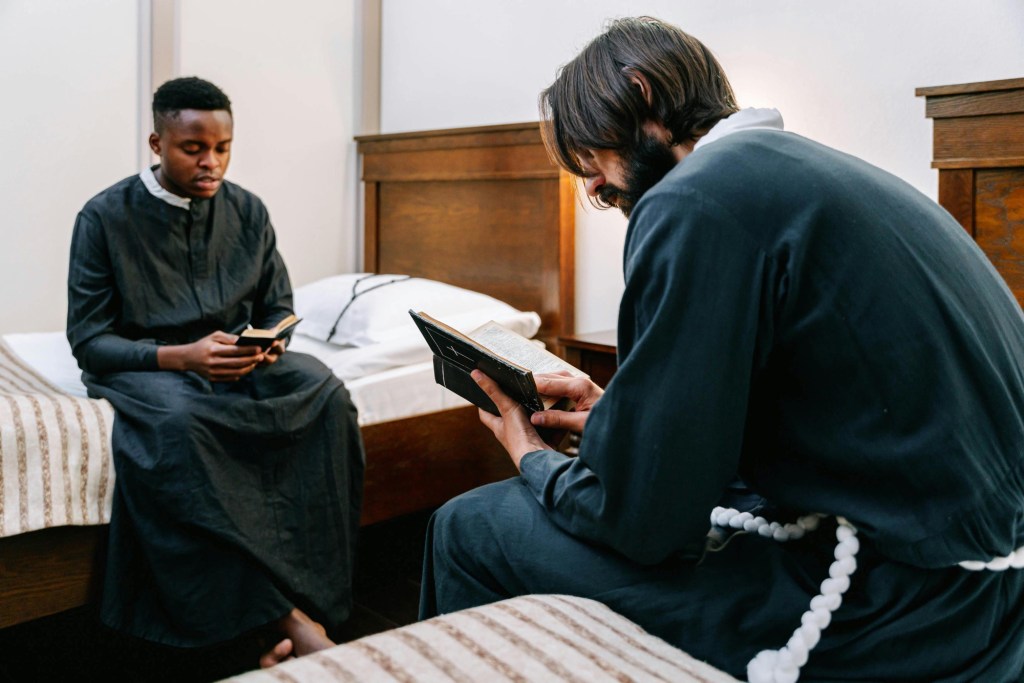
This morning we studied John 7:16-18. Jesus Christ said, “My teaching is not Mine, but His [God the Father] who sent Me. If anyone’s will is to do God’s will, he will know whether the teaching is from God or whether I am speaking on My own authority. The one who speaks on his own authority seeks his own glory; but the one who seeks the glory of Him [God] who sent him is true, and in him there is no falsehood.”
We have had this passage for some time. There is simply a lot to learn and explore in this passage. Christ Jesus calls on us to learn and teach only from that of God the Father and Jesus Christ, which is also that of the Spirit (John 16:13). As an example, we explore the doctrine of election as it has been taught conventionally. We would like to know if it would pass scrutiny of Scripture. We touched on Romans 9, Galatians 4, and Genesis 17.
Embracing the conventional teaching on “election” would certainly conclude a “double predestination” – if there are people who are elected to be saved, then there are also people elected to be damned. This has been rejected and debated much. Rightly so, for if God is the God of love and grace, how do we justify saying He picks and chooses those He saves and reprobates others? On the other hand, if “election” is indeed according to the teaching of the Bible – electing and reprobating people for and from salvation – then we ought to find Scripture’s clear teaching on the doctrine. Adhering to confessions, writings of men, would not suffice. Only Scripture is inerrant and infallible.
As We have studied this morning. Paul’s teaching on election was applied to a specific time and people group. In Romans 9, Paul highlighted one Israel by ethnicity, and the other by promise (see Romans 9:6-13). Two Israels, by two sons of Abraham. Galatians said, “One by Hagar, the other Sarah” (see Galatians 4:21-31) – the latter was by God’s unilateral covenant with Abraham (Genesis 17:15-16, 21); the first, on the other hand, was a bilateral covenant by circumcision (Genesis 17:10-14). That’s exactly Paul’s teaching from Galatians 4:21 to 5:10.
Herewith is an excerpt from GotQuestions.Org with an explainer of the two covenants. “A covenant is an agreement between two parties. There are two basic types of covenants: conditional and unconditional. A conditional or bilateral covenant is an agreement that is binding on both parties for its fulfillment. Both parties agree to fulfill certain conditions. If either party fails to meet their responsibilities, the covenant is broken and neither party has to fulfill the expectations of the covenant. An unconditional or unilateral covenant is an agreement between two parties, but only one of the two parties has to do something. Nothing is required of the other party.”
Old Covenant Israel ceased with the destruction of the temple in 70 A.D. Without the temple, together with its regulations gone, then Old Covenant Israel could no longer exist (Hebrews 9:1-10). Rightly so, for Christ Jesus was the true acceptable offering for salvation (Hebrews 9:11-15). In Romans 9, written 57 A.D., the temple was still standing; hence, there were still two Israels: one born by the covenant of circumcision (bilateral) and the other born of the spirit (John 3:3, 5-6), or the covenant of faith or promise.
So before the end of the Jewish Age, Paul explained the reality of God’s election for the salvation of some Jews (Old Covenant Israel). With Paul saying, “So too at the present time there is a remnant, chosen by grace.” (Romans 11:5)
The “present time” is not today, but the days of Paul, the era of his generation. So obviously it’s history to us. Paul then concludes in Romans 11:28, saying, “As regards the gospel, they [Old Covenant Israel] are enemies for your sake. But as regards election, they [Israel of Promise] are beloved for the sake of their forefathers [forefathers, referring to God’s covenant to Abraham, Isaac, and Israel or Jacob].”
Therefore, there was no double predestination in reality even then. Old Covenant Israel had been under God’s wrath; hence, they awaited a coming Messiah (Christ Jesus). Look, John the Baptist was announcing exactly that: “Repentance is now, judgment is imminent” (see Matthew 3:2, “Repent, for the kingdom of heaven is at hand”).
See also Matthew 3:7-10. “But when he [John the Baptist] saw many of the Pharisees and Sadducees coming to his baptism, he said to them, “You brood of vipers! WHO WARNED YOU TO FLEE FROM THE WRATH TO COME? BEAR FRUIT IN KEEPING WITH REPENTANCE. And do not presume to say to yourselves, ‘We have Abraham as our father,’ for I tell you, God is able from these stones to raise up children for Abraham. EVEN NOW THE AXE IS LAID TO THE ROOT OF THE TREES. Every tree therefore that does not bear good fruit is cut down and thrown into the fire.”
“Raising children for Abraham from stones” certainly is not by natural conception or birth. Like the incarnate Jesus Christ, His birth was by God’s promise and His Spirit (Gen 3:15; Isa 7:14; Matt 1:23). So that’s the reason Jesus Christ told Nicodemus, “You must be born again [John 3:3], born of the Spirit not of flesh [John 3:5-7].”
Without a doubt, the axe was symbolic of God’s wrath and impending judgment. The trees were to be cut from its roots. Isn’t that a metaphor of an impending cessation of Old Covenant Israel? Just as I shared earlier, without the temple and its ordinances, Old Covenant Israel ceased to exist.
Keep in mind that with the coming of Christ Jesus, God’s grace has been for everyone. There is no more Jew or Gentile in the eyes of God (Galatians 3:26-29).
There is no teaching of double predestination in the Bible. God’s church is the manifestation of God’s unilateral covenant with Abraham. It’s a covenant of promise, which rests in Christ Jesus, so it’s also a covenant of faith. Salvation is in Christ Jesus alone, through faith in Him. Faith in Christ Jesus encompasses His deeds and His Word.
1 Thessalonians 1:4-5 has to be the most interesting and glaring vis-à-vis the conventional teaching on election, a cherry-picking election.
God’s grace has been offered to everyone because all have sinned and fallen short of God’s glory (Romans 3:21-23). Isn’t it paradoxical that God offers grace and yet He elects?
Now see 1 Thessalonians 1:4-5. Paul said, “For we know, brothers loved by God, that HE HAS CHOSEN YOU, BECAUSE OUR GOSPEL CAME TO YOU not only in word, but also in power and in the Holy Spirit and with full conviction. You know what kind of men we proved to be among you for your sake.”
Point #1. By “we”, Paul refers to himself and his co-workers. In other words, living Christians of his era. That’s respecting time relevance.
Point #2. The word translated “chosen” was from the Greek word translated “election” in Romans 9 & 11; 2 Peter and Acts. Therefore, it’s the same. Paul was talking about the election of the Thessalonians believers. That’s respecting the context, audience, and time relevance.
Point #3. Therefore, “election or chosen” does not imply or mean God selects, picks, or chooses somebody and outright rejects others. Rather, God elects people by the preaching and teaching of His Word. See 1 Thessalonians 1:4-5 again; Scripture said, “God has chosen you because our Gospel came to you”.
Christ Jesus taught in Matthew 13:18-23 reasons that hinder a person from becoming good soil of His Word. In Matthew 13:23, Jesus Christ concludes, “As for what was sown on good soil, this is the one who HEARS THE WORD AND UNDERSTANDS IT. He indeed bears fruit and yields, in one case a hundredfold, in another sixty, and in another thirty.”
Keep in mind that Jesus Christ is the Sower in His parables (Matt 13:37). He sows the Word of God (Matt 13:18-23).
Lastly, the audience of Paul in 1 Thessalonians were Jewish Christians. Once more, see 1 Thessalonians 2:13-15. Paul said, “And we also thank God constantly for this, that WHEN YOU RECEIVED THE WORD OF GOD, WHICH YOU HEARD FROM US, YOU ACCEPTED IT NOT AS THE WORD OF MEN BUT AS WHAT IT REALLY IS, THE WORD OF GOD, WHICH IS AT WORK IN YOU BELIEVERS. For you, brothers, became imitators of the churches of God in Christ Jesus that are in Judea. FOR YOU SUFFERED THE SAME THINGS FROM YOUR OWN COUNTRYMEN AS THEY DID FROM THE JEWS, who killed both the Lord Jesus and the prophets, and drove us out, and displeased God and opposed all mankind.”
Let us learn well the teachings of the Word so that we may silence those who teach from men’s teachings. The point is not to debate, but to explain to those who truly seek God’s Word but were misled.
Truly, there is no double predestination in Scripture, but if anyone misreads Scripture and teaches outside the teachings of the Trinity God, it could end in double the trouble, for you and your hearers. Paul warned, “Keep a close watch on yourself and on the teaching. Persist in this, for by so doing you will save both yourself and your hearers.” (1 Timothy 4:16)
Always learn from the Word of God, not men’s teaching. Scripture alone is the arbiter of truth, not men.
Peter, in the words of Acts 3:6, declared, “I possess neither silver nor gold, but in the name of Jesus Christ, I offer you what I have.” Share freely, for you freely receive. Stay updated by heading to our about page and subscribe directly to receive notifications in your inbox. Blessing!
It’s been more than five centuries since the Reformation Day. Is it still relevant today? I believe the answer to that question is the same as that of the EDSA People Power Revolution in 1986. Is it still relevant today?
The Reformation Day, like the People’s Power of EDSA, would always have its significance. With EDSA, freedom was restored, though compromised from time to time. Reformation, on the other hand, restored the truthful teaching on soteriology—the doctrine of salvation. That is, salvation is by the grace of God through faith in Christ Jesus alone, not by penance or indulgence.
However, both events failed to sustain their goals. The Reformation did not fully restore the truthful teachings of Scripture. It created its traditions. Calvinism also misrepresented Scripture, like that of the doctrine of election. God did not mystically pick and choose people for salvation. Rather, God’s calling and election is always by the preaching and teaching of His Word (Ro 10:14-17). Jesus Christ explained that clearly in His Parable of the Sower. Matthew 13:23 teaches that the “good soil is the one who hears the Word and understands it”.
Ironically, both events, historical as they are, yet their ideas came to a halt because they were left in the hands of men. Never mind that of EDSA, but the Reformation could have been sustained on its course if Christians had kept themselves to Scripture alone.
Should Christians then remember the Reformation? Yes, but only if the goal is to reignite the spirit of reformation. Though it should be back to the Bible alone. Don’t seek to repeat and learn the traditions of the Reformation. Rather, study and learn the traditions of the Scripture as it was taught by the Lord Jesus Christ and His apostles.
The apostle Paul said “So then, brothers, stand firm and hold to the traditions that you were taught by us [the apostles], either by our spoken word or by our letter.” (2Th 2:15)
And again, Paul wrote, “I appeal to you, brothers, to watch out for those who cause divisions and create obstacles contrary to the doctrine that you have been taught; avoid them.” (Rom 16:17)
For as long as Christians follow the writings of uninspired men, though of religious orders, yet are fallible and capable of error, then there will always be a need for a reformation. But if you desire to progress beyond the reformation and keep it, then learn and apply the science of biblical interpretation. Respect always the context, time element, audience relevance, and other disciplines in the exegesis of Scripture.
Peter, in the words of Acts 3:6, declared, “I possess neither silver nor gold, but in the name of Jesus Christ, I offer you what I have.” Share freely, for you freely receive. Stay updated by heading to our about page and subscribe directly to receive notifications in your inbox. Blessing!
“The Jews therefore marveled, saying, “How is it that this man [Jesus Christ] has learning, when He has never studied?” So Jesus answered them, “My teaching is not Mine, but His who sent Me. If anyone’s will is to do God’s will, he will know whether the teaching is from God or whether I am speaking on My own authority. The one who speaks on his own authority seeks his own glory; but the one who seeks the glory of Him who sent Him is true, and in Him there is no falsehood.”
So, how do we know that we are learning from Jesus Christ, the Father, and the Holy Spirit, not from men? The teaching should always be in sync with the Scripture. Unlike today, a lot of Christian doctrines are misaligned, opposing each other.
Example: Christians teach that at the moment of death, believers would go to heaven, and yet they also say Jesus has yet to return. However, Jesus, in John 14:6, said, “I am the way, and the truth, and the life. No one comes to the Father except through Me.” Christ beforehand also said, “Let not your hearts be troubled. Believe in God; believe also in Me. In My Father’s house are many rooms. If it were not so, WOULD I HAVE TOLD YOU THAT I GO TO PREPARE A PLACE FOR YOU? AND IF I GO AND PREPARE A PLACE FOR YOU, I WILL COME AGAIN AND WILL TAKE YOU TO MYSELF, THAT WHERE I AM YOU MAY BE ALSO.” (John 14:1-3)
We all know forty days after Jesus’ resurrection [Acts 1:3], He ascended to the Father, thereby fulfilling His promise to prepare and return to take the believers to be with Him in heaven. So, if the Christian teaching today is correct, and He has yet to return, then no one can go to the Father at the moment because Jesus promised and made clear He alone is the way to the Father, and He would return to take the believers to heaven. In other words, before Jesus’ return, heaven should be off-limits to us.
That truth is reinforced by Hebrews 9:28: “So also Christ, having been offered once to bear the sins of many, WILL APPEAR A SECOND TIME, NOT TO BEAR SIN, BUT TO BRING SALVATION TO THOSE WHO ARE WAITING FOR HIM.”
Christians today aren’t the only ones waiting for Christ’s return. The contemporaries of Paul and Peter, Christians before the destruction of the Jerusalem temple, were waiting as well. See passages below.
“so that you are not lacking in any gift, as you wait for the revealing of our Lord Jesus Christ” (1Co 1:7)
“But our citizenship is in heaven, and from it we await a Savior, the Lord Jesus Christ” (Php 3:20)
“For not only has the word of the Lord sounded forth from you in Macedonia and Achaia, but your faith in God has gone forth everywhere, so that we need not say anything. For they themselves report concerning us the kind of reception we had among you, and how you turned to God from idols to serve the living and true God, and to wait for His Son from heaven, whom He raised from the dead, Jesus who delivers us from the wrath to come.” (1Th 1:8-10)
Paul and his generation of Christians were waiting for Christ’s return. Peter made clear however, the return of Christ Jesus and His salvation would be consummated in his generation. See 1Peter 1:10-13.
“CONCERNING THIS SALVATION, the prophets [OT prophets] who prophesied about the grace that was to be yours [Peter’s contemporary Christians] searched and inquired carefully, inquiring what person or time the Spirit of Christ in them was indicating when He [God] predicted the sufferings of Christ and the subsequent glories. IT WAS REVEALED TO THEM THAT THEY WERE SERVING NOT THEMSELVES [OT prophets] BUT YOU [Peter’s contemporary Christians], in the things that have now been announced to you [Peter’s contemporaries] through those who preached the good news to you [Peter’s contemporaries] by the Holy Spirit sent from heaven, things into which angels long to look. THEREFORE, PREPARING YOUR [Peter’s contemporary Christians] MINDS FOR ACTION, AND BEING SOBER-MINDED, SET YOUR HOPE [Peter’s contemporary Christians] FULLY ON THE GRACE THAT WILL BE BROUGHT TO YOU [Peter’s contemporary Christians] AT THE REVELATION [or appearing] OF JESUS CHRIST.”
Peter, therefore rightly reiterated Jesus’ Word and promise. See Matthew 16:28. “Truly, I say to you [Peter and his fellow apostles], there are some standing here who will not taste death until they see the Son of Man coming in His kingdom.”
Unless perhaps, the then apostles of Christ are still alive today – similar to the conspiracy theory about Elvis Presley being alive still and in hiding somewhere 😝.
If somebody promised to meet you at a specific time then stood you up, what do you make of that person? Trustworthy or not? Oh, maybe you would say perhaps he has a legitimate reason for being remiss of his word? But that can’t be true with Christ Jesus. The promised great prophet of Deuteronomy 18:15-22; Acts 3:22-23; Acts 7:37.
Do you understand the implications of such teaching? Asserting that Jesus Christ is yet to come; contrary to the claim of the Scripture. It opposes the very Word and promise of Christ Jesus. Therefore, futurist preachers today are actually – perhaps unknowingly but still by inference – saying Jesus failed in His Word and promise. The renowned, actually it should be infamous, C.S. Lewis said perhaps Jesus was hallucinating so He said those words to His apostles. Lewis even said, “Matthew 24:34 is the most embarrassing verse in the Bible” because Jesus promised to return to the generation of His apostles, but He did not. [https://www.behindthegospels.com/p/surprised-by-cs-lewis-the-most-embarrassing]
I don’t know about most Christians, but I would always adhere to Jesus Christ and His infallible words. It cannot be that Christ remised on His Word. Rather, if the Bible says one thing and the contemporary teaching opposes it, the Bible being infallible would mean it is always right. It’s our Christian duty to study the Bible until we have reconciled with God’s Word, discerning the truth. If modern Christian teaching does not stand up to the scrutiny of Scripture, then it ought to be disputed and corrected – even if it would invite attacks from critics because they insist on their truth.
Let me forewarn everyone though, back in the garden of Eden and with the temptation of Jesus Christ, it was the devil who had twisted God’s Word. No wonder, therefore, the unbelieving Jews opposed Christ’s Words, so Jesus refers to them as children of the devil (John 8:44-45). Certainly, we would not want to be in opposition to God’s Word.
In conclusion, Scripture said,
“He [Jesus Christ] was foreknown before the foundation of the world but was made manifest in the last times [last days] for the sake of you [Peter’s immediate audience or readers] who through Him are believers in God, who raised Him from the dead and gave Him glory, so that your faith and hope are in God. Having purified your souls by your obedience to the truth for a sincere brotherly love, love one another earnestly from a pure heart, since you have been born again, not of perishable seed but of imperishable, through the living and abiding word of God;for “All flesh is like grass and all its glory like the flower of grass. The grass withers, and the flower falls, but the word of the Lord remains forever.”And this word is the good news that was preached to you.” (1Pe 1:20-25)
Scripture made clear, that no one was mysteriously born again, but by the unchanging imperishable Word of God. Would you rather trust in man’s teachings or only the Word of God? Seek and discern the source of your learnings. Was it from man’s imagination or the diligent and careful study of God’s Word? Truthful teaching of God’s Word should always adhere to, not oppose, clear and straightforward teachings of the Scripture.
Jesus Christ said, “The Spirit is the one who gives life. The flesh doesn’t help at all. The words that I have spoken to you are spirit and are life.” (John 6:63)
Peter, in the words of Acts 3:6, declared, “I possess neither silver nor gold, but in the name of Jesus Christ, I offer you what I have.” Share freely, for you freely receive. Stay updated by heading to our about page and subscribe directly to receive notifications in your inbox. Blessing!
It’s erroneous to say the incarnate Jesus Christ didn’t know the time of His return. That’s not what Matthew 24:36 and Mark 13:32 were teaching [Click on the highlights to read the passage] because that is borderline, if not already is, Kenosis theory. Such understanding runs opposite to the purpose (John 20:30-31) and opening statements (John 1:1-3, 14-18) of John’s Gospel.
“Now Jesus did many other signs in the presence of the disciples, which are not written in this book; but these are written so that you may believe that Jesus is the Christ, the Son of God, and that by believing you may have life in His name.” (John 20:30-31)
“In the beginning was the Word, and the Word was with God, and the Word was God. He was in the beginning with God. All things were made through Him [the Word], and without Him was not any thing made that was made.” (John 1:1-3)
“And the Word became flesh and dwelt among us, and we have seen His glory, glory as of the only Son from the Father, full of grace and truth.(John bore witness about Him, and cried out, “This was He of whom I said, ‘He who comes after me ranks before me, because He was before me.’”)For from His fullness we have all received, grace upon grace. For the law was given through Moses; grace and truth came through Jesus Christ. No one has ever seen God; the only God, who is at the Father’s side, He has made Him [Jesus Christ] known.” (John 1:14-18)
As to what Matthew and Mark were referring to “the day or that hour that was known only to the Father”? Did Jesus not say, “I and the Father are one” (John 10:30)? So the incarnate Christ Jesus must know.
Here is a clue for Christ Jesus’ declaration in both Matthew 24:36 & Mark 13:32. Always take note of His Word. Jesus Christ said:
“Do not think that I have come to abolish the Law or the Prophets; I have not come to abolish them but to fulfill them. For truly, I say to you, until heaven and earth pass away, not an iota, not a dot, will pass from the Law until all is accomplished.” (Matthew 5:17-18)
Incidentally, both Matthew 24:36 and Mark 13:32 were preceded by the phrase “Heaven and earth will pass away, but My words will not pass away.” Isn’t that precisely what Jesus Christ declared in Matthew 5:18? [Again, click on the highlights to read and see] Jesus Christ came not only to fulfill the OT law but all prophecies as well.
“Then He [Jesus Christ] said to them, “These are My words that I spoke to you while I was still with you, that everything written about Me in the Law of Moses and the Prophets and the Psalms must be fulfilled.”” (Luke 24:44)
Let Scripture explain Scripture. But to learn that discipline, we must first unlearn traditions that are not supported by Scripture. Once again, keep in mind Christ’s teachings: “It is only by hearing His Word and after we have understood it that we may become good soil.”
“As for what was sown on good soil, this is the one who hears the word and understands it. He indeed bears fruit and yields, in one case a hundredfold, in another sixty, and in another thirty.”(Matthew 13:23)
So here is my final clue. Christ Jesus in both Matthew 24:36 and Mark 13:32 was quoting an OT prophecy, and declaring the certainty of its fulfillment in the generation of Jews He was speaking to. Click on the highlighted link to see. Always respect the context. In both passages, from the context, Jesus Christ was teaching and asserting the certainty of things He declared to occur within the generation of His disciples.
The grave error of today’s readers of the Scripture is that instead of applying the Scripture to its contextual audience—of course unless specified otherwise by the Scripture—they read the Scripture always like it applies to current events. For millennia, that’s been the erroneous habit of Christian readers of the Scripture. So in every century, perhaps as short as decades, there is a sensational declaration that Jesus Christ is coming soon.
Didn’t Jesus Christ promise the apostle John He was coming soon? Twice at the beginning of Revelation (Rev 1:1; 3:11), and thrice at the end (Rev 22:7; 22:12 ; 22:20).
“Soon” to us can never be “soon” to John. Similarly, if it’s soon to John, then it’s definitely not soon to us. Unless you have a different vocabulary for “soon”.
Peter, in the words of Acts 3:6, declared, “I possess neither silver nor gold, but in the name of Jesus Christ, I offer you what I have.” Share freely, for you freely receive. Stay updated by heading to our about page and subscribe directly to receive notifications in your inbox. Blessing!
Accountants always believe in numbers. They can study your books of account to know whether a business is doing good or bad. So they say, “Numbers don’t lie,” but it’s not necessarily true in terms of Christian ministries.
Boracay used to be the most sought-after beach resort in the Philippines, but news reports below said it’s no longer true today. Here once more is proof that nothing lasts forever. During its heyday, every investor milked the island to make money, without any consideration of its long-term negative effect on nature. Improper waste disposal of the masses, among other things, had eroded the sanctity of the island. Similarly, the same has long occurred in the modern church or Christianity.
Christians always have the desire to multiply their number and yet, they refuse to keep biblical disciplines, compromising truths of the Bible, thereby throwing away the sanctity of the church. Negligence will always have its cost. It’s like falling into quicksand, the more resistance Christians exert, keeping even further away from biblical truths, the deeper they sink.
Mind you, Christianity is not simply about learning biblical truths, but learning biblical truths and living it out. As the saying goes, “Practice makes perfect.” The apostle Paul said it adequately: “Therefore, I urge you, brothers and sisters, in view of God’s mercy, TO OFFER YOUR BODIES AS A LIVING SACRIFICE, holy and pleasing to God— this is your true and proper worship. Do not conform to the pattern of this world, but be transformed by the renewing of your mind. Then you will be able to test and approve what God’s will is—his good, pleasing and perfect will.”(Romans 12:1-2 NIV)
Don’t be mistaken; Paul was not asking Christians to keep the discipline during Sunday gatherings. The pronoun “your” here, used by Paul, is in the Greek plural. Therefore, by “bodies or body”, Paul was calling upon individual Christians, as a member of Christ’s body, to live their everyday life in godliness, and that is his call for the church’s spiritual act of worship, thereby keeping the sanctity of the church.
Consequently, see Paul’s words to the misbehaving church in Corinth:
“Your boasting is not good. Do you not know that a little leaven leavens the whole lump? Cleanse out the old leaven that you may be a new lump, as you really are unleavened. For Christ, our Passover lamb, has been sacrificed.”(1Co 5:6-7)
Again, see how serious was Paul in his call for church’s sanctity. Once again, Paul said:
“I wrote to you in my letter not to associate with sexually immoral people— not at all meaning the sexually immoral of this world, or the greedy and swindlers, or idolaters, since then you would need to go out of the world. But now I am writing to you not to associate with anyone who bears the name of brother if he is guilty of sexual immorality or greed, or is an idolater, reviler, drunkard, or swindler—not even to eat with such a one. For what have I to do with judging outsiders? Is it not those inside the church whom you are to judge? God judges those outside. “Purge the evil person from among you.””(1Co 5:9-13)
Look, Paul even quoted from Deuteronomy, the Scripture “purge the evil person from among you”, to demonstrate that his call was not from him alone, but God Himself.
Sadly though, even today, a lot of modern churches refuse to deal away the bad eggs that are among them. Worse, they appear to be in a state of denial, pretending that all is well and good. Hence, the rust that is within them, which they refuse to reckon with, has eaten up its entire structure. That is the common sad story of many Christian congregations. Most start well, yet somehow end badly. Those who struggle to survive are actually in a near-comatose state.
So what is the common mistake?
John chapter six started by telling us a large crowd had been following Christ Jesus. The crowd was said to be five thousand people. To modern Christian thinking, that’s a successful ministry, isn’t it? All because modern Christianity has adopted the world’s concept of success and CEO mindset – it’s all about the numbers and ROI (return on investment). Consequently, by such a barometer or measurement of success, Christ Jesus would have a failed ministry. See John 6:66-67. “After this many of His (Christ Jesus’) disciples turned back and no longer walked with Him. So Jesus said to the twelve, “Do you want to go away as well?”
To add insult to injury, out of the twelve, one even betrayed Jesus Christ. Yet, truly Jesus Christ was faithful to His ministry. The disciples came to know the truth about Him. See the preceding verses. “Simon Peter answered Him (Jesus Christ), “Lord, to whom shall we go? You have the words of eternal life, and we have believed, and have come to know, that you are the Holy One of God.” Jesus answered them, “Did I not choose you, the twelve? And yet one of you is a devil.” He spoke of Judas the son of Simon Iscariot, for he, one of the twelve, was going to betray Him.” (John 6:68-71)
Christianity is never about the numbers. In God’s kingdom and workings, numbers do lie. It’s not about the quantity but the quality. Christianity is about the one lost sheep recovered. It’s about Christians learning the Scripture and living by the Scripture. The failure of a church is always due to its non-adherence to the Scripture. Christians cannot let God’s truth slide or be diluted due to concerns about attendance or a decrease in memberships. Christians cannot compromise God’s truth, for that alone keeps or upholds the sanctity of God’s church. Jesus Christ was never concerned His large following would be diminished. Jesus Christ said, “Enter by the narrow gate. For the gate is wide and the way is easy that leads to destruction, and those who enter by it are many. For the gate is narrow and the way is hard that leads to life, and those who find it are few.” (Mat 7:13-14)
See also the words of Christ Jesus to the Seven Churches of the Book of Revelation. It has no ifs or buts, only compliance with God’s standards.
On the flip side, faithfulness to God’s truth would have its sure reward. Every Christian has a role to play. Every investment – be it time spent, money offered, or anything else done for the spread of the Gospel – would have its return. And God alone rewards our faithfulness, notwithstanding whether we are early or late in His ministry. Christ Jesus taught that truth in Matthew 20:1-16, the parable of the Lord’s vineyard vis-a-vis His laborers; everyone would have one single and common reward – that is, entrance into God’s kingdom.
Now, if anyone would desire something else other than be part of God’s kingdom people, then sorry to say this: you are repeating the sin of Adam and Eve. They both succumbed to the temptation of the serpent, which is the devil, foolishly rejecting God, who alone is our sufficiency in all things.
Christians, stop compromising the faith. Do not lose sight of God’s true concern. Numbers mean nothing to God if it lacks quality. Elijah was wrong thinking he had failed vis-a-vis his call for Israel to return to God. The Bible said, “Do you not know what the Scripture says of Elijah, how he appeals to God against Israel? “Lord, they have killed your prophets, they have demolished your altars, and I alone am left, and they seek my life.” But what is God’s reply to him? “I have kept for myself seven thousand men who have not bowed the knee to Baal.” So too at the present time there is a remnant, chosen by grace.”(Rom 11:2-5)
God alone calls people to salvation (Rom 11:4). The Gospel is always God’s means in calling people to salvation (Rom 10:14-17). God concerns Himself with the faithful remnant, not the entirety of Old Covenant Israel (Rom 11:4-5). Saving faith comes only by hearing the Words of Christ (Rom 10:17). The same applies to us Christians today. We should only and always be concerned about the truthfulness of our Gospel message and the validity of its message in our daily lives.
Peter, in the words of Acts 3:6, declared, “I possess neither silver nor gold, but in the name of Jesus Christ, I offer you what I have.” Share freely, for you freely receive. Stay updated by heading to our about page and subscribe directly to receive notifications in your inbox. Blessing!
Christians tend to believe what they are told, instead of what Scripture has taught or Scripture itself. Yes, there is a huge difference between the two.
For instance, we were told that Christ Jesus was nailed to the cross and died of crucifixion on a Friday, and He was resurrected early Sunday morning. Yet in Scripture, Jesus Christ clearly said, “He would be three days and three nights buried in the ground.” See Matthew 12:40. Jesus said: “For just as Jonah was three days and three nights in the belly of the great fish, so will the Son of Man be three days and three nights in the heart of the earth.”
No matter how good a person is at manipulating days and nights, no way can three days and three nights be fitted into Friday to Sunday. TRADITION has it that Jesus Christ resurrected early morning of Sunday. Jesus Christ clearly died at three in the afternoon (Matthew 27:46, Mark 15:34; Luke 23:44-46, 9th hour, Jewish time) and was buried before the Special (high) Sabbath. See the following statements in Scripture. First, John 19:30-31.
“When Jesus had received the sour wine, He said, “It is finished,” and He bowed His head and gave up His spirit.Since it was the day of Preparation, and so that the bodies would not remain on the cross on the Sabbath (for that Sabbath was a high day), the Jews asked Pilate that their legs might be broken and that they might be taken away.”
Next, John 19:38-42.
“After these things Joseph of Arimathea, who was a disciple of Jesus, but secretly for fear of the Jews, asked Pilate that he might take away the body of Jesus, and Pilate gave him permission. So he came and took away his body. Nicodemus also, who earlier had come to Jesus by night, came bringing a mixture of myrrh and aloes, about seventy-five pounds in weight. So they took the body of Jesus and bound it in linen cloths with the spices, as is the burial custom of the Jews. Now in the place where He was crucified there was a garden, and in the garden a new tomb in which no one had yet been laid. So because of the Jewish day of Preparation, since the tomb was close at hand, they laid Jesus there.”
Jesus Christ was buried before the “high Sabbath,” the Jewish feast day, on the 15th of Nisan. The “Jewish Day of Preparation” was the 14th of Nisan before sundown. At sundown, at the start of the “high Sabbath”, no work can be done. The conditions for a Sabbath day when no work can be done apply to a special Sabbath. Yes, the “high Sabbath” could be any day in the week, for as long as it’s the 15th day of the Jewish month of Nisan.
So we see the Jews wanting to take Jesus down from the cross before sundown – the beginning of the “high Sabbath” – and also, Joseph and Nicodemus taking the body of Jesus, making all the necessary Jewish burial customs and laying Him in an empty and unused tomb before sundown. This was before the “high Sabbath” kicked in.
Now, to illustrate the impossibility of fitting Friday to Sunday to three days and three nights, let’s just – FOR THE MOMENT – agree with a Friday death by crucifixion at 3:00 PM, yet be mindful that the Jewish cycle for a day begins at sundown (6:00 PM) to before sundown the next day. Friday, 3:00 PM to before 6:00 PM (sundown) cannot be a day by any count. So the truth of the matter is, there was only one full Saturday, then at sundown it’s Sunday – which again, according to tradition, just hours later, Jesus Christ resurrected.
Obviously, Friday to Sunday is a misrepresentation of the Word of God. Mind you, it’s not a non-essential detail because the integrity of Jesus’ words is at stake.
I recall once, while I was still a seminary student, we had a mission exposure trip encountering Muslims. We met an Imam (a spiritual advisor and expert in Islamic Law), who is well-equipped with the Christian Bible. So he asked us a few questions that were based on Christian tradition but not supported by Scripture. One of the questions he asked was about Jesus’ three-day and three-night statements vis-a-vis Christian’s claim of Friday to Sunday burial and resurrection. No one was able to defend the faith when confronted by knowledgeable questions. Consequently, it’s not enough that we claim faith that is not according to knowledge. We will forever be struggling when confronted with legitimate challenges. How then can we convert intelligent people of other faith?
Christians have been chopping up theology or chopping up reading of the Bible and have become easy prey to tradition. Soteriology (doctrine of salvation) was disconnected from ecclesiology (doctrine of the church), also from eschatology (doctrine of last things), etc. Then, sad to say, once rebuked or challenged, they would justify it as inconsequential compared to the overall message. Worse, they would bring the “love one another” cliché.
We all commit mistakes believing in traditions that are not founded in Scripture. However, when corrected and proven wrong, we should not justify ourselves by using the “love one another” cliché. The Christian “love one another” teaching of Jesus Christ cannot be divorced from the need to hold on to the truth of the Scripture. See John 15:12-15.
“This is My (Jesus Christ’s) commandment, that you LOVE ONE ANOTHER as I have loved you. Greater love has no one than this, that someone lay down His life for his friends. YOU ARE MY FRIENDS IF YOU DO WHAT I COMMAND YOU. No longer do I call you servants, for the servant does not know what his Master is doing; but I have called you friends, FOR ALL THAT I HAVE HEARD FROM MY FATHER I HAVE MADE KNOWN TO YOU.”
Christians cannot simply “be the kind one”. The apostle Paul never used the “love one another” cliché when there was wrong committed. Persisting on a wrong can be a sin against the body of Christ, the church. See 1Timothy 5:17-20.
“Let the elders who rule well be considered worthy of double honor, especially those who labor in preaching and teaching. For the Scripture says, “You shall not muzzle an ox when it treads out the grain,” and, “The laborer deserves his wages.” Do not admit a charge against an elder except on the evidence of two or three witnesses. As for those who persist in sin, rebuke them in the presence of all, so that the rest may stand in fear.”
Now, going back to my discussion on Jesus’ death and resurrection. For context, in Matthew 12, the Pharisees had been challenging the miraculous deeds (signs) of Jesus Christ. Among other things, the Pharisees attributed Jesus’ healing miracles and His casting out of demons to that of the prince of demons, Beelzebul. In response, Jesus made clear He cast out demons by the Spirit of God, thereby announcing the arrival of God’s kingdom (Matthew 12:28), which of course also meant He was the Messiah. In return, the Pharisees continued in their disbelief and asked Jesus to provide a sign that He indeed was the Messiah.
To prove without a doubt that indeed Jesus Christ was the Messiah who was to come, He gave them the sign of Noah – that, He would be three days and three nights in the ground before His resurrection.
To briefly point out the truth, allow me to highlight key passages only. See Matthew 12:22. “Then a demon-oppressed man who was blind and mute was brought to Him (Jesus Christ), and He healed him, so that the man spoke and saw. And all the people were amazed, and said, Can this be the Son of David?” (Take note, the “Son of David” was the prophesied coming Messiah; see 2Samuel 7:8-16; Matthew 21:9) But when the Pharisees heard it, they said, “It is only by Beelzebul, the prince of demons, that this man casts out demons.” Knowing their thoughts, He (Jesus Christ) said to them, “Every kingdom divided against itself is laid waste, and no city or house divided against itself will stand. And if Satan casts out Satan, he is divided against himself. How then will his kingdom stand? And if I cast out demons by Beelzebul, by whom do your sons cast them out? Therefore they will be your judges. But if it is by the Spirit of God that I cast out demons, then the kingdom of God has come upon you.”
See also Matthew 12:38-40. “Then some of the scribes and Pharisees answered Him (Jesus Christ), saying, “Teacher, we wish to see a sign from you.” But He answered them, “An evil and adulterous generation seeks for a sign, but no sign will be given to it except the sign of the prophet Jonah. For just as Jonah was three days and three nights in the belly of the great fish, so will the Son of Man be three days and three nights in the heart of the earth.”
Consequently, Jesus Christ’s death, burial, and resurrection have to be exactly three days and three nights before He would be seen alive. Anything short of that would be a discredit to His claim that He was the Christ, the Messiah. That can’t be non-essential in any sense because it had to be fulfilled exactly as Jesus Christ had pronounced, authenticating that indeed He was the Messiah. And if there was any contradiction to His pronouncement of three days and three nights, just a fraction short of that, the Jews could have denounced Jesus as having a fake claim to God’s promise of the Messiah.
The Jewish religious leaders of Old Covenant Israel recognized the veracity of Jesus rising back to life after three days and three nights, so they made sure it could not be fake. See Matthew 27:62-64.
“The next day, that is, after the day of Preparation, the chief priests and the Pharisees gathered before Pilate and said, “Sir, we remember how that impostor said, while He (Jesus Christ) was still alive, After three days I will rise.’ Therefore order the tomb to be made secure until the third day, lest His disciples go and steal Him away and tell the people, ‘He has risen from the dead,’ and the last fraud will be worse than the first.” Pilate said to them, “You have a guard of soldiers. Go, make it as secure as you can.” So they went and made the tomb secure by sealing the stone and setting a guard.”
Christians ought to be apologists (defenders) of the faith, not defenders of themselves. Once truths of the Scripture are challenged, compromised, or inadequately presented, we have a responsibility to correct and explain the truth. But we ought to know the truth firsthand before we can do so. In the Book of Acts, Apollos was described as eloquent in Scripture, but he only knew about John’s baptism. So he too was instructed by Priscilla and Aquila on the Scripture more accurately. Priscilla and Aquila practiced the Christian virtue of “loving one another” they taught Apollos more accurately about Christ Jesus our Lord. Similarly, Apollos embraced the correction and instruction in the spirit of loving one another. Go read Acts 18:24-28.
No Christian can sincerely say they are obedient to Christ’s command of “loving one another” – at least, not until we learn to love Christ Jesus and His word. Loving God’s Word means we are ready to protect at all times the integrity of Jesus’ Words and declarations. No ifs and no buts.
Perhaps for a time, some passages in Scripture might be unclear or vague to us. Yet, Scripture said, “Yes, if you call out for insight and raise your voice for understanding, if you seek it like silver and search for it as for hidden treasures, then you will understand the fear of the LORD and find the knowledge of God.” (Proverbs 2:3-5)
In conclusion, let us meditate John’s writing on the virtue of love. See 1John 4:7-19.
“Beloved, let us love one another, for love is from God, and whoever loves has been born of God and knows God. Anyone who does not love does not know God, because God is love. In this the love of God was made manifest among us, that God sent His only Son into the world, so that we might live through Him. In this is love, not that we have loved God but that He loved us and sent His Son to be the propitiation for our sins. Beloved, if God so loved us, we also ought to love one another. No one has ever seen God; if we love one another, God abides in us and His love is perfected in us.”
“By this we know that we abide in Him and He in us, because He has given us of His Spirit [Keep in mind, Jesus said “His Words are Spirit and life, see John 6:63; John 12:49-50; Romans 10:17; 1Corinthians 2:9-14; 1Thessalonians 2:13; 1Peter 1:22-23]. And we have seen and testify that the Father has sent His Son to be the Savior of the world. Whoever confesses that Jesus is the Son of God, God abides in him, and he in God. So we have come to know and to believe the love that God has for us. God is love, and whoever abides in love abides in God, and God abides in him. By this is love perfected with us, so that we may have confidence for the day of judgment, because as He is so also are we in this world. There is no fear in love, but perfect love casts out fear. For fear has to do with punishment, and whoever fears has not abeen perfected in love. We love because He first loved us.”
Also, Peter’s words on God’s Word and loving one another. See 1Peter 1:22 to 2:3.
“Having purified your souls by your obedience to the truth for a sincere brotherly love, love one another earnestly from a pure heart,since you have been born again, not of perishable seed but of imperishable, through the living and abiding word of God; for “All flesh is like grass and all its glory like the flower of grass. The grass withers, and the flower falls, but the word of the Lord remains forever.”And this word is the good news that was preached to you. So put away all malice and all deceit and hypocrisy and envy and all slander. Like newborn infants, long for the pure spiritual milk, that by it you may grow up into salvation— if indeed you have tasted that the Lord is good.”
Let us refrain from using the “love one another” cliché as a way of escape when we have committed wrongs or misrepresentated the Word of God. Christ Jesus died for our sins to free us who believe in Him from our wrongdoings and shortcomings. Salvation is never a pass for saying nonsense and then atoning by claiming the “love one another cliché”. Scripture said, “Put away all malice and all deceit and hypocrisy and envy and all slander (1Peter 2:1)”.
Christians should always be humble before the Word of God. Always ready to be corrected and rebuked when confronted by Scripture. Similarly, always be ready to learn and be equipped by the Bible.
“Do your best to present yourself to God as one approved, a worker who has no need to be ashamed, rightly handling the word of truth.” (2Timothy 2:15)
The apostle Paul instructed, “What you have learned and received and heard and seen in me—practice these things, and the God of peace will be with you.” (Take note, Paul’s words and doings are in the Scripture. We can surely learn from him.)
Again, Paul instructed, “You then, my child, be strengthened by the grace that is in Christ Jesus, and what you have heard from me in the presence of many witnesses entrust to faithful men, who will be able to teach others also.” (2Timothy 2:1-2)
Once more, Paul instructed, “Keep a close watch on yourself and on the teaching. Persist in this, for by so doing you will save both yourself and your hearers.”
Blessings!
If you want to follow our journey of unlearning tradition and relearning Scripture, you can stay updated just head to our about page and subscribe directly to receive notifications in your inbox. Subscription is free.
Without a doubt, 21st-century Christianity comes in many shapes and forms. Christians differ in doctrines, but they seem to be unified in believing that the return of Jesus Christ is still in the future, though it has been millennia since Jesus promised His apostles that He would be coming in their generation. See Matthew 16:27-28.
“For the Son of Man is going to come with His angels in the glory of His Father, and then He will repay each person according to what he has done. Truly, I say to you, there are some standing here who will not taste death until they see the Son of Man coming in his kingdom.””
The synoptic Gospels – Matthew, Mark, & Luke – have the same assurance concerning the imminent return of Christ:
“And He (Jesus Christ) said to them (apostles), “Truly, I say to you, there are some standing here who will not taste death until they see the kingdom of God after it has come with power.”” (Mark 9:1)
“For whoever is ashamed of Me (Jesus Christ) and of My words, of him will the Son of Man be ashamed when He comes in His glory and the glory of the Father and of the holy angels. But I tell you truly, there are some standing here who will not taste death until they see the kingdom of God.”” (Luke 9:26-27)
Not only that, Jesus Christ sending out the twelve apostles, instructing them on His message, said, “And proclaim as you go, saying, ‘The kingdom of heaven is at hand.’” (Matthew 10:7)
“At hand” in the original Greek language means “near,” and near cannot by any means be thousands of years and continuing, as suggested by the Futurists. Jesus Christ did not just give them the message to proclaim, but He reinforced the message with the assurance that it was indeed occurring soon. See Matthew 10:23.
“When they persecute you (the apostles) in one town, flee to the next, for truly, I say to you, you will not have gone through all the towns of Israel before the Son of Man comes.”
As I researched the validity of Jesus’ words, it’s sad, actually disgusting, to find known Bible scholars saying, “No, Jesus was confused or hallucinating when He uttered those words.” Some dismissed the passages saying, “There must be another meaning for that, but we just have to find out.”
Funny that for as long as the passages or verses are convenient to their theological position, they adhere to the Words of Christ, but if it doesn’t, then it’s excuses after excuses. Scripture does not need affirmation from men; rather, the Bible is the dispenser of truth because it is the Word of God.
One of the key disciplines in interpreting Scripture involves recognizing “time statements.” However, Futurists often overlook these time statements in the Bible, particularly in the New Testament, and instead suggest that they refer to the future. It’s important to remember that what the apostles considered “the future” is no longer future to us today.
Hence, statements like “this generation” in Matthew 24:34 no longer make an impact on the readers, for time statements have been disregarded. See Matthew 24:29-34.
“29 Immediately after the tribulation of those days the sun will be darkened, and the moon will not give its light, and the stars will fall from heaven, and the powers of the heavens will be shaken. 30 Then will appear in heaven the sign of the Son of Man, and then all the tribes of the earth will mourn, and they will see the Son of Man coming on the clouds of heaven with power and great glory. 31 And He will send out His angels with a loud trumpet call, and they will gather His elect from the four winds, from one end of heaven to the other. 32 “From the fig tree learn its lesson: as soon as its branch becomes tender and puts out its leaves, you know that summer is near. 33 So also, when you see all these things, you know that He is near, at the very gates. 34 Truly, I say to you, this generation will not pass away until all these things take place.
So some have suggested “this generation” refers to the generation who saw the literal signs of Matthew 24:29-34. Yet, they miss out on John’s confession in Revelation that he was already in tribulation. See Revelation 1:9.
“I, John, your brother and partner in the tribulation and the kingdom and the patient endurance that are in Jesus, was on the island called Patmos on account of the word of God and the testimony of Jesus.”
Scripture is a unity. The apostles’ writings cannot be different from the Words of Jesus found in the Gospels, the Book of Acts, or the Book of Revelation. Jesus’ words have their foundation in the Old Testament Scripture. The entire Bible is a cohesive revelation concerning the declaration and fulfillment of God’s words.
See Luke 24:44.
Then He (Jesus Christ) said to them (The disciples), “These are My words that I spoke to you while I was still with you, that everything written about Me in the Law of Moses and the Prophets and the Psalms must be fulfilled.”
In recent years, we have witnessed the rise of fake news online. Most people now get their news from the web, particularly from platforms like Facebook and YouTube. Unfortunately, fake news spreads easily because many individuals click to watch or read without considering the source or the intent of the uploader or poster.
Even if a Facebook post or YouTube video contains factual information, ignoring the date it was published can severely affect its relevance today. The same principle applies when reading and studying the Bible. It is essential to recognize the audience’s relevance, the timing of statements, and their historical accuracy. Failing to do so can lead to misinterpretations of Scripture, whether by inexperienced readers or poorly informed pastors.
Jesus Christ warned, “Can a blind man lead a blind man? Will they not both fall into a pit?” (Luke 6:39)
Find someone who can teach you the disciplines of studying Scripture. Avoid using human-tailored Bible study materials, as they often reflect human influence. It’s important to recognize that even within different Bible translations, traces of human interpretation can be found. Let me be clear: the Bible itself is perfect, infallible, and without error; the issues arise with the translations.
You don’t need to be a scholar of Greek, Hebrew, or Aramaic, but it is beneficial to read the Bible by comparing different translations. Additionally, learning to use language tools, such as lexicons, is essential for in-depth Bible study. There are many free lexicon tools available online or for download. You just need to find someone knowledgeable to guide you in using these tools effectively.
It’s never too late to start studying Scripture and practicing proper exegesis. Ultimately, Scripture reveals truths about salvation that extend beyond our physical needs and concerns, addressing both our current lives and eternity. Don’t let yourself become part of confused Christianity.
Peter, in the words of Acts 3:6, declared, “I possess neither silver nor gold, but in the name of Jesus Christ, I offer you what I have.” Share this article freely, for you freely receive. Take note, underlines and highlights are clickable links for definitions or Bible references. Stay updated by heading to our about page and subscribe directly to receive notifications in your inbox. Blessing!
It is traditionally believed that Jesus Christ’s Second Coming is yet to happen. Many claim the fulfillment of the Savior’s return is imminent – about to happen. Not surprising, for Jesus Christ did say, “I am coming soon,” four times actually in the Book of Revelation.
See Revelation 3:11; “I am coming soon. Hold fast what you have, so that no one may seize your crown.”
Also Revelation 22:7; “And behold, I am coming soon. Blessed is the one who keeps the words of the prophecy of this book.”
Again Revelation 22:12;“Behold, I am coming soon, bringing My recompense with Me, to repay each one for what he has done.“
Finally, Revelation 22:20;“He who testifies to these things says, ‘Surely I am coming soon.’ Amen. Come, Lord Jesus!”
Actually that’s not all, the Book of Revelation overwhelmingly declared the soon coming or return of Jesus Christ. Let me make clear, though, “it’s soon to the audience of John, not to us,” the introductory and closing remarks of John in Revelation declared it clearly that “the time is near.”
See Revelation 1:1-3
The revelation of Jesus Christ, which God gave Him to show to his servants [John] the things that must soon take place. He made it known by sending His angel to his servant John, who bore witness to the word of God and to the testimony of Jesus Christ, even to all that he saw. Blessed is the one who reads aloud the words of this prophecy, and blessed are those who hear, and who keep what is written in it, for the time is near.
Next, Revelation 22:10-20
And he said to me, “Do not seal up the words of the prophecy of this book, for the time is near. Let the evildoer still do evil, and the filthy still be filthy, and the righteous still do right, and the holy still be holy.” “Behold, I am coming soon, bringing My recompense with Me, to repay each one for what he has done. I am the Alpha and the Omega, the first and the last, the beginning and the end.” Blessed are those who wash their robes, so that they may have the right to the tree of life and that they may enter the city by the gates. Outside are the dogs and sorcerers and the sexually immoral and murderers and idolaters, and everyone who loves and practices falsehood. “I, Jesus, have sent My angel to testify to you about these things for the churches. I am the root and the descendant of David, the bright morning star.” The Spirit and the Bride say, “Come.” And let the one who hears say, “Come.” And let the one who is thirsty come; let the one who desires take the water of life without price. I warn everyone who hears the words of the prophecy of this book: if anyone adds to them, God will add to him the plagues described in this book, and if anyone takes away from the words of the book of this prophecy, God will take away his share in the tree of life and in the holy city, which are described in this book. He who testifies to these things says, “Surely I am coming soon.” Amen. Come, Lord Jesus!
In Revelation 22:18-19, what was/is the point of Jesus’ warning “not to add nor take away from the words of the book of this prophecy”? The Book of Revelation clearly speaks about the imminency of Christ’s return, which was the hope of the early church. So the warning has to do with false prophecy concerning His soon return. Do we see evidence of such danger on prevailing letters with that of Revelation? See 2 Timothy 2:15-19.
Do your best to present yourself to God as one approved, a worker who has no need to be ashamed, rightly handling the word of truth. But avoid irreverent babble, for it will lead people into more and more ungodliness, and their talk will spread like gangrene. Among them are Hymenaeus and Philetus, who have swerved from the truth, saying that the resurrection has already happened. They are upsetting the faith of some. But God’s firm foundation stands, bearing this seal: “The Lord knows those who are His,” and, “Let everyone who names the name of the Lord depart from iniquity.”
The biblical concept for resurrection and the Second Coming of Jesus Christ are synonymous events. 2 Timothy most clearly was the last of Paul’s letters. He spoke about his soon departure and the soon Return of Jesus Christ to judge the living and the dead (2 Timothy 4:6-8). By departure, Paul was talking about his martyrdom for the faith.
For I am already being poured out as a drink offering, and the time of my departure has come. I have fought the good fight, I have finished the race, I have kept the faith. Henceforth there is laid up for me the crown of righteousness, which the Lord, the righteous judge, will award to me on that day, and not only to me but also to all who have loved His appearing.
Clearly Paul was anticipating the imminency of his death, and he was looking forward to the yet coming Judgment Day of Jesus. In 2 Timothy 2:17-18, Paul made clear that the claim of Hymenaeus and Philetus were false; the resurrection had not yet occur because the Judgment Day had yet to come. The resurrection spoken by both Hymenaeus and Philetus denied the resurrection foretold in Daniel 12:1-4.
At that time shall arise Michael, the great prince who has charge of your people [Jews]. And there shall be a time of trouble, such as never has been since there was a nation till that time. But at that time your people [Jews] shall be delivered, everyone whose name shall be found written in the book. And many of those who sleep in the dust of the earth shall awake, some to everlasting life, and some to shame and everlasting contempt. And those who are wise shall shine like the brightness of the sky above; and those who turn many to righteousness, like the stars forever and ever. But you, Daniel, shut up the words and seal the book, until the time of the end. Many shall run to and fro, and knowledge shall increase.
But how could the resurrection of the last day have occurred if the Jewish Temple was still standing at the time Paul wrote his second letter to Timothy? Paul obviously was still looking forward to that Day; see 2 Timothy 4:8.
Henceforth there is laid up for me the crown of righteousness, which the Lord, the righteous judge, will award to me on that day, and not only to me but also to all who have loved His appearing.
Daniel 12:2 actually provided a clue when it would occur saying, “And there shall be a time of trouble, such as never has been since there was a nation till that time,” which was quoted by Jesus in Matthew 24 when He spoke about the destruction of the temple. See Matthew 24:15-28.
So when you see the abomination of desolation spoken of by the prophet Daniel, standing in the holy place (let the reader understand), then let those who are in Judea flee to the mountains. Let the one who is on the housetop not go down to take what is in his house, and let the one who is in the field not turn back to take his cloak. And alas for women who are pregnant and for those who are nursing infants in those days! Pray that your flight may not be in winter or on a Sabbath. For then there will be great tribulation, such as has not been from the beginning of the world until now, no, and never will be [Matthew 24:21 cf. Daniel 12:2]. And if those days had not been cut short, no human being would be saved. But for the sake of the elect those days will be cut short. Then if anyone says to you, ‘Look, here is the Christ!’ or ‘There he is!’ do not believe it. For false christs and false prophets will arise and perform great signs and wonders, so as to lead astray, if possible, even the elect. See, I have told you beforehand. So, if they say to you, ‘Look, he is in the wilderness,’ do not go out. If they say, ‘Look, he is in the inner rooms,’ do not believe it. For as the lightning comes from the east and shines as far as the west, so will be the coming of the Son of Man. Wherever the corpse is, there the vultures will gather.
Bear in mind the context for Jesus’ words in Matthew 24:15-28 was from Matthew 24:1-3.
Jesus left the temple and was going away, when His disciples came to point out to Him the buildings of the temple.But He answered them, “You see all these, do you not? Truly, I say to you, there will not be left here one stone upon another that will not be thrown down.”As He sat on the Mount of Olives, the disciples came to Him privately, saying, “Tell us, when will these things be, and what will be the sign of your coming and of the end of the age?”
I have said this in my other blogpost, but let me reiterate it again. The disciples of Jesus clearly understood with the destruction of Jerusalem and the temple then it’s the Coming of the Christ. They understood it because Isaiah prophesied about the final destruction of the Jewish Temple. Read Isaiah 24-27; it’s simply too long to include here. Perhaps I can write about the passage sometime soon. I hope it’s soon.
Anyway, centuries after the destruction of the Jewish Temple, Julian the apostate, a Roman Emperor years after Constantine, tried but failed to rebuild the Jewish Temple. You have to understand Rome was still the empire in power during those time, yet despite Julian’s approval and support, the Jews fail to rebuild it – simply because in Isaiah 25:2, Scripture said, “For you have made the city [Jerusalem] a heap, the fortified city a ruin; the foreigners’ palace is a city no more; it will never be rebuilt.”
Oh yes, Jerusalem is back in the map of Israel since 1948, but until today, despite attempts, the Temple has not been rebuilt. In fact, the Dome of Rock, an Islamic Mosque, stands on the ground of the old Jerusalem Temple. War surely would erupt, and the Jews must win the fight, before the mosque may be destroyed then the rebuilding of the temple perhaps may commence. If God’s word said, “it wouldn’t be rebuilt,” then what would proponents for a rebuilt Jewish temple be? Pro or against God’s Word?
The idea of the Tabernacle was first mentioned in Scripture after the confirmation of God’s covenant made with Israel at Exodus (Exodus 19-24); see Exodus 25:1-9.
The LORD said to Moses, “Speak to the people of Israel, that they take for me a contribution. From every man whose heart moves him you shall receive the contribution for Me. And this is the contribution that you shall receive from them: gold, silver, and bronze, blue and purple and scarlet yarns and fine twined linen, goats’ hair, tanned rams’ skins, goatskins, acacia wood, oil for the lamps, spices for the anointing oil and for the fragrant incense, onyx stones, and stones for setting, for the ephod and for the breastpiece. And let them make Me a sanctuary, that I may dwell in their midst. Exactly as I show you concerning the pattern of the tabernacle, and of all its furniture, so you shall make it.
At the time of David and Solomon, the tent of tabernacle was made into a temple, which God approved upon the wishes of David, who desired a better dwelling place for the Ark of the Covenant (2 Samuel 7:1-2). The temple therefore was the sign of God’s presence with Israel. Without the temple, then God’s presence was no longer with Israel. So even if Jews are back in Palestine, without the temple Jerusalem ceases to be the city of God. Israel of today is no longer the Israel of the Bible. Isaiah 25:2 had been fulfilled saying “For you have made the city a heap, the fortified city a ruin, the foreigner’s palace is a city no more; it will never be rebuilt.”
A pastor friend believing in the concept of a rebuilt Jewish Temple followed by the Second Coming of Jesus once said, “Don’t be too sure that it would not be rebuilt, it may happen before you know it.” My answer to him is simply to read Deuteronomy 18:18-22, for Scripture say it would never be rebuilt, but religious people say it will.
I will raise up for them a Prophet [Jesus] like you from among their brothers. And I will put My words in His mouth, and He shall speak to them all that I command Him. And whoever will not listen to My words that He shall speak in My name, I Myself will require it of him. But the prophet who presumes to speak a word in My name that I have not commanded him to speak, or who speaks in the name of other gods, that same prophet shall die.’ And if you say in your heart, ‘How may we know the word that the LORD has not spoken?’— when a prophet speaks in the name of the LORD, if the word does not come to pass or come true, that is a word that the LORD has not spoken; the prophet has spoken it presumptuously. You need not be afraid of him.
It has been almost two thousand years since the final destruction of the Jewish Temple. Claims upon claims have been made, but the temple remains in ruin, just as Jesus told His disciples (Matthew 24:2). Everyone is free whatever he/she chooses to believe, but I will always choose to believe Jesus Christ, His Word, the Scripture.
So back to our discussion about Daniel 12 and Matthew 24, Jesus clearly warned about talks on the fulfillment of His Return before and after the destruction of the temple. That was exactly the error of Hymenaeus and Philetus; they spoke of the occurrence of the resurrection while the temple was still standing. It is silly then that some claiming to know Scripture used 2 Timothy 2:17-19 to refute the idea that Jesus had already return. To think that two verses before, Paul wrote, “Do your best to present yourself to God as one approved, a worker who has no need to be ashamed, rightly handling the truth (2 Timothy 2:15).”Without a doubt, the destruction of the Jewish Temple, as understood by Jesus’ disciples, was the Return of Christ Jesus and the time of the resurrection (Matthew 24:1-3). It’s the completion of Jesus’ New Covenant and the passing of the Old Covenant (Hebrews 12:22-29).
The Return of Christ also signaled the completion of God’s Kingdom here on earth. See Matthew 6:9-10; Jesus, teaching His disciples about prayer, said:
Pray then like this: “Our Father in heaven, hallowed be your name. Your kingdom come, your will be done, on earth as it is in heaven.
See also Matthew 5:1-5
Seeing the crowds, He [Jesus] went up on the mountain, and when He sat down, His disciples came to Him. And He opened His mouth and taught them, saying: “Blessed are the poor in spirit, for theirs is the kingdom of heaven. Blessed are those who mourn, for they shall be comforted. Blessed are the meek, for they shall inherit the earth.
In the Beatitude of Jesus, the blessedness of the meek is that they shall inherit the earth. How then could Jesus destroy the earth with fire as taught by tradition if it is part of the inheritance of the blessed people of God? Don’t you find that ridiculous?
The prayer that Jesus taught His disciples was for God’s kingdom to come on earth. Why then would Jesus destroy earth?
Despite the numerous mentions of imminency of Jesus’ return, the traditional Christian teaching continues to deny and declare that Jesus Christ is yet to come. We have to remember that the revelation of Christ, revealed none other but by God the Father to Jesus (See Revelation 1:1; “The revelation of Jesus Christ, which God gave Him to show His servants the things that must soon take place”), which was written down by John (the apostle) through the revelation of the Returning King, was announced almost two millennia ago, to real people and audience – the first century church. It made no sense to them (the first-century church) to believe the message of imminency if it would occur beyond their lifetime, and it makes no sense to us that Christ Jesus promised to return soon yet it has been two thousand years now. Obviously if we are sincerely seeking the Word of Truth, we need to recalibrate the traditional presupposition concerning the doctrine of Christ’s Second Coming.
The Gospel of Matthew spoke on the theme of the “Kingdom of Heaven” repeatedly – 32 verses altogether. The Book of Daniel revealed to us that Four Gentile kingdoms would rule over Israel before the appearance of God’s Kingdom. See Daniel 2:36-45.
This was the dream. Now we will tell the king its interpretation. You, O king [Nebuchadnezzar, king of Babylon], the king of kings, to whom the God of heaven has given the kingdom, the power, and the might, and the glory, and into whose hand He has given, wherever they dwell, the children of man, the beasts of the field, and the birds of the heavens, making you rule over them all—you are the head of gold. Another kingdom [Mede and Persia] inferior to you shall arise after you, and yet a third kingdom[Greece] of bronze, which shall rule over all the earth. And there shall be a fourth kingdom [Rome], strong as iron, because iron breaks to pieces and shatters all things. And like iron that crushes, it shall break and crush all these. And as you saw the feet and toes, partly of potter’s clay and partly of iron, it shall be a divided kingdom, but some of the firmness of iron shall be in it, just as you saw iron mixed with the soft clay. And as the toes of the feet were partly iron and partly clay, so the kingdom [Fourth kingdom] shall be partly strong and partly brittle. As you saw the iron mixed with soft clay, so they will mix with one another in marriage, but they will not hold together, just as iron does not mix with clay. And in the days of those kings [iron & clay] the God of heaven will set up a kingdom that shall never be destroyed, nor shall the kingdom be left to another people. It shall break in pieces all these kingdoms and bring them to an end, and it shall stand forever, just as you saw that a stone was cut from a mountain by no human hand, and that it broke in pieces the iron, the bronze, the clay, the silver, and the gold. A great God has made known to the king what shall be after this. The dream is certain, and its interpretation sure.”
According to the prophecy, the kingdom of heaven would appear during the time of the Fourth Gentile kingdom – Rome. Remarkably, Jesus Christ came announcing the imminent coming of God’s kingdom. See Matthew 4:17.
From that time Jesus began to preach, saying, “Repent, for the kingdom of heaven is at hand.”
The apostle Paul in turn clearly explained that the Kingdom of Heaven would fully be realized at the Return of Jesus Christ. See 1 Corinthians 15:22-26.
For as in Adam all die, so also in Christ shall all be made alive. But each in his own order: Christ the firstfruits, then at His coming those who belong to Christ. Then comes the end, when he delivers the kingdom to God the Father after destroying every rule and every authority and power. For He must reign until He has put all His enemies under His feet. The last enemy to be destroyed is death.
Incidentally, Paul was not talking about a physical resurrection. Look at 1 Corinthians 15:22 again: “For as in Adam all die.” Back in the Garden of Eden, God warned Adam and Eve that the moment they ate the forbidden fruit, they would surely die. Did they die? They lived on and had numerous children later. Certainly God’s Word cannot be thwarted, neither does it change. Then, a death must have occurred. Yes, of course, but it was a spiritual death – the breaking of God’s Covenant. Consequently, the resurrection must also be spiritual – Jesus’ offer of a New Covenant. Again, continuing with 1 Corinthians 15:22, “So also in Christ shall all be made alive.” Just as it was a spiritual resurrection, so God’s kingdom on earth is spiritual as well. See John 4:21-24.
Jesus said to her [Samaritan woman], “Woman, believe Me, the hour is coming when neither on this mountain nor in Jerusalem will you worship the Father. You worship what you do not know; we worship what we know, for salvation is from the Jews. But the hour is coming, and is now here, when the true worshipers will worship the Father in spirit and truth, for the Father is seeking such people to worship Him. God is spirit, and those who worship Him must worship in spirit and truth.”
Without a doubt, Scripture has a unified declaration concerning Jesus’ Second Coming. Several times, John, in Revelation, said, “The time is near.” Jesus, on the other hand, repeatedly said, “I am coming soon.” Everyone who insists and says otherwise, here is the question for you: “What is the meaning of ‘soon’ for you?”
Scripture versus tradition – why believe tradition over the Word of God? To have more insights on the topic of tradition, you may want to read my previous blogpost entitled “The Dilemma of Tradition”.
May God grant everyone the discernment to differentiate truth from error.
If you want to follow our journey of unlearning tradition and relearning Scripture, you can stay updated by heading to our about page and subscribe directly to receive notifications in your inbox.