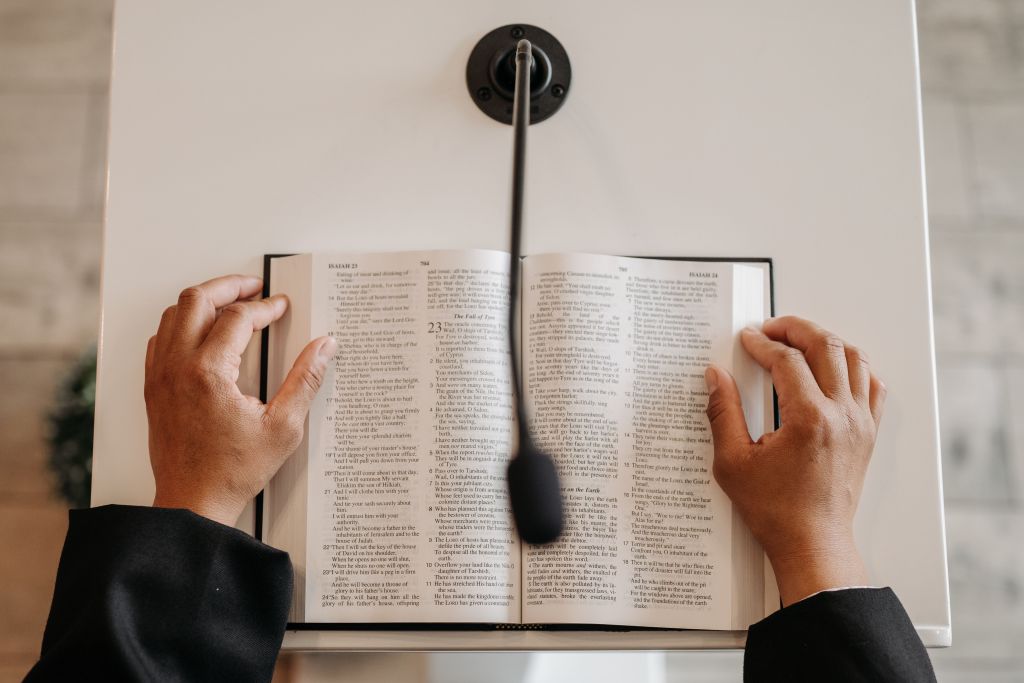
Since last week, our study was on Matthew 12:1-8. The focus of Matthew 12 may be seen in verses 6-8. Jesus states,“I tell you, something greater than the temple is here. And if you had known what this means, ‘I desire mercy, and not sacrifice,’ you would not have condemned the guiltless. For the Son of Man is Lord of the Sabbath.” (Matthew 12:6-8)
Key to understanding Matthew 12 boils down to understanding its context, Christ’s declaration, and His quote of the Old Testament Scripture. In our discussion, Jesus quoted Hosea 6:6, “For I desire steadfast love and not sacrifice, the knowledge of God rather than burnt offerings.”
Hosea, the last prophet to condemn the Ten Tribes of Israel, specifically the Northern kingdom, delivered his prophecies sometime after the kingdom’s division during the reign of Rehoboam. Despite its prosperity under Jeroboam’s rule, the Northern kingdom became insecure that Jews from the North might continue to travel to Jerusalem for worship, as per the Law of Moses. Consequently, Jeroboam constructed a rival temple both in Bethel and Dan. (1 Kings 12:25-33) This act marked the beginning of the Northern kingdom’s decline, ultimately leading to its conquest by the Assyrians, fulfilling God’s pronouncement of judgment upon the Ten Tribes.
The context of Matthew was the arrival of Jesus, the promised Christ (or Messiah) of the Old Testament Scripture. And yet, the contemporary Jews of Jesus’ days, though acknowledging His signs (John 2:23), refused to acknowledge the truth. In other words, they were in denial. Incidentally, in John’s Gospel, Jesus states, “Destroy this temple, and in three days I will raise it up.” (John 2:19) John explained that Jesus was speaking about the temple of His body, that is, His church. (John 2:21-22) Key to understand is that the establishment of Christ’s church is upon the proclamation of the Gospel and by His resurrection. Hence, it is important to understand, and we ought to refrain from calling the building or the place of gatherings the church. Because Christ’s church is not made by bricks and mortar but by His death and resurrection. Consequently, Jesus told Peter, “I will give you the keys of the kingdom of heaven, and whatever you bind on earth shall be bound in heaven, and whatever you loose on earth shall be loosed in heaven.” (Matthew 16:19) Christ Jesus and His Gospel are the key to God’s kingdom. Jesus declares, “I am the way, and the truth, and the life. No one comes to the Father except through Me.” (John 14:6)
Hebrews clearly taught that for as long as the temple in Jerusalem stands, the present age (i.e. the Jewish age) exists, which deals with food and drink and various washings, regulation until the time of reformation. (Hebrews 9:1-10) The reformation here has nothing to do with the reformation of Martin Luther and his contemporaries, but all about God’s workings. See Romans 8:18-23. Strong Greek Lexicon explains “Reformation, G1357, refers to the Messianic restoration. Jesus Christ, in Revelation 21:5, “Behold, I am making all things new.” “It is done! I am the Alpha and the Omega, the beginning and the end.” (Revelation 21:6)
Take note as well that Christ Jesus states that the redemption would draw near when Jerusalem has been surrounded by armies (Luke 21:20-28). The Jerusalem temple ceased to exist after its second destruction by the Romans in 70 AD. The question we ought to ask and understand has been complicated by our contemporary understanding of Christ’s return. Yet, Hebrews’ teachings about the reformation or redemption completed only after Christ’s return were clearly stipulated in Hebrews 9:28, “So also Christ, having been offered once to bear the sins of many, will appear a second time, not to bear sin, but to bring salvation to those who are waiting for Him.” Hence, John testified and states, “Then I saw a new heaven and a new earth, for the first heaven and the first earth had passed away, and the sea was no more.” (Revelation 21:1) John witnessed about the imminent passing of the first heaven and first earth and the arrival of the new heaven and new earth. In other words, John witnessed the passing of the Old Covenant creation and age, and the commencement of the New Creation. This explains Paul’s declaration, “Therefore, if anyone is in Christ, he is a new creation. The old has passed away; behold, the new has come.” (2 Corinthians 5:17)
Consequently, Christ’s declaration to the Old Covenant people, the Jewish people of His days, was significant, it’s a message of grace and mercy, a last chance if you will, because the end of the (Jewish) age was upon them (See Christ’s parable of the weeds, Matthew 13:36-43).
Sadly, contemporary Christians fail to comprehend, just as the Jews of Jesus’ time did not, that the blessings and arrival of Jesus Christ are now ours. The curse of Adam has been lifted, and we are now citizens of God’s kingdom. Those who have genuinely confessed faith in Christ Jesus would no longer suffer death, not to mean physical but rather spiritual death, which has become the consequence of Adam, the representative of all humanity, when God made His creation covenant with him. It’s important to note that Adam did not die physically immediately after he sinned or broke God’s covenant with him. Instead, he lived to the age of 930, contrary to God’s pronouncement, “But on the day you eat of it, you will certainly die” (Genesis 2:16-17). However, he did die at the very moment when he broke God’s covenant, just as God had stated the conditions for that covenant. Where is the evidence of Adam’s death? He was aware of his nakedness and was afraid of God. Later, after God’s curse had been pronounced upon him and all humanity following him, Adam and Eve were both banished from Eden, God’s paradise (Genesis 3:22-24).
See Genesis 3:6-7. Immediately after Adam and Eve ate the forbidden fruits, they realized they were naked. The passage does not imply being physically naked alone, but covenant nakedness. Hence, Paul speaking to the Jewish Christians, in 2 Corinthians 5:2-4 explained, “For we know that if our earthly tent (i.e the Mosaic Covenant) we live in is destroyed, we have a building from God, an eternal dwelling in the heavens, not made with hands (God’s eternal covenant). Indeed, we groan in this tent, desiring to put on our heavenly dwelling, since when we are clothed, we will not be found naked. Indeed, we groan while we are in this tent, burdened as we are, because we do not want to be unclothed but clothed, so that mortality may be swallowed up by life.” (For God’s New Covenant, see Jeremiah 31:31-34; Hebrews 8:8-12; Luke 22:20; 2 Corinthians 3:4-7; Paul contrasts the New Covenant, of the Spirit, to that of the letter [Mosaic covenant, carved in letters of stone])
Let us therefore rejoice and learn from Scripture. Paul states, “Now these things (i.e. the Old Covenant narrative on the disobedience of the Jews) took place as examples for us (Christians, people of the New Covenant), so that we will not desire evil things as they did.” (1 Corinthians 10:6)
Again, Paul states, “Let us not test Christ as some of them (Old Testament Jews) did and were destroyed by snakes. And don’t grumble as some of them did, and were killed by the destroyer. These things happened to them as examples, and they were written for our (Christians) instruction, on whom the ends of the ages have come.” (1 Corinthians 10:9-11) Take note that “ages” does not imply the end of human history, but the entirety of the Jewish age or Old Covenant age.
Christ Jesus came, and He had fulfilled all of God’s purpose for His New Covenant people. We who have truly confessed faith in Christ Jesus ought to understand God’s workings, so as not to repeat the mistake of those under the Old Covenant. Christ Jesus alone is our peace with God (Ephesians 2:14-22). He alone is the mediator to the New Covenant (Hebrews 9:11-15; 12:24). It is not that we ceased to sin, but by faith in Christ Jesus, His righteousness has been imputed upon us who believed (2 Corinthians 5:21; Romans 1:16-17). But does that mean we can go on sinning? Paul states, “What should we say then? Should we continue in sin so that grace may multiply? Absolutely not! How can we who died to sin still live in it? Or are you unaware that all of us who were baptized into Christ Jesus were baptized into His death? Therefore we were buried with Him by baptism into death, in order that, just as Christ was raised from the dead by the glory of the Father, so we too may walk in newness of life. For if we have been united with Him in the likeness of His death, we will certainly also be in the likeness of His resurrection.” (Romans 6:1-5)
Ironically, isn’t that the confession we made during our water baptism? Aren’t we declaring before those who witness our baptism that henceforth we are to walk in the newness of life? Do any of us think we can live a double life and yet claim eternity with Jesus? Let us all be reminded by God’s Word: “The Father loves the Son and has given all things into His hand. Whoever believes in the Son has eternal life; whoever does not obey the Son shall not see life, but the wrath of God remains on him.” (John 3:35-36)
Paul asserts, “The saying is trustworthy because if we have died with Jesus, we will also live with Him; if we endure, we will also reign with Him; if we deny Him, He will also deny us; if we are faithless, He remains faithful—for He cannot deny Himself.” (2 Timothy 2:11-13) Never assume that when everything appears perfect, we have God’s approval. Many people, without God, yet lead seemingly blissful and peaceful lives. Having earthly riches is never a measure of God’s approval; instead, it’s His grace. It’s up to us to recognize that everything comes from God. So, if we are blessed, should we abuse His grace and live our lives as if there’s no God, or should we be thankful and live in obedience?
Peter, in the words of Acts 3:6, declared, “I possess neither silver nor gold, but in the name of Jesus Christ, I offer you what I have.” Share this article freely, for you freely receive. Take note, underlines and highlights are clickable links for definitions or Bible references. Stay updated by heading to our about page and subscribe directly to receive notifications in your inbox. Blessings!
 Unlearning Tradition, Relearning Scripture