Tag: Peter and Paul in Rome?

  • Paul’s Martyrdom in Rome? (conclusion)

    Click here for the source of map above

    For background, you may want to read my previous blog “Paul’s Martyrdom in Rome?”

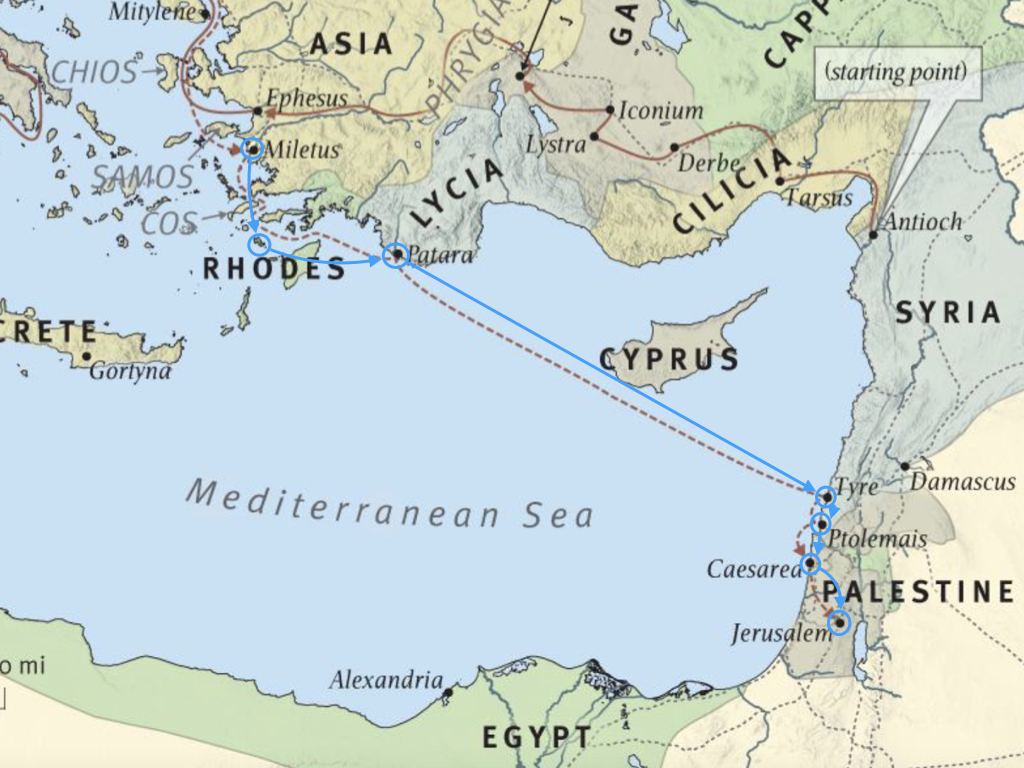
    Here is a summary of Paul’s travel to Jerusalem after his 3rd Missionary Journey: Paul met church elders from Ephesus at Miletus because he wanted to sail past Ephesus for he was hastening to be at Jerusalem for the Pentecost (Acts 20:16). No, I don’t think he wanted to be there by Pentecost for the festivity per se – rather, the opportunity to preach the Gospel, considering that Jews from everywhere would be in Jerusalem for the Pentecost. From Miletus, Paul took several ships’ ride, from one port to another, arriving in Ptolemais where he met Christian brothers and stayed for a night (Acts 21:7). The next day, Paul travelled by land coming to Caesarea (Acts 21:8). Again he met fellow believers, then few days later Paul went up to Jerusalem (Acts 21:8-15).

    It is important to remember Paul’s travel route as we come to conclude his possible location when he was martyed for the faith. So, it’s by several boat or ship rides from Miletus to Ptolemais, next by land to Caesarea and then Jerusalem.

    I uploaded a map (see above) to show the distance from Rome to Spain. In his letter to the church in Rome, Paul indicated his plans to go to Spain via Rome. See Romans 15:23-28.

    But now, since I no longer have any room for work in these regions, and since I have longed for many years to come to you, I hope to see you in passing as I go to Spain, and to be helped on my journey there by you, once I have enjoyed your company for a while. At present, however, I am going to Jerusalem bringing aid to the saints. For Macedonia and Achaia have been pleased to make some contribution for the poor among the saints at Jerusalem. For they were pleased to do it, and indeed they owe it to them. For if the Gentiles have come to share in their spiritual blessings, they ought also to be of service to them in material blessings. When therefore I have completed this and have delivered to them what has been collected, I will leave for Spain by way of you.

    Paul indeed arrived in Rome but via a different circumstance. He was a prisoner for the Gospel of Christ, which actually was his 4th Missionary Journey. As we can see from Acts 28:30-31, Paul stayed under house arrest in Rome for two years. Incidentally, the key verses of Luke’s second writing, Acts 1:6-8, came to fulfillment with his closing verses at the end of his narrative (Acts 28:28,30-31).

    So when they [the apostles] had come together, they asked Him [Jesus Christ], “Lord, will you at this time restore the kingdom to Israel?” He said to them, “It is not for you to know times or seasons that the Father has fixed by his own authority. But you will receive power when the Holy Spirit has come upon you, and you will be my witnesses in Jerusalem and in all Judea and Samaria, and to the end of the earth.” (Acts 1:6-8)

    Therefore let it be known to you that this salvation of God has been sent to the Gentiles; they will listen.” He lived there two whole years at his own expense, and welcomed all who came to him, proclaiming the kingdom of God and teaching about the Lord Jesus Christ with all boldness and without hindrance. (Acts 28:28,30-31)

    Without a doubt, Paul, through his missionary journeys, particularly his fourth under house arrest, indeed he became a witness to the “end of the earth” – Rome, the capital of the known world of Israel in the last days.

    Now see Jesus’ words to the apostles in Matthew 24:1-22.

    Jesus left the temple and was going away, when His disciples came to point out to Him the buildings of the temple. But He answered them, “You see all these, do you not? Truly, I say to you, there will not be left here one stone upon another that will not be thrown down.” As He sat on the Mount of Olives, the disciples came to him privately, saying, “Tell us, when will these things be, and what will be the sign of your coming and of the end of the age?” And Jesus answered them, “See that no one leads you astray. For many will come in my name, saying, ‘I am the Christ,’ and they will lead many astray. And you will hear of wars and rumors of wars. See that you are not alarmed, for this must take place, but the end is not yet. For nation will rise against nation, and kingdom against kingdom, and there will be famines and earthquakes in various places. All these are but the beginning of the birth pains. “Then they will deliver you up to tribulation and put you to death, and you will be hated by all nations for my name’s sake. And then many will fall away and betray one another and hate one another. And many false prophets will arise and lead many astray. And because lawlessness will be increased, the love of many will grow cold. But the one who endures to the end will be saved. And this gospel of the kingdom will be proclaimed throughout the whole world as a testimony to all nations, and then the end will come. “So when you see the abomination of desolation spoken of by the prophet Daniel, standing in the holy place (let the reader understand), then let those who are in Judea flee to the mountains. Let the one who is on the housetop not go down to take what is in his house, and let the one who is in the field not turn back to take his cloak. And alas for women who are pregnant and for those who are nursing infants in those days! Pray that your flight may not be in winter or on a Sabbath. For then there will be great tribulation, such as has not been from the beginning of the world until now, no, and never will be. And if those days had not been cut short, no human being would be saved. But for the sake of the elect those days will be cut short.

    Now compare Acts 1:6-8 with Matthew 24:14-15,21-22, then ask yourselves, “Do you see similarities in both passages?” Acts 1:8 spoke of the Gospel reaching the end of the earth, same with Matthew 24:14. Also, in Acts 1:6, the apostles asked about the restoration of Israel’s kingdom; then in Matthew 24:29-36,42 (see below), Jesus went on to tell the disciples about the end of the Old Covenant age, the coming of Jesus Christ.

    “Immediately after the tribulation of those days [the destruction of Jerusalem and the temple] the sun will be darkened, and the moon will not give its light, and the stars will fall from heaven, and the powers of the heavens will be shaken. Then will appear in heaven the sign of the Son of Man, and then all the tribes of the earth will mourn, and they will see the Son of Man coming on the clouds of heaven with power and great glory. And He will send out His angels with a loud trumpet call, and they will gather His elect from the four winds, from one end of heaven to the other. “From the fig tree learn its lesson: as soon as its branch becomes tender and puts out its leaves, you know that summer is near. So also, when you see all these things, you know that he is near, at the very gates. Truly, I say to you, this generation will not pass away until all these things take place. Heaven and earth will pass away, but My words will not pass away. But concerning that day and hour no one knows, not even the angels of heaven, nor the Son, but the Father only … Therefore, stay awake, for you do not know on what day your Lord is coming. (Matthew 24:29-36,42)

    Jesus said, “Heaven and earth will pass away, but My words will not pass away” (Matthew 24:35). The Gospel is for eternal (Revelation 14:6), it shall not pass away. “Heaven and earth” is covenant language; see Isaiah 65:17. “For behold, I create new heavens and a new earth, and the former things shall not be remembered or come to mind.”

    Therefore, it’s not literal “heaven and earth passing away but the Old Covenant”. See Isaiah 66:1.

    Thus says the LORD: “Heaven is My throne, and the earth is My footstool; what is the house that you would build for Me, and what is the place of My rest?

    Don’t you find it ridiculous for God to destroy His own throne, and the place of His reign (earth is God’s footstool)? Even during the flood in Noah days, God flooded the earth and destroyed humans and living things but not the earth.

    True, no one knows the day and the hour, only the Father, yet Jesus clearly declared the fulfillment of God’s judgment – the destruction of Jerusalem and its temple – would be with the generation of the disciples, the immediate audience of Jesus Christ at His first coming (See Matthew 24:34; Matthew 16:27-28; Matthew 10:23 and others). You may want also to read this article from crosswalk.com entitledLiar, Lunatic or Lord?”

    Now going back to Paul’s journey after his released from house arrest in Rome, let us look at the details of 2 Timothy 4:9-13, 19-21.

    [9] Do your best to come to me soon. [10] For Demas, in love with this present world, has deserted me and gone to Thessalonica. Crescens has gone to Galatia, Titus to Dalmatia. [11] Luke alone is with me. Get Mark and bring him with you, for he is very useful to me for ministry. [12] Tychicus I have sent to Ephesus. [13] When you come, bring the cloak that I left with Carpus at Troas, also the books, and above all the parchments. (2 Timothy 4:9-13)

    [19] Greet Prisca and Aquila, and the household of Onesiphorus. [20] Erastus remained at Corinth, and I left Trophimus, who was ill, at Miletus. [21] Do your best to come before winter. Eubulus sends greetings to you, as do Pudens and Linus and Claudia and all the brothers. (2 Timothy 4:19-21)

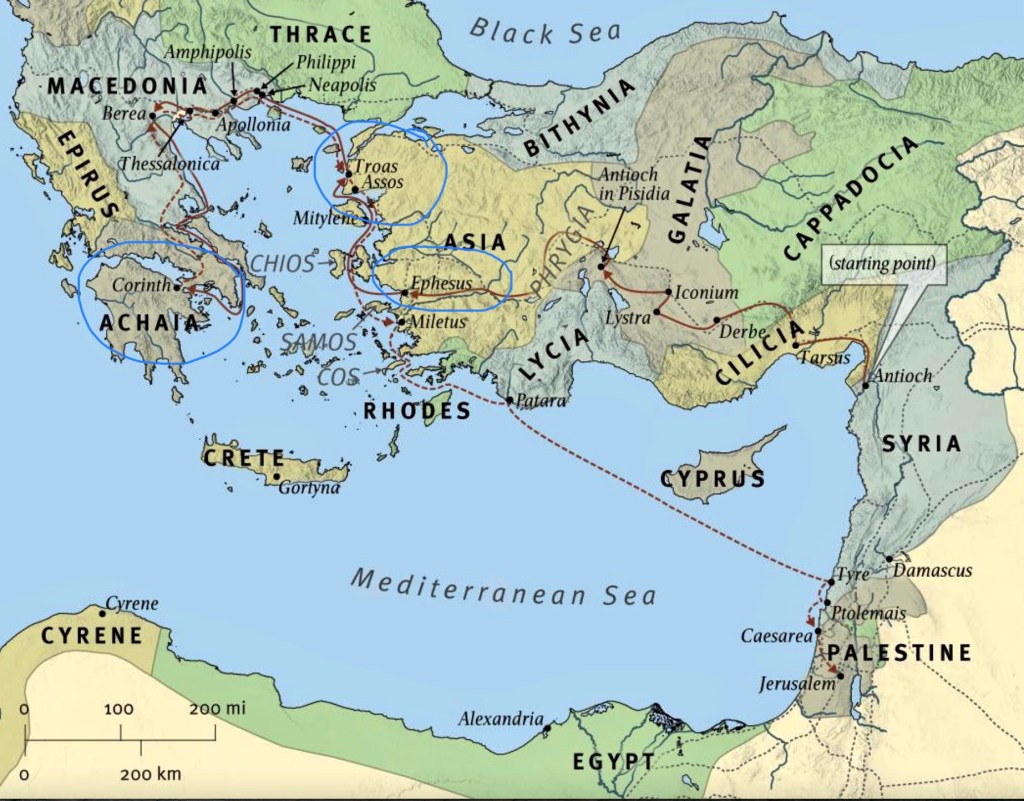
    Paul asked Timothy to come to him soon (4:9), but he should first pick up the cloak Paul left at Troas, as well as the books and all the parchments (4:13), and he should come before winter.
    ESV Study Bible Map, Paul’s 3rd Missionary Journey

    Look at the first map at the top, the beginning of this blog. You will see Rome, Greece and Asia Minor. We will focus on the last two. Here on our second map, Corinth is the same with Greece. Look at the areas I encircled with blue. Paul came to Troas after his released from house arrest at Rome (2 Timothy 4:13).

    Next, Paul mentioned leaving Trophimus at the care of believers in Asia Minor at Miletus (2 Timothy 4:20), right below Ephesus, see map above. Remember that Paul’s opponents, those who wanted him dead, were in Ephesus, so he told the Ephesian elders they would no longer see each other (Acts 20:25), but it was not out of fear or a desire to preserve his own life but to finish his course of ministry that he received from the Lord Jesus (Acts 20:24).

    Timothy, on the other hand, was previously with Paul at Rome. Let us look at the four prison letters of Paul. First, Philippians 1:1-2.

    Paul and Timothy, servants of Christ Jesus, To all the saints in Christ Jesus who are at Philippi, with the overseers and deacons: Grace to you and peace from God our Father and the Lord Jesus Christ.

    So clearly, Paul was with Timothy when he wrote to the Philippians. Next, Colossians 1:1-2.

    Paul, an apostle of Christ Jesus by the will of God, and Timothy our brother, To the saints and faithful brothers in Christ at Colossae: Grace to you and peace from God our Father.

    Again, Paul was with Timothy on his letter to the Colossians. Next, Philemon 1:1-2.

    Paul, a prisoner for Christ Jesus, and Timothy our brother, To Philemon our beloved fellow worker and Apphia our sister and Archippus our fellow soldier, and the church in your house:

    The letter to the Colossians and Philemon could have been sent at the same time because Philemon was from Colossae. Archippus, who was greeted along with Philemon, was a co-worker of Paul in Colossae. See Colossians 4:15-17.

    Give my greetings to the brothers at Laodicea, and to Nympha and the church in her house. And when this letter has been read among you, have it also read in the church of the Laodiceans; and see that you also read the letter from Laodicea. And say to Archippus, “See that you fulfill the ministry that you have received in the Lord.”

    Colossae, Hierapolis and Laodicea were tri-cities in Asia Minor. Only Laodicea was rebuilt quickly after the great earthquake but by their own effort – they were sufficient by themselves refusing help from Rome. The two other cities were left in ruins, slow to rebuild. So we see in Revelation, Jesus addressed only seven churches, excluding Laodicea and Hierapolis.

    The area often suffered from earthquakes, especially from the great shock that occurred in the reign of Nero (60 AD) in which the town was completely destroyed. But the inhabitants declined imperial assistance to rebuild the city and restored it from their own means.[10]

    Source, click here.

    Cities grow as they develop commercial centers that provide jobs for their residents. The ancient city of Colossae was built on a major trade route through the Lycus River Valley in the Roman province of Asia Minor (in the southwest corner of modern-day Turkey). There the Co­lossians manufactured a beautiful dark red wool cloth (colossinum) for which the city became famous. But Colossae’s importance as a business center diminished significantly around 100 BC, when the neighboring city of Laodicea was founded as an active and commercially aggressive competitor. The two towns, along with neighboring Hierapolis, were destroyed by earthquakes in AD 17 (in the reign of Tiberius) and again in 60 (in the reign of Nero). Rebuilt after each earthquake, Colossae never regained its early prominence, and by 400 the city no longer existed.

    TheologyOfWork, Background on Colossae and the Colossians

    Continuing on our discussion, next is Ephesians 1:1-2.

    Paul, an apostle of Christ Jesus by the will of God, To the saints who are in Ephesus, and are faithful in Christ Jesus: Grace to you and peace from God our Father and the Lord Jesus Christ.

    Here in Ephesians, there was no mention of Timothy. Perhaps Paul’s pastoral letter to Timothy could shed some light; see 1 Timothy 1:2-3.

    To Timothy, my true child in the faith: Grace, mercy, and peace from God the Father and Christ Jesus our Lord. As I urged you when I was going to Macedonia, remain at Ephesus so that you may charge certain persons not to teach any different doctrine.

    So Timothy was asked to remain in Ephesus while Paul embarked to Macedonia, but we don’t know for sure if he first went to Spain, just as he told the Romans prior to his arrest in Jerusalem, or he went straight to Macedonia after his released from house arrest in Rome.

    So now, we can see the details of Paul’s travel after his Roman imprisonment. He was imprisoned only once in Rome as we can see with my previous blog on the topic. Scholars found no evidence of either Peter or Paul entombed or later transferred and buried in Rome. Paul’s travel, as indicated from his own letters after his released from house arest in Rome, was clearly in the direction heading to Jerusalem. From Rome, Paul went to Macedonia (1 Timothy 1:2-3), then Troas (2 Timothy 4:13), and next Miletus (2 Timothy 4:20). Again, Paul’s travel direction was obviously going towards Jerusalem. See again Paul’s journey back to Jerusalem before his house arrest in Rome. From Miletus, Paul travelled by boat or ship, through several ports, then landing in Tyre or Ptolemais going to Caesarea, then Jerusalem. So where was Paul martyred?
    Now, let us again see Scripture and understand the heart and earnest desire of Paul as far as his ministry was concern.

    See Acts 21:13.

    Then Paul answered, “What are you doing, weeping and breaking my heart? For I am ready not only to be imprisoned but even to die in Jerusalem for the name of the Lord Jesus.

    Also, Romans 10:1-4.

    Brothers, my heart’s desire and prayer to God for them is that they [the Jews] may be saved. For I bear them witness that they have a zeal for God, but not according to knowledge. For, being ignorant of the righteousness of God, and seeking to establish their own, they did not submit to God’s righteousness. For Christ is the end of the law for righteousness to everyone who believes.

    Next, let us see what Jesus said about His prophets and apostles:

    See, Matthew 23:32-38.

    Fill up, then, the measure of your fathers. You serpents, you brood of vipers, how are you to escape being sentenced to hell? Therefore I send you prophets and wise men and scribes, some of whom you will kill and crucify, and some you will flog in your synagogues and persecute from town to town, so that on you may come all the righteous blood shed on earth, from the blood of righteous Abel to the blood of Zechariah the son of Barachiah, whom you murdered between the sanctuary and the altar. Truly, I say to you, all these things will come upon this generation. “O Jerusalem, Jerusalem, the city that kills the prophets and stones those who are sent to it! How often would I have gathered your children together as a hen gathers her brood under her wings, and you were not willing! See, your house [temple] is left to you desolate.

    Next, Luke 13:31-35.

    At that very hour some Pharisees came and said to Him [Jesus], “Get away from here, for Herod wants to kill you.” And He said to them, “Go and tell that fox, ‘Behold, I cast out demons and perform cures today and tomorrow, and the third day I finish my course. Nevertheless, I must go on my way today and tomorrow and the day following, for it cannot be that a prophet should perish away from Jerusalem.’ O Jerusalem, Jerusalem, the city that kills the prophets and stones those who are sent to it! How often would I have gathered your children together as a hen gathers her brood under her wings, and you were not willing! Behold, your house is forsaken. And I tell you, you will not see me until you say, ‘Blessed is he who comes in the name of the Lord!’”

    Question: Was Paul a prophet or only an apostle?

    See Acts 13:1,9.

    Now there were in the church at Antioch prophets and teachers, Barnabas, Simeon who was called Niger, Lucius of Cyrene, Manaen a lifelong friend of Herod the tetrarch, and Saul … But Saul, who was also called Paul, filled with the Holy Spirit, looked intently at him.

    So, was Paul among the prophets or teachers only? What then is a Prophet of God?

    The Nelson’s New International Bible Dictionary defined “Prophet” as a person who spoke for God and who communicated God’s message courageously to God’s Chosen People – the nation of Israel.

    The Hastings’ Dictionary of the Bible said, “The ministry of the word (Acts 6:4) was a prophetic ministry, and so we find Paul himself described as a prophet long after he had become an Apostle (Acts 13:1).”

    Paul, an apostle and prophet of Christ Jesus, also perished in Jerusalem, and the Jews was made accountable for his innocent blood, so Jerusalem and the temple became desolate in 70 AD. The Old Covenant Israel came to an end, so indeed “Therefore, if anyone is in Christ, he is a new creation. The old has passed away; behold, the new has come” (2 Corinthians 5:17).

    Oh, by the way, Peter was said to be in Babylon. See 1 Peter 5:12-13.

    By Silvanus, a faithful brother as I regard him, I have written briefly to you, exhorting and declaring that this is the true grace of God. Stand firm in it. She who is at Babylon, who is likewise chosen, sends you greetings, and so does Mark, my son.

    But Rome was not Babylon, Jerusalem is. See my blog entitled “Dating the Book of Revelation” to read the explanation. In conclusion, both Peter and Paul were martyred in Old Covenant Jerusalem.

    Blessings!

    If you want to follow our journey of unlearning tradition and relearning Scripture, you can stay updated by heading to our about page and subscribe directly to receive notifications in your inbox

  • Paul’s Martyrdom in Rome?

    According to Britannica.Com, the Tradition of Peter in Rome has no valid proofs except that of tradition claimed by early church fathers, see excerpt below:

    The strongest evidence to support the thesis that Peter was martyred in Rome is to be found in the Letter to the Corinthians (c. 96 CE; 5:1–6:4) of St. Clement of Rome.

    Peter, who by reason of wicked jealousy, not only once or twice but frequently endured suffering and thus, bearing his witness, went to the glorious place which he merited (5:4).…To these men [Peter and Paul] who lived such holy lives there was joined a great multitude of the elect who by reason of rivalry were victims of many outrages and tortures and who became outstanding examples among us (6:1).

    Note: The said letter to the Corinth were not those of the apostle Paul, but of Clement of Rome written in AD 96, many years after Paul was martyred for the faith. Therefore, that letter is by no means authoritative nor Scripture.

    These sources, plus the suggestions and implications of later works, combine to lead many scholars to accept Rome as the location of the martyrdom and the reign of Nero as the time.

    Excavations were begun in the late 19th century in order to substantiate the theory that the burial of Peter and Paul was ad catacumbas. After a half century of investigation, it now seems reasonable to concede that a cult of the apostles existed there about 260 CE, though Christian influence may have been exerted as early as 200 CE. None of the excavations, however, in all of the areas indicated at various times as the resting place of the apostolic relics, have produced any evidence whatsoever that the bodies of Peter and Paul were either buried there originally or brought there at a later time after earlier burials elsewhere.

    According to GotQuestions.Org, Christian catacombs, an underground tombs did not came to exist in Rome until the second century. See quotation below:

    In ancient Rome people were forbidden to bury their dead within the city limits. This rule led to the creation of the catacombs, a network of underground passages used as a cemetery. The pagans of Rome mainly used cremation, but some pagans and Jews utilized the catacombs to bury loved ones. Following the practice of the Jewish community, Christians began using the catacombs to bury their dead around the second century.

    Therefore, the claim that both Peter and Paul were martyred in Rome is highly doubtful. So here is a study on the possible location of Paul’s martyrdom. The second letter of Paul to Timothy provides clues to his whereabouts. See 2 Timothy 4:6-8.

    For I am already being poured out as a drink offering, and the time of my departure has come. I have fought the good fight, I have finished the race, I have kept the faith. Henceforth there is laid up for me the crown of righteousness, which the Lord, the righteous judge, will award to me on that day, and not only to me but also to all who have loved His appearing.

    “Departure [Greek 359]” was used only here in 2 Timothy. Yet, from the context, Paul claimed to have faithfully finished his mission. He had previously said, “For if I preach the gospel, that gives me no ground for boasting. For necessity is laid upon me. Woe to me if I do not preach the gospel! (1 Corinthians 9:16)” Consequently, no doubt this was a farewell letter of Paul to Timothy.

    Now, let us trace Paul’s last recorded journey to Jerusalem before he was arrested. See Acts 20:17-25.

    Now from Miletus he [Paul] sent to Ephesus and called the elders of the church to come to him. And when they came to him, he said to them: “You yourselves know how I lived among you the whole time from the first day that I set foot in Asia, serving the Lord with all humility and with tears and with trials that happened to me through the plots of the Jews; how I did not shrink from declaring to you anything that was profitable, and teaching you in public and from house to house, testifying both to Jews and to Greeks of repentance toward God and of faith in our Lord Jesus Christ. And now, behold, I am going to Jerusalem, constrained by the Spirit, not knowing what will happen to me there, except that the Holy Spirit testifies to me in every city that imprisonment and afflictions await me. But I do not account my life of any value nor as precious to myself, if only I may finish my course and the ministry that I received from the Lord Jesus, to testify to the gospel of the grace of God. And now, behold, I know that none of you [elders from the church in Ephesus] among whom I have gone about proclaiming the kingdom will see my face again.

    So here are the facts:

    1. Paul’s goal was to finish his course of ministry entrusted by Jesus to him (Acts 20:24).
    2. The Lord Jesus constrained Paul to go to Jerusalem, where he would face afflictions and imprisonments (Acts 20:22).
    3. Paul’s opponents were the Jews (Acts 20:18-19).
    4. Paul said he won’t see the Ephesian’s elders again (Acts 20:25).

    Here are some important details concerning Paul’s travel to Jerusalem:

    See Acts 20:17,22-23

    “Now from Miletus he sent to Ephesus and called the elders of the church to come to him. And now, behold, I am going to Jerusalem, constrained by the Spirit, not knowing what will happen to me there, except that the Holy Spirit testifies to me in every city that imprisonment and afflictions await me.”

    Next, Acts 20:36-38

    “And when he had said these things, he knelt down and prayed with them all. And there was much weeping on the part of all; they embraced Paul and kissed him, being sorrowful most of all because of the word he had spoken, that they would not see his face again. And they accompanied him to the ship.”

    Finally, Acts 21:1-8,15-18

    And when we had parted from them and set sail, we came by a straight course to Cos, and the next day to Rhodes, and from there to Patara. And having found a ship crossing to Phoenicia, we went aboard and set sail. When we had come in sight of Cyprus, leaving it on the left we sailed to Syria and landed at Tyre, for there the ship was to unload its cargo. And having sought out the disciples, we stayed there for seven days. And through the Spirit they were telling Paul not to go on to Jerusalem. When our days there were ended, we departed and went on our journey, and they all, with wives and children, accompanied us until we were outside the city. And kneeling down on the beach, we prayed and said farewell to one another. Then we went on board the ship, and they returned home. When we had finished the voyage from Tyre, we arrived at Ptolemais, and we greeted the brothers and stayed with them for one day. On the next day we departed and came to Caesarea, and we entered the house of Philip the evangelist, who was one of the seven, and stayed with him. After these days we got ready and went up to Jerusalem. And some of the disciples from Caesarea went with us, bringing us to the house of Mnason of Cyprus, an early disciple, with whom we should lodge. When we had come to Jerusalem, the brothers received us gladly. On the following day Paul went in with us to James, and all the elders were present.

    It is important to note that Paul travelled to Jerusalem by ship, several connecting ports, from Miletus to Ptolemais, then arriving in Caesarea en route by land to Jerusalem. See map below, follow the blue line to see the travel route of Paul from Miletus to Jerusalem.

    Map courtesy of ESV Study Bible Resources Follow the blue line to see the travel route of Paul from Miletus to Jerusalem

    Now continuing on our study of Paul’s journey back to Jerusalem before his house arrest in Rome, see Acts 21:27-28.

    When the seven days were almost completed, the Jews from Asia, seeing him [Paul] in the temple, stirred up the whole crowd and laid hands on him, crying out, “Men of Israel, help! This is the man who is teaching everyone everywhere against the people [the Jews] and the law [the Mosaic law] and this place [the Temple]. Moreover, he even brought Greeks into the temple and has defiled this holy place.”

    The enemies of Paul, Jews in Asia Minor, came also to Jerusalem and saw Paul. They instigated against him, claiming he was an enemy of the Jews, the Mosaic Law and the temple itself. So Paul was arrested; see Acts 21:30-37.

    Then all the city was stirred up, and the people ran together. They seized Paul and dragged him out of the temple, and at once the gates were shut. And as they were seeking to kill him, word came to the tribune of the cohort that all Jerusalem was in confusion. He at once took soldiers and centurions and ran down to them. And when they saw the tribune and the soldiers, they stopped beating Paul. Then the tribune came up and arrested him and ordered him to be bound with two chains. He inquired who he was and what he had done. Some in the crowd were shouting one thing, some another. And as he could not learn the facts because of the uproar, he ordered him to be brought into the barracks. And when he came to the steps, he was actually carried by the soldiers because of the violence of the crowd, for the mob of the people followed, crying out, “Away with him!” As Paul was about to be brought into the barracks, he said to the tribune, “May I say something to you?” And he said, “Do you know Greek?

    Like that of the Lord Jesus Christ, Paul’s arrest came by the instigation of the Jews, who wanted him dead (Acts 21:31). If not for the intervention of Roman soldier, in their effort to keep peace in Jerusalem, perhaps Paul might have been stoned to death outright.

    While being investigated at the Roman tribune, the soldiers came to know that Paul was a citizen of Rome; see Acts 22:25-30.

    But when they had stretched him out for the whips, Paul said to the centurion who was standing by, “Is it lawful for you to flog a man who is a Roman citizen and uncondemned?” When the centurion heard this, he went to the tribune and said to him, “What are you about to do? For this man is a Roman citizen.” So the tribune came and said to him, “Tell me, are you a Roman citizen?” And he said, “Yes.” The tribune answered, “I bought this citizenship for a large sum.” Paul said, “But I am a citizen by birth.” So those who were about to examine him withdrew from him immediately, and the tribune also was afraid, for he realized that Paul was a Roman citizen and that he had bound him. But on the next day, desiring to know the real reason why he was being accused by the Jews, he unbound him and commanded the chief priests and all the council to meet, and he brought Paul down and set him before them.

    While Paul was still in Jerusalem, he was next examined and confronted by the Chief Priest and the Jewish Sanhedrin. Paul raised the topic of Resurrection, creating a division among the Sadducees and Pharisees. Click here to understand the differences between these two Jewish religious sect.

    A plot against Paul’s life was designed with the cooperation of the Chief Priests and elders. See Acts 23:12-15.

    When it was day, the Jews made a plot and bound themselves by an oath neither to eat nor drink till they had killed Paul. There were more than forty who made this conspiracy. They went to the chief priests and elders and said, “We have strictly bound ourselves by an oath to taste no food till we have killed Paul. Now therefore you, along with the council, give notice to the tribune to bring him down to you, as though you were going to determine his case more exactly. And we are ready to kill him before he comes near.”

    The plot however came to the knowledge of Paul and the tribune, so the Roman soldiers escorted Paul out of Jerusalem and transferred him to the custody of Felix, the Roman governor of Judea, Caesarea. Paul spent two years imprisoned at Caesarea until Felix was succeeded by Porcius Festus; see Acts 24:27 to 25:1-7.

    When two years had elapsed, Felix was succeeded by Porcius Festus. And desiring to do the Jews a favor, Felix left Paul in prison. Now three days after Festus had arrived in the province, he went up to Jerusalem from Caesarea. And the chief priests and the principal men of the Jews laid out their case against Paul, and they urged him, asking as a favor against Paul that he summon him to Jerusalem—because they were planning an ambush to kill him on the way. Festus replied that Paul was being kept at Caesarea and that he himself intended to go there shortly. “So,” said he, “let the men of authority among you go down with me, and if there is anything wrong about the man, let them bring charges against him.” After he stayed among them not more than eight or ten days, he went down to Caesarea. And the next day he took his seat on the tribunal and ordered Paul to be brought. When he had arrived, the Jews who had come down from Jerusalem stood around him, bringing many and serious charges against him that they could not prove.

    It had been two years after Paul was first arrested in Jerusalem. Though he was away, imprisoned in Caesarea, the Jews still wanted him dead. Paul was later interrogated by Festus and King Agrippa [Herod Agrippa II]. It was at this time that Paul appealed for Caesar (Acts 25:10-12; Acts 25:21-22; Acts 26:32).

    Paul appealed to appear before Caesar, not really to escape death, for he has previously claimed desire to die in Jerusalem preaching the Gospel (Acts 21:13), but to further do his mission – to testify also in Rome. See Acts 23:11.

    The following night the Lord stood by him [Paul] and said, “Take courage, for as you have testified to the facts about Me in Jerusalem, so you must testify also in Rome.”

    On hindsight, before his arrest in Jerusalem, while he was still doing his ministry at Ephesus, the Spirit of Jesus had actually previously told Paul about his future mission in Jerusalem, then Rome (Acts 19:21-22).


    At this point, a relevant information might connect 2 Timothy 4:14-18 with the riot against Paul at Ephesus in Acts 19. That must be the reason, Paul told the Ephesian elders, after his departure to Jerusalem he won’t be seeing them again. For the simple reason, later, it was the Jews from Asia (Ephesus) who came to Jerusalem accusing Paul of wrongdoings against the Jewish traditions. They might be the forty Jews who pledged to kill Paul also.

    See 2 Timothy 4:14-17.

    Alexander the coppersmith did me great harm; the Lord will repay him according to his deeds. Beware of him yourself, for he strongly opposed our message. At my first defense no one came to stand by me, but all deserted me. May it not be charged against them! But the Lord stood by me and strengthened me, so that through me the message might be fully proclaimed and all the Gentiles might hear it. So I was rescued from the lion’s mouth.

    Now see and compare Acts 19:22-27,33-34.

    And having sent into Macedonia two of his helpers, Timothy and Erastus, he himself stayed in Asia for a while. About that time there arose no little disturbance concerning the Way. For a man named Demetrius, a silversmith, who made silver shrines of Artemis, brought no little business to the craftsmen. These he gathered together, with the workmen in similar trades, and said, “Men, you know that from this business we have our wealth. And you see and hear that not only in Ephesus but in almost all of Asia this Paul has persuaded and turned away a great many people, saying that gods made with hands are not gods. And there is danger not only that this trade of ours may come into disrepute but also that the temple of the great goddess Artemis may be counted as nothing, and that she may even be deposed from her magnificence, she whom all Asia and the world worship.”Some of the crowd prompted Alexander, whom the Jews had put forward. And Alexander, motioning with his hand, wanted to make a defense to the crowd. But when they recognized that he was a Jew, for about two hours they all cried out with one voice, “Great is Artemis of the Ephesians!”

    Alexander was prompted by fellow Jews not to make a defense on Paul’s behalf, but in an effort to protect themselves – Jews – against the possible animosity of the Gentiles. They fear for themselves and perhaps for their trade as well. Alexander was a coppersmith man in Ephesus, probably also a maker of the image of Artemis.

    On his first letter to Timothy (1 Timothy 1:18-20), Paul also mentioned Alexander along with Hymenaeus, saying: “This charge I entrust to you, Timothy, my child, in accordance with the prophecies previously made about you, that by them you may wage the good warfare, holding faith and a good conscience. By rejecting this, some have made shipwreck of their faith, among whom are Hymenaeus and Alexander, whom I have handed over to Satan that they may learn not to blaspheme.

    Possibly, after the riot, sometime later, the Gospel was shared to Alexander, but his true colors came out. He might be with Hymenaeus and Philetus, promulgating heresy regarding the resurrection; see 2 Timothy 2:16-18.

    But avoid irreverent babble, for it will lead people into more and more ungodliness, and their talk will spread like gangrene. Among them are Hymenaeus and Philetus, who have swerved from the truth, saying that the resurrection has already happened. They are upsetting the faith of some.

    Concerning the heresy about the resurrection, read my blog entitled “Scripture vs. Tradition”, click on the link to read.

    Now back to 2 Timothy 4:17, Paul’s mention of lion’s mouth refers to the Jews of Ephesus, for the context begins with his mention of Alexander the coppersmith. In 1 Corinthians 15:32, Paul said: “What do I gain if, humanly speaking, I fought with beasts at Ephesus? If the dead are not raised, ‘Let us eat and drink, for tomorrow we die.‘”

    Furthermore, Paul also said (2 Timothy 1:15-18):

    You are aware that all who are in Asia turned away from me, among whom are Phygelus and Hermogenes. May the Lord grant mercy to the household of Onesiphorus, for he often refreshed me and was not ashamed of my chains, but when he arrived in Rome he searched for me earnestly and found me— may the Lord grant him to find mercy from the Lord on that day!—and you well know all the service he rendered at Ephesus.

    Luke’s narrative here has to do with Paul’s house arrest in Rome, Acts 28. His trouble was instigated by Jews in Asia. So it makes so much sense that in Revelation, the Seven churches of Asia Minor became the focus of Jesus Christ, for among the seven was Ephesus, the beasts whom Paul fought.


    Now back to Paul’s journey. In Acts 28:16,30-31, finally Paul came to Rome, though was in house arrest but was able to freely preach the Gospel for two years, thereby fulfilling his mandated mission.

    And when we {Luke, the author of Acts was with Paul] came into Rome, Paul was allowed to stay by himself, with the soldier who guarded him … He lived there two whole years at his own expense, and welcomed all who came to him, proclaiming the kingdom of God and teaching about the Lord Jesus Christ with all boldness and without hindrance.

    During his house arrest in Rome, Paul wrote four letters to the churches, namely Ephesians, Philippians, Colossians and Philemon. GotQuestions.Org placed his Rome imprisonment about 60-62 AD. Below is an excerpt from the said website concerning Paul’s imprisonment in Rome.

    The prison epistles—EphesiansPhilippiansColossians, and Philemon—are so named because they were written by the apostle Paul during one of his incarcerations. It is generally accepted that Paul wrote the prison epistles during his first Roman imprisonment. The exact dates he wrote each of the prison epistles is unknown, but the two-year period he spent under house arrest in Rome has been narrowed down to the years AD 60–62. Paul’s imprisonment in Rome is verified by the book of Acts, where we find references to his being guarded by soldiers (Acts 28:16), being permitted to receive visitors (Acts 28:30), and having opportunities to share the gospel (Acts 28:31). These details, along with Paul’s mention of being with “those who belong to Caesar’s household” (Philippians 4:22), support the view that Paul wrote the prison epistles from Rome. Paul’s Roman incarceration produced three great letters to the churches of Ephesus, Colosse, and Philippi, as well as a personal letter to his friend Philemon.

    Details on Paul’s whereabouts after his release from house arrest in Rome may be seen through the prison letters of Paul vis-a-vis the details found in his pastoral letters to Timothy. However, due to its length, we will continue our study in my next blog, on Paul’s whereabouts when he was martyred, which obviously was not in Rome.

    Blessings!

    If you want to follow our journey of unlearning tradition and relearning Scripture, you can stay updated by heading to our about page and subscribe directly to receive notifications in your inbox