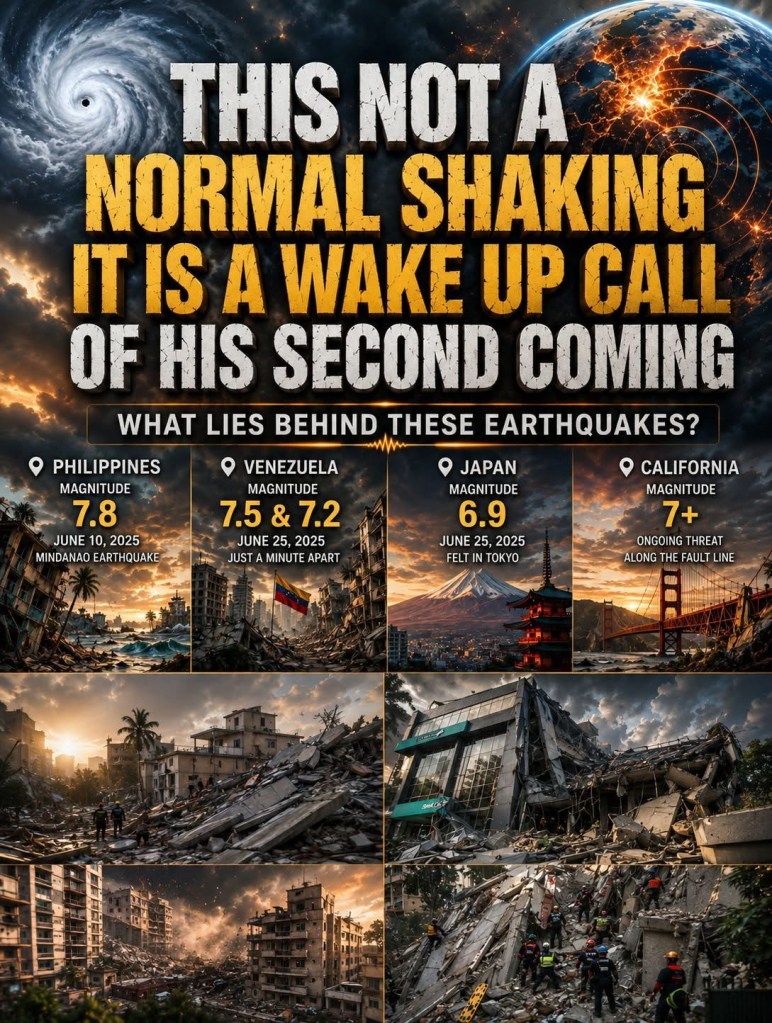
Photo taken from “Buhay Kristyano 6.33”
No, that is not correct. The recent earthquakes are not connected to Christ’s return. Let us look into Scripture to see where such an idea might have originated. The Bible says:
“Jesus left the temple and was going away when His disciples came to show Him the temple buildings. But He said to them, ‘Do you see all of these? Truly, I tell you, not one stone here will remain on another; every one will be thrown down.’ Later, as He sat on the Mount of Olives, the disciples approached Him privately and asked, ‘Tell us, when will these things happen, and what will be the sign of Your coming and of the end of the age?’” (Matthew 24:1-3)
Let us explore the question: When will the temple be destroyed? What will be the sign of Your coming and of the end of the age? These seemingly three distinct questions collectively encapsulate a single, overarching inquiry.
Take note, the disciples sought the sign of Jesus’ coming because of His prediction of the temple’s destruction. They were well aware of the connection between the desolation of the temple and the two other events – the coming of Jesus and the end of the age. Jesus first warned them about the deceptive nature of false prophets. He cautioned them:
“Be on guard against false prophets. Many will come in My name, claiming to be the Christ, and they will lead many astray.” (Matthew 24:4-5)
Let’s quickly address the concept of “end of the age.” The Bible states:
“On many past occasions and in many different ways, God spoke to our fathers through the prophets. But in these last days He has spoken to us by His Son, whom He appointed heir of all things, and through whom He made the universe” (Hebrews 1:1-2).
The arrival of Jesus, commonly referred to as “Christ’s First Coming,” marked the commencement of the “last days” mentioned in both the Old and New Testament Scriptures (Daniel 2:27-45; Deuteronomy 4:30; 18:15-22; 31:29; Acts 2:17-41; Galatians 4:4-5; Ephesians 2:3-14; 2 Peter 3:3-13). In essence, it signifies the final days of Old Covenant Israel, not the entire world.
Here’s the proof that God is going to create a new people, see Isaiah 65:17-19:
“For behold, I create new heavens and a new earth, and the former things shall not be remembered or come into mind. But be glad and rejoice forever in that which I create; for behold, I create Jerusalem to be a joy, and her people to be a gladness. I will rejoice in Jerusalem and be glad in My people; no more shall be heard in it the sound of weeping and the cry of distress.”
In the Gospel of Luke, during the Last Supper or the Passover meal, the Bible states:
“And Jesus took bread, and when He had given thanks, He broke it and gave it to His disciples, saying, ‘This is My body, which is given for you. Do this in remembrance of Me.’ And likewise the cup after they had eaten, saying, ‘This cup that is poured out for you is the new covenant in My blood.’” (Luke 22:19-20)
Here is the essence of Christ’s declaration of the New Covenant. Paul, in 2 Corinthians 5:16-17 states:
“From now on, therefore, we regard no one according to the flesh (i.e., circumcision or Old Covenant). Even though we once regarded Christ according to the flesh, we regard Him thus no longer. Therefore, if anyone is in Christ, he is a new creation. The old has passed away; behold, the new has come.”
Back to Christ’s warning against deceptive false prophets (Matthew 24:4-5). As students of the Bible, we should have noticed Jesus’ repeated warning to His disciples on this matter in Matthew 24. Jesus cautions:
“Then if anyone says to you, ‘Look, here is the Christ!’ or ‘There he is!’ do not believe it. For false christs and false prophets will arise and perform great signs and wonders, so as to lead astray, if possible, even the elect. See, I have told you beforehand. So, if they say to you, ‘Look, he is in the wilderness,’ do not go out. If they say, ‘Look, he is in the inner rooms,’ do not believe it’” (Matthew 24:23-26).
It was undoubtedly of utmost importance for Jesus to reiterate this warning three times, as seen for the first time in Matthew 24:4-5. But why did He do so?
Let’s take a look at Jesus’ declaration, both to the Pharisees and to His disciple on the same reference “look, here it is! or there!”
“Being asked by the Pharisees when the kingdom of God would come, Jesus answered them, “The kingdom of God is not coming in ways THAT CAN BE OBSERVED, nor will they say, ‘Look, here it is!’ or ‘There!’ for behold, the kingdom of God is in the midst of you.” And Jesus said to the disciples, “The days are coming when you will desire to see one of the days of the Son of Man, and you will not see it. And they will say to you, ‘Look, there!’ or ‘Look, here!’ Do not go out or follow them. For as the lightning flashes and lights up the sky from one side to the other, so will the Son of Man be in His day. But first He must suffer many things and be rejected by this generation.” (Luke 17:20-25)
Contrary to popular belief, Jesus wasn’t implying that His coming would be swift and easily noticeable by saying, “For as the lightning flashes and illuminates the sky from one side to the other.” Instead, Christ was quoting Zechariah 9:14:
“Then the LORD will appear over them, and His arrow will be sent forth like lightning; the Lord GOD will sound the trumpet and will march forth in the whirlwinds of the south.”
In essence, Jesus declares that He, the Son of Man, will return in the glory of LORD or YHWH, the covenant name of God. God Almighty – God the Father, God the Son and the Holy Spirit.
Look at Jesus words again: “The days are coming when you will desire to see one of the days of the Son of Man, and you will not see it. And they will say to you, ‘Look, there!’ or ‘Look, here!’ Do not go out or follow them.” (Luke 17:22-23)
By quoting from Zechariah 9, Jesus assures His disciples that He is the Christ, the King who came to Jerusalem riding a donkey (Zechariah 9:9). This prophecy was fulfilled just days later in Luke 19:28-38. Contrary to contemporary Christian beliefs and teachings, the Bible never taught about two separate comings of Jesus Christ. With the coming of Jesus, the Christ, He was to fulfill Scriptures (Matthew 5:17; Luke 24:44). The Book of Hebrews clearly teaches:
“Just as man is appointed to die once, and after that to face judgment, so also Christ was offered once to bear the sins of many; and He will appear a second time, not to bear sin, but to bring salvation to those who eagerly await Him” (Hebrews 9:27-28).
It is not two comings, but by His return, He completed His salvation work for all who believe in Him. Christ Jesus’ return would be marked by glory and power, not by a visible appearance, but rather by the event of the temple’s desolation or destruction, which occurred in 70 AD. Contrary to contemporary Christian teachings and beliefs, Acts 1:11 explicitly states that Jesus will return in glory, not in a physical form. Jesus’ coming on the clouds signifies His return in glory, as specifically stated by Paul in 1 Timothy 3:16.
“Indeed, we confess, is the mystery of godliness: He was manifested in the flesh, vindicated by the Spirit, seen by angels, proclaimed among the nations, believed on in the world, and taken up in glory.”
After Christ’s ascension, Jesus manifested Himself to Stephen before his martyrdom for the faith and to Paul during his Damascus encounter. In Acts, Jesus was either seen on the right hand of God (Acts 7:55-56), in glory (Acts 9:3-7), or in the Spirit (Acts 16:7).
Consequently, Jesus cautioned His disciples against believing claims of seeing Him visibly during His coming. Refer to Luke 17:22-24, where He addressed the disciples and said:
“The days are coming when you will yearn to witness one of the days of the Son of Man, but you will not be able to see it. They will say to you, ‘Look, there!’ or ‘Look, here!’ Do not go out or follow them. For as the lightning flashes and illuminates the sky from one side to the other, so will the Son of Man be in His day.”
The same message was conveyed by Jesus in Matthew 24:23-27. In verse 27, Jesus seems to have likened His return to the lightning that illuminates the sky from one side to the other (Luke 17:24), but in reality, He quotes Zechariah 9:14:
“Then the LORD will appear over them, and His arrow will go forth like lightning; the Lord GOD will sound the trumpet and will march forth in the whirlwinds of the south”
The declaration in Zechariah 9:14-17 signifies that Jesus would return in glory and power, and His salvation would be completed upon His return, same with Hebrews 9:28.
“So also Christ was offered once to bear the sins of many; and He will appear a second time, not to bear sin, but to bring salvation to those who eagerly await Him.” (Hebrews 9:28)
There’s no huge gap after all in Christ’s coming, unlike the beliefs of many today. It’s been millennia since Jesus appeared. Instead, Jesus fulfilled Scriptures, as foreshadowed by the Exodus to the Promised Land. Israel spent forty years in Exodus with Moses before Joshua led them in conquering the Promised Land. Luke explained the transfiguration of Jesus, stating:
“Suddenly two men, Moses and Elijah, began talking with Jesus. They appeared in glory and spoke about His departure, which He was about to accomplish at Jerusalem” (Luke 9:30-31).
The Greek word translated “departure” literally means “exodus,” so like the Exodus, which was the shadow of things to come. Jesus was in fulfillment of Scriptures; He led His people in exodus to the true Promised Land. The Bible states:
“For if Joshua had given them rest, God would not have spoken of another day later on. So then, there remains a Sabbath rest for the people of God, for whoever has entered God’s rest has also rested from his works as God did from His.” (Hebrews 4:8-10)
The Promised Land signifies rest. God has welcomed back mankind – that is, those who believe in Jesus Christ – to the Garden of Eden, where God is in communion with man, and man works not to survive, but in the command of God. (Genesis 2:15) Jesus Christ declares:
“Do not work for the food that perishes, but for the food that endures to eternal life, which the Son of Man will give to you. For on Him God the Father has set His seal.” (John 6:27)
Work on how to increase your faith, and always believe in Jesus Christ. For Jesus states:
“So don’t worry about these things, saying, ‘What will we eat? What will we drink? What will we wear?’ These things dominate the thoughts of unbelievers, but your heavenly Father already knows all your needs. Seek the Kingdom of God above all else, and live righteously, and He will give you everything you need.” (Matthew 6:31-33)
Next, in Matthew 24:6-8, Jesus states:
“And you will hear of wars and rumors of wars. See that you are not alarmed, for this must take place, but the end is not yet. For nation will rise against nation, and kingdom against kingdom, and there will be famines and earthquakes in various places. All these are but the beginning of the birth pains.”
During the time of the disciples, were there no wars or rumors of wars, nor were there any earthquakes? The Jewish war occurred during the era of Jesus Christ’s disciples. According to the Jewish historian Flavius Josephus, a severe earthquake struck Jerusalem during the festival of Pentecost (Shavuot) in 66 AD, just before the outbreak of the Jewish-Roman War. Josephus also recorded the occurrence of famine during that period.
Furthermore, the decades preceding the 70 AD destruction of Jerusalem and the temple were marked by a series of geological upheavals throughout the Roman Empire. Although not confined to Jerusalem, earthquakes devastated cities in Crete, Smyrna, Miletus, Campania, and the renowned 63 AD earthquake that obliterated Pompeii. These events were widely interpreted by early followers as forewarnings of the city’s impending downfall.
Continuing on, in Matthew 24:9-15, Jesus next states:
“Then they will deliver you (i.e., the disciples) up to tribulation and put you to death, and you will be hated by all nations for My name’s sake. And then many will fall away and betray one another and hate one another. And many false prophets will arise and lead many astray. And because lawlessness will be increased, the love of many will grow cold. But the one who endures to the end will be saved. And this gospel of the kingdom will be proclaimed throughout the whole world as a testimony to all nations, and then the end will come.”
The Book of Acts chronicles the spread of the Gospel. It begins in Jerusalem (Acts 2-7), extends to all Judea and Samaria (Acts 8), and ultimately reaches the ends of the earth (Acts 11:19-28:31). Paul was in Rome at the conclusion of Luke’s narration in Acts. As the capital of the Roman Empire, Rome represented the culmination of the then-known Jewish world, fulfilling Acts 1:8. Jesus prophesied to His apostles:
“But you will receive power when the Holy Spirit has come upon you, and you will be my witnesses in Jerusalem and in all Judea and Samaria, and to the ends of the earth.”
Therefore, contrary to contemporary Christian beliefs, Matthew 24:14 has been fulfilled in Acts. The Gospel had indeed reached the ends of the world. Refer to Paul’s subsequent declaration for further insight (Romans 10:18; Romans 15:18-21; Romans 16:25-26; Colossians 1:5-6; Colossians 1:23).
Jesus finally revealed the sign of His coming, saying:
“So, when you see the abomination of desolation spoken of by the prophet Daniel standing in the holy place (let the reader understand), then let those in Judea flee to the mountains. Those on the housetop should not descend to take what is in their house, and those in the field should not turn back to retrieve their cloaks. Alas, women who are pregnant and those who are nursing infants during those days! Pray that your flight may not occur in winter or on a Sabbath. For then there will be great tribulation, such as has never been experienced since the beginning of the world and will never be again. If those days had not been shortened, no human being would be saved. However, for the sake of the elect, those days will be shortened.” (Matthew 24:15-22)
The destruction of the temple was the sign of Jesus’ coming, as mentioned in Daniel’s prophecies (Daniel 8:13, 9:26-27, and 12:11-13). Anyone still skeptical that Jesus in Matthew 24:15 spoke of the temple’s desolation should simply refer to Luke’s narration on the same event.
“But when you see Jerusalem surrounded by armies, then know that its desolation has come near. Then let those who are in Judea flee to the mountains, and let those who are inside the city depart, and let not those who are out in the country enter it, for these are days of vengeance, to fulfill all that is written. Alas for women who are pregnant and for those who are nursing infants in those days! For there will be great distress upon the earth and wrath against this people. They will fall by the edge of the sword and be led captive among all nations, and Jerusalem will be trampled underfoot by the Gentiles, until the times of the Gentiles are fulfilled.” (Luke 21:20-24)
Interestingly, many people overlooked the fact that Jesus quoted Daniel 12:1 in Matthew 24:21, stating:
“For then there will be great tribulation, such as has not been from the beginning of the world until now, no, and never will be.”
Moreover, it’s crucial to note that Daniel 12:3 states:
“And those who are wise shall shine like the brightness of the sky above; and those who turn many to righteousness, like the stars forever and ever.”
Jesus quoted this verse when He spoke about the kingdom of heaven. Refer to Matthew 13:43. Let us learn from Christ’s teaching on Daniel 12:3 or Matthew 13:43, the context for Jesus’ teaching in Matthew 13:44-52.
“Then the righteous will shine like the sun in the kingdom of their Father. He who has ears, let him hear (Daniel 12:3). The kingdom of heaven is like treasure hidden in a field, which a man found and covered up. Then in his joy he goes and sells all that he has and buys that field.” “Again, the kingdom of heaven is like a merchant in search of fine pearls, who, on finding one pearl of great value, went and sold all that he had and bought it.” “Again, the kingdom of heaven is like a net that was thrown into the sea and gathered fish of every kind. When it was full, men drew it ashore and sat down and sorted the good into containers but threw away the bad. So it will be at the end of the age. The angels will come out and separate the evil from the righteous and throw them into the fiery furnace. In that place there will be weeping and gnashing of teeth.” “Have you understood all these things?” They said to Jesus, “Yes.” And He said to them, “Therefore every scribe who has been trained for the kingdom of heaven is like a master of a house, who brings out of his treasure what is new and what is old.” And when Jesus had finished these parables, he went away from there,” (Matthew 13:43-53)
So, here’s the challenge: have we truly been trained for the kingdom of heaven? Sadly, the fallacy concerning the Return of Jesus has persisted for too long that people have accepted it as the truth. Indeed, as the saying goes, “Repeat a lie often enough, and it becomes the truth.”
Have we been obedient to do our part in God’s kingdom? Paul wrote in Romans:
“So we (i.e., God’s church), though many, are one body in Christ, and individually members one of another. Having gifts that differ according to the grace given to us, let us use them: if prophecy, in proportion to our faith; if service, in our serving; the one who teaches, in his teaching; the one who exhorts, in his exhortation; the one who contributes, in generosity; the one who leads, with zeal; the one who does acts of mercy, with cheerfulness.” (Romans 12:5-8)
Some individuals have been serving for financial gain, but Paul emphasizes that they are not like many others who peddle God’s word. Instead, they are sincere men, commissioned by God, who speak in Christ in the presence of God. (2 Corinthians 2:17) Others, similarly fixated on their calculators evaluating their contributions to God’s work, behave like stock market investors. When their investments decrease, their giving also diminishes. However, what happens when the market is thriving? Do their giving practices align with the increase in their financial standing?
Here’s a story from the Bible:
“Jesus sat opposite the treasury and observed the people depositing money into the offering box. Many wealthy individuals contributed substantial sums. However, a poor widow approached and placed two small copper coins, which constitute a penny. Jesus then called His disciples to Him and said, ‘Truly, I say to you, this impoverished widow has contributed more than all those who are giving to the offering box. They all contributed out of their abundance, but she, despite her poverty, has given everything she had, all that she needed to sustain herself.’” (Mark 12:41-44)
Let us all give to the Lord what has been entrusted to us first. Scripture state:
“Beware lest you say in your heart, ‘My power and the might of my hand have gotten me this wealth.’ You shall remember the LORD your God, for it is He who gives you power to get wealth.” (Deuteronomy 8:17-18)
Christ Jesus told of a person who came to Him, asking about eternal life. Sadly though, being rich, Jesus issued a challenge to him. He walked away sorrowfully. (Matthew 19:16-22) Jesus then turned to His disciples and said:
“Truly, I say to you, only with difficulty will a rich person enter the kingdom of heaven. Again I tell you, it is easier for a camel to go through the eye of a needle than for a rich person to enter the kingdom of God.” (Matthew 19:23-24)
In several instance, the Bible warns against the love of money (1 Timothy 6:10; Hebrews 13:5). Some individuals are called to fulfill their work full-time in Christ’s ministry, while others are blessed with wealth. The Bible states:
“God’s workers accept nothing from people who are not believers. Therefore, we ourselves should support them so that we can be their partners as they teach the truth.” (3 John 5-8)
This serves as a test of our faithfulness to Jesus Christ, for both us as servants of God’s work and all Christians. God’s workers should remain faithful to His Word, and the church should partner with them through support and giving. Consider the story of Elijah in 1 Kings 17. It was not Elijah who was provided with sustenance, but the widow who gave him food.
“So Elijah arose and went to Zarephath. And when he came to the gate of the city, behold, a widow was there gathering sticks. And he called to her and said, ‘Bring me a little water in a vessel, that I may drink.’ And as she was going to bring it, he called to her and said, ‘Bring me a morsel of bread in your hand.’ And she said, ‘As the LORD your God lives, I have nothing baked, only a handful of flour in a jar and a little oil in a jug. And now I am gathering a couple of sticks that I may go in and prepare it for myself and my son, that we may eat it and die.’ And Elijah said to her, ‘Do not fear; go and do as you have said. But first make me a little cake of it and bring it to me, and afterward make something for yourself and your son. For thus says the LORD, the God of Israel, “The jar of flour shall not be spent, and the jug of oil shall not be empty, until the day that the LORD sends rain upon the earth.” And she went and did as Elijah said. And she and he and her household ate for many days. The jar of flour was not spent, neither did the jug of oil become empty, according to the word of the LORD that He spoke by Elijah.” (1 Kings 17:10-16)
Back to our topic, thrice, Jesus warned the disciples, saying:
“If anyone says to you, ‘Look, here is the Christ!’ or ‘There!’ don’t believe it. False christs and false prophets will rise and perform great signs and wonders to deceive, if possible, even the elect. I have already told you this. Therefore, if they say to you, ‘Look, He is in the desert!’ don’t go out; or ‘Look, He is in the inner rooms!’ don’t believe it. Just as the lightning flashes from the east to the west, so too will the coming of the Son of Man. Wherever the dead body is, the eagles will gather around it.” (Matthew 24:23-28)
For Matthew 24:28, most modern translations of the Bible have it as “Wherever the corpse is, there the vultures will gather.” However, the above translation from the NKJV uses “eagle” instead of “vultures.” In Greek, the word “Aetos” (G105) should have been translated as “eagles” instead of “vultures.” This verse is a reference to Deuteronomy 28:49, which states:
“The LORD will bring a nation against you (i.e., the Old Covenant Israel) from far away, from the end of the earth, swooping down like the eagle, a nation whose language you do not understand.”
In 70 AD, Rome, the foreign nation, destroyed both the city of Jerusalem and the sanctuary. God’s judgment was imminent for the generation that crucified Jesus, oppressed, and killed His apostles. Jesus declared:
“Truly, I say to you, all these things will come upon this generation” (Matthew 23:36).
Christ reiterated His judgment, stating:
“Truly, I say to you, this generation will not pass away until all these things take place” (Matthew 24:34).
So, why did post-first-century Christianity commit mistakes until today? Why is our current understanding of Christ’s return completely different from what I explained here? Christian theologians heavily relied on the early church fathers writings instead of the Scriptures, leading to their errors becoming our errors. Jesus emphasized the importance of discipleship, stating:
“Can a blind man lead a blind man? Will they not both fall into a pit? A disciple is not above his teacher, but everyone when he is fully trained will be like his teacher.” (Luke 6:39-40)
We have only one Teacher, and that’s Jesus Christ, our Lord and Savior. (Isaiah 30:22-21; 1 Corinthians 3:5-11) Let us learn from His Word, not from human writings. Be a Berean, verifying every teaching we hear or read from Scripture. (Acts 17:11) The Bible alone is inerrant.
At Unlearning Tradition, Relearning Scripture, we strive to restore the Bible’s authentic teachings. However, the only effective approach is to return to the traditional study of the Bible, as we were trained in seminary. This involves exegeting each passage, analyzing its context, audience, and historical relevance. Before the Bible addressed us, it first spoke to the early Christian community. Reading the Bible in the context of our current events would be eisegesis, which involves inserting our own ideas into the text rather than reading it as it was originally intended.
God through Jesus Christ promised us His eternal blessings. But distorted teachings on the Bible, and the need to live and survive have challenged our faith. How can we understand God’s Word in the midst of life’s turmoil?
The Bible states, “Be still, and know that I am God. I will be exalted among the nations, I will be exalted in the earth!” (Psalm 46:10). Take time to learn from the Bible, and live in faith. Live a victorious life in Jesus Christ.
Jesus states, “I have said these things to you, that in Me you may have peace. In the world you will have tribulation. But take heart; I have overcome the world.” (John 16:33)
Peter, in the words of Acts 3:6, declared, “I possess neither silver nor gold, but in the name of Jesus Christ, I offer you what I have.” Share this article freely, for you freely receive. Take note, underlines and highlights are clickable links for definitions or Bible references. Stay updated by heading to our about page and subscribe directly to receive notifications in your inbox. Blessings!

 Unlearning Tradition, Relearning Scripture