Let me warn Christians that anyone who claims and teaches that the present conflict in Iran is a prelude to the Second Coming of Jesus Christ is delusional and false. All the prophecies in the Old Testament were fulfilled in Christ Jesus.
After His resurrection, Jesus Christ declared, “These are My words that I spoke to you (i.e., the disciples) while I was still with you. Everything written about Me in the Law of Moses, the Prophets, and the Psalms must be fulfilled.” (Luke 24:44) During His sermon on the mount, Jesus emphasized, “Do not think that I have come to abolish the Law or the Prophets; I have not come to abolish them but to fulfill them” (Matthew 5:17). In essence, Jesus Christ proclaimed that He was fulfilling Scriptures from the very beginning of His earthly ministry and even after His resurrection. It’s crucial to understand that if Jesus didn’t fulfill all Scriptures, He wouldn’t be true to His Word and couldn’t be the Christ. However, Jesus certainly is the Christ.
Hebrews teaches that the coming of Jesus Christ signaled the last days. See Scripture, “Long ago, at many times and in many ways, God spoke to our fathers by the prophets, but in these last days He has spoken to us by His Son, whom He appointed the heir of all things, through whom also He created the world” (Hebrews 1:1-2). The Bible says “it’s the last days”, not millennia. Peter affirmed it’s the last days in Acts 2:16-40, same as Paul and other apostles (2 Timothy 3:1; James 5:3; 2 Peter 3:3).
Contrary to contemporary Christian teachings, God’s kingdom cannot be postponed. Daniel prophesied that it will come during the reign of the fourth Gentile kingdom ruling over Israel, asserting that it’s certain and sure (Daniel 2:44-45). Rome was the fourth empire after Babylon (Daniel 2:36-38), Persia, and Greece (Daniel 8:20-21). The fact is, even the Jewish religious leaders, despite denying Christ, knew its time; hence, Jesus said they were forcing themselves into the kingdom. See Luke 16:16, “The Law and the Prophets were until John; since then the good news of the kingdom of God is preached, and everyone forces his way into it.”
The teaching about a Revived Roman Empire was developed to circumvent God’s declarations. There are many more lies invented to justify their assertions, and sadly many Christians have fallen into their myths and deceptions.
God’s kingdom is spiritual. The Bible nowhere teaches it would be physical. Jesus made clear it’s not coming in ways that can be observed.
Jesus Christ declared the arrival of God’s kingdom; see Luke 17:20-21, “Being asked by the Pharisees when the kingdom of God would come, Jesus answered them, ‘The kingdom of God is not coming in ways that can be observed, nor will they say, “Look, here it is!” or “There!” for behold, the kingdom of God is in the midst of you.’”
See Christ’s conversation with the Samaritan woman: “Jesus said to her, ‘Woman, believe Me, the hour is coming when neither on this mountain nor in Jerusalem will you worship the Father. You worship what you do not know; we worship what we know, for salvation is from the Jews. But the hour is coming, and is now here, when the true worshipers will worship the Father in spirit and truth, for the Father is seeking such people to worship Him. God is spirit, and those who worship Him must worship in spirit and truth.’ The woman said to Him, ‘I know that Messiah is coming (He who is called Christ). When He comes, He will tell us all things.’ Jesus said to her, ‘I who speak to you am He.’” (John 4:21-26)
Without a doubt, Jesus is the Christ, the Messiah who was to come. He came, therefore the Messianic kingdom was inaugurated; that’s the reason the temple was destroyed in 70 A.D. Take note, Jesus did say, with His coming, Jerusalem would cease to be the place for worship. Believers are no longer confined to spaces or a sanctuary, but are to worship God in truth and spirit.
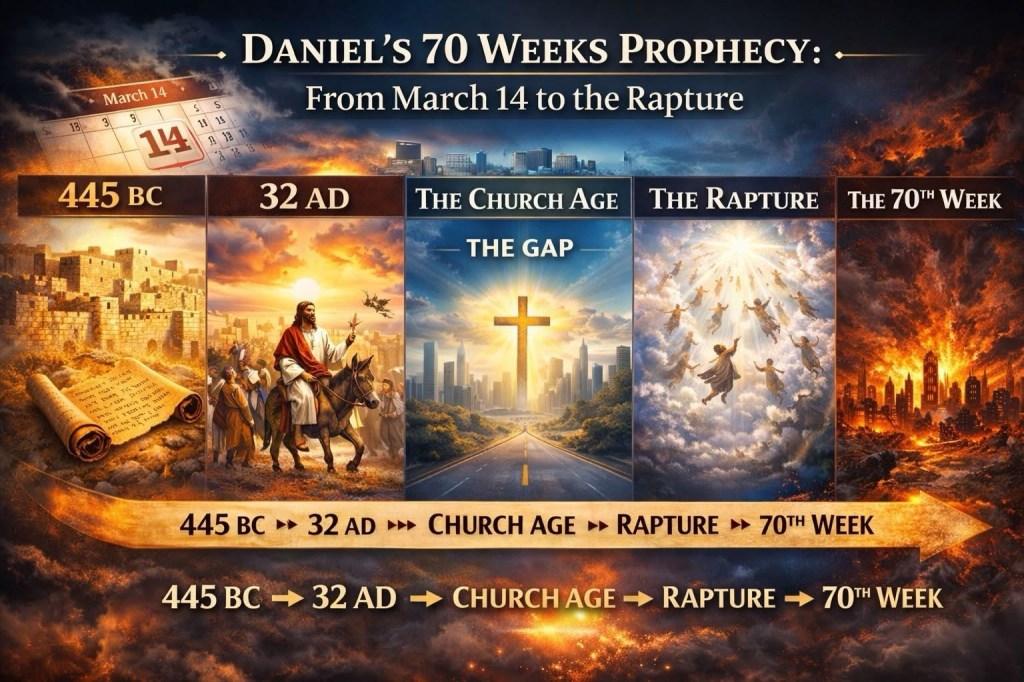
The Messianic kingdom was spoken in Psalm 2. Jesus Christ is the King of Zion, a fulfillment of Isaiah 9:6-7 and Isaiah 7:14 as declared in Matthew 1:22-23. The Bible never spoke of a gap in the prophetic fulfillment of God’s kingdom. The talk of a rapture is nonsense. With the coming of Jesus, the Messianic kingdom has begun. Paul, in Acts, declared the fulfillment of Psalm 2, “And we bring you the good news that what God promised to the fathers, this He has fulfilled to us, their children, by raising Jesus, as also it is written in the second Psalm, ‘You are My Son, today I have begotten You’” (Acts 13:32-33). The Messianic kingdom is God’s kingdom – the kingdom of heaven – as heralded by John the Baptist (Matthew 3:1-2) and announced by Jesus Christ to have arrived (Matthew 4:17; 12:28; Luke 11:20).
What is too hard to understand? It’s plain and simple. But contemporary Christianity resists the truth and insists on what they have been told and taught. Example of the lie below:
Taken from Tony Campbell
Now that another Middle East crisis is at hand, soothsayers once more are abound. But Jesus Christ alone is the true prophet of God, to whom we ought to listen. At the transfiguration of Jesus, God declared, “This is My beloved Son, with whom I am well pleased; listen to Him.” (Matthew 17:5)
Christians, let us not be alarmed by claims or teachings that supposedly the end of the world is coming. The Bible never spoke of the end of the world, but the end of the age. Jesus Christ taught about two ages only, the present age and the age to come, see Mark 10:29-30 and Luke 18:29-30. By “present age or in this age”, Jesus didn’t mean our time but the Old Covenant age – the period in which He came, lived, died, and resurrected, which consists of regulations, offerings, and animal sacrifices – see Hebrews 9:1-15. The Bible teaches that Christ Jesus has made it obsolete, with the passing of the Jewish temple (Hebrews 8:13). Making it impossible for the Mosaic regulations to be observed and practiced. The Bible declared Christ Jesus the mediator of the New Covenant (Hebrews 9:15; 12:24).
Paul, in Ephesians, expounded on the mystery of God about the church also teaches only two ages (Ephesians 1:21-22).
However, Jewish survivors of the A.D. 70 destruction of the temple continued in disbelief, so they came out with the Talmudic writings. Prominent on its declaration is a third rebuilding of the Jewish temple, which was nowhere taught in the Old or New Testament Scripture, but has been promoted by some Christians who hold dispensational theology. Beware of what you are learning, believing, and teaching. You might be disseminating falsehoods.
Study the Bible thoroughly with a clear mind, free from biases introduced by mainstream Christianity. Just a few decades after Jesus Christ’s resurrection, false gospels began spreading, prompting Paul to confront them by writing letters to various churches (Galatians 1:6-9; 2 Corinthians 11:1-4). Also, the writing of the gospels ensued— Matthew, Mark, Luke, and John. Today, it remains an issue even millennia later. The root cause seems to be Christianity’s tendency to rely on the writings of early church fathers, those of the Reformers, or modern scholars rather than the Bible itself.
Peter, in the words of Acts 3:6, declared, “I possess neither silver nor gold, but in the name of Jesus Christ, I offer you what I have.” Share this article freely, for you freely receive. Take note, underlines and highlights are clickable links for definitions or Bible references. Stay updated by heading to our about page and subscribe directly to receive notifications in your inbox. Blessing!
The article says, Ajoy, now 34, is one of a growing network of “ex-evangelicals” who have removed themselves from what they now view as the damaging beliefs of some evangelical, Pentecostal, and Baptist churches. She runs a popular TikTok account discussing faith and, among other things, the effects of traumatic religious experiences that can last for years – even a lifetime. Click to read the full article below.
Scaring people into believing doesn’t work. It has resulted in people who claim to believe in Christ Jesus but wouldn’t endure for their faith. Their sole desire was to be raptured and escape the supposed seven years of tribulation that follow the rapture.
Here is a short video explaining how the teaching about rapture came to exist.
Paul, in his letter to the church, emphasized, “For it has been granted to you that for the sake of Christ you should not only believe in Him but also suffer for His sake, engaged in the same conflict that you witnessed I had and now hear that I still endure.” (Philippians 1:29-30)
John, the apostle of Christ Jesus, was already facing tribulation. John in Revelation said, “I, John, your brother and partner in the tribulation and the kingdom and the patient endurance that are in Jesus, was on the island called Patmos on account of the word of God and the testimony of Jesus.” (Revelation 1:9) Yes, the tribulation that Jesus Christ taught in Matthew 24:9-14, which applies to His followers— Christians of John’s era.
How can we be certain that this applies to the first-century Christians, particularly during John’s time? Jesus spoke of a Great Tribulation that would follow, as mentioned in Matthew 24:15-35. This refers to the Old Covenant Jews, specifically the destruction of the temple and city by the Romans.
If you are not convinced, see the context of Matthew 24, leading to Christ’s teaching on the tribulation and great tribulation. Scripture in Matthew 24 told us: “Jesus left the temple and was going away, when His disciples came to point out to Him the buildings of the temple. But He answered them, ‘You see all these, do you not? Truly, I say to you, there will not be left here one stone upon another that will not be thrown down.’ As He sat on the Mount of Olives, the disciples came to Him privately, saying, ‘Tell us, when will these things be, and what will be the sign of your coming and of the end of the age?’” (Matthew 24:1-3)
What age was ending? Jesus only spoke of two ages. Refer to Mark 10:29-30: “Jesus declared, ‘Truly, I say to you, no one who has forsaken home, brothers, sisters, mother, father, children, or possessions for my sake and for the gospel will not receive a hundredfold reward in this present age—houses, brothers, sisters, mothers, children, and possessions—along with persecutions. And in the age to come, eternal life.’”
The present age that Jesus spoke of was the Old Covenant Age, while the age to come is the New Covenant, which we understand as the Church Age.
One significant piece of evidence that the Old Covenant Age has ended is the absence of the Jewish temple. The Book of Hebrews illustrates this point, specifically in Hebrews 9:8-28. Let’s examine these passages to understand their proper teaching.
First, the scripture teaches us that the Holy Spirit indicates that the way into the holy places is not yet opened as long as the first section (the temple) is still standing, which symbolizes the present age. (Hebrews 9:1-10)
Next, from Hebrews 9:11-26:
Under this arrangement, gifts and sacrifices are offered that cannot perfect the conscience of the worshiper; they only address food, drink, and various washings—regulations for the body imposed until the time of reformation. However, when Christ appeared as the High Priest of the good things that have come, He entered once for all into the holy places—not by means of the blood of goats and calves but by means of His own blood, thus securing an eternal redemption.
If the blood of goats and bulls, and the sprinkling of defiled persons with the ashes of a heifer, can sanctify for the purification of the flesh, how much more will the blood of Christ, who through the eternal Spirit offered Himself without blemish to God, purify our conscience from dead works to serve the living God?
Therefore, Jesus Christ is the mediator of a new covenant, so that those who are called may receive the promised eternal inheritance, because a death has occurred that redeems them from the transgressions committed under the first covenant. Where there is a will, the death of the one who made it must be established. A will takes effect only at death; it is not in force while the one who made it is alive. Thus, not even the first covenant was inaugurated without blood.
When every commandment of the law was declared by Moses to all the people, he took the blood of calves and goats along with water, scarlet wool, and hyssop, and sprinkled both the book itself and all the people, saying, “This is the blood of the covenant that God commanded for you.” In the same way, he sprinkled the blood on the tent and all the vessels used in worship. Indeed, under the law, almost everything is purified with blood, and without the shedding of blood, there is no forgiveness of sins.
Therefore, it was necessary for the copies of the heavenly things to be purified with these rites, but the heavenly things themselves required better sacrifices than these. For Christ has entered, not into holy places made with hands, which are copies of the true things, but into heaven itself, now to appear in the presence of God on our behalf.
He did not need to offer Himself repeatedly, as the high priest enters the holy places every year with blood not his own; otherwise, He would have had to suffer repeatedly since the foundation of the world. But as it is, He has appeared once for all at the end of the ages (the term “aiōn” in Greek could be translated as “age,” not necessarily “ages”) to put away sin by the sacrifice of Himself.
Lastly, Hebrews 9:27-28:
Just as it is appointed for man to die once and after that comes judgment, so Christ, having been offered once to bear the sins of many, will appear a second time, not to deal with sin but to save those who are eagerly waiting for Him.
The Christian church has lost its grip on truth. When will Christians wake up to realize that their primary mission is not simply to maintain the existence of the organized church? The means does not always justify the end. Christians should uphold the truths of the Bible. If believing in those truths causes some Christians to leave, so be it.
We can learn from the story in John 6. Jesus Christ shared the truth about Himself with the Jews, but they found it strange and unacceptable. Scripture states, “When many of Christ’s disciples heard it, they said, ‘This is a hard saying; who can listen to it?’” Jesus, aware that His disciples were grumbling, responded, “Do you take offense at this? Then what if you were to see the Son of Man ascending to where He was before? It is the Spirit who gives life; the flesh is no help at all. The words that I have spoken to you are spirit and life” (John 6:60-63).
Jesus went on to say: “This is why I told you that no one can come to Me unless it is granted him by the Father.” After this, many of His disciples turned back and no longer walked with Him. So Jesus said to the twelve, “Do you want to go away as well?” Simon Peter answered Him, “Lord, to whom shall we go? You have the Words of eternal life, and we have believed and have come to know that You are the Holy One of God.” Jesus answered them, “Did I not choose you, the twelve? And yet one of you is a devil.” He spoke of Judas, the son of Simon Iscariot, for he, one of the twelve, was going to betray Him. (John 6:65-71)
Paul, in Romans 10:17, concluded his lengthy discourse on election, which began in Romans 9, by stating, “So faith comes from hearing, and hearing through the word of Christ.” God calls people through His Word. Jesus has earlier emphasized this concept in John 6:63, saying, “My Word is spirit and life.” This is the biblical manifestation of election, not a supernatural, random selection by God.
Following the story of John 6, in another similar occasion, “Jesus said to Jews, “If God were your Father, you would love Me, for I came from God and I am here. I came not of My own accord, but He sent Me. Whydoyou not understand what I say? It is because you cannot bear to hear My WORD.” (John 8:42-43)
Christianity revolves around Jesus Christ and His Word, nothing more and nothing less. I encourage fellow Christians to engage in a sincere study of God’s Word. There is a reason why believers should attend seminary and graduate before becoming pastors; this training equips them to teach from Scripture correctly.
However, If they still cannot teach solely from the Bible, they should seek additional training to learn how to handle the Bible correctly, as instructed by the apostle Paul (2 Timothy 2:15).
Let me remind everyone of what the apostle James said about us who teach from the Bible: “My brothers, not many of you should become teachers, for you know that we who teach will be judged more strictly.” (James 3:1)
A lot of Christians desires to learn from the Bible. As the saying goes in a Spiderman movie, “With great powers comes great responsibility”, the same may be said of us who teach from the Bible. Jesus Christ said, “Can a blind man lead a blind man? Will they not both fall into a pit? A disciple is not above his teacher, but everyone when he is fully trained will be like his teacher.” (Luke 6:39-40)
In Isaiah 30:20, the Bible promised, “And though the Lord give you the bread of adversity and the water of affliction, yet your Teacher will not hide Himself anymore, but your eyes shall see your Teacher.” Christ Jesus is the manifestation of God’s promised Teacher. Shouldn’t Christians seek to learn from Him alone? Jesus is the Word (John 1:14-17). He further emphasized in Luke 6:40 that we could emulate Him by comprehending God’s Word.
Peter, in the words of Acts 3:6, declared, “I possess neither silver nor gold, but in the name of Jesus Christ, I offer you what I have.” Share this article freely, for you freely receive. Take note, underlines and highlights are clickable links for definitions or Bible references. Stay updated by heading to our about page and subscribe directly to receive notifications in your inbox. Blessing!
The concept of the “end of the world” is not found in the Bible. It’s a mistranslation; the Bible actually refers to the “end of the ages.”
In 1 Corinthians 10:11, Paul writes, “Now these things happened to them as an example, but they were written down for our instruction, to whom the end of the ages has come.” In this context, “them” refers to Old Covenant Israel, as Paul declares that the end of the ages has arrived for them.
Furthermore, Hebrews 9:24-26 explains, “For Christ has entered, not into holy places made with hands, which are copies of the true things, but into heaven itself, now to appear in the presence of God on our behalf. Nor was it to offer Himself repeatedly, as the high priest enters the holy places every year with blood not his own; for then He would have had to suffer repeatedly since the foundation of the world. But as it is, He has appeared once for all at the end of the ages to put away sin by the sacrifice of Himself.”
Isn’t it evident that with the incarnate coming of Jesus Christ, Old Covenant Israel reached the end of the ages?
With the temple destroyed and the Old Testament regulations no longer applicable, this signifies the conclusion of the Old Covenant era, paving the way for the New Creation or New Covenant era, as ushered in by Christ Jesus. Consequently, Paul asserted in 2 Corinthians 5:17, “Therefore, if anyone is in Christ, he is a new creation. The old has passed away; behold, the new has come.”
Isn’t the New Covenant also the everlasting covenant? Hebrews 13:20 states, “Now may the God of peace who brought again from the dead our Lord Jesus, the great shepherd of the sheep, by the blood of the eternal covenant.” Since it is an eternal covenant, why do we still hear teachings about an impending end? Doesn’t this seem contradictory to God’s word?
Scripture only mentions two ages. Jesus Christ said, “And whoever speaks a word against the Son of Man will be forgiven, but whoever speaks against the Holy Spirit will not be forgiven, either in this age or in the age to come.” (Matthew 12:32)
Paul also mentions these ages: “far above all rule and authority and power and dominion, and above every name that is named, not only in this age but also in the one to come.” (Ephesians 1:21)
Additionally, Paul writes, “For it is impossible, in the case of those who have once been enlightened, who have tasted the heavenly gift, and have shared in the Holy Spirit, and have tasted the goodness of the word of God and the powers of the age to come, and then have fallen away, to restore them again to repentance, since they are crucifying once again the Son of God to their own harm and holding Him up to contempt.” (Hebrews 6:4-6)
Scripture also notes, “As Jesus sat on the Mount of Olives, the disciples came to Him privately, saying, ‘Tell us, when will these things be, and what will be the sign of Your coming and of the end of the age?’” (Matthew 24:3)
Have you noticed that the disciples associated the destruction of the Jewish temple with the return of Christ and the end of the age? Remember the Bible speaks of only two ages: the coming of Jesus Christ marked the coming end of the first age, and His return will bring it to completion. The New Covenant is eternal and therefore has no end. As a result, the disciples of Christ were living in the intermediate period of the two ages. This concept is highlighted in the Book of Hebrews, which states: “Long ago, at many times and in many ways, God spoke to our fathers by the prophets; but in these last days, He has spoken to us by His Son, whom He appointed the heir of all things, through whom also He created the world.” (Hebrews 1:1-2)
According to the Bible, what age should we be in today, millennia after the destruction of the temple? It seems illogical for Christians to talk about a coming end. The Jewish temple has long been gone, just as Christ Jesus had declared its end, making it unreasonable for some Christians to discuss the rebuilding of the temple, especially since the Bible does not indicate that a third temple in Jerusalem will be constructed. This belief is not a Christian teaching; rather, it stems from those who continue to adhere to Judaism, which implies a rejection of Christ Jesus. Sadly, numerous Christians have fallen to this lie.
Claims regarding the rebuilding of the Jerusalem temple have been circulating for decades, and those who support these teachings can be compared to the boy who cried wolf. Deuteronomy 18:15-22 cautions us against such individuals, identifying them as false prophets. Conversely, any assertions that contradict Christ’s declarations inadvertently label Jesus a liar. No wonder, Paul asserted and declared: “Keep a close watch on yourself and on the teaching. Persist in this, for by so doing you will save both yourself and your hearers.” (1Ti 4:16)
Many Christians mistakenly believe that the doctrine of Christ’s return is a minor issue that does not impact one’s salvation. However, the doctrines of the Bible are interconnected; they form a unified teaching about Christ Jesus and His offer of salvation.
Consider John 14:1-7:
“Let not your hearts be troubled. Believe in God; believe also in Me. In My Father’s house are many rooms. If it were not so, would I have told you that I go to prepare a place for you? And if I go and prepare a place for you, I will come again and will take you to Myself, that where I am, you may be also. And you know the way to where I am going.”
Thomas said to Him, “Lord, we do not know where You are going. How can we know the way?”
Jesus said to him, “I am the way, and the truth, and the life. No one comes to the Father except through Me. If you had known Me, you would have known My Father also. From now on, you do know Him and have seen Him.”
This passage emphasizes the importance of understanding Christ’s teachings, including His return, as part of the holistic message of salvation.
Jesus emphasized two important points here. First, He is the only way to the Father. Second, no one will be able to be where He went until He returns. Jesus said, “If I go and prepare a place for you, I will come again and will take you to Myself, so that where I am, you may be also.”
Note: Click on underlines and highlights for definitions or Bible references.
Peter , in the words of Acts 3:6, declared, “I possess neither silver nor gold, but in the name of Jesus Christ, I offer you what I have.” Share freely, for you freely receive. Stay updated by heading to our about page and subscribe directly to receive notifications in your inbox. Blessing!
An egg always consists of the shell, the white, and the yolk. Anything less than that is not an egg. Similarly, the Gospel is about the arrival of God’s kingdom and the end of the age. Therefore, no one can claim to care only about the preaching of the Gospel without also caring about eschatology, which is the doctrine of the last days or, more commonly, the Second Coming of Jesus Christ. See Matthew 24:14, Jesus Christ said.
“And this gospel of the kingdom will be proclaimed throughout the whole world as a testimony to all nations, and then the end will come.”
Scripture never speaks of an end time, but the time of the end. See Daniel 12:1-4. Scripture said, “At that time shall arise, Michael, the great prince who has charge of your people [Jewish people]. And there shall be a time of trouble, such as never has been since there was a nation till that time [cf. Matt 24:21]. But at that time your people shall be delivered, everyone whose name shall be found written in the book. And many of those who sleep in the dust of the earth shall awake, some to everlasting life, and some to shame and everlasting contempt [cf. 1Co. 15:51-54; Rev 20:11-12]. And those who are wise shall shine like the brightness of the sky above; and those who turn many to righteousness, like the stars forever and ever [cf. Matt 13:41-43]. But you, Daniel, shut up the words and seal the book, until the time of the end. Many shall run to and fro, and knowledge shall increase.”
Here is a presentation by R.C. Sproul gathered through the writings of the Jewish historian Flavius Josephus and that of the Roman historian Tacitus narrating the events leading to the destruction of Jerusalem and the temple. R.C. Sproul argued that the “last days” spoken in Scripture concerns not that of the world, but of the Jewish age.
See Christ’s Olivet Discourse, Matthew 24:1-34. Scripture said, “Jesus left the temple and was going away, when His disciples came to point out to Him the buildings of the temple. But He answered them, “You see all these, do you not? Truly, I say to you, there will not be left here one stone upon another that will not be thrown down.” As He sat on the Mount of Olives, the disciples came to Him privately, saying, “Tell us, when will these things be, and what will be the sign of Your coming and of the end of the age?” And Jesus answered them, “See that no one leads you astray. For many will come in My name, saying, ‘I am the Christ,’ and they will lead many astray. And you will hear of wars and rumors of wars. See that you are not alarmed, for this must take place, but the end is not yet. For nation will rise against nation, and kingdom against kingdom, and there will be famines and earthquakes in various places. All these are but the beginning of the birth pains. “Then they will deliver you up to tribulation and put you to death, and you will be hated by all nations for My name’s sake. And then many will fall away and betray one another and hate one another. And many false prophets will arise and lead many astray. And because lawlessness will be increased, the love of many will grow cold. But the one who endures to the end will be saved. And this gospel of the kingdom will be proclaimed throughout the whole world as a testimony to all nations, and then the end will come.“So when you see the abomination of desolation spoken of by the prophet Daniel, standing in the holy place (let the reader understand), then let those who are in Judea flee to the mountains. Let the one who is on the housetop not go down to take what is in his house, and let the one who is in the field not turn back to take his cloak. And alas for women who are pregnant and for those who are nursing infants in those days! Pray that your flight may not be in winter or on a Sabbath. For then there will be great tribulation, such as has not been from the beginning of the world until now, no, and never will be. And if those days had not been cut short, no human being would be saved. But for the sake of the elect those days will be cut short. Then if anyone says to you, ‘Look, here is the Christ!’ or ‘There he is!’ do not believe it. For false christs and false prophets will arise and perform great signs and wonders, so as to lead astray, if possible, even the elect. See, I have told you beforehand. So, if they say to you, ‘Look, he is in the wilderness,’ do not go out. If they say, ‘Look, he is in the inner rooms,’ do not believe it. For as the lightning comes from the east and shines as far as the west, so will be the coming of the Son of Man. Wherever the corpse is, there the vultures will gather. “Immediately after the tribulation of those days the sun will be darkened, and the moon will not give its light, and the stars will fall from heaven, and the powers of the heavens will be shaken. Then will appear in heaven the sign of the Son of Man, and then all the tribes of the earth will mourn, and they will see the Son of Man coming on the clouds of heaven with power and great glory. And He will send out His angels with a loud trumpet call, and they will gather His elect from the four winds, from one end of heaven to the other. “From the fig tree learn its lesson: as soon as its branch becomes tender and puts out its leaves, you know that summer is near. So also, when you see all these things, you know that He is near, at the very gates. Truly, I say to you, this generation will not pass away until all these things take place.”
Jesus Christ spoke of His coming judgment upon Old Covenant Israel. Twice, He prophesied about the destruction of the Jewish temple (Matt 23:37-38; 24:1-2). Jesus said everything He said would occur within the generation of His then-living apostles (Matt 23:36-38; 24:33-34). It was indeed the last days of the Jewish age.
Oh! Incidentally, regarding God’s kingdom, Jesus Christ said, “The kingdom of God is not coming in ways that can be observed, nor will they say, ‘Look, here it is!’ or ‘There!’ for behold, the kingdom of God is in the midst of you.’” (Luk 17:20-21)
Reflect carefully. Check your Bible. Can you see now that it was a lie to believe in a future coming of Jesus Christ? Learn only from Scripture, not men’s writings. I have written repeatedly on this same topic arguing from the Scripture. R.C. Sproul offered the same thought but from an eyewitness account. That’s the purpose of this blog.
Peter, in the words of Acts 3:6, declared, “I possess neither silver nor gold, but in the name of Jesus Christ, I offer you what I have.” Share freely, for you freely receive. Stay updated by heading to our about page and subscribe directly to receive notifications in your inbox. Blessing!
Disclaimer: I do not endorse R.C. Sproul’s other video teachings. Just this one. Because his position agrees with the Scripture.
During the pandemic, many Christians believe we are in the “last days.” This belief has been largely influenced by novels and books that discuss the supposed signs of the impending rapture and the Second Coming of Jesus Christ.
About a century ago, a pandemic known as the “Spanish Flu” lasted for a couple of years and claimed many lives. If that generation had shared a similar mindset, they might have believed they were experiencing the “last days.” However, here we are today, facing a new pandemic and many people are once again believing we are in the last days. So, it seems this is the “last last days” following the last days a century ago. This concept doesn’t make sense.
The Bible does speak of the “last days,” actually five times in the New Testament Scripture. Let us explore them each, starting with Acts 2:16-21,36-38,40.
But this is what was uttered through the prophet Joel [cf. Joel 2:28-32]: “‘And in the last daysit shall be, God declares,that I will pour out My Spirit on all flesh, and your sons and your daughters shall prophesy, and your young men shall see visions, and your old men shall dream dreams; even on My male servants and female servants in those days I will pour out My Spirit, and they shall prophesy. And I will show wonders in the heavens above and signs on the earth below, blood, and fire, and vapor of smoke; the sun shall be turned to darkness and the moon to blood,before the day of the Lordcomes, the great and magnificent day. And it shall come to pass that everyone who calls upon the name of the Lord shall be saved.’ (Acts 2:16-21)
“Let all the house of Israel therefore know for certain that God has made Him both Lord and Christ, this Jesus whom you crucified.” Now when they heard this they were cut to the heart, and said to Peter and the rest of the apostles, “Brothers, what shall we do?” And Peter said to them, “Repent and be baptized every one of you in the name of Jesus Christ for the forgiveness of your sins, and you will receive the gift of the Holy Spirit … And with many other words he bore witness and continued to exhort them, saying, “Save yourselves from this crooked generation.” (Acts 2:36-38,40)
What was the occasion of Acts 2? It’s the day of Pentecost, it’s the fourth of the Seven Jewish Feasts; see Leviticus 23:15-17.
You shall count seven full weeks from the day after the Sabbath, from the day that you brought the sheaf of the wave offering [the Resurrection Day of Jesus, cf. Leviticus 23:10-11]. You shall count fifty days [literal meaning of “Pentecost”] to the day after the seventh Sabbath. Then you shall present a grain offering of new grain to the LORD. You shall bring from your dwelling places two loaves of bread to be waved, made of two tenths of an ephah. They shall be of fine flour, and they shall be baked with leaven, as firstfruits to the LORD [cf. Acts 2:41; 2 Thessalonians 2:13].
The time for God’s harvest began at Pentecost, see Acts 2:41“So those who received his word were baptized, and there were added that day about three thousand souls.”
See also 2 Thessalonians 2:13.
But we [Paul and his co-workers] ought always to give thanks to God for you [the Thessalonians believers], brothers beloved by the Lord, because God chose you as the firstfruits to be saved, through sanctification by the Spirit and belief in the truth.
Pentecost was the second of three Jewish Harvest Festivals when Jews from everywhere were required to appear before the LORD in Jerusalem. See Deuteronomy 16:16.
“Three times a year all your males shall appear before the LORD your God at the place that he will choose: at the Feast of Unleavened Bread, at the Feast of Weeks [Pentecost], and at the Feast of Booths. They shall not appear before the LORD empty-handed.”
In Peter’s sermon, he referenced the prophet Joel (Joel 2:28-32), stating that its fulfillment began at Pentecost. This event marked the beginning of the countdown to the last days, leading up to the Day of the LORD (Acts 2:17,20), which is also the day of God’s vengeance. This concept is further supported by Luke 21:20-22.
But when you see Jerusalem surrounded by armies, then know that its desolation has come near. Then let those who are in Judea flee to the mountains, and let those who are inside the city depart, and let not those who are out in the country enter it, for these are days of vengeance, to fulfill all that is written.
The “day of the Lord” then was the day of God’s vengeance against Jerusalem. This is also highlighted in Matthew 23, where the Lord Jesus Christ pronounces several “woes” against the scribes and Pharisees. Pay special attention to the highlighted verses 36-38 to understand who will experience God’s vengeance and when it will take place.
Fill up, then, the measure of your fathers. You serpents, you brood of vipers, how are you to escape being sentenced to hell? Therefore I send you prophets and wise men and scribes, some of whom you will kill and crucify, and some you will flog in your synagogues and persecute from town to town, so that on you may come all the righteous blood shed on earth, from the blood of righteous Abel to the blood of Zechariah the son of Barachiah, whom you murdered between the sanctuary and the altar. Truly, I say to you, all these things will come upon THIS GENERATION. O Jerusalem, Jerusalem, the city that kills the prophets and stones those who are sent to it!How often would I have gathered your children together as a hen gathers her brood under her wings, and you were not willing! See, your house is left to you desolate.
It is clear that Jesus stated, “God’s vengeance would be upon the generation He spoke against” (Matthew 23:36). He specifically referred to Jerusalem when He said, “See, your house is left desolate” (Matthew 23:38). This provides us with both the “who” and the “when”—Jerusalem during Jesus’ generation. The “house” left desolate refers to the Jewish Temple. Jesus further explained this in His discourse; see Matthew 24:1-3.
Jesus left the temple and was going away, when His disciples came to point out to Him the buildings of the temple. But He answered them,“You see all these, do you not? Truly, I say to you, there will not be left here one stone upon another that will not be thrown down.” As He sat on the Mount of Olives, the disciples came to Him privately, saying, “Tell us, when will these things be, and what will be the sign of your coming and of the end of the age?”
Without a doubt, the last days lead to the Day of God’s vengeance, the Day of the Lord, the Second Coming, and the end of the age—the end of the Old Covenant Age, as noted in Hebrews 8:13.
In speaking of a new covenant, He makes the first one obsolete. And what is becoming obsolete and growing old is ready to vanish away.
Without the Temple, the Jewish people ceased to be God’s covenant people. I remember previously writing about this topic but can’t remember which blog. If you find it worthwhile to dig deeper, you may find the topic in my previous blogs.
The countdown to the “last days” began at Pentecost and continued until the destruction of Jerusalem. You can see for yourselves that the Jerusalem Temple no longer stands today. This was the sign understood by the disciples of Jesus regarding the fulfillment of the Day of the Lord (Matthew 24:3) and the Second Coming of Jesus Christ.
The second passage in the New Testament Scripture that spoke of the “last days” may be found in 2 Timothy 3:1-7.
But understand this, that in the last days there will come times of difficulty. For people will be lovers of self, lovers of money, proud, arrogant, abusive, disobedient to their parents, ungrateful, unholy, heartless, unappeasable, slanderous, without self-control, brutal, not loving good, treacherous, reckless, swollen with conceit, lovers of pleasure rather than lovers of God, having the appearance of godliness, but denying its power. Avoid such people. For among them are those who creep into households and capture weak women, burdened with sins and led astray by various passions, always learning and never able to arrive at a knowledge of the truth.
Although it is unfortunate, the recent revelation and confirmation by Christianity Today concerning Ravi Zacharias, a prominent preacher within a Christian organization, serves as a notable example of 2 Timothy 3:5. The Gospel of Jesus Christ represents the power of God, as stated in Romans 1:16.
“For I am not ashamed of the gospel, for it is the power of God for salvation to everyone who believes, to the Jew first and also to the Greek.”
Such an arrogance and bad hermeneutics for some to believe, claim, and teach that the power is with us Christians. Let me be clear, the power is not with the Christian but by the Gospel (Romans 1:16). So Paul, in Philippians 2:12-13 said:
Therefore, my beloved, as you have always obeyed, so now, not only as in my presence but much more in my absence, work out your own salvation with fear and trembling, for it is God who works in you, both to will and to work for His good pleasure.
In reference to 2 Timothy 3:5, the formerly renowned preacher failed to experience the transformative power of the Gospel. Therefore, Scripture states, “Having the appearance of godliness, but denying its power. Avoid such people.”
This was Paul’s second letter to Timothy. In this letter, Paul warned Timothy about the challenges he would face in his ministry, emphasizing that the last days would be a difficult time. Paul provides descriptions of people’s behavior during these last days in 2Timothy 3:1-5, which aligns with Peter’s words spoken at Pentecost about the “last days” (see Acts 2:40). Peter urged the Jews at Pentecost by saying, “Save yourselves from this crooked generation,” using many other words to bear witness and encourage them.
Interestingly, on the first chapter of 2 Timothy, Paul did imply that the Day of the Lord was coming in his generation; see 2 Timothy 1:15-18.
You are aware that all who are in Asia turned away from me [Paul}, among whom are Phygelus and Hermogenes. May the Lord grant mercy to the household of Onesiphorus, for he often refreshed me and was not ashamed of my chains, but when he arrived in Rome he searched for me earnestly and found me— may the Lord grant him to find mercy from the Lord ON THAT DAY!—and you well know all the service he rendered at Ephesus.
Onesiphorus must still be alive for him to find mercy on the Day of the Lord. Again, as I have said in my other blogs, the Lord Jesus Christ again and again did spoke of His Return in the days of His apostles. See Matthew 10:23.
When they persecute you [the apostles, see Matthew 10:1-5, Jesus was speaking to them] in one town, flee to the next, for truly, I say to you, you will not have gone through all the towns of Israel before the Son of Man comes.
Also see Matthew 16:27-28.
For the Son of Man is going to come with His angels in the glory of His Father, and then He will repay each person according to what he has done. Truly, I say to you, there are some standing here who will not taste death until they see the Son of Man coming in His kingdom.”
Now, let’s see the next passage that spoke of the “last days”; see Hebrews 1:1-2.
Long ago, at many times and in many ways, God spoke to our fathers by the prophets, but in these last days He has spoken to us by His Son, whom He appointed the heir of all things, through whom also He created the world.
The “last days” then covers the people of Jesus’ generation – those who had heard firsthand from the Son, Jesus Christ, the last and Great Prophet of God. So again, Hebrews agrees with both Acts and 2 Timothy that the New Testament people mentioned in Scripture were living in the last days leading to the Day of the Lord.
Next, we have James 5:1-3.
Come now, you rich, weep and howl for the miseries that are coming upon you [the actual audience of James]. Your riches have rotted and your garments are moth-eaten. Your gold and silver have corroded, and their corrosion will be evidence against you and will eat your flesh like fire. You have laid up treasure in the last days.
Lastly, 2 Peter 3:1-4.
This is now the second letter that I am writing to you, beloved. In both of them I am stirring up your sincere mind by way of reminder, that you should remember the predictions of the holy prophets and the commandment of the Lord and Savior through your apostles,knowing this first of all, that scoffers will come in the last days with scoffing, following their own sinful desires. They will say, “Where is the promise of His coming? For ever since the fathers fell asleep, all things are continuing as they were from the beginning of creation.”
Here, the apostle Peter was rebuking false teachers – see 2 Peter 2:1-2 – for denying the imminent or soon coming of Jesus Christ.
But false prophets also arose among the people, just as there will be false teachers among you, who will secretly bring in destructive heresies, even denying the Master who bought them, bringing upon themselves swift destruction. And many will follow their sensuality, and because of them the way of truth will be blasphemed.
What was that they denied about the Master, Jesus Christ? It was His promise to return, again see 2 Peter 3:1-4, the continuing narrative of Peter regarding the heresies of the false teachers (2 Peter 2:1-22).
This is now the second letter that I am [Peter] writing to you, beloved. In both of them I am stirring up your sincere mind by way of reminder, that you should remember the predictions of the holy prophets and the commandment of the Lord and Savior through your apostles, knowing this first of all, that scoffers will come in the last days with scoffing, following their own sinful desires. They will say, “Where is the promise of His coming? For ever since the fathers fell asleep, all things are continuing as they were from the beginning of creation.”
Come to think of it, two millennia cannot be soon by any measurement, don’t you think? Peter assures the Lord’s coming was soon in his generation; see 2 Peter 3:13, again the continuing narrative of Peter on the same discourse.
But according to His [Jesus Christ] promise we [Peter and his contemporaries] are waiting for new heavens and a new earth in which righteousness dwells.
Again Scripture made clear that Peter and his contemporaries indeed was expecting the soon return of Jesus Christ. Still not convinced? Let’s see 1 Peter 4:7. “The end of all things is at hand; therefore be self-controlled and sober-minded for the sake of your prayers.”
Peter said “the end of all things is at hand.” The Scripture Direct, an online lexicon explained that “at hand” in Greek means “the occurrence of a point of time close to a subsequent point of time”. In other words, the time Peter spoke of “the end of things” was close to the time of its fulfillment, so indeed it was the “last days”. However, if it hasn’t been fulfilled, as it was/is taught today, then the end of things which was spoken two thousand years ago cannot in any means be close (at hand) to Peter’s days than closer to us, as claimed by the popular and traditional teachings.
One more, in 1 Peter 5:1-4.
So I exhort the elders among you, as a fellow elder and a witness of the sufferings of Christ, as well as a partaker in the glory that is going to be revealed: shepherd the flock of God that is among you, exercising oversight, not under compulsion, but willingly, as God would have you; not for shameful gain, but eagerly; not domineering over those in your charge, but being examples to the flock. And when the chief Shepherd appears, you will receive the unfading crown of glory.
The “glory to be revealed” refers to the coming of Jesus Christ, the chief Shepherd, which Peter assures his audience “they are partakers of the coming glory” – the Second Coming of Jesus Christ. Again the lexicon Scripture Direct explained “partaker” means “one who participates with another in some enterprise or matter of joint concern,” and in the case of 1 Peter 5:1, it spoke of Peter’s audience as the partaker or participants of the Second Coming of Jesus Christ. Once again, it agrees with Jesus’ repeated declaration that His Return would be in the days of His generation – the generation of Jews that crucified Jesus Christ.
See Numbers 32:13.
And the LORD’s anger was kindled against Israel, and He made them wander in the wilderness forty years, until all the generation that had done evil in the sight of the LORD was gone.
A Jewish generation is forty years. In Exodus, as revealed through Number 32:13, the Jews, who were first to received God’s covenant at Mount Sinai, wandered in the wilderness for FORTY YEARS and perished because they broke the covenant. So they failed to enter the Promised Land. At the time of Jesus, the Jews were offered the New Covenant – the Gospel – but they rejected Christ, the mediator of the New Covenant and crucified Him. See Hebrews 12:24.
And to Jesus, the mediator of a new covenant, and to the sprinkled blood that speaks a better word than the blood of Abel.
FORTY YEARS later, beginning with the earthly ministry of Jesus Christ (30 A.D.) that generation of Jews perished with the fall of Jerusalem in 70 A.D. Similarly forty years, a generation, coincidence? Of course not, because the Exodus account actually foreshadowed both the First and the Second Coming of Jesus Christ.
In conclusion, Matthew 3:10-12 narrated the story of John the Baptist as he spoke of the last days – the judgment and regathering of God’s people.
Even now the axe is laid to the root of the trees. Every tree therefore that does not bear good fruit is cut down and thrown into the fire. “I baptize you with water for repentance, but He [Jesus Christ] who is coming after Me is mightier than I, whose sandals I am not worthy to carry. He will baptize you with the Holy Spirit and fire. His winnowing fork is in His hand, and He will clear His threshing floor and gather His wheat into the barn, but the chaff He will burn with unquenchable fire.”
The cutting down of the tree analogy leaving only the stump alludes to God’s declaration found in Isaiah 6:8-13.
And I heard the voice of the Lord saying, “Whom shall I send, and who will go for us?” Then I said, “Here I am! Send me.” And He said, “Go, and say to this people: “‘Keep on hearing, but do not understand; keep on seeing, but do not perceive.’ Make the heart of this people dull, and their ears heavy, and blind their eyes; lest they see with their eyes, and hear with their ears, and understand with their hearts, and turn and be healed.” Then I said, “How long, O Lord?”And He said: “Until cities lie waste without inhabitant, and houses without people, and the land is a desolate waste [the Day of the Lord], and the LORD removes people far away, and the forsaken places are many in the midst of the land. And though a tenth remain in it, it will be burned again, like a terebinth or an oak, whose stump remains when it is felled.” The Holy Seed is its stump.
Who was the “holy seed”? See Galatians 3:16.
Now the promises were made to Abraham and to his offspring. It does not say, “And to offsprings,” referring to many, but referring to one, “And to your offspring,” who is Christ.
The doctrine of the “last days” has intrigued many, and it was/is one of the most misinterpreted idea or concept in the Bible. Simply because readers of the Bible approached the Scripture with a preconditioned mind, the “Second Coming of Jesus Christ” is still in the future. I remember once in the seminary, a professor of mine introduced the idea of the possibility that all Scripture has been fulfilled, meaning even the Second Coming event has been fulfilled. Everyone’s immediate reaction was to reject outright the idea without even considering a second look in the Scripture. The same mistake was/is happening then and now. People will adamantly reject the idea outright, yet if challenged to give a passage in Scripture proving that the Second Coming truly is still in the future, I seriously doubt that it would stand. I’m offering a friendly challenge that proponents of the future Second Coming offer a passage in the Bible that could sustain the popular and traditionally existing belief.
After considering all five times, “the last days” was mentioned in the New Testament Scripture, and all agreed that the generation of the apostles were living in the “last days”. It’s definitely a “last days” – not an unending last days as it would appear in the argument of everyone who insist the Second Coming is still in the future.
Blessings!
If you want to follow our journey of unlearning tradition and relearning Scripture, you can stay updated by heading to our about page and subscribe directly to receive notifications in your inbox




 Unlearning Tradition, Relearning Scripture