Tag: John 1:14-17

  • Gospel of Mark: John the Baptist (#2)

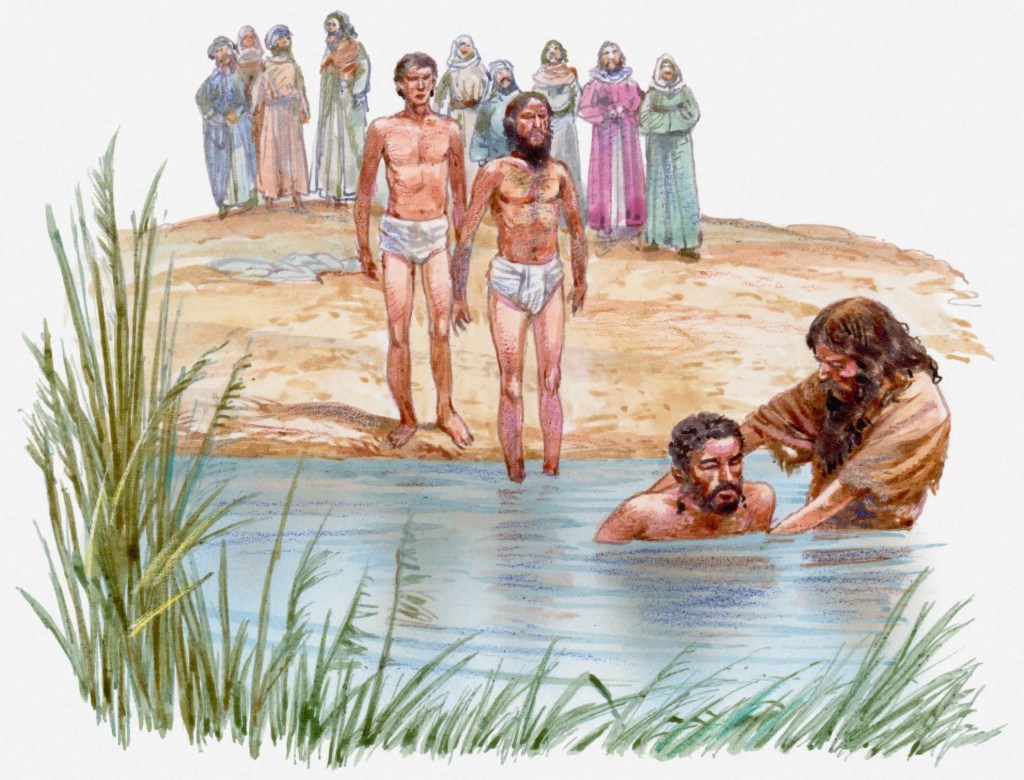
    Photo taken from bibleinfo.com

    In our Bibles, the Old Testament ends with Malachi, and the New Testament begins with Matthew. Malachi is often regarded as the last prophet to speak directly to Israel, and after his prophecy, there was a span of roughly four hundred years before John the Baptist appeared. This period mirrors the time between Joseph’s passing (Genesis 50:26) and the rise of Moses, when Israel endured four centuries of slavery in Egypt. God’s words to Abraham were fulfilled, as stated in Genesis 15:13-14:

    > “Then the LORD said to Abram, ‘Know for certain that your offspring will be sojourners in a land that is not theirs and will be servants there, and they will be afflicted for four hundred years. But I will bring judgment on the nation that they serve, and afterward they shall come out with great possessions.’”

    During those four hundred silent years in Egypt, Scripture records nothing new, and God seemed silent. It was only in Exodus 2:24 that we read:

    > “And God heard their groaning, and God remembered His covenant with Abraham, with Isaac, and with Jacob.”

    From the time of Malachi to the ministry of John the Baptist, history repeated itself with another four hundred years of silence. The arrival of Jesus Christ signified the culmination of this period, a moment that could be called the Second Exodus. Luke 9:30-31 affirms this during the transfiguration:

    > “And behold, two men talked with Jesus, who were Moses and Elijah, who appeared in glory and spoke of His exodus, which He was about to accomplish at Jerusalem.”

    For the second time, Jesus Christ was leading Israel out of bondage—this time from the law into grace (John 1:14-17). Paul highlights this transition in Galatians 3:23: “Before faith came, we were held captive under the law, imprisoned until the coming faith would be revealed.” Understanding this backdrop is crucial to grasping the Gospel of Mark.

    The first instance of this is mentioned by Paul in his letter to the Corinthians, describing the exodus. He emphasizes that the ancestors of the Jews were all under the cloud, passed through the sea, and were baptized into Moses in both the cloud and the sea. They shared the same spiritual nourishment and drank from the spiritual Rock that accompanied them, which was Christ. (1 Corinthians 10:1-4)

    Now, Mark begins by declaring Jesus Christ as the Son of God and the beginning of the Gospel. He cites two Old Testament prophecies, though he attributes them to Isaiah alone:

    > “As it is written in Isaiah the prophet, ‘Behold, I send My messenger before Your face, who will prepare Your way, the voice of one crying in the wilderness: “Prepare the way of the Lord, make His paths straight.”’”

    The two referenced prophets are Isaiah (40:3) and Malachi (3:1). John the Baptist, therefore, is presented as the partial fulfillment of these prophecies, with the complete fulfillment through the coming of Jesus Christ.

    Malachi 3:1 foretold:

    > “Behold, I send My messenger, and he will prepare the way before Me. And the Lord whom you seek will suddenly come to His temple; and the messenger of the covenant in whom you delight, behold, He is coming, says the LORD of hosts.”

    Mark then introduces John the Baptist:

    > “John appeared, baptizing in the wilderness and proclaiming a baptism of repentance for the forgiveness of sins. And all the country of Judea and all Jerusalem were coming to him and were being baptized by him in the river Jordan, confessing their sins. Now John was clothed with camel’s hair and wore a leather belt around his waist and ate locusts and wild honey. And he preached, saying, ‘After me comes He who is mightier than I, the strap of whose sandals I am not worthy to stoop down and untie. I have baptized you with water, but He will baptize you with the Holy Spirit.’” (Mark 1:2-8)

    John’s message, “Repent, for the kingdom of heaven is at hand” (Matthew 3:2), puzzled many. The Jews knew Old Testament prophecy well, and Daniel had foretold that God’s kingdom would appear during the reign of the Fourth Gentile Kingdom—Rome—following Babylon, Medo-Persia, and Greece. With John and Jesus’ arrival, the kingdom of God had indeed come.

    Yet, as in John’s day, people today debate whether the kingdom truly arrived, expecting an earthly utopia. Many Jews back in the days of John and Jesus were also disheartened when political circumstances did not change, remaining under Roman rule. Judas Iscariot, a Zealot hoping for rebellion, betrayed Jesus when his expectations were unmet. Despite spending three years with Jesus, Judas never abandoned his own agenda.

    Jesus confirmed John’s role as the Elijah who was to come:

    > “From the days of John the Baptist until now, the kingdom of heaven has suffered violence, and the violent take it by force. For all the Prophets and the Law prophesied until John, and if you are willing to accept it, he is Elijah who is to come.” (Matthew 11:12-14)

    Understanding these truths lays the proper foundation for studying the Gospel of Mark, which shows Jesus as the fulfillment of the Law and Prophets (Matthew 5:17; Luke 24:25-27) and the dawn of God’s kingdom.


    Peter, in the words of Acts 3:6, declared, “I possess neither silver nor gold, but in the name of Jesus Christ, I offer you what I have.” Share this article freely, for you freely receive. Take note, underlines and highlights are clickable links for definitions or Bible references. Stay updated by heading to our about page and subscribe directly to receive notifications in your inbox. Blessings!

  • “Great Power comes with Great responsibility.”

    Photo taken from CNN.com

    The article says, Ajoy, now 34, is one of a growing network of “ex-evangelicals” who have removed themselves from what they now view as the damaging beliefs of some evangelical, Pentecostal, and Baptist churches. She runs a popular TikTok account discussing faith and, among other things, the effects of traumatic religious experiences that can last for years – even a lifetime. Click to read the full article below.

    Scaring people into believing doesn’t work. It has resulted in people who claim to believe in Christ Jesus but wouldn’t endure for their faith. Their sole desire was to be raptured and escape the supposed seven years of tribulation that follow the rapture.

    Here is a short video explaining how the teaching about rapture came to exist.

    Paul, in his letter to the church, emphasized, “For it has been granted to you that for the sake of Christ you should not only believe in Him but also suffer for His sake, engaged in the same conflict that you witnessed I had and now hear that I still endure.” (Philippians 1:29-30)

    John, the apostle of Christ Jesus, was already facing tribulation. John in Revelation said, “I, John, your brother and partner in the tribulation and the kingdom and the patient endurance that are in Jesus, was on the island called Patmos on account of the word of God and the testimony of Jesus.” (Revelation 1:9) Yes, the tribulation that Jesus Christ taught in Matthew 24:9-14, which applies to His followers— Christians of John’s era.

    How can we be certain that this applies to the first-century Christians, particularly during John’s time? Jesus spoke of a Great Tribulation that would follow, as mentioned in Matthew 24:15-35. This refers to the Old Covenant Jews, specifically the destruction of the temple and city by the Romans.

    If you are not convinced, see the context of Matthew 24, leading to Christ’s teaching on the tribulation and great tribulation. Scripture in Matthew 24 told us: “Jesus left the temple and was going away, when His disciples came to point out to Him the buildings of the temple. But He answered them, ‘You see all these, do you not? Truly, I say to you, there will not be left here one stone upon another that will not be thrown down.’ As He sat on the Mount of Olives, the disciples came to Him privately, saying, ‘Tell us, when will these things be, and what will be the sign of your coming and of the end of the age?’” (Matthew 24:1-3)

    What age was ending? Jesus only spoke of two ages. Refer to Mark 10:29-30: “Jesus declared, ‘Truly, I say to you, no one who has forsaken home, brothers, sisters, mother, father, children, or possessions for my sake and for the gospel will not receive a hundredfold reward in this present age—houses, brothers, sisters, mothers, children, and possessions—along with persecutions. And in the age to come, eternal life.’”

    The present age that Jesus spoke of was the Old Covenant Age, while the age to come is the New Covenant, which we understand as the Church Age.

    One significant piece of evidence that the Old Covenant Age has ended is the absence of the Jewish temple. The Book of Hebrews illustrates this point, specifically in Hebrews 9:8-28. Let’s examine these passages to understand their proper teaching.


    First, the scripture teaches us that the Holy Spirit indicates that the way into the holy places is not yet opened as long as the first section (the temple) is still standing, which symbolizes the present age. (Hebrews 9:1-10)


    Next, from Hebrews 9:11-26:

    Under this arrangement, gifts and sacrifices are offered that cannot perfect the conscience of the worshiper; they only address food, drink, and various washings—regulations for the body imposed until the time of reformation. However, when Christ appeared as the High Priest of the good things that have come, He entered once for all into the holy places—not by means of the blood of goats and calves but by means of His own blood, thus securing an eternal redemption.

    If the blood of goats and bulls, and the sprinkling of defiled persons with the ashes of a heifer, can sanctify for the purification of the flesh, how much more will the blood of Christ, who through the eternal Spirit offered Himself without blemish to God, purify our conscience from dead works to serve the living God?

    Therefore, Jesus Christ is the mediator of a new covenant, so that those who are called may receive the promised eternal inheritance, because a death has occurred that redeems them from the transgressions committed under the first covenant. Where there is a will, the death of the one who made it must be established. A will takes effect only at death; it is not in force while the one who made it is alive. Thus, not even the first covenant was inaugurated without blood.

    When every commandment of the law was declared by Moses to all the people, he took the blood of calves and goats along with water, scarlet wool, and hyssop, and sprinkled both the book itself and all the people, saying, “This is the blood of the covenant that God commanded for you.” In the same way, he sprinkled the blood on the tent and all the vessels used in worship. Indeed, under the law, almost everything is purified with blood, and without the shedding of blood, there is no forgiveness of sins.

    Therefore, it was necessary for the copies of the heavenly things to be purified with these rites, but the heavenly things themselves required better sacrifices than these. For Christ has entered, not into holy places made with hands, which are copies of the true things, but into heaven itself, now to appear in the presence of God on our behalf.

    He did not need to offer Himself repeatedly, as the high priest enters the holy places every year with blood not his own; otherwise, He would have had to suffer repeatedly since the foundation of the world. But as it is, He has appeared once for all at the end of the ages (the term “aiōn” in Greek could be translated as “age,” not necessarily “ages”) to put away sin by the sacrifice of Himself.


    Lastly, Hebrews 9:27-28:

    Just as it is appointed for man to die once and after that comes judgment, so Christ, having been offered once to bear the sins of many, will appear a second time, not to deal with sin but to save those who are eagerly waiting for Him.


    The Christian church has lost its grip on truth. When will Christians wake up to realize that their primary mission is not simply to maintain the existence of the organized church? The means does not always justify the end. Christians should uphold the truths of the Bible. If believing in those truths causes some Christians to leave, so be it.

    We can learn from the story in John 6. Jesus Christ shared the truth about Himself with the Jews, but they found it strange and unacceptable. Scripture states, “When many of Christ’s disciples heard it, they said, ‘This is a hard saying; who can listen to it?’” Jesus, aware that His disciples were grumbling, responded, “Do you take offense at this? Then what if you were to see the Son of Man ascending to where He was before? It is the Spirit who gives life; the flesh is no help at all. The words that I have spoken to you are spirit and life” (John 6:60-63).

    Jesus went on to say: “This is why I told you that no one can come to Me unless it is granted him by the Father.” After this, many of His disciples turned back and no longer walked with Him. So Jesus said to the twelve, “Do you want to go away as well?” Simon Peter answered Him, “Lord, to whom shall we go? You have the Words of eternal life, and we have believed and have come to know that You are the Holy One of God.” Jesus answered them, “Did I not choose you, the twelve? And yet one of you is a devil.” He spoke of Judas, the son of Simon Iscariot, for he, one of the twelve, was going to betray Him. (John 6:65-71)

    Paul, in Romans 10:17, concluded his lengthy discourse on election, which began in Romans 9, by stating, “So faith comes from hearing, and hearing through the word of Christ.” God calls people through His Word. Jesus has earlier emphasized this concept in John 6:63, saying, “My Word is spirit and life.” This is the biblical manifestation of election, not a supernatural, random selection by God.

    Following the story of John 6, in another similar occasion, “Jesus said to Jews, “If God were your Father, you would love Me, for I came from God and I am here. I came not of My own accord, but He sent Me. Why do you not understand what I say? It is because you cannot bear to hear My WORD.” (John 8:42-43)

    Christianity revolves around Jesus Christ and His Word, nothing more and nothing less. I encourage fellow Christians to engage in a sincere study of God’s Word. There is a reason why believers should attend seminary and graduate before becoming pastors; this training equips them to teach from Scripture correctly.

    However, If they still cannot teach solely from the Bible, they should seek additional training to learn how to handle the Bible correctly, as instructed by the apostle Paul (2 Timothy 2:15).

    Let me remind everyone of what the apostle James said about us who teach from the Bible: “My brothers, not many of you should become teachers, for you know that we who teach will be judged more strictly.” (James 3:1)

    A lot of Christians desires to learn from the Bible. As the saying goes in a Spiderman movie, “With great powers comes great responsibility”, the same may be said of us who teach from the Bible. Jesus Christ said, “Can a blind man lead a blind man? Will they not both fall into a pit? A disciple is not above his teacher, but everyone when he is fully trained will be like his teacher.” (Luke 6:39-40)

    In Isaiah 30:20, the Bible promised, “And though the Lord give you the bread of adversity and the water of affliction, yet your Teacher will not hide Himself anymore, but your eyes shall see your Teacher.” Christ Jesus is the manifestation of God’s promised Teacher. Shouldn’t Christians seek to learn from Him alone? Jesus is the Word (John 1:14-17). He further emphasized in Luke 6:40 that we could emulate Him by comprehending God’s Word.

    Peter, in the words of Acts 3:6, declared, “I possess neither silver nor gold, but in the name of Jesus Christ, I offer you what I have.” Share this article freely, for you freely receive. Take note, underlines and highlights are clickable links for definitions or Bible references. Stay updated by heading to our about page and subscribe directly to receive notifications in your inbox. Blessing!