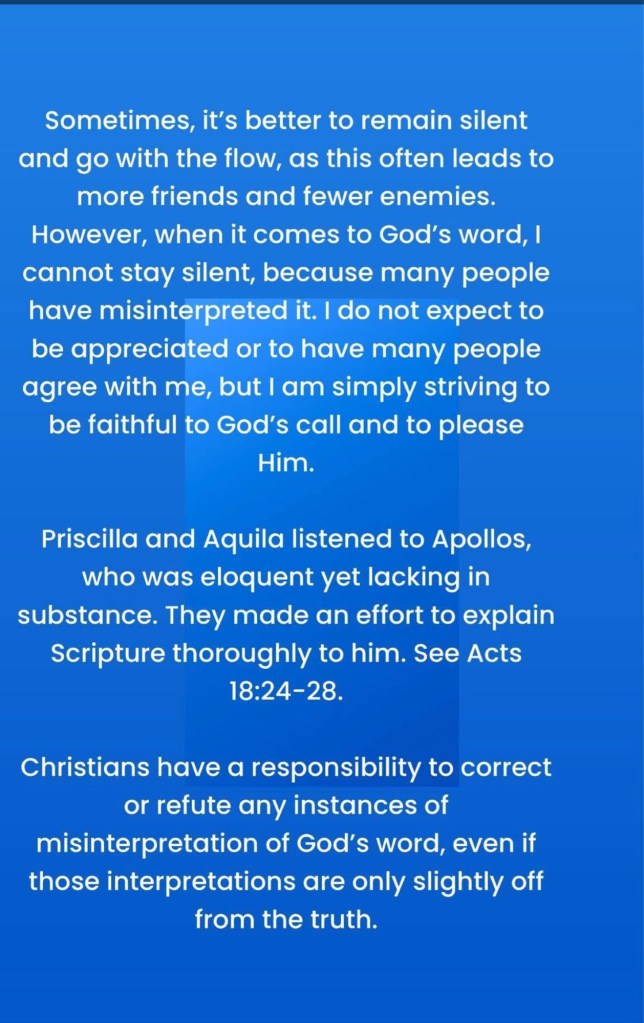
Since June is an occasion for fathers, I am writing this letter to call on the attention of Christian fathers. Many Christian fathers are unable to minister to their families these days, perpetuating a cycle of decline. Since most Christian churches grow through birth rather than evangelism, it’s no surprise that we’re witnessing a decline in Christian leadership over time. To address this present dilemma, we must train the next generation in biblical interpretation. We should teach them how to properly explain Scripture, as people have been prioritizing communication skills over faithfulness to the content. Consequently, we see Christians adopting diverse and peculiar doctrines.
However, since the deterioration in doctrine has been occurring for decades, if not centuries, defective doctrines have become the norm. Consequently, truthful biblical teaching has become indistinguishable to most Christians.
The sanctity of the church hinges on two key aspects: right doctrine and Christian living, and these two aspects are intrinsically linked. How can we discern true Christian living if our doctrines are flawed? How can the church remain unified if each individual has their own interpretation of the church or its doctrine? Remember that Paul emphasized that true Christian unity rests on its doctrine. See Scripture below:
“As a prisoner for the Lord, I urge you to walk in a manner befitting your calling. Be humble and gentle, patient, and loving towards one another. Let us strive to maintain the unity of the Spirit in the bond of peace. We are one body and one Spirit, just as you were called to the ONE hope that belongs to your calling. We have ONE Lord, ONE faith, ONE baptism, ONE God and Father of all, who is over all, through all, and in all.
Grace has been given to each of us according to the measure of Christ’s gift. Therefore, it says, “When He ascended on high, He led a host of captives and gave gifts to men.” (In saying “He ascended,” what does it mean but that He also descended into the lower regions, the earth? He who descended is the one who also ascended far above all the heavens, so that He might fill all things.)
He gave the apostles, the prophets, the evangelists, the pastors, and the teachers to EQUIP the saints for the work of ministry and to BUILD UP the body of Christ, the church. Until we all attain to the UNITY OF FAITH (i.e. beliefs or doctrines) and knowledge of the Son of God, we will mature into men, reaching the measure of the fullness of Christ. Then we will no longer be children, tossed to and fro by the waves and carried about by every wind of doctrine, human cunning, and deceitful schemes.” Rather than SPEAKING THE TRUTH IN LOVE, we are to grow up in every way into Christ, the head of the church, from whom the whole body (i.e. the church), joined and held together by every joint, when each part works properly, makes the body grow so that it builds itself up in love. (Ephesians 4:1-16)
Love, as defined in Scripture, encompasses, rather centers on, right doctrines. So, why has the church chosen to prioritize protecting its aesthetics over its inner self or constitution (i.e., its doctrines)? Until when will Christians continue to be pretentious, claiming that everything is well with the church?
Lies, deceptions, or prosthetics can only keep those who are indifferent, naive in Scripture, or fatally attached due to relational bonds, but not the thinking, intellectually inclined, and truth-seeking Christians. Are you truly not aware of the reasons behind the church’s failures? The church has long ceased to effectively fulfill its mandate from Christ.
If you claim ignorance, then you don’t deserve to lead the church (1Timothy 3:1-13; Titus 1:5-9) . However, if you are aware of the situation, your silence and indifference are harming God’s church. Let me remind everyone of Paul’s words: “If anyone destroys God’s temple (i.e., the church), God will destroy him. For God’s temple is holy, and you are that temple.” (1 Corinthians 3:17)
Each Christian is obligated to uphold the sanctity of God’s church, particularly ministers, pastors, elders, deacons, and those who claim to be reverends.
Quoting Paul’s words: “For I wrote to you out of much affliction and anguish of heart and with many tears, not to cause you pain but to let you know the abundant love that I have for you.” (2 Corinthians 2:4)
As the saying goes, “Sharing is caring.” Let’s consider this article in the context of loving and caring for God’s church.
Peter , in the words of Acts 3:6, declared, “I possess neither silver nor gold, but in the name of Jesus Christ, I offer you what I have.” Share freely, for you freely receive. Stay updated by heading to our about page and subscribe directly to receive notifications in your inbox. Blessing!
Peter, in the words of Acts 3:6, declared, “I possess neither silver nor gold, but in the name of Jesus Christ, I offer you what I have.” Share freely, for you freely receive. Stay updated by heading to our about page and subscribe directly to receive notifications in your inbox. Blessing!
Although others may teach about a possible chance even after death, the Bible is unequivocal that our sole opportunity for salvation lies in this present life or existence. Jesus Christ, through a parable, imparted this profound truth.
“There was a rich man who was clothed in purple and fine linen and who feasted sumptuously every day. And at his gate was laid a poor man named Lazarus, covered with sores, who desired to be fed with what fell from the rich man’s table. Moreover, even the dogs came and licked his sores. The poor man died and was carried by the angels to Abraham’s side. The rich man also died and was buried, and in Hades, being in torment, he lifted up his eyes and saw Abraham far off and Lazarus at his side. And he called out, ‘Father Abraham, have mercy on me, and send Lazarus to dip the end of his finger in water and cool my tongue, for I am in anguish in this flame.’ But Abraham said, ‘Child, remember that you in your lifetime received your good things, and Lazarus in like manner bad things; but now he is comforted here, and you are in anguish. And besides all this, between us and you a great chasm has been fixed, in order that those who would pass from here to you may not be able, and none may cross from there to us.’ And he said, ‘Then I beg you, father, to send him to my father’s house— for I have five brothers—so that he may warn them, lest they also come into this place of torment.’ But Abraham said, ‘They have Moses and the Prophets; let them hear them.’ And he said, ‘No, father Abraham, but if someone goes to them from the dead, they will repent.’ He said to him, ‘If they do not hear Moses and the Prophets, neither will they be convinced if someone should rise from the dead.’” (Luke 16:19-31)
Here are some detailed facts:
After death, both Lazarus and the rich man found themselves in Hades. Hades was the place of death before God’s final judgment at the coming of Christ Jesus (as mentioned in 2 Corinthians 5:10, John 5:28-29; Revelation 20:11-14, and so on).
The rich man, who had lived luxuriously and cared little for Lazarus’ destitute state, ended up in the place of torment. In contrast, Lazarus, despite being poor, was also in Hades but in a blissful state, in Abraham’s bosom.
Perhaps you might ask, “Why did Lazarus find himself in a state of bliss? Was it simply because he was poor?” The answer to that question wasn’t explicitly stated in the story, but rather in the context of the parable. See Luke 16:13-16:
Jesus Christ said, “No servant can serve two masters, for either he will hate the one and love the other, or he will be devoted to the one and despise the other. You cannot serve God and money.” The Pharisees, who were lovers of money, heard all these things, and they ridiculed Him. And He (Jesus) said to them, “You are those who justify yourselves before men, but God knows your hearts. For what is exalted among men is an abomination in the sight of God. “The Law and the Prophets were until John; since then the good news of the kingdom of God is preached, and everyone forces his way into it.”
The parable was spoken in response to the Pharisees’ hardness of heart. They refused God’s offer of salvation because they had much to give up—they were lovers of money. Consequently, by inference, Lazarus, despite having no riches, was dependent on God’s mercy and trusted in His grace, which explains why he ended up in Abraham’s side. Keep in mind that Abraham was the father of faith, as Paul states in Romans 4:9-12. Therefore, by implication, Lazarus also, lived in faith.
Hoping that this simple explanation would clear out myths about death and heaven. Paul, writing to the Corinthians, said, “I know a man in Christ who fourteen years ago was caught up to the third heaven—whether in the body or out of the body I do not know, God knows. And I know that this man was caught up into paradise—whether in the body or out of the body I do not know, God knows— and he heard things that cannot be told, which man may not utter.” (2 Corinthians 12:2-4)
Easton’s Bible Dictionary explain: According to the Jewish notion there were three heavens,
Clearly, at the time of Paul, heaven remained inaccessible to man. He was only privileged to glimpse a vision of heaven even before Christ had returned.
Furthermore, in Christ’s parable, Jesus made it clear that there was a vast chasm between the realms of the living and the dead, and no one from either side could cross over. Therefore, after death, the destination of people was sealed, and they were only waiting for the final judgment. Hence, the idea of praying for the dead is nowhere in the Bible.
Jesus asserted that no one would be permitted to return to the realm of the living after death. Christ further explained that even those who had been informed about His resurrection would ultimately end up in the place of torment in Hades because they had failed to believe the teachings of Moses and the Prophets—a reference to the Old Testament Scriptures. Jesus, speaking about His resurrection, said, “These are My words that I spoke to you while I was still with you, that everything written about Me in the Law of Moses, the Prophets, and the Psalms must be fulfilled.” (Luke 24:44)
The entire Bible is about Jesus Christ. Therefore, it is crucial to be careful not to reject His Word.
Yes, God’s offer of salvation through Christ Jesus is a second chance. Better yet, a limited chance because it is only valid while we are still alive. Once we die, our time is up. Go, therefore, and share the Gospel with your loved ones, family, and friends. Knowing that it’s their chance of a lifetime.
Peter, in the words of Acts 3:6, declared, “I possess neither silver nor gold, but in the name of Jesus Christ, I offer you what I have.” Share freely, for you freely receive. Stay updated by heading to our about page and subscribe directly to receive notifications in your inbox. Blessing!
Jesus Christ in John 10 proclaims, “I am the good shepherd” (John 10:11). This declaration echoes Ezekiel 34:11, where the Lord God declares, “Behold, I, I Myself will search for My sheep and will seek them out.”
Christ Jesus came to fulfill both the Law and the Prophets (Matthew 5:17-18). If He had arrived and left other Old Testament Scriptures unfulfilled for millennia, then His Word would have been deemed incomplete. However, Christ Jesus is the Word (John 1:1-5, 14-18), and He has undoubtedly fulfilled all His promises. Therefore, it is our responsibility to reconcile His teachings with our own.
Being ridiculed by the religious leaders of Israel for mingling with sinners and tax-collectors, Jesus Christ then told them two parables:
“What man of you, having a hundred sheep, if he has lost one of them, does not leave the ninety-nine in the open country, and go after the one that is lost, until he finds it? And when he has found it, he lays it on his shoulders, rejoicing. And when he comes home, he calls together his friends and his neighbors, saying to them, ‘Rejoice with me, for I have found my sheep that was lost.’ Just so, I tell you, there will be more joy in heaven over one sinner who repents than over ninety-nine righteous persons who need no repentance.” “Or what woman, having ten silver coins, if she loses one coin, does not light a lamp and sweep the house and seek diligently until she finds it? And when she has found it, she calls together her friends and neighbors, saying, ‘Rejoice with me, for I have found the coin that I had lost.’ Just so, I tell you, there is joy before the angels of God over one sinner who repents.” (Luke 15:4-10)
In Christ’s parable, the lost sheep represents the sinners and tax collectors who are seeking salvation through His words and teachings. If Jesus Christ fulfills the prophecy in Ezekiel 34 as the Shepherd of God’s flock, then it follows that those who oppose Him and His message are false shepherds.
If God condemned the false shepherds of the Old Testament, would He not do the same today for pastors who do not guide people to His Word?
Christianity centers on God’s Word. Men’s traditions have no authority over God’s Word. Christ Jesus and His Word is the final arbiter of faith and truth.
Peter, in the words of Acts 3:6, declared, “I possess neither silver nor gold, but in the name of Jesus Christ, I offer you what I have.” Share freely, for you freely receive. Stay updated by heading to our about page and subscribe directly to receive notifications in your inbox. Blessing!
In John 9, Jesus’ disciples asked Him, “Rabbi, who sinned, this man or his parents, that he was born blind?” Jesus answered, “It was not that this man sinned, or his parents, but that the works of God might be displayed in him.” (John 9:2-3)
What did Jesus mean by “the works of God”? In John 6:29, we see that the work of God is for people to believe in Jesus Christ, whom He has sent.
John 9 is not solely about miracles and healings; rather, John emphasizes that these events are signs of Christ Jesus (John 20:30-31). Before Christ’s coming, the Jews experienced four hundred years of silence from God—where no miracles or words were spoken (What were the 400 years of silence? | GotQuestions.org; I disagree with the last sentence on this site. To understand why, visit my blog site https://unlearningtraditionrelearningscripture.com). Malachi foretold that Israel should anticipate the arrival of a forerunner preceding the coming of Christ Jesus (Malachi 3:1-5; 4:1-6). Thus, the signs performed by Christ announced His arrival (John 7:31). Although recognized by the religious leaders, they ultimately rejected Jesus, misleading Israel and condemning Him to the cross (John 11:47-48).
Are we faithfully bringing Jesus Christ to the awareness of others? Is our teaching about Jesus Christ aligned with Scripture? As Christians, are we living lives that reflect God’s grace?
We must always be vigilant about what we teach. It is essential to convey only the truths found in Scripture. Paul warned against those who teach about another Jesus or another Gospel (Galatians 1:6-7; 2 Corinthians 11:3-4).
“I am astonished that you are so quickly deserting him who called you in the grace of Christ and are turning to a different gospel—not that there is another one, but there are some who trouble you and want to distort the gospel of Christ.” (Galatians 1:6-7)
“But I am afraid that as the serpent deceived Eve by his cunning, your thoughts will be led astray from a sincere and pure devotion to Christ. For if someone comes and proclaims another Jesus than the one we proclaimed, or if you receive a different spirit from the one you received, or if you accept a different gospel from the one you accepted, you put up with it readily enough.” (2 Corinthians 11:3-4)
Let us learn only from the Word of God and not from men. Jesus Christ told a parable: “Can a blind man lead a blind man? Will they not both fall into a pit? A disciple is not above his teacher, but everyone when fully trained will be like his teacher.” (Luke 6:39-40)
True teaching of God’s Word is only truly learned when one is thoroughly trained in it. While reading men’s writings can sometimes be helpful, it should always be approached with discernment and discretion. We must be careful not to repeat the mistakes of others, as this could lead us to mislead those we teach. If that happens, can we still claim to be doing the work of God, which is to lead people to believe in Jesus Christ?
Peter, in the words of Acts 3:6, declared, “I possess neither silver nor gold, but in the name of Jesus Christ, I offer you what I have.” Share freely, for you freely receive. Stay updated by heading to our about page and subscribe directly to receive notifications in your inbox. Blessing!
Despite clear utterance from the Lord Jesus Christ that His return or parousia would be during the lifetime of the apostles, it has been rejected and denied by the futurists – actually, that includes the majority of professing Christians. See my blog “Confused Christianity” on Jesus’ assurance concerning His return.
One of the most often used arguments may be found through the writings of Luke, see Acts 1:9-11.
“And when He (Jesus Christ) had said these things, as they were looking on, He was lifted up, and a cloud took Him out of their sight. And while they were gazing into heaven as He went, behold, two men stood by them in white robes, and said, “Men of Galilee, why do you stand looking into heaven? This Jesus, who was taken up from you into heaven, will come in the same way as you saw Him go into heaven.””
They believe “Jesus returning in the same manner as He was taken” means a physical return. Was it?
First, let us see where Jesus was going at His ascension. See John 20:17.
“Jesus said to her (Mary), “Do not cling to me, for I have not yet ascended to the Father; but go to my brothers and say to them, ‘I am ascending to My Father and your Father, to My God and your God.’””
Jesus was ascending to His glory, to God the Father in heaven. Isn’t that where Jesus exactly told the disciples He was going? See John 14:2.
“In My Father’s house are many rooms. If it were not so, would I have told you that I go to prepare a place for you?”
Sometime after His ascension, Jesus Christ appeared to Stephen. See Acts 7:55-56.
“But he (Stephen), full of the Holy Spirit, gazed into heaven and saw the glory of God, and Jesus standing at the right hand of God. And he said, “Behold, I see the heavens opened, and the Son of Man standing at the right hand of God.””
In other words, after His ascension, Jesus Christ, now glorious, is at the right hand of God. Finally, Paul also said the same about Jesus after His ascension. See 1 Timothy 3:16.
“Great indeed, we confess, is the mystery of godliness: He (Jesus Christ) was manifested in the flesh, vindicated by the Spirit, seen by angels, proclaimed among the nations, believed on in the world, taken up in glory.”
Nowhere in Scripture would you find Jesus returning in the flesh, but with the cloud. Isn’t that what Luke wrote in Acts 1:9?
“And when He (Jesus Christ) had said these things, as they were looking on, He was lifted up, and a cloud took Him out of their sight.” (Acts 1:9)
Consequently, the angels were testifying about the imminent fulfillment of God’s kingdom and judgment as prophesied in Daniel 7:13-14.
““I saw in the night visions, and behold, with the clouds of heaven there came one like a son of man, and He came to the Ancient of Days and was presented before Him. And to Him was given dominion and glory and a kingdom, that all peoples, nations, and languages should serve him; his dominion is an everlasting dominion, which shall not pass away, and his kingdom one that shall not be destroyed.”
Incidentally, Jesus made it clear He wasn’t establishing a physical kingdom; see John 18:36.
“Jesus answered, “My kingdom is not of this world. If My kingdom were of this world, My servants would have been fighting, that I might not be delivered over to the Jews. But My kingdom is not from the world.””
Finally, Jesus said His kingdom cannot be observed but is present. See Luke 17:20-21.
“Being asked by the Pharisees when the kingdom of God would come, He (Jesus Christ) answered them, “The kingdom of God is not coming in ways that can be observed, nor will they say, ‘Look, here it is!’ or ‘There!’ for behold, the kingdom of God is in the midst of you.””
Aren’t futurists proclaiming the exact opposite of Jesus at His return and the conflicting realities of His kingdom?
Note: Futurist are those who insist and teach that Jesus’ Return is yet to come.
Blessings!
If you want to follow our journey of unlearning tradition and relearning Scripture and stay updated, you can head to our about page and subscribe directly to receive notifications in your inbox.
Without a doubt, 21st-century Christianity comes in many shapes and forms. Christians differ in doctrines, but they seem to be unified in believing that the return of Jesus Christ is still in the future, though it has been millennia since Jesus promised His apostles that He would be coming in their generation. See Matthew 16:27-28.
“For the Son of Man is going to come with His angels in the glory of His Father, and then He will repay each person according to what he has done. Truly, I say to you, there are some standing here who will not taste death until they see the Son of Man coming in his kingdom.””
The synoptic Gospels – Matthew, Mark, & Luke – have the same assurance concerning the imminent return of Christ:
“And He (Jesus Christ) said to them (apostles), “Truly, I say to you, there are some standing here who will not taste death until they see the kingdom of God after it has come with power.”” (Mark 9:1)
“For whoever is ashamed of Me (Jesus Christ) and of My words, of him will the Son of Man be ashamed when He comes in His glory and the glory of the Father and of the holy angels. But I tell you truly, there are some standing here who will not taste death until they see the kingdom of God.”” (Luke 9:26-27)
Not only that, Jesus Christ sending out the twelve apostles, instructing them on His message, said, “And proclaim as you go, saying, ‘The kingdom of heaven is at hand.’” (Matthew 10:7)
“At hand” in the original Greek language means “near,” and near cannot by any means be thousands of years and continuing, as suggested by the Futurists. Jesus Christ did not just give them the message to proclaim, but He reinforced the message with the assurance that it was indeed occurring soon. See Matthew 10:23.
“When they persecute you (the apostles) in one town, flee to the next, for truly, I say to you, you will not have gone through all the towns of Israel before the Son of Man comes.”
As I researched the validity of Jesus’ words, it’s sad, actually disgusting, to find known Bible scholars saying, “No, Jesus was confused or hallucinating when He uttered those words.” Some dismissed the passages saying, “There must be another meaning for that, but we just have to find out.”
Funny that for as long as the passages or verses are convenient to their theological position, they adhere to the Words of Christ, but if it doesn’t, then it’s excuses after excuses. Scripture does not need affirmation from men; rather, the Bible is the dispenser of truth because it is the Word of God.
One of the key disciplines in interpreting Scripture involves recognizing “time statements.” However, Futurists often overlook these time statements in the Bible, particularly in the New Testament, and instead suggest that they refer to the future. It’s important to remember that what the apostles considered “the future” is no longer future to us today.
Hence, statements like “this generation” in Matthew 24:34 no longer make an impact on the readers, for time statements have been disregarded. See Matthew 24:29-34.
“29 Immediately after the tribulation of those days the sun will be darkened, and the moon will not give its light, and the stars will fall from heaven, and the powers of the heavens will be shaken. 30 Then will appear in heaven the sign of the Son of Man, and then all the tribes of the earth will mourn, and they will see the Son of Man coming on the clouds of heaven with power and great glory. 31 And He will send out His angels with a loud trumpet call, and they will gather His elect from the four winds, from one end of heaven to the other. 32 “From the fig tree learn its lesson: as soon as its branch becomes tender and puts out its leaves, you know that summer is near. 33 So also, when you see all these things, you know that He is near, at the very gates. 34 Truly, I say to you, this generation will not pass away until all these things take place.
So some have suggested “this generation” refers to the generation who saw the literal signs of Matthew 24:29-34. Yet, they miss out on John’s confession in Revelation that he was already in tribulation. See Revelation 1:9.
“I, John, your brother and partner in the tribulation and the kingdom and the patient endurance that are in Jesus, was on the island called Patmos on account of the word of God and the testimony of Jesus.”
Scripture is a unity. The apostles’ writings cannot be different from the Words of Jesus found in the Gospels, the Book of Acts, or the Book of Revelation. Jesus’ words have their foundation in the Old Testament Scripture. The entire Bible is a cohesive revelation concerning the declaration and fulfillment of God’s words.
See Luke 24:44.
Then He (Jesus Christ) said to them (The disciples), “These are My words that I spoke to you while I was still with you, that everything written about Me in the Law of Moses and the Prophets and the Psalms must be fulfilled.”
In recent years, we have witnessed the rise of fake news online. Most people now get their news from the web, particularly from platforms like Facebook and YouTube. Unfortunately, fake news spreads easily because many individuals click to watch or read without considering the source or the intent of the uploader or poster.
Even if a Facebook post or YouTube video contains factual information, ignoring the date it was published can severely affect its relevance today. The same principle applies when reading and studying the Bible. It is essential to recognize the audience’s relevance, the timing of statements, and their historical accuracy. Failing to do so can lead to misinterpretations of Scripture, whether by inexperienced readers or poorly informed pastors.
Jesus Christ warned, “Can a blind man lead a blind man? Will they not both fall into a pit?” (Luke 6:39)
Find someone who can teach you the disciplines of studying Scripture. Avoid using human-tailored Bible study materials, as they often reflect human influence. It’s important to recognize that even within different Bible translations, traces of human interpretation can be found. Let me be clear: the Bible itself is perfect, infallible, and without error; the issues arise with the translations.
You don’t need to be a scholar of Greek, Hebrew, or Aramaic, but it is beneficial to read the Bible by comparing different translations. Additionally, learning to use language tools, such as lexicons, is essential for in-depth Bible study. There are many free lexicon tools available online or for download. You just need to find someone knowledgeable to guide you in using these tools effectively.
It’s never too late to start studying Scripture and practicing proper exegesis. Ultimately, Scripture reveals truths about salvation that extend beyond our physical needs and concerns, addressing both our current lives and eternity. Don’t let yourself become part of confused Christianity.
Peter, in the words of Acts 3:6, declared, “I possess neither silver nor gold, but in the name of Jesus Christ, I offer you what I have.” Share this article freely, for you freely receive. Take note, underlines and highlights are clickable links for definitions or Bible references. Stay updated by heading to our about page and subscribe directly to receive notifications in your inbox. Blessing!
Without a doubt, the story of Jonah is better known than that of Nahum, though both books spoke of God’s judgment against Assyria. In traditional Sunday school setting, perhaps the focus of Jonah’s story would often be that of his adventure – he was swallowed by the great fish for three days and three nights (Jonah 1:17) – and that of his miraculous survival after he had prayed to God for mercy (Jonah 2:10). A serious study of the book however would reveal that the subject of Jonah’s story was God and His great mercy and love for His creation. See Jonah 4:10-11.
And the LORD said, “You [Jonah] pity the plant, for which you did not labor, nor did you make it grow, which came into being in a night and perished in a night. And should not I pity Nineveh, that great city, in which there are more than 120,000 persons who do not know their right hand from their left, and also much cattle?”
God obviously does love and care for His creation, see Matthew 5:44-45, Jesus Christ said:
But I say to you, love your enemies and pray for those who persecute you, so that you may be sons of your Father who is in heaven. For He makes His sun rise on the evil and on the good, and sends rain on the just and on the unjust.
However, God’s love expressed through Jesus Christ, that alone brings salvation; see Romans 5:8-10. The apostle Paul writing to the believers in Rome said:
But God shows His love for us in that while we were still sinners, Christ died for us. Since, therefore, we have now been justified by His blood, much more shall we be saved by Him from the wrath of God. For if while we were enemies we were reconciled to God by the death of His Son, much more, now that we are reconciled, shall we be saved by His life.
Again see Acts 4:10-12.
Let it be known to all of you and to all the people of Israel that by the name of Jesus Christ of Nazareth, whom you crucified, whom God raised from the dead—by Him this man is standing before you well. This Jesus is the stone that was rejected by you, the builders, which has become the cornerstone. And there is salvation in no one else, for there is no other name under heaven given among men by which we must be saved.”
Continuing on our topic, it is noteworthy to know that from within the Old Testament Scripture Jonah was mentioned once outside his book (Jonah); see 2 Kings 14:23-25.
In the fifteenth year of Amaziah the son of Joash, king of Judah, Jeroboam the son of Joash, king of Israel, began to reign in Samaria, and he reigned forty-one years. And he did what was evil in the sight of the LORD. He did not depart from all the sins of Jeroboam the son of Nebat, which he made Israel to sin. He restored the border of Israel from Lebo-hamath as far as the Sea of the Arabah, according to the word of the LORD, the God of Israel, which He spoke by His servant Jonah the son of Amittai, the prophet, who was from Gath-hepher.
Let me get this out first, there were two Joash in 2 Kings. One was the father of Amaziah king of Judah and the other father of Jeroboam II king of Israel.
Next, understand that after the split of the monarchy under David and Solomon, Jeroboam the son of Nebat became the first king of the northern kingdom of Israel. The other half, the southern kingdom, was known as Judah. Jeroboam the son of Josh or Jeroboam II was the fourteenth king of the northen kingdom of Israel. Also, Joash and Jehoash were the same person, the father of Jeroboam II; see 2 Kings 13:25.
Then Jehoash the son of Jehoahaz took again from Ben-hadad the son of Hazael the cities that he had taken from Jehoahaz his father in war. Three times Joash defeated him and recovered the cities of Israel.
Jehoahaz was the twelfth king of Israel, Jehoash or Joash the thirteenth king and Jeroboam II the fourteenth king of the northern kingdom of Israel.
Jonah then had not always been a reluctant prophet of God as seen from 2 Kings 14:25 quoted above. Also, since he had or started his ministry during the reign of Jeroboam II, Jonah then could be contemporaries with Hosea and Amos or he was shortly ahead of them; see Hosea 1:1
The word of the LORD that came to Hosea, the son of Beeri, in the days of Uzziah, Jotham, Ahaz, and Hezekiah, kings of Judah, and in the days of Jeroboam the son of Joash, king of Israel.
Now see Amos 1:1.
The words of Amos, who was among the shepherds of Tekoa, which he saw concerning Israel in the days of Uzziah king of Judah and in the days of Jeroboam the son of Joash, king of Israel, two years before the earthquake. (Amos 1:1)
All three prophets – Jonah, Hosea and Amos – had their ministry during the reign of Jeroboam II. On the other hand, Jonah and Nahum should be seen as Book 1 & 2 of God’s judgment against Assyria. Nahum prophesied in the time between the Assyrian capture of Thebes in Egypt which is known to have occurred in 663 or 661 B.C. (Nahum 3:8-11), and the final destruction of Nineveh in 612 B.C. (Nahum 2:8-13). Source for the dates of Nahum are taken from the Complete Word Study Bible. Nahum was a seventh century B.C. prophet; Jonah, on the other hand was an eighth century B.C. prophet of God.
An online website, History World, under History of Assyria narrated that the Assyrian empire was the greatest then destroying the northern kingdom of Israel and the coastal cities of Phoenicia in the late eighth and early seventh century B.C, next was Thebes of Egypt, far up the Nile sacked in 663 B.C. Exactly as it was detailed in Scripture.
Jeroboam II reigned in the northern kingdom of Israel 41 years (2 Kings 14:23). Zechariah succeeded him and he reigned for six months (2 Kings 15:8), followed by Shallum who reigned only for a month (2 Kings 15:13), then Menahem ruled for 10 years (2 Kings 15:17). During his reign, Assyria came against the land of northern Israel but then they left after Menahem paid tribute to the king of Assyria. Pekahiah succeeded Menahem and he reigned for two years (2 Kings 15:23), and second to the last was Pekah who reigned 20 years (2 Kings 15:27). In the days of Pekah king of Israel, Assyria again came and captured territories of the northern kingdom. This time people were exiled as captives to Assyria (2 Kings 15:29). It was also Pekah king of Israel who connived with the Syrian king in attacking Judah, the other half of the former monarchy of the unified Israel (2 Kings 16:5). Pekah however was murdered by Hoshea. He was the last king of the northern kingdom of Israel, and he reigned 9 years (2 Kings 15:30; 17:1). It was during Hoshea’s reign that the northern kingdom of Israel fell completely into the hands of Assyria and the whole of the northern kingdom of Israel was exiled and scattered (2 Kings 17:6). With the end of the northern kingdom of Israel, Scripture made an important remark; see 2 Kings 17:7-8,15.
And this occurred because the people of Israel had sinned against the LORD their God, who had brought them up out of the land of Egypt from under the hand of Pharaoh king of Egypt, and had feared other gods and walked in the customs of the nations whom the LORD drove out before the people of Israel, and in the customs that the kings of Israel had practiced … They despised His statutes and His covenant that He [God] made with their fathers and the warnings that He gave them. They went after false idols and became false, and they followed the nations that were around them, concerning whom the LORD had commanded them that they should not do like them.
See also 2 Kings 17:18-20.
Therefore the LORD was very angry with Israel and removed them out of his sight. None was left but the tribe of Judah only.Judah also did not keep the commandments of the LORD their God, but walked in the customs that Israel had introduced. And the LORD rejected all the descendants of Israel and afflicted them and gave them into the hand of plunderers, until He had cast them out of His sight.
Altogether after Jeroboam II who reigned 41 years, the succeeding kings reigned a total of 41 years and 7 months. Also, Assyria had practically and constantly theatened the northen kingdom of Israel after the reign of Jeroboam II, all 41 years beginning with Menahem’s reign. Since it was barely seven months after the reign of Jeroboam II when Menahem came to power, perhaps Jonah saw firsthand the oppression of Assyria against his homeland. He was from Gath-hepher, a border town of Zebulun, one of the ten tribes of the northern kingdom of Israel. Jonah must have wondered why God had favored Assyria, sending him to preach His divine judgment. Jonah knew God would relent from His judgment once Assyria turned to Him for forgiveness; hence, he disobeyed God’s call and went the opposite direction, see Jonah 4:2-3.
And he [Jonah] prayed to the LORD and said, “O LORD, is not this what I said when I was yet in my country? That is why I made haste to flee to Tarshish; for I knew that You are a gracious God and merciful, slow to anger and abounding in steadfast love, and relenting from disaster. Therefore now, O LORD, please take my life from me, for it is better for me to die than to live.”
Perhaps we could relate to Jonah’s displeasure and anger. After all, his own homeland had been threatened by the Assyrians whom God have forgiven. Did God really favored Assyria over Israel? Could Jonah be asking as well, “Why can’t God offer the same favor and forgive Israel too as He had done for Assyria?”
Remember I explained earlier that Pekah the king of Israel connived with Syria to attack Judah. The combined attack did occur, but they just can’t conquer Judah (2 Kings 16:5). Also, it was by God’s design that Israel should fall into the hands of the Assyrian because they have broken God’s covenant (2 Kings 17:7-9,13-15). Yes, Judah also did the same against God, yet they were spared? See 2 Kings 17:18-20.
Therefore the LORD was very angry with Israel and removed them out of His sight. None was left but the tribe of Judah only. Judah also did not keep the commandments of the LORD their God, but walked in the customs that Israel had introduced. And the LORD rejected all the descendants of Israel and afflicted them and gave them into the hand of plunderers, until He had cast them out of his sight.
God seemed to have relented on His earlier judgment against Nineveh because Assyria was His vessel of vengeance against Israel; see Isaiah 7:7-9.
Thus says the Lord GOD: “It shall not stand, and it shall not come to pass. For the head of Syria is Damascus, and the head of Damascus is Rezin. And within sixty-five years Ephraim will be shattered from being a people. And the head of Ephraim is Samaria, and the head of Samaria is the son of Remaliah. If you [King Ahaz of Judah] are not firm in faith, you will not be firm at all.”
God never backed down from His word, and He changes not. Israel was punished according to the stipulation of God’s Covenant with them; see Deuteronomy 28:15.
But if you will not obey the voice of the LORD your God or be careful to do all His commandments and His statutes that I command you today, then all these curses shall come upon you and overtake you.
Continue with Deuteronomy 28:25-26.
The LORD will cause you to be defeated before your enemies. You shall go out one way against them and flee seven ways before them. And you shall be a horror to all the kingdoms of the earth. And your dead body shall be food for all birds of the air and for the beasts of the earth, and there shall be no one to frighten them away.
Also Deuteronomy 28:33-34.
A nation that you have not known shall eat up the fruit of your ground and of all your labors, and you shall be only oppressed and crushed continually, so that you are driven mad by the sights that your eyes see.
And again Deuteronomy 28:36-37.
The LORD will bring you and your king whom you set over you to a nation that neither you nor your fathers have known. And there you shall serve other gods of wood and stone. And you shall become a horror, a proverb, and a byword among all the peoples where the LORD will lead you away.
Finally Deuteronomy 28:45-49.
All these curses shall come upon you and pursue you and overtake you till you are destroyed, because you did not obey the voice of the LORD your God, to keep His commandments and His statutes that He commanded you. They shall be a sign and a wonder against you and your offspring forever. Because you did not serve the LORD your God with joyfulness and gladness of heart, because of the abundance of all things, therefore you shall serve your enemies whom the LORD will send against you, in hunger and thirst, in nakedness, and lacking everything. And He will put a yoke of iron on your neck until He has destroyed you. The LORD will bring a nation against you from far away, from the end of the earth, swooping down like the eagle, a nation whose language you do not understand …
No wonder then, at the time of Pekah king of Israel, Isaiah 7:17 said:
The LORD will bring upon you and upon your people and upon your father’s house such days as have not come since the day that Ephraim departed from Judah—the king of Assyria!
As you can see, first, Nineveh turned to the LORD for forgiveness with God’s judgment by Jonah. Perhaps a second reason – God is sovereign and He knew all things, so Assyria was preserved for God’s purpose against Israel. Same with Judah, though they have followed Israel and disobeyed God’s commandments (2 Kings 17:18-19) yet they were preserved for the meantime until the coming of Jesus Christ, see Isaiah 7:13-14.
And he [Isaiah] said, “Hear then, O house of David! Is it too little for you to weary men, that you weary my God also? Therefore the Lord Himself will give you a sign. Behold, the virgin shall conceive and bear a son, and shall call His name Immanuel.“
See also Matthew 1:22-23.
All this took place to fulfill what the Lord had spoken by the prophet [Isaiah]: ‘Behold, the virgin shall conceive and bear a Son, and they shall call His name Immanuel (which means, God with us).
This passage spoke of the fulfillment of Isaiah 7:13-14, the coming of Jesus Christ. At that time, Jerusalem together with its temple which was in Judah was the known nation of the Jew. But within forty years after the crucifixion, death, resurrection and ascension of Jesus Christ, Jerusalem (Judah) was destroyed and the surviving Jews were scattered for close to two millennium fulfilling exactly Deuteronomy 28.
It is therefore not surprising that Jonah failed to comprehend God’s purpose. Truly, just as God said in Isaiah 55:8-9,
For My thoughts are not your thoughts, neither are your ways My ways, declares the LORD. For as the heavens are higher than the earth, so are My ways higher than your ways and My thoughts than your thoughts.
At this point, having understood how God’s word remained true and was fulfilled in history, let us learn to always trust God, especially when times are tough, perplexed and doubtful. Always put our faith in God for He alone holds our future and He is good. Let us also obey God’s word though circumstances may seem to suggest otherwise. For no one can ever thwart His good purpose and will, He alone reigns sovereign.
In conclusion, Jonah was an eighth century prophet during the reign of Jeroboam II as mentioned in 2 Kings 14:25. Biblical scholars have differing dates for Jeroboam II. Both Easton Bible Dictionary and Smith Bible Dictionary dated his reigned 825-784 B.C. But taking the dating from the Jewish Virtual Library, it should be around 789-748 B.C. Jonah then should be a hundred or so years ahead of Nahum ministry – after 663-661 B.C. but before 612 B.C.
As I have said earlier, history proved true God’s word. It is ironic that God illustrated His impending judgment against Assyria by their own capture of Thebes. See Nahum 3:8-11.
Are you [Assyria] better than Thebes that sat by the Nile, with water around her, her rampart a sea, and water her wall? Cush was her strength; Egypt too, and that without limit; Put and the Libyans were her helpers. Yet she became an exile; she went into captivity; her infants were dashed in pieces at the head of every street; for her honored men lots were cast, and all her great men were bound in chains. You [Assyria] also will be drunken; you will go into hiding; you will seek a refuge from the enemy.
I have mentioned earlier that an online website (History World, History of Assyria) proved to us the fulfillment of God’s Word. We having the benefit of history now see the truthfulness of God’s word so we should also learn that most of the time it is only on hindsight that we get to see God’s good purpose for things that He have allowed into our lives.
Also as I have said earlier, both Jonah and Nahum preached about God’s judgment against Assyria. In Jonah’s time, Nineveh repented so God relented upon His judgment; in Nahum’s, the LORD affirmed with finality His destruction of Assyria. See Nahum 2:8-13.
Nineveh is like a pool whose waters run away. “Halt! Halt!” they cry, but none turns back. Plunder the silver, plunder the gold! There is no end of the treasure or of the wealth of all precious things. Desolate! Desolation and ruin! Hearts melt and knees tremble; anguish is in all loins; all faces grow pale! Where is the lions’ den, the feeding place of the young lions, where the lion and lioness went, where his cubs were, with none to disturb? The lion tore enough for his cubs and strangled prey for his lionesses; he filled his caves with prey and his dens with torn flesh. Behold, I am against you, declares the LORD of hosts, and I will burn your chariots in smoke, and the sword shall devour your young lions. I will cut off your prey from the earth, and the voice of your messengers shall no longer be heard.
Jonah and Nahum indeed are the stories of God’s justice, mercy and grace. Assyria, Israel and Judah were mere actors portraying God’s greater purpose in creation. Judah was spared for awhile simply because the Lord and Savior Jesus Christ, Immanuel, would be brought into the world through them. Scripture is not simply telling us stories of people but of God’s character and His divine purpose for salvation. Life is complex and profound. It is easy to be led astray by the humps and bumps of life causing us to made choices or decisions base on human perspective. Never leave God out of the equation of life. Focus on the Lord Jesus Christ, He alone should be at the center of our life and the decision we make. Only then may we truly glorify and honor God.
Blessings!
If you want to follow our journey of unlearning tradition and relearning Scripture, you can stay updated by heading to our about page and subscribe directly to receive notifications in your inbox.By the way, subscription is free and with no hidden cost.
One undeniable truth about life is that our physical existence has an end. Nobody should be surprised by it. It’s a known fact since the beginning of humanity. Perhaps we may say medical science has progress so much that the years of life have been prolonged. But I rather believe that medical science has helped improve the quality of life at the onset of diseases. It could also be argued that medical science might sometimes have unknowingly been prolonging the suffering of a terminally ill person. So it could be a matter of perspective.
Mankind has forever been trying to solve the problem of aging in the hope of addressing the reality of death. Death is a reality declared in the Bible. And Scripture did provide the solution to death.
In Genesis, God declared the punishment of death once the first humans broke His commandment – that they should not eat from the tree of the knowledge of good and evil. God gave mankind everything they needed for life, just one command, and yet they chose to break it so death occured.
But wait, what exactly did God say to Adam? See Genesis 2:16 -17.
And the LORD God commanded the man, saying, “You may surely eat of every tree of the garden, but of the tree of the knowledge of good and evil you shall not eat, FOR IN THE DAY THAT YOU EAT OF IT YOU SHALL SURELY DIE.”
Fast forward to Genesis 3:6-8.
So when the woman saw that the tree was good for food, and that it was a delight to the eyes, and that the tree was to be desired to make one wise, she took of its fruit and ate, and she also gave some to her husband who was with her, and he ate. Then the eyes of both were opened, and they knew that they were naked. And they sewed fig leaves together and made themselves loincloths. And they heard the sound of the LORD God walking in the garden in the cool of the day, and the man and his wife hid themselves from the presence of the LORD God among the trees of the garden.
No physical death occured immediately after mankind violated God’s commandment. The excuse that death came later cannot be acceptable if we take God’s Word accordingly. Reading from the text of Genesis 3:6-8, two things immediatly occured – mankind saw themselves naked and they became alienated from God – so spiritual death occured immediately after they broke God’s covenant. See Genesis 3:10.
And he [Adam] said, “I heard the sound of You [God] in the garden, and I was afraid, because I was naked, and I hid myself.”
Yes, God made a Covenant with Adam the moment He put him in the garden of Eden. The condition of God’s covenant was clearly stipulated in Genesis 2:16-17. Adam did not simply violate God’s commandment, he broke God’s Covenant with him. See Hosea 6:7, God said: “But like Adam they transgressed the Covenant; there they dealt faithlessly with Me.”
The Scripture in Job 1:21 said: And he [Job] said, “Naked I came from my mother’s womb, and naked shall I return. The LORD gave, and the LORD has taken away; blessed be the name of the LORD.”
Physical nakedness cannot be the problem. Adam and Eve were created naked (Genesis 2:25). No human was born dressed. It’s quite obvious from the narrative of Genesis that God didn’t saw nakedness as a problem, mankind did. See Genesis 3:10-11.
And he [Adam] said, “I heard the sound of you in the garden, and I was afraid, because I was naked, and I hid myself.” He [God] said, “Who told you that you were naked? Have you eaten of the tree of which I commanded you not to eat?”
Also see Genesis 2:25“And the man and his wife were both naked and were not ashamed.” Both Adam and Eve were naked when they were created and there seemed to be no problem with it. But when Adam told God he was afraid because he was naked so he hid himself, the LORD replied, “Who told you that you were naked?” Then He asked Adam, “Have you eaten of the tree of which I commanded you not to eat?” (Genesis 3:10-11).
Do you understand God’s question to Adam? God actually was asking Adam, “Did you broke the covenant that I have made with you?
Clearly nakedness as implied by Adam equates to his breaking of God’s covenant. And since God’s condition for mankind to remain inside the Garden of Eden was broken, Adam and Eve needed to be banished from the garden. See Genesis 3:22-24
Then the LORD God said, “Behold, the man has become like one of us in knowing good and evil. Now, lest he reach out his hand and take also of the tree of life and eat, and live forever-“ therefore the LORD God sent him out from the garden of Eden to work the ground from which he was taken. He drove out the man, and at the east of the garden of Eden he placed the cherubim and a flaming sword that turned every way to guard the way to the tree of life.
Before Adam and Eve broke God’s Covenant, mankind was in a state of innocence because they knew no evil, only goodness. Now that humanity had committed an evil deed breaking God’s covenant with them; hence, they now knew good and evil. Yet despite mankind’s sin, God clothed them to cover their shame – clearly an act of God’s kindness toward His creation. See Genesis 3:21.
And the LORD God made for Adam and for his wife garments of skins and clothed them.
God simply provided a temporary remedy for mankind; it looks forward to the calling of Abraham and the covenant making at Mount Sinai to the coming and return of Jesus Christ. See 2 Corinthians 5:2-4.
For in this tent we groan, longing to put on our heavenly dwelling, if indeed by putting it on we may not be found naked. For while we are still in this tent, we groan, being burdened-not that we would be unclothed, but that we would be further clothed, so that what is mortal may be swallowed up by life.
By “tent”, the apostle Paul here spoke of the Mosaic covenant, of which Paul said they groan longing to be further clothed by the New Covenant of Christ Jesus, then mortality may be swallowed up by life.
Spiritual death then means to be out of God’s Covenant. And without God’s Covenant mankind could forever be outside the Garden of Eden, where the TREE OF LIFE is.
It is quite obvious that mankind remains to be living even after Adam and Eve had broken God’s covenant and banished from the garden. In fact, they even multiplied by having children. But henceforth, every human would be born outside of the Garden of Eden and apart from God’s Creation Covenant.
The immediate consequence of mankind’s banishment from the Garden of Eden then demands as stipulated in Genesis 3:19 saying,
By the sweat of your face you shall eat bread, till you return to the ground, for out of it you were taken; for you are dust, and to dust you shall return.
Consequently, apart from God’s Covenant, physical birth and death became the natural cycle of humanity, and there is no way out of it. Mankind being of dust also is susceptible to degeneration, hence aging and death. The dilemma of death was the making of Adam, the representation of all humanity before God, with whom the LORD first made a covenant.
We can’t make any complaint or demands with God. The life that we have now still originated from God. See Genesis 2:7.
Then the LORD God formed the man of dust from the ground and breathed into his nostrils the breath of life, and the man became a living creature.
See also Ecclesiastes 12:7; Scripture said: “And the dust returns to the earth as it was, and the spirit returns to God who gave it.” By “spirit”, the Bible refers to the “breath of life” which made man a living being. See also Genesis 6:3.
Then the LORD said, “My Spirit shall not abide in man forever, for he is flesh: his days shall be 120 years.”
Our present existence or life is truly a gift from God. Eternity is not part of the original equation in creation due to Adam’s fall to sin. Rather, eternity is God’s gift for everyone whom will embrace His New Covenant. See Matthew 26:27-29.
And He [Jesus Christ] took a cup, and when He had given thanks He gave it to them [the disciples] saying, “Drink of it, all of you, for this is My blood of the covenant, which is poured out for many for the forgiveness of sins. I tell you I will not drink again of this fruit of the vine until that day when I drink it new with you in My Father’s kingdom.”
See also Hebrews 8:6.
But as it is, Christ has obtained a ministry that is as much more excellent than the old as the covenant he mediates is better, since it is enacted on better promises.
Jesus Christ alone is the solution to the humanities problem of death. The apostle Paul on his letter to the church of Ephesus said:
And you were dead in the trespasses and sins in which you once walked, following the course of this world, following the prince of the power of the air, the spirit that is now at work in the sons of disobedience- among whom we all once lived in the passions of our flesh, carrying out the desires of the body and the mind, and were by nature children of wrath, like the rest of mankind. But God, being rich in mercy, because of the great love with which he loved us,even when we were dead in our trespasses, made us alive together with Christ-by grace you have been saved– and raised us up with him and seated us with him in the heavenly places in Christ Jesus …
The journey of faith sometimes is long and tedious. But the transition from unbelief and faith in Christ Jesus is made once and should be real and true. God’s covenant with Adam demands obedience. Similarly the New Covenant of Jesus Christ also requires faith and obedience. See John 3:35-36.
The Father loves the Son and has given all things into His hand. Whoever believes in the Son has eternal life; whoever does not obey the Son shall not see life, but the wrath of God remains on him.
It is a delusion to claim faith in Jesus Christ yet be without obedience. Consequently, the apostle James said, “So also faith by itself, if it does not have works, is dead” (James 2:17).
If you want to follow our journey of unlearning tradition and relearning Scripture, you can stay updated by heading to our about page and subscribe directly to receive notifications in your inbox.
John chapters 13-17 covers the story of Jesus Christ with His disciples. The story begins with Jesus and His disciples taking the Passover Meal, so it’s the 14th of Nissan – the beginning of the Jewish Spring Festival. The Jewish day begins at sundown (6pm) to sundown (6pm) – the following day to us. It was the last moments of the Lord with His disciples. John 18 narrates the occasion of His arrest by the temple guards and the betrayal of Judas Iscariot.
John 13:30 tells us that Judas had departed after Jesus had handed him the morsel of bread. So beginning at John 13:31 to 17:26, it’s Jesus Christ and eleven apostles. These chapters of John’s Gospel were the last words of Jesus Christ to His eleven remaining disciples.
Jesus spoke of His glorification; see John 13:31-32
When he [Judas Iscariot] had gone out, Jesus said, “Now is the Son of Man glorified, and God is glorified in Him. If God is glorified in Him, God will also glorify Him in Himself, and glorify Him at once.
Jesus spoke of His departure; see John 13:33
Little children, yet a little while I am with you. you will seek Me, and just as I said to the Jews, so now I also say to you ‘Where I am going you cannot come.’
Jesus spoke of the New Commandment; see John 13:34
A new commandment I gave you, that you should love one another; just as I have loved you, you also are to love one another. By this all people will know that you are My disciples, if you have love for one another.
Jesus spoke of His Return; see John 14:3-4,6; also John 14:18-21
And if I go and prepare a place for you, I will come again and will take you to Myself, that where I am you may be also. And you know the way to where I am going … I am the way, and the truth, and the life. No one comes to the Father except through Me. (John 14:3-4,6)
I will not leave you as orphans; I will come to you. Yet a little while and the world will see Me no more, but you will see Me. Because I live, you also will live. In that day you will know that I am in My Father, and you in Me, and I in you. Whoever has My commandments and keeps them, he it is who loves Me. And he who loves Me will be loved by My Father, and I will love him and manifest Myself to him. (John 14:18-21)
Jesus spoke of the coming of the Holy Spirit; see John 14:25-26
These things I have spoken to you while I am still with you. But the Helper [Advocate], the Holy Spirit, whom the Father will send in My name, He will teach you all things and bring to your remembrance all that I have said to you.
Jesus spoke of the tribulation of His disciples; see John 15:18-25
If the world hates you, know that it has hated Me before it hated you. If you were of the world, the world would love you as its own; but because you are not of the world, but I chose you out of the world, therefore the world hated you. Remember the word that I said to you: ‘A servant is not greater than his Master.’ If they persecuted Me, they will also persecute you. If they kept My word, they will also keep yours. But all these things they will do to you on account of My name, because they do not know Him who sent Me. If I had not come and spoken to them, they would not have been guilty of sin, but now they have no excuse for their sin. Whoever hates Me hates My Father also. if I had not done among them the works that no one else did, they would not be guilty of sin, but now they have seen and hated both Me and My Father. But the word that is written in their Law must be fulfilled: ‘They hated Me without a cause.’
Jesus Christ, in John 15:25, quoted Psalm 35:19. “Let not those rejoice over Me who are wrongfully My foes, and let not those wink the eye who hate Me without cause.”
Psalms 34 & 35 does speak of David’s suffering. He was unjustly hated by Saul. But these two psalms are messianic psalms prophesying about the unjust persecution and suffering of Jesus Christ. So the story of David actually foreshadowed the betrayal and suffering of Jesus Christ by His own people – the Jew – and that He was hated for no cause. This further affirms my previous assertions in my blogs entitled “Immanuel, Our Confidence”, “Jesus Christ, Our Righteousness”, and “The Son of Man, Our Redeemer” that Psalms 34 & 35, both psalms of David, were Messianic prophesies concerning Jesus Christ.
Amazing, isn’t it? The Lord God truly is sovereign over all things. By divine providence, David’s life and righteousness foreshadowed that of Christ Jesus our Lord. Bear in mind that the context of Psalms 34 & 35 were those of David’s life involving his battle against Goliath, his faithful service to Saul and his anointing as God’s appointed King over Israel. Psalms 34 & 35 was written many years before David’s sin with Bathsheba. Psalms then are not simply utterance of praise or lament; Jesus said the Psalm/Psalms were Laws of the Jews (Luke 24:44).
In conclusion, the Bible really is a unit. The Old Testament Scripture is a commentary to the New Testament Scripture and vise-versa. Moses, the author of the First Five Books of the Old Testament Scripture – Genesis, Exodus, Leviticus, Numbers and Deuteronomy – existed 1600 years before John, author of Revelation, the last book of the New Testament Scripture. Yet, both spoke of the same truth – the end of Old Covenant Israel.
In this time of the pandemic, there is no other assurance other than the Bible. But the Bible must be understood and interpreted according to its intent and purpose. We must not fall into the mistake or errors of the past, the traditions that have no real biblical basis. Neither should we be led astray by modern preaching that have no regard of the biblical context, time statement and audience relevance. Don’t just listen to Sunday preaching, read along the Scripture to see if indeed what was said was from the inerrant teaching of the Scripture.
Blessings!
If you want to follow our journey of unlearning tradition and relearning Scripture, you can stay updated by heading to our about page and subscribe directly to receive notifications in your inbox.










 Unlearning Tradition, Relearning Scripture