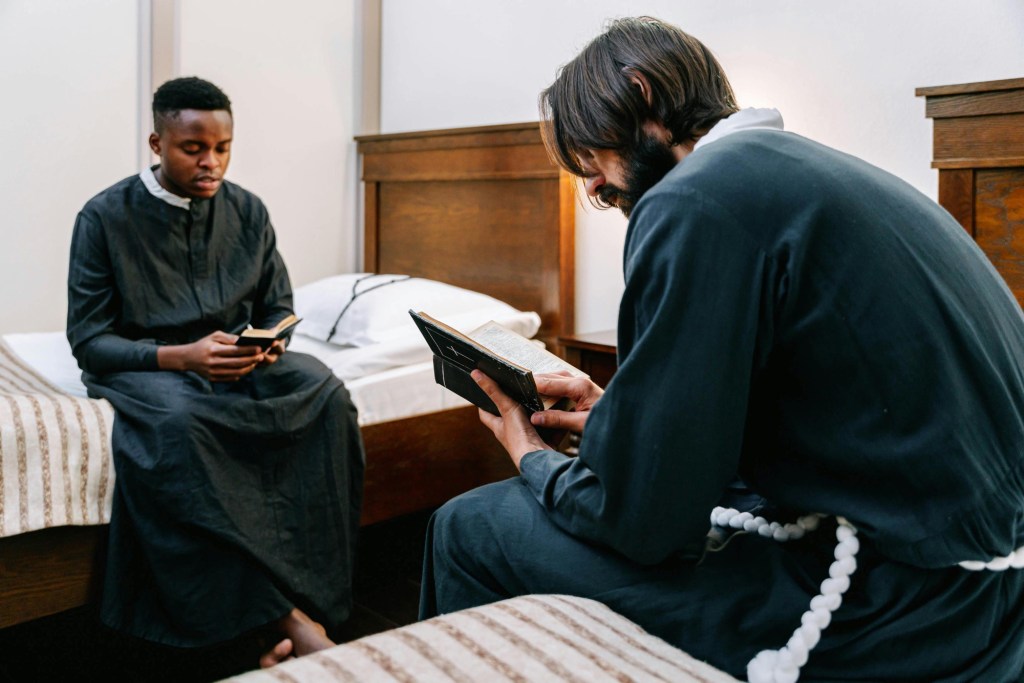
This morning we studied John 7:16-18. Jesus Christ said, “My teaching is not Mine, but His [God the Father] who sent Me. If anyone’s will is to do God’s will, he will know whether the teaching is from God or whether I am speaking on My own authority. The one who speaks on his own authority seeks his own glory; but the one who seeks the glory of Him [God] who sent him is true, and in him there is no falsehood.”
We have had this passage for some time. There is simply a lot to learn and explore in this passage. Christ Jesus calls on us to learn and teach only from that of God the Father and Jesus Christ, which is also that of the Spirit (John 16:13). As an example, we explore the doctrine of election as it has been taught conventionally. We would like to know if it would pass scrutiny of Scripture. We touched on Romans 9, Galatians 4, and Genesis 17.
Embracing the conventional teaching on “election” would certainly conclude a “double predestination” – if there are people who are elected to be saved, then there are also people elected to be damned. This has been rejected and debated much. Rightly so, for if God is the God of love and grace, how do we justify saying He picks and chooses those He saves and reprobates others? On the other hand, if “election” is indeed according to the teaching of the Bible – electing and reprobating people for and from salvation – then we ought to find Scripture’s clear teaching on the doctrine. Adhering to confessions, writings of men, would not suffice. Only Scripture is inerrant and infallible.
As We have studied this morning. Paul’s teaching on election was applied to a specific time and people group. In Romans 9, Paul highlighted one Israel by ethnicity, and the other by promise (see Romans 9:6-13). Two Israels, by two sons of Abraham. Galatians said, “One by Hagar, the other Sarah” (see Galatians 4:21-31) – the latter was by God’s unilateral covenant with Abraham (Genesis 17:15-16, 21); the first, on the other hand, was a bilateral covenant by circumcision (Genesis 17:10-14). That’s exactly Paul’s teaching from Galatians 4:21 to 5:10.
Herewith is an excerpt from GotQuestions.Org with an explainer of the two covenants. “A covenant is an agreement between two parties. There are two basic types of covenants: conditional and unconditional. A conditional or bilateral covenant is an agreement that is binding on both parties for its fulfillment. Both parties agree to fulfill certain conditions. If either party fails to meet their responsibilities, the covenant is broken and neither party has to fulfill the expectations of the covenant. An unconditional or unilateral covenant is an agreement between two parties, but only one of the two parties has to do something. Nothing is required of the other party.”
Old Covenant Israel ceased with the destruction of the temple in 70 A.D. Without the temple, together with its regulations gone, then Old Covenant Israel could no longer exist (Hebrews 9:1-10). Rightly so, for Christ Jesus was the true acceptable offering for salvation (Hebrews 9:11-15). In Romans 9, written 57 A.D., the temple was still standing; hence, there were still two Israels: one born by the covenant of circumcision (bilateral) and the other born of the spirit (John 3:3, 5-6), or the covenant of faith or promise.
So before the end of the Jewish Age, Paul explained the reality of God’s election for the salvation of some Jews (Old Covenant Israel). With Paul saying, “So too at the present time there is a remnant, chosen by grace.” (Romans 11:5)
The “present time” is not today, but the days of Paul, the era of his generation. So obviously it’s history to us. Paul then concludes in Romans 11:28, saying, “As regards the gospel, they [Old Covenant Israel] are enemies for your sake. But as regards election, they [Israel of Promise] are beloved for the sake of their forefathers [forefathers, referring to God’s covenant to Abraham, Isaac, and Israel or Jacob].”
Therefore, there was no double predestination in reality even then. Old Covenant Israel had been under God’s wrath; hence, they awaited a coming Messiah (Christ Jesus). Look, John the Baptist was announcing exactly that: “Repentance is now, judgment is imminent” (see Matthew 3:2, “Repent, for the kingdom of heaven is at hand”).
See also Matthew 3:7-10. “But when he [John the Baptist] saw many of the Pharisees and Sadducees coming to his baptism, he said to them, “You brood of vipers! WHO WARNED YOU TO FLEE FROM THE WRATH TO COME? BEAR FRUIT IN KEEPING WITH REPENTANCE. And do not presume to say to yourselves, ‘We have Abraham as our father,’ for I tell you, God is able from these stones to raise up children for Abraham. EVEN NOW THE AXE IS LAID TO THE ROOT OF THE TREES. Every tree therefore that does not bear good fruit is cut down and thrown into the fire.”
“Raising children for Abraham from stones” certainly is not by natural conception or birth. Like the incarnate Jesus Christ, His birth was by God’s promise and His Spirit (Gen 3:15; Isa 7:14; Matt 1:23). So that’s the reason Jesus Christ told Nicodemus, “You must be born again [John 3:3], born of the Spirit not of flesh [John 3:5-7].”
Without a doubt, the axe was symbolic of God’s wrath and impending judgment. The trees were to be cut from its roots. Isn’t that a metaphor of an impending cessation of Old Covenant Israel? Just as I shared earlier, without the temple and its ordinances, Old Covenant Israel ceased to exist.
Keep in mind that with the coming of Christ Jesus, God’s grace has been for everyone. There is no more Jew or Gentile in the eyes of God (Galatians 3:26-29).
There is no teaching of double predestination in the Bible. God’s church is the manifestation of God’s unilateral covenant with Abraham. It’s a covenant of promise, which rests in Christ Jesus, so it’s also a covenant of faith. Salvation is in Christ Jesus alone, through faith in Him. Faith in Christ Jesus encompasses His deeds and His Word.
1 Thessalonians 1:4-5 has to be the most interesting and glaring vis-à-vis the conventional teaching on election, a cherry-picking election.
God’s grace has been offered to everyone because all have sinned and fallen short of God’s glory (Romans 3:21-23). Isn’t it paradoxical that God offers grace and yet He elects?
Now see 1 Thessalonians 1:4-5. Paul said, “For we know, brothers loved by God, that HE HAS CHOSEN YOU, BECAUSE OUR GOSPEL CAME TO YOU not only in word, but also in power and in the Holy Spirit and with full conviction. You know what kind of men we proved to be among you for your sake.”
Point #1. By “we”, Paul refers to himself and his co-workers. In other words, living Christians of his era. That’s respecting time relevance.
Point #2. The word translated “chosen” was from the Greek word translated “election” in Romans 9 & 11; 2 Peter and Acts. Therefore, it’s the same. Paul was talking about the election of the Thessalonians believers. That’s respecting the context, audience, and time relevance.
Point #3. Therefore, “election or chosen” does not imply or mean God selects, picks, or chooses somebody and outright rejects others. Rather, God elects people by the preaching and teaching of His Word. See 1 Thessalonians 1:4-5 again; Scripture said, “God has chosen you because our Gospel came to you”.
Christ Jesus taught in Matthew 13:18-23 reasons that hinder a person from becoming good soil of His Word. In Matthew 13:23, Jesus Christ concludes, “As for what was sown on good soil, this is the one who HEARS THE WORD AND UNDERSTANDS IT. He indeed bears fruit and yields, in one case a hundredfold, in another sixty, and in another thirty.”
Keep in mind that Jesus Christ is the Sower in His parables (Matt 13:37). He sows the Word of God (Matt 13:18-23).
Lastly, the audience of Paul in 1 Thessalonians were Jewish Christians. Once more, see 1 Thessalonians 2:13-15. Paul said, “And we also thank God constantly for this, that WHEN YOU RECEIVED THE WORD OF GOD, WHICH YOU HEARD FROM US, YOU ACCEPTED IT NOT AS THE WORD OF MEN BUT AS WHAT IT REALLY IS, THE WORD OF GOD, WHICH IS AT WORK IN YOU BELIEVERS. For you, brothers, became imitators of the churches of God in Christ Jesus that are in Judea. FOR YOU SUFFERED THE SAME THINGS FROM YOUR OWN COUNTRYMEN AS THEY DID FROM THE JEWS, who killed both the Lord Jesus and the prophets, and drove us out, and displeased God and opposed all mankind.”
Let us learn well the teachings of the Word so that we may silence those who teach from men’s teachings. The point is not to debate, but to explain to those who truly seek God’s Word but were misled.
Truly, there is no double predestination in Scripture, but if anyone misreads Scripture and teaches outside the teachings of the Trinity God, it could end in double the trouble, for you and your hearers. Paul warned, “Keep a close watch on yourself and on the teaching. Persist in this, for by so doing you will save both yourself and your hearers.” (1 Timothy 4:16)
Always learn from the Word of God, not men’s teaching. Scripture alone is the arbiter of truth, not men.
Peter, in the words of Acts 3:6, declared, “I possess neither silver nor gold, but in the name of Jesus Christ, I offer you what I have.” Share freely, for you freely receive. Stay updated by heading to our about page and subscribe directly to receive notifications in your inbox. Blessing!
It’s been more than five centuries since Reformation Day, and forty years since the EDSA People Power Revolution in 1986. Are these events still relevant today? I believe the answer is the same for both.
EDSA, retains lasting importance. Just as the return of freedom through EDSA has faced occasional limits, the spiritual renewal of the Reformation—which restored the accurate teaching on soteriology, the doctrine of salvation—must also be continually upheld. This means salvation comes through God’s grace by faith in Christ Jesus alone, rather than through penance or indulgence.
However, both events failed to sustain their goals. The Reformation did not fully restore the truthful teachings of Scripture. It created its own traditions. Calvinism also misrepresented Scripture, like that of the doctrine of election. God did not mystically pick and choose people for salvation. Rather, God’s calling and election is always by the preaching and teaching of His Word (Ro 10:14-17). Jesus Christ explained that clearly in His Parable of the Sower. Matthew 13:23 teaches that the “good soil is the one who hears the Word and understands it”.
Ironically, both events though historical, yet their ideas stalled because they were left to men. The Reformation might have continued if Christians had adhered to Scripture alone.
Should Christians remember the Reformation? Yes, but only if the aim is to revive the spirit of reform. This return should focus on the Bible alone. Instead of repeating Reformation traditions, study the traditions of Scripture as taught by the Lord Jesus Christ and His apostles.
The apostle Paul said “So then, brothers, stand firm and hold to the traditions that you were taught by us [the apostles], either by our spoken word or by our letter.” (2Th 2:15)
And again, Paul wrote, “I appeal to you, brothers, to watch out for those who cause divisions and create obstacles contrary to the doctrine that you have been taught; avoid them.” (Rom 16:17)
For as long as Christians follow the writings of uninspired men, though of religious orders, yet are fallible and capable of error, then there will always be a need for a reformation. But if you desire to progress beyond the reformation and keep it, then learn and apply the science of biblical interpretation. Respect always the context, time element, audience relevance, and other disciplines in the exegesis of Scripture.
Christian teachings have grown so varied that some may question which version is accurate.
In this social media era, anyone may openly share beliefs and views. I propose we instead discuss our differences with civility. There is no need for throwing shade; such behavior often comes from those who cannot defend their positions and turn to insults instead.
Paul admonished Timothy, “Remind them of these things, and charge them before God not to quarrel about words, which does no good, but only ruins the hearers. Do your best to present yourself to God as one approved, a worker who has no need to be ashamed, rightly handling the word of truth. But avoid irreverent babble, for it will lead people into more and more ungodliness…” ( 2 Timothy 2:14–16)
Ultimately, every Christian disagreement should be resolved through biblical exegesis. It should not rely on tradition or quotations from various figures. Even creeds or confessions are insufficient. As the Westminster Confession of Faith, 31.4 notes, “All synods or councils since the apostles’ times, whether general or particular, may err, and many have erred; therefore they are not to be made the rule of faith or practice, but to be used as a help in both.”
Peter, in the words of Acts 3:6, declared, “I possess neither silver nor gold, but in the name of Jesus Christ, I offer you what I have.” Share freely, for you freely receive. Stay updated by heading to our about page and subscribe directly to receive notifications in your inbox. Blessing!
Without a doubt, 21st-century Christianity comes in many shapes and forms. Christians differ in doctrines, but they seem to be unified in believing that the return of Jesus Christ is still in the future, though it has been millennia since Jesus promised His apostles that He would be coming in their generation. See Matthew 16:27-28.
“For the Son of Man is going to come with His angels in the glory of His Father, and then He will repay each person according to what he has done. Truly, I say to you, there are some standing here who will not taste death until they see the Son of Man coming in his kingdom.””
The synoptic Gospels – Matthew, Mark, & Luke – have the same assurance concerning the imminent return of Christ:
“And He (Jesus Christ) said to them (apostles), “Truly, I say to you, there are some standing here who will not taste death until they see the kingdom of God after it has come with power.”” (Mark 9:1)
“For whoever is ashamed of Me (Jesus Christ) and of My words, of him will the Son of Man be ashamed when He comes in His glory and the glory of the Father and of the holy angels. But I tell you truly, there are some standing here who will not taste death until they see the kingdom of God.”” (Luke 9:26-27)
Not only that, Jesus Christ sending out the twelve apostles, instructing them on His message, said, “And proclaim as you go, saying, ‘The kingdom of heaven is at hand.’” (Matthew 10:7)
“At hand” in the original Greek language means “near,” and near cannot by any means be thousands of years and continuing, as suggested by the Futurists. Jesus Christ did not just give them the message to proclaim, but He reinforced the message with the assurance that it was indeed occurring soon. See Matthew 10:23.
“When they persecute you (the apostles) in one town, flee to the next, for truly, I say to you, you will not have gone through all the towns of Israel before the Son of Man comes.”
As I researched the validity of Jesus’ words, it’s sad, actually disgusting, to find known Bible scholars saying, “No, Jesus was confused or hallucinating when He uttered those words.” Some dismissed the passages saying, “There must be another meaning for that, but we just have to find out.”
Funny that for as long as the passages or verses are convenient to their theological position, they adhere to the Words of Christ, but if it doesn’t, then it’s excuses after excuses. Scripture does not need affirmation from men; rather, the Bible is the dispenser of truth because it is the Word of God.
One of the key disciplines in interpreting Scripture involves recognizing “time statements.” However, Futurists often overlook these time statements in the Bible, particularly in the New Testament, and instead suggest that they refer to the future. It’s important to remember that what the apostles considered “the future” is no longer future to us today.
Hence, statements like “this generation” in Matthew 24:34 no longer make an impact on the readers, for time statements have been disregarded. See Matthew 24:29-34.
“29 Immediately after the tribulation of those days the sun will be darkened, and the moon will not give its light, and the stars will fall from heaven, and the powers of the heavens will be shaken. 30 Then will appear in heaven the sign of the Son of Man, and then all the tribes of the earth will mourn, and they will see the Son of Man coming on the clouds of heaven with power and great glory. 31 And He will send out His angels with a loud trumpet call, and they will gather His elect from the four winds, from one end of heaven to the other. 32 “From the fig tree learn its lesson: as soon as its branch becomes tender and puts out its leaves, you know that summer is near. 33 So also, when you see all these things, you know that He is near, at the very gates. 34 Truly, I say to you, this generation will not pass away until all these things take place.
So some have suggested “this generation” refers to the generation who saw the literal signs of Matthew 24:29-34. Yet, they miss out on John’s confession in Revelation that he was already in tribulation. See Revelation 1:9.
“I, John, your brother and partner in the tribulation and the kingdom and the patient endurance that are in Jesus, was on the island called Patmos on account of the word of God and the testimony of Jesus.”
Scripture is a unity. The apostles’ writings cannot be different from the Words of Jesus found in the Gospels, the Book of Acts, or the Book of Revelation. Jesus’ words have their foundation in the Old Testament Scripture. The entire Bible is a cohesive revelation concerning the declaration and fulfillment of God’s words.
See Luke 24:44.
Then He (Jesus Christ) said to them (The disciples), “These are My words that I spoke to you while I was still with you, that everything written about Me in the Law of Moses and the Prophets and the Psalms must be fulfilled.”
In recent years, we have witnessed the rise of fake news online. Most people now get their news from the web, particularly from platforms like Facebook and YouTube. Unfortunately, fake news spreads easily because many individuals click to watch or read without considering the source or the intent of the uploader or poster.
Even if a Facebook post or YouTube video contains factual information, ignoring the date it was published can severely affect its relevance today. The same principle applies when reading and studying the Bible. It is essential to recognize the audience’s relevance, the timing of statements, and their historical accuracy. Failing to do so can lead to misinterpretations of Scripture, whether by inexperienced readers or poorly informed pastors.
Jesus Christ warned, “Can a blind man lead a blind man? Will they not both fall into a pit?” (Luke 6:39)
Find someone who can teach you the disciplines of studying Scripture. Avoid using human-tailored Bible study materials, as they often reflect human influence. It’s important to recognize that even within different Bible translations, traces of human interpretation can be found. Let me be clear: the Bible itself is perfect, infallible, and without error; the issues arise with the translations.
You don’t need to be a scholar of Greek, Hebrew, or Aramaic, but it is beneficial to read the Bible by comparing different translations. Additionally, learning to use language tools, such as lexicons, is essential for in-depth Bible study. There are many free lexicon tools available online or for download. You just need to find someone knowledgeable to guide you in using these tools effectively.
It’s never too late to start studying Scripture and practicing proper exegesis. Ultimately, Scripture reveals truths about salvation that extend beyond our physical needs and concerns, addressing both our current lives and eternity. Don’t let yourself become part of confused Christianity.
Peter, in the words of Acts 3:6, declared, “I possess neither silver nor gold, but in the name of Jesus Christ, I offer you what I have.” Share this article freely, for you freely receive. Take note, underlines and highlights are clickable links for definitions or Bible references. Stay updated by heading to our about page and subscribe directly to receive notifications in your inbox. Blessing!
Everyone is born into a tradition one way or the other. The practice of tradition was to keep the status quo. Paul, the apostle of Jesus Christ, spoke of tradition. See 2 Thessalonians 2:13-15.
But we ought always to give thanks to God for you, brothers beloved by the Lord, because God chose you as the firstfruits to be saved, through sanctification by the Spirit and belief in the truth. To this He called you through our gospel, so that you may obtain the glory of our Lord Jesus Christ. So then, brothers, stand firm and hold to the traditions that you were taught by us, either by our spoken word or by our letter.
The tradition that which Paul and his co-workers promote, however, was not from man but by the Spirit and the truth of the Gospel of Christ Jesus our Lord. This was not the tradition held by the Jews, though the tradition or truth of the Gospel may be seen through the Old Testament Scripture.
Standing before King Agrippa, Paul, explaining the conviction of his faith, said, “To this day I have had the help that comes from God, and so I stand here testifying both to small and great, saying nothing but what the prophets and Moses said would come to pass:that the Christ must suffer and that, by being the first to rise from the dead, He would proclaim light both to our people and to the Gentiles.” (Acts 26:22-23)
Here is the proof that Paul was telling the truth: Acts 26:23 was a quotation from Isaiah 49:6. But for the purpose of context and clarity, let us see Isaiah 49:1-6.
Listen to Me [Jesus], O coastlands, and give attention, you peoples from afar. The LORD called Me from the womb, from the body of My mother He [God] named My name [cf. Matthew 1:20-21]. He made My mouth like a sharp sword; in the shadow of His hand He hid Me; He made Me a polished arrow; in His quiver He hid Me away. And He [God the Father] said to Me [Jesus], “You are My servant, Israel, in whom I will be glorified.” But I said, “I have labored in vain; I have spent My strength for nothing and vanity; yet surely My right is with the LORD, and My recompense with My God.” And now the LORD says, He who formed Me from the womb to be His Servant, to bring Jacob back to Him; and that Israel might be gathered to Him— for I am honored in the eyes of the LORD, and My God has become My strength— He [God] says: “It is too light a thing that You should be My servant to raise up the tribes of Jacob and to bring back the preserved of Israel; I will make You as a light for the nations, that My salvation may reach to the end of the earth.”
On the other hand, Paul described the tradition that should be rejected – those which he previously also held; see Galatians 1:13-14.
For you have heard of my former life in Judaism, how I persecuted the church of God violently and tried to destroy it. And I was advancing in Judaism beyond many of my own age among my people, so extremely zealous was I for the traditions of my fathers.
The Complete Word Study Bible Dictionary defined “Judaism” as the religious system held by the Jews. Its teachings emanate from the Old Testament Scripture, especially from the Law of Moses as found from Exodus 20 through Deuteronomy, and also from the traditions of elders (Mark 7:3-13), some of which the Lord Jesus condemned. The main emphases of Judaism are circumcision and Sabbath-keeping.
Judaism that was from the Old Testament Scripture, if rightly interpreted and applied, should support the New Testament Scripture – the teachings of Jesus Christ and the apostles. It was the tradition of elders that Jesus rejected and condemned. See Mark 7:3-8.
(For the Pharisees and all the Jews do not eat unless they wash their hands properly, holding to the tradition of the elders, and when they come from the marketplace, they do not eat unless they wash. And there are many other traditions that they observe, such as the washing of cups and pots and copper vessels and dining couches. ) And the Pharisees and the scribes asked Him, “Why do Your disciples not walk according to the tradition of the elders, but eat with defiled hands?” And He said to them, “Well did Isaiah prophesy of you hypocrites, as it is written, “‘This people honors Me with their lips, but their heart is far from Me; in vain do they worship Me, teaching as doctrines the commandments of men.’ You leave the commandment of God and hold to the tradition of men.”
Washing here was not that of keeping proper hygiene but ceremonial washing, a tradition declaring themselves clean.
Doubtless, circumcision and Sabbath also were important concepts in the Jewish faith. See Genesis 17:1-2,4-7,9-14.
When Abram was ninety-nine years old the LORD appeared to Abram and said to him, “I am God Almighty; walk before Me, and be blameless, that I may make My covenant between Me and you, and may multiply you greatly.”
“Behold, My covenant is with you, and you shall be the father of a multitude of nations. No longer shall your name be called Abram, but your name shall be Abraham, for I have made you the father of a multitude of nations. I will make you exceedingly fruitful, and I will make you into nations, and kings shall come from you. And I will establish My covenant between Me and you and your offspring after you throughout their generations for an everlasting covenant, to be God to you and to your offspring after you.
And God said to Abraham, “As for you, you shall keep My covenant, you and your offspring after you throughout their generations. This is My covenant, which you shall keep, between Me and you and your offspring after you: Every male among you shall be circumcised. You shall be circumcised in the flesh of your foreskins, and it shall be a sign of the covenant between Me and you. He who is eight days old among you shall be circumcised. Every male throughout your generations, whether born in your house or bought with your money from any foreigner who is not of your offspring, both he who is born in your house and he who is bought with your money, shall surely be circumcised. So shall My covenant be in your flesh an everlasting covenant. Any uncircumcised male who is not circumcised in the flesh of his foreskin shall be cut off from his people; he has broken My covenant.”
It is clear that circumcision was the condition or sign binding God’s covenant with Abraham and the Jewish people, even among foreigners seeking to be in covenant with the LORD. Sabbath, on the other hand, was a covenant binding commandment, see Exodus 20:8-11.
Remember the Sabbath day, to keep it holy. Six days you shall labor, and do all your work, but the seventh day is a Sabbath to the LORD your God. On it you shall not do any work, you, or your son, or your daughter, your male servant, or your female servant, or your livestock, or the sojourner who is within your gates. For in six days the LORD made heaven and earth, the sea, and all that is in them, and rested on the seventh day. Therefore the LORD blessed the Sabbath day and made it holy.
The Jews were insistent in observing circumcision and Sabbath, yet Jesus made a case that complicated perfect observance of both; see John 7:21-24.
Jesus answered them [the Jews], “I did one work, and you all marvel at it. Moses gave you circumcision (not that it is from Moses, but from the fathers), and you circumcise a man on the Sabbath. If on the Sabbath a man receives circumcision, so that the law of Moses may not be broken, are you angry with Me because on the Sabbath I made a man’s whole body well? Do not judge by appearances, but judge with right judgment.”
Paul explained the true essence of circumcision, see Romans 2:25-29.
For circumcision indeed is of value if you obey the law, but if you break the law, your circumcision becomes uncircumcision. So, if a man who is uncircumcised keeps the precepts of the law, will not his uncircumcision be regarded as circumcision? Then he who is physically uncircumcised but keeps the law will condemn you who have the written code and circumcision but break the law. For no one is a Jew who is merely one outwardly, nor is circumcision outward and physical. But a Jew is one inwardly, and circumcision is a matter of the heart, by the Spirit, not by the letter. His praise is not from man but from God.
In another letter of Paul, he explained further. See Colossians 2:11-14.
In Him [Christ Jesus] also you were circumcised with a circumcision made without hands, by putting off the body of the flesh, by the circumcision of Christ, having been buried with Him in baptism [death], in which you were also raised with Him [resurrection] through faith in the powerful working of God, who raised Him from the dead. And you, who were dead in your trespasses and the uncircumcision of your flesh, God made alive together with Him, having forgiven us all our trespasses, by canceling the record of debt that stood against us with its legal demands. This He set aside, nailing it to the cross.
In Christ, circumcision then is no longer of flesh but a circumcision of the heart (Romans 2:29), which requires repentance and the transformation of a person. The Christian man is dead – buried with Christ in baptism – and made alive living a life for the glory of God. Colossians 2:11-12 is no way, as alleged by some, a call for water baptism, specifically that of infant baptism. Paul was calling believers into a new life with Christ Jesus our Lord, so it’s about obedience to the Lord and His Word.
The Jews, by their rejection of Christ Jesus, have corrupted the true teachings of the Old Testament Scripture; hence was rejected and condemned by the Lord. The traditions that they held, Paul said “an empty deceit, according to human tradition, according to the elemental spirits of the world, and not according to Christ” (Colossians 2:8). That was/is the dilemma of tradition – that is, according to man. Therefore, true Christianity should hold on to Scripture alone, nothing more or less, and with a right interpretation. See 2 Timothy 2:15-16.
Do your [Timothy] best to present yourself to God as one approved, a worker who has no need to be ashamed, rightly handling the word of truth. But avoid irreverent babble, for it will lead people into more and more ungodliness …
After the ascension of Christ, at the time of the Paul and the other apostles, false teachings have clearly emerged. It was from within the church; see Acts 20:28-30.
Pay careful attention to yourselves and to all the flock, in which the Holy Spirit has made you overseers, to care for the church of God, which He obtained with His own blood. I know that after my departure fierce wolves will come in among you, not sparing the flock;and from among your own selves will arise men speaking twisted things, to draw away the disciples after them.
See also 1 John 2:18-21.
Children, it is the last hour, and as you have heard that antichrist is coming, so now many antichrists have come. Therefore we know that it is the last hour. They went out from us, but they were not of us; for if they had been of us, they would have continued with us. But they went out, that it might become plain that they all are not of us. But you have been anointed by the Holy One, and you all have knowledge. I write to you, not because you do not know the truth, but because you know it, and because no lie is of the truth.
At the time of Jesus and the early days of Christianity, the opponent of the church was the Judaism but later, it’s the Judaizers. The Nelson’s New Illustrated Bible Dictionary defined this sect as the “early converts to Christianity who tried to force believers from non-Jewish backgrounds to adopt Jewish customs as a condition of salvation”. Evidence of this movement within the early church first emerged in A.D. 49, when certain men came from Judea and taught the brethren – ‘Unless you are circumcised according to the custom of Moses, you cannot be saved’ (See Acts 15:1).
That was the reason why Paul, in his letter to the Galatians, wrote, “I am astonished that you are so quickly deserting Him [God] who called you in the grace of Christ and are turning to a different gospel— not that there is another one, but there are some who trouble you and want to distort the gospel of Christ.” (Galatians 1:6-7)
Again, on his letter to the Corinthians, Paul wrote, “For I feel a divine jealousy for you, since I betrothed you [the church] to one Husband [Jesus Christ], to present you as a pure virgin to Christ. But I am afraid that as the serpent deceived Eve by his cunning, your thoughts will be led astray from a sincere and pure devotion to Christ. For if someone comes and proclaims another Jesus than the one we proclaimed, or if you receive a different spirit from the one you received, or if you accept a different gospel from the one you accepted, you put up with it readily enough.” (2 Corinthians 11:2-4)
Obviously, the enemy of the truth of the Gospel was both from within, as there were from outside the church. In our present time, many call themselves Christians, but it would be interesting to verify if everyone who claims to be of the faith truly has one truth of the Gospel. Especially since, there are a lot of denominations, different claims and interpretation of the Bible. Don’t you think it’s scary that we might have believed the false?
Unlearning Tradition, Relearning Scripture aims to study, learn and teach the absolute truth of the Scripture. It was quite a journey, come to think of the tradition that we previously held. It is traditionally held that Jesus Christ has yet to return, though He repeated hinted that He’s coming in the generation of Jew that crucified Him and of His apostles.
See Matthew 26:63-64.
But Jesus remained silent. And the high priest said to Him, “I adjure You by the living God, tell us if You are the Christ, the Son of God.” Jesus said to him, “You have said so. But I tell you, from now on you will see the Son of Man seated at the right hand of Power and coming on the clouds of heaven.”
What was that Jesus had said to the high priest? Jesus told the Jewish religious leaders that they would see Him – seated at the right hand of power – come in judgment. The allusion to His coming on the clouds of heaven points to His fulfillment of Daniel 7:13-14.
I saw in the night visions, and behold, with the clouds of heaven there came one like a Son of man, and He came to the Ancient of Days and was presented before Him. And to Him was given dominion and glory and a kingdom, that all peoples, nations, and languages should serve Him; His dominion is an everlasting dominion, which shall not pass away, and His kingdom one that shall not be destroyed.
Obviously the Scripture spoke of a spiritual kingdom; Jesus said, “God is spirit, and those who worship Him must worship in spirit and truth.” (John 4:24)
Paul, on the other hand, said, “I appeal to you therefore, brothers, by the mercies of God, to present your bodies as a living sacrifice, holy and acceptable to God, which is your spiritual worship.” (Romans 12:1)
In Matthew 16:27-28, Jesus told His apostles (see Matthew 16:21).
For the Son of Man is going to come with His angels in the glory of His Father, and then He will repay each person according to what He has done. Truly, I say to you, there are some standing here who will not taste death until they see the Son of Man coming in His kingdom.
A lot of known theologians, checking on their commentaries and writings, confronted by Matthew 16:27-28 and suggested that Jesus must have lost His mind, either due to the pressure of His ministry or His impending death. Let us be truthful. If we insist that Jesus hasn’t return, though His Words did promise to do so, then we are making Jesus to be a liar and not truthful. That was my moment of transition, knowing that Jesus is trustworthy and true.
In Matthew 10:23, Jesus sent out His apostles (Matthew 10:5), telling them their mission, persecution and suffering (Matthew 10:5-22), and the assurance of His return in their generation saying, “When they persecute you in one town, flee to the next, for truly, I say to you, you will not have gone through all the towns of Israel before the Son of Man comes.“
The same claim and promise may be seen in Paul’s and the other New Testament writings of the Bible. But many times we may have simply read through without carefully discerning what truly was written. If the Word of God is clear, should we choose to believe otherwise? To do so, again, is the dilemma of tradition.
Allow me then to challenge you to read your Bibles, thoroughly discerning the truthful teaching of the Scripture. Let Scripture alone reveal the truth, not the commentaries – modern or centuries old traditions that were/are according to men. Jesus Christ and His Scripture alone is infallible and trustworthy. Jesus Christ said, “Truly, truly, I say to you, if anyone keeps My word, he will never see death” (John 8:51). Let us seek to be sure then that what we have believe were/are the Words of Christ.
Blessings!
If you want to follow our journey of unlearning tradition and relearning Scripture, you can stay updated by heading to our about page and subscribe directly to receive notifications in your inbox.
As noted in my earlier post, the Sabbath serves as the central theme in John 5. The Gospel mentions the Sabbath ten times, with four occurrences in this chapter alone. This focus makes sense because the events in John 5 take place during the Jewish Fall Harvest Festival—the Feast of Booths—since the core of that celebration is Sabbath rest.
This theme of rest is particularly meaningful when contrasted with the unrest of exile. As a young man, the prophet Daniel was taken into exile (Daniel 1:3–6). This Exile, also known as the Seventy Years of Babylonian Captivity, fulfilled God’s declared judgment on Judah, the southern kingdom and final remnant of David and Solomon’s monarchy. For context, see Jeremiah 25:3–14.
For twenty-three years, from the thirteenth year of Josiah the son of Amon, king of Judah, to this day, the word of the LORD has come to me, and I have spoken persistently to you, but you have not listened. You have neither listened nor inclined your ears to hear, although the LORD persistently sent to you all His servants the prophets, saying, “Turn now, every one of you, from his evil ways and evil deeds, and dwell upon the land that the LORD has given to you and your fathers from of old and forever. Do not go after other gods to serve and worship them, or provoke Me to anger with the work of your hands. Then I will do you no harm.” Yet you have not listened to Me, declares the LORD, that you might provoke Me to anger with the work of your hands to your own harm.
Therefore thus says the LORD of hosts: Because you have not obeyed My words, behold, I will send for all the tribes of the north, declares the LORD, and for Nebuchadnezzar the king of Babylon, My servant, and I will bring them against this land and its inhabitants, and against all these surrounding nations, I will devote them to destruction, and make them a horror, a hissing, and an everlasting desolation. Moreover, I will banish from them the voice of the mirth and the voice of gladness, the voice of the bridegroom and the voice of the bride, the grinding of the milestones and the light of the lamp. The whole land shall become a ruin and a waste, and these nations shall serve the king of Babylon seventy years. Then after the seventy years are completed, I will punish the king of Babylon and that nation, the land of the Chaldeans, for their iniquity, declares the LORD, making the land an everlasting waste. I will bring upon the land all the words that I have uttered against it, everything written in this book, which Jeremiah prophesied against all the nations. For many nations and great kings shall make slaves even of them, and I will recompense them according to their deeds and the work of their hands.
By Daniel’s later years, he may have reached his eighties, since seventy years had passed after his exile to Babylon. See Daniel 9:1–2.
In the first year of Darius the son of Ahasuerus, by descent a Mede, who was made king over the realm of Chaldeans – in the first year of his reign, I Daniel, perceived in the books the number of years that, according to the word of the LORD to Jeremiah the prophet, must pass before the end of the desolations of Jerusalem, namely, seventy years.
After the seventy-year Babylonian captivity ended—the judgment God announced through Jeremiah—Daniel asked the LORD for mercy and restoration. The answer to Daniel’s prayer and request appears in Daniel 9:24–27. We can examine Daniel 9:24, which captures the full scope of God’s declaration:
Seventy weeks are decreed about your people and your holy city, to finish the transgression, to put an end to sin, and to atone for iniquity, to bring in everlasting righteousness, to seal both vision and prophet, and to anoint a most holy place.
Perhaps to Daniel’s surprise, God is not finished with Israel; he was informed of the final judgment, described as “to finish transgression, to put an end to sin.” The atonement was “to atone for iniquity, to bring in everlasting righteousness,” and finally, God’s dwelling presence—the tabernacle (booths)—was “to anoint a most holy place.” By the way, the themes in Daniel 9:24 align with elements in John 5.
John 5:30, spoke of Judgment, which is the culmination of the Feast of Trumpets.
I can do nothing of My own. As I hear, I judge, and My judgment is just, because I seek not My own will but the will of Him [God the Father] who sent Me.
Next, John 5:21, spoke of Resurrection, the fulfillment of the Feast of Atonement.
For as the Father raises the dead and gives them life, so also the Son gives life to whom He will.
Finally, John 5:24, spoke of Eternal Life, the consummation of the Feast of Booths.
Truly, truly, I say to you, whoever hears My word and believes Him who sent Me has eternal life. He does not come into judgment, but has passed from death to life.
Daniel’s life spanned the era of the first Gentile kingdom, Babylon, and into the second, the Medo-Persian Empire. He understood this transition when he was called to interpret the dream of King Nebuchadnezzar (Daniel 2). In this dream, God revealed that four Gentile kingdoms would rule over Israel before the coming of the Son of Man—the Anointed One, the Deliverer of Israel (Daniel 2:44-45). This prophetic confirmation is further elaborated in Daniel 7.
The fulfillment of God’s Messianic Kingdom, as foretold, would take place during the reign of the fourth Gentile kingdom (Daniel 2:40–45). Scripture names the first three kingdoms: Babylon (Daniel 2:37–38), Medo-Persia, and Greece (Daniel 8:20–21). The fourth kingdom remains unnamed, but Daniel 7:7 provides a vital clue about its identity.
After this I saw in the night visions, and behold, a fourth beast, terrifying and dreadful and exceedingly strong. It had great iron teeth; it devoured and broke into pieces and stamped what was left with its feet. It was different from all the beasts that were before it, and it had ten horns.
About 600 years later, the identity of the fourth kingdom was finally revealed by the apostle John. See Revelation 13:1 and 17:7-11.
And I saw a beast rising out of the sea, with ten horns and seven heads, with ten diadems on its horns and blasphemous names on its heads. (Revelation 13:1)
But the angel said to me [John], “Why do you marvel? I will tell you the mystery of the woman, and of the beast with seven heads and ten horns that carries her. The beast that you saw was, and is not, and is about to rise from the bottomless pit and go to destruction. And the dwellers on earth whose names have not been written in the books of life from the foundation of the world will marvel to see the beast, because it was and is not and it to come. This calls for a mind of wisdom: the seven heads are the seven mountains on which the woman is seated; they are also the seven kings, five of whom have fallen, one is, the other has not yet come, and when he does come he must remain only a little while. As for the beast that was and is not, it is an eight but it belongs to the seven, and it goes to destruction.” (Revelation 17:7-11)
It should be noted that in the Greek, the seven mountains could also be translated as “seven hills,” and there is only one city at the time of the apostle, perhaps even now, that was known to sit on seven hills— that is, Rome. The seven kings, five of whom have fallen, refers to the Roman emperors, beginning with (1) Julius Caesar, (2) Augustus Caesar, (3) Tiberius Caesar, (4) Caligula Caesar, (5) Claudius Caesar; “one is,” refers to Nero Caesar— the emperor reigning at the time of Peter, John, and Paul.
I, John, your brother and partner in the tribulation and the kingdom and the patient endurance that are in Jesus, was on the island called Patmos on account of the Word of God and the testimony of Jesus. I was in the Spirit on the Lord’s Day, and I heard behind me a loud voice like a trumpet saying, “Write what you see in a book and send it to the seven churches, to Ephesus and to Smyrna and to Pergamum and to Thyatira and to Sardis and to Philadelphia and to Laodicea.”
According to the King James Concordance, “trumpet” is mentioned eleven times in the New Testament, with six of those instances appearing in the Book of Revelation, including Revelation 1:10. This frequent use of the trumpet imagery calls to mind the Fall Harvest Festivals of Leviticus 23, which begin with the Feast of Trumpets, followed by the Feast of Atonement, and finally the Feast of Booths.
Incidentally, the “Lord’s Day” of Revelation 1:10, which the Strong’s Hebrew and Greek Dictionaries said was “from G2962; belonging to the Lord,” could not be referring to a Sunday, as traditionally suggested, but the Sabbath. See Genesis 2:2–3.
And on the seventh day God finished His work that He had done, and He rested on the seventh day from all His work that He had done. So God blessed the seventh day and made it holy, because on it God rested from all His work that He had done in creation.
Brown-Driver-Briggs’ Hebrew Definition defined “holy” as to consecrate, sanctify, prepare, dedicate, be hallowed, be holy, be sanctified, be separate. Therefore, the seventh day, which is the Sabbath, was sanctified, consecrated, and set apart for the LORD God; hence, the Lord’s Day or a “day belonging to the Lord.”
Remember the Sabbath day, to keep it holy. Six days you shall labor and do all your work, but the seventh day is a sabbath of the LORD your God … For in six days the LORD made the heavens and the earth, the sea and all that is in them, and rested on the seventh day; therefore the LORD blessed the sabbath day and made it holy.
The Lord’s Day cannot be a Sunday, which traditionally was derived from the phrase “first day of the week” found in every gospel narrative concerning the resurrection of Jesus Christ.
So because of the Jewish Day of Preparation, since the tomb was close at hand, they laid Jesus there. Now on the first day of the week Mary Magdalene came to the tomb early, while it was still dark, and saw that the stone had been taken away from the tomb.
Since it was the day of Preparation, and so that the bodies would not remain on the cross on the Sabbath (for that Sabbath was a high day), the Jew asked Pilate that their legs might be broken and that they might be taken away.
Every Passover and Unleavened Bread Festival, there would be two Sabbaths in the week: a regular Sabbath [the seventh day of the week; Saturday to us] and the High or Special Sabbath, which could be any day of the week as long as it is the fifteenth of Nisan. Leviticus 23:7 states, “On the first day you shall have a holy convocation; you shall not do any ordinary work [Sabbath rest].” The first day of the Feast of Unleavened Bread was the beginning of the Passover-week festival, the fifteenth of Nisan.
The Passover event in Exodus occurred “between the two evenings” (Exodus 12:6–8, translated “twilight”), beginning on the fourteenth of Nisan, which was the Preparation for the Passover. The Jewish day begins at sunset and ends before sunset (6pm to before 6pm); unlike ours, which is 12 midnight to before 12 midnight. Hence, Exodus 12:29 states:
At midnight [Hebrew “middle of two night” H2677 & H3915] the LORD struck down all the firstborn in the land of Egypt …
Jesus, then, was crucified on the day of Preparation (John 19:14). He was buried before sundown, the beginning of the High Sabbath, 15th of Nisan (John 19:30, 42). Now, in John 20:1, “first day of the week” in the Greek actually means on “one Sabbath or first Sabbath“— meaning, first Sabbath after the High Sabbath. Yes, “Sabbath” (G4521, from Hebrew H7676) but was somehow translated “week” by the English translation of the Bible.
So because the Jewish Day of Preparation, since the tomb was close at hand, they laid Jesus there. Now on the [One]first [Sabbath]day of the week Mary Magdalene came to the tomb early, while it was still dark, and saw that the stone had been taken away from the tomb.
Interlinear Bible for John 20:1,
<1161> The first <3391> day of the week <4521> cometh <2064> (5736) Mary <3137> Magdalene <3094> early <4404>, when it was <5607> (5752) yet <2089> dark <4653>, unto <1519> the sepulchre <3419>, and <2532> seeth <991> (5719) the stone <3037> taken away <142> (5772) from <1537> the sepulchre <3419>.
A check on an interlinear Bible said “The first” G3391, irregular feminine of G1520, which Thayer’s Greek Definitiondefined to mean “one.” Next, “day of the week” G4521, defined by Strong’s Hebrew and Greek Dictionaries as “Of Hebrew origin” [H7676]— the Sabbath.
And when evening had come, since it was the day of Preparation [14th of Nisan], that is, the day before the Sabbath [15th of Nisan] … Mary Magdalene and Mary the mother of Jesus saw where He was laid. When the Sabbath [High] was past, Mary Magdalene, Mary the mother of James, and Salome brought spices, so that they might go and anoint Him. And very early on thefirst[One, G1520]day of the week[Sabbath, G4521], when the sun had risen, they went to the tomb.
Then they returned and prepared the spices and perfumes. And on the Sabbath [High] they rested according to the commandment. But on the first [One, G1520] day ofthe week[Sabbath, G4521], at early dawn, they came to the tomb bringing the spices which they had prepared.”
Lastly, Matthew 28:1
Now after the Sabbath [High], toward the dawn of the first [One, G1520] dayof the week[Sabbath, G4521], Mary Magdalene and the other Mary went to see the tomb.
Now Paul, in 1 Corinthians 5:7 declared Jesus Christ as the Passover Lamb that has been sacrificed. Then, in 1 Corinthians 15:23, Christ was the firstfruits, speaking of His resurrection. Therefore, another proof that Jesus could not have resurrected on a Sunday, as traditionally taught and believed, but rather on a Sabbath, fulfilling the Feast of Firstfruits of Leviticus 23, which occurred on a Sabbath (G4521), following the High Sabbath (John 19:31).
See Leviticus 23:10-11,15-16 from the NASB translation, a literal word-for-word translation.
“Speak to the sons of Israel and say to them, ‘When you enter the land which I am going to give to you and reap its harvest, then you shall bring in the sheaf of the first fruits of your harvest to the priest. He shall wave the sheaf before the LORD for you to be accepted; on the day after the Sabbath the priest shall wave it.”
“You shall also count for yourselves from the day after the Sabbath,from the day when you brought in the sheaf of the wave offering; there shall be seven complete Sabbaths. You shall count fifty days to the day after the seventh Sabbath …“
To count seven complete sabbaths, then the beginning of the count must also be on a Sabbath; thereby, the day after the High Sabbath refers to the regular weekly Sabbath. Clearly then, Jesus resurrected back to life on a Sabbath, not Sunday; fulfilling therefore the Feast of Firstfruits.
To review: Paul, in 1 Corinthians 5:7 declared Jesus Christ is the Passover Lamb that has been sacrificed. Then, in 1 Corinthians 15:23, Christ was the firstfruits, speaking of His resurrection. Therefore, once more, another proof that Jesus could not have resurrected on a Sunday, as traditionally taught and believed, but rather on a Sabbath, fulfilling the Feast of Firstfruits of Leviticus 23:10–11, which always occurs on a Sabbath following the High Sabbath.
Although Rome leveled Jerusalem in AD 70 during summer instead of winter, it is striking that Jesus observed, “Pray that your flight may not be in winter or on a Sabbath.” (Matthew 24:20)
From our earlier study, it follows that the timing must align with a Sabbath, since Revelation describes John hearing a loud voice like a trumpet “on the Lord’s Day.” The events throughout the Book of Revelation point to the Last Day and the Second Coming of Jesus Christ, completing the Fall Harvest Festivals in Leviticus 23.
Then I saw another angel flying directly overhead, with an eternal gospel to proclaim to those who dwell on earth, to every nation and tribe and language and people. And he said with a loud voice, “Fear God and give Him glory, because the hour of His judgment has come, and worship Him who made heaven and earth, the sea and the springs of water … And I heard a voice from heaven saying, “Write this: Blessed are the dead who die in the Lord from now on. ‘Blessed indeed,” says the Spirit, “that they may rest from their labors, for their deeds follow them!’”
By the way, “a loud voice” in Revelation 1:10 was said to be “like a trumpet,” so similarly “a loud voice” in Revelation 14:7 must also be “like a trumpet,” which declared the arrival of the time of God’s judgment. Following the sound of the trumpet, a voice from heaven then declared, “Blessed are the dead who die in the Lord from now on. Blessed indeed, that they may rest from their labors, for their deeds follow them!”
So there remains a Sabbath rest for the people of God. For the one who has entered His rest has himself also rested from his works, as God did from His.
Perhaps that was why Jesus would heal even on a Sabbath, indicating therefore that He was working— first to make Himself known and believed by people (John 6:29) and second, to fulfill the true Sabbath Rest (Revelation 14:13; Hebrews 4:9–10), which would be a reality only after God rested from His work (Hebrews 4:9–10). So the apostle’s narrative on John 5:16–17 makes real sense now.
And this was why the Jews were persecuting Jesus, because He was doing these things on the Sabbath. But Jesus answered them, “My Father is working until now, and I am working.”
It should be worth mentioning then that on top of the Seven Jewish Feasts of Leviticus 23 was the command to observe the Sabbath (Leviticus 23:3), since that was the essence of all the festivities of Israel, the fulfillment or the renewal of Genesis 2:2–3.
See Leviticus 23:3.
Six days shall work be done, but on the seventh day is a Sabbath of solemn rest, a holy convocation. You shall do no work. It is a Sabbath to the LORD in all your dwelling places.
Next, Genesis 2:2-3.
And on the seventh day God finished His work that He had done, and He rested on the seventh day from all His work that He had done. God blessed the seventh day and made it holy, because on it God rested from all His work that He had done in creation.
A small detail indeed reveals a lot. We must seek to know the true teachings of the Scripture. Traditions have blinded us from understanding the true essence of the Sabbath, which speaks of the salvation plan of God. Not until God had rested from His work would His creation ever experience and understand the true Sabbath Rest of God. See Revelation 21:3–4.
And I heard a loud voice from the throne, saying, “Behold, the dwelling place [tabernacle] of God is with man, and He will dwell with them, and they will be His people, and God Himself will be with them as their God. He will wipe away every tear from their eyes, and death shall be no more, neither shall there be mourning, nor crying, nor pain anymore, for the former things have passed away.
The doctrine of the Second Coming of Jesus and his fulfillment of the Final Harvest Feast, the Fall Festivals, need not be divided into specific events, since Paul noted this.
Behold, I tell you a mystery; we will not all sleep, but we will all be changed, in a moment, in the twinkling of an eye, at the last trumpet; for the trumpet will sound, and the dead will be raise imperishable, and we will be changed … But when this perishable will have put on the imperishable, and this mortal will have put on immortality, then will come about the saying that is written, “Death is swallowed up in victory.” (1 Corinthians 15:51-52,56)
Truly, a little deflection from the truth can indeed lead to a devastating false assumption. The Roman Empire, the fourth Gentile kingdom reigning over Israel, ceased to exist for more than a millennium now. So what does that tell us? Be reminded that God showed Daniel that the Messianic reign of Jesus Christ would occur within the time of the fourth Gentile kingdom, Rome. The Bible never spoke of a revived Roman Empire. Don’t you think we ought to take seriously our study of the Bible?
P.S. I have always wanted to understand the doctrine of the last things, eschatology. It was quite important and personal to me, for I wanted to be assured of what happened after death. That was the question that bothered me while I was at the wake of my only son. It’s been twenty years now. Glory be to God that finally I now comprehend Scripture, and the Lord Jesus Christ has graciously provided me understanding concerning the said doctrine.
The Lord Jesus Christ impressed His words in Isaiah 30:20–21 upon me while I wrestled with whether to begin seminary training so late in life. Scripture says, “And though the Lord give you the bread of adversity and the water of affliction, yet your Teacher will not hide himself anymore, but your eyes shall see your Teacher. And your ears shall hear a word behind you, saying, ‘This is the way, walk in it,’ when you turn to the right or when you turn to the left.” (Isaiah 30:20–21)
Looking back, I recognize that the Lord, my Teacher, Jesus Christ, graciously led me and my family to know Him and grasp His Word. This journey started at my son’s wake, who posthumously showed me God’s goodness through a penholder he had given me months before joining the Lord. Here is a link to the blog “Regarding Wilmer,” which recounts my path to Christianity.
Peter, in the words of Acts 3:6, declared, “I possess neither silver nor gold, but in the name of Jesus Christ, I offer you what I have.” Share this article freely, for you freely receive. Take note, underlines and highlights are clickable links for definitions or Bible references. Stay updated by heading to our about page and subscribe directly to receive notifications in your inbox. Blessings!