In today’s passage, Mark 1:21–34, the evangelist continues his narrative by affirming the signs of the times. In Mark 1:21–28, we read of the moment when an unclean spirit recognized the divinity of Jesus and declared, “What have you to do with us, Jesus of Nazareth? Have You come to destroy us? I know who You are—the Holy One of God.” (Mark 1:24)
Jesus cast out the unclean spirit, leaving those present in awe, and His fame spread across Galilee. Yet He sought no recognition. Leaving the synagogue, He went to the home of Simon and Andrew, accompanied by James and John, where He healed Simon’s mother-in-law. That evening, many who were sick or tormented by demons were brought to Him for healing and deliverance. Once again, Jesus silenced the demons, forbidding them to speak, for they recognized His true identity as the Holy One of God. (Mark 1:25–34)
Certainly, Jesus—as the Second Person of the Triune God—possesses authority over diseases and demons. This power is plainly shown in the narrative. Yet Mark did not merely inform his audience that Jesus could perform such acts; instead, Mark confirmed the signs of the times.
Luke narrates a story when John the Baptist was already in prison. After Jesus raised a widow’s son from the dead, and reports came to John, he immediately sent two of his disciples asking Jesus, “Are you the One who is to come, or shall we look for another?” (Luke 7:19). Jesus proves He is the Christ by saying, “Go and tell John what you have seen and heard: the blind receive their sight, the lame walk, lepers are cleansed, and the deaf hear, the dead are raised up, the poor have good news preached to them.” (Luke 7:22)
In other words, the evidence that Jesus is the Christ has to do with the signs that He performed. He fulfilled Old Testament prophecies concerning the Christ: Isaiah 29:18–19; 35:4–6; 42:6–7; 61:1–3; and Jeremiah 31:8. Jesus Himself declared that Isaiah 61:1–3 had been fulfilled in the hearing of the Jews in a synagogue (see Luke 4:16–21).
“And Jesus came to Nazareth, where He had been brought up. And as was His custom, He went to the synagogue on the Sabbath day, and He stood up to read. And the scroll of the prophet Isaiah was given to Him. He unrolled the scroll and found the place where it was written, ‘The Spirit of the Lord is upon Me, because He has anointed me to proclaim good news to the poor. He has sent Me to proclaim liberty to the captives and recovering of sight to the blind, to set at liberty those who are oppressed, to proclaim the year of the Lord’s favor.’ And He rolled up the scroll and gave it back to the attendant and sat down. And the eyes of all in the synagogue were fixed on Him. And Jesus began to say to them, ‘Today this Scripture has been fulfilled in your hearing.’” (Luke 4:16-21)
Even the Jewish Sanhedrin, the religious leaders during Jesus’ time, acknowledged the signs following His raising of Lazarus, who had been buried for four days. As Scripture notes, “So the chief priests and the Pharisees gathered the council and said, ‘What are we to do? For this man (Jesus) performs many signs.’” (John 11:47)
Here’s the twist of irony: While Christians today recognize Jesus as the Christ, they often view the signs merely as miraculous deeds rather than understanding their intended biblical purpose.
Many in the contemporary Christian communities believe they can still intently heal a person of sickness. While I do not discount that God still heals today, many of the supposed miraculous healing crusades done in our generation have been proven questionable. Similarly, some insist they can still speak in tongues today. This is a serious misunderstanding of the Bible.
Let us take Mark 16:15–18 as a case study: “Jesus said to the apostles, ‘Go into all the world and proclaim the gospel to the whole creation. Whoever believes and is baptized will be saved, but whoever does not believe will be condemned. And these signs will accompany those who believe: in My name they will cast out demons; they will speak in new tongues; they will pick up serpents with their hands; and if they drink any deadly poison, it will not hurt them; they will lay their hands on the sick, and they will recover.’”
I do not dismiss the idea that God still performs wonders today, though they appear confined to individuals. Who would dare to handle snakes? Is anyone prepared to drink lethal poison without harm? Many claim to expel demons now, and some pastors attempt healing through the laying on of hands. Has anyone ever restored health in the precise way seen in the days of Jesus and the apostles—instantaneously?
Paul, in 1 Corinthians, teaches: “Love never ends. As for prophecies, they will pass away; as for tongues, they will cease; as for knowledge, it will pass away. For we know in part and we prophesy in part, but when the perfect comes, the partial will pass away.” (1 Corinthians 13:8–10)
1 Corinthians 13:12 provides a key guide: “For now we see in a mirror dimly, but then face to face. Now I know in part; then I shall know fully, even as I have been fully known.” Paul sets a present against a future comparison—what could those represent? I believe 1 Corinthians 15 is vital for understanding his meaning. In that section, Paul outlines the time following the resurrection of the dead, the now and the then.
Paul explained the need for the resurrection of the dead; see 1 Corinthians 15:22–26: “For as in Adam all die, so also in Christ shall all be made alive. But each in his own order: Christ the firstfruits, then at His coming those who belong to Christ. Then comes the end, when He delivers the kingdom to God the Father after destroying every rule and every authority and power. For He must reign until He has put all His enemies under His feet. The last enemy to be destroyed is death.”
Paul shifted his discussion to the era of Adam. At the start of the first heaven and earth, the first creation (Genesis 1:1; 2:4,15-16), God established a bilateral covenant with Adam: “You (Adam) may certainly eat from every tree in the garden, but you must not eat from the tree of the knowledge of good and evil, because you will surely die on the day you eat from it” (Genesis 2:16–17). Did Adam perish immediately after breaking this covenant? (Genesis 3:9-11). He apparently did not; Adam lived until the age of 930 and then died, as Scripture notes (Genesis 5:5).
Paul maintains that Adam died and everyone born after him died as well (1 Corinthians 15:22; Romans 5:12,17). It is worth noting that before Adam violated God’s covenant (Hosea 6:7), God walked within the garden of Eden where He had placed Adam and Eve (Genesis 3:8). Once Adam had broken the covenant, he found himself covenantally naked (Genesis 3:10), and God immediately knew he had eaten from the forbidden tree (Genesis 3:11).
Paul in 2 Corinthians touched on the topic of nakedness. However, it’s not being nude, without dress or clothing, but covenantally naked. See 2 Corinthians 5:1–10:
“For we know that if the tent that is our earthly home is destroyed, we have a building from God, a house not made with hands, eternal in the heavens. For in this tent we groan, longing to put on our heavenly dwelling, if indeed by putting it on we may not be found naked. For while we are still in this tent, we groan, being burdened—not that we would be unclothed, but that we would be further clothed, so that what is mortal may be swallowed up by life. He who has prepared us for this very thing is God, who has given us the Spirit as a guarantee. So we are always of good courage. We know that while we are at home in the body we are away from the Lord, for we walk by faith, not by sight. Yes, we are of good courage, and we would rather be away from the body and at home with the Lord. So whether we are at home or away, we make it our aim to please him. For we must all appear before the judgment seat of Christ, so that each one may receive what is due for what he has done in the body, whether good or evil.” (2 Corinthians 5:1-10)
The context of 2 Corinthians 5 traces back to chapter 3, where Paul contrasted the New Covenant with the Old—the Spirit versus the letter (2 Corinthians 3:4-6). In this passage, Paul uses tent and body to represent the Old Covenant. The Mosaic Covenant functioned as an annex to God’s covenant with Adam, which he broke bringing covenantal death to all humanity. As a result, Paul made clear that Christians should follow the Gospel rather than the Mosaic law. In 2 Corinthians 5:17, he writes, “Therefore, if anyone is in Christ, he is a new creation. The old has passed away; behold, the new has come. All this is from God, who through Christ reconciled us to Himself and gave us the ministry of reconciliation; that is, in Christ God was reconciling the world to Himself, not counting their trespasses against them, and entrusting to us the message of reconciliation.” (2 Corinthians 5:17–19)
Paul’s reference in 1 Corinthians to the partial that was passing away points to the Old Covenant or Creation in Genesis 1:1. The perfect yet to come is the fullness of the New Covenant, the new heaven and new earth described in Revelation 21–22. Scripture notes, “They will see His face, and His name will be on their foreheads.” (Revelation 22:4)
In Genesis, after God had pronounced His judgment against Adam and Eve, they were banished from the Garden of Eden, preventing them from reaching out to the tree of life (Genesis 3:22-24). With the New Creation, everyone who believes in Jesus Christ now has an access back to God’s garden, where the tree of life exists. Consequently, Paul declared, “O death, where is your victory? O death, where is your sting?” The sting of death is sin, and the power of sin is the law. But thanks be to God, who gives us the victory through our Lord Jesus Christ.” (1 Corinthians 15:55-57)
With the destruction of Old Covenant Jerusalem in 70 AD, the Old Covenant age ends; it passed away. However, John writes, “For God so loved the world, that He gave His only Son, Jesus Christ, that whoever believes in Him should not perish but have eternal life. For God did not send His Son into the world to condemn the world, but in order that the world might be saved through Him. Whoever believes in Him is not condemned, but whoever does not believe is condemned already, because he has not believed in the name of the only Son of God.” (John 3:16–18)
Today, everyone is free to choose. The choice is ours: would you like to be in Christ Jesus and have eternal life, or remain in the status quo, born of Adam?
Paul states, “Thus it is written, ‘The first man Adam became a living being’; the last Adam (Jesus) became a life-giving spirit. But it is not the spiritual that is first but the natural, and then the spiritual. The first man was from the earth, a man of dust; the second man is from heaven. As was the man of dust, so also are those who are of the dust, and as is the man of heaven, so also are those who are of heaven. Just as we have borne the image of the man of dust, we shall also bear the image of the man of heaven.” (1 Corinthians 15:45-49)
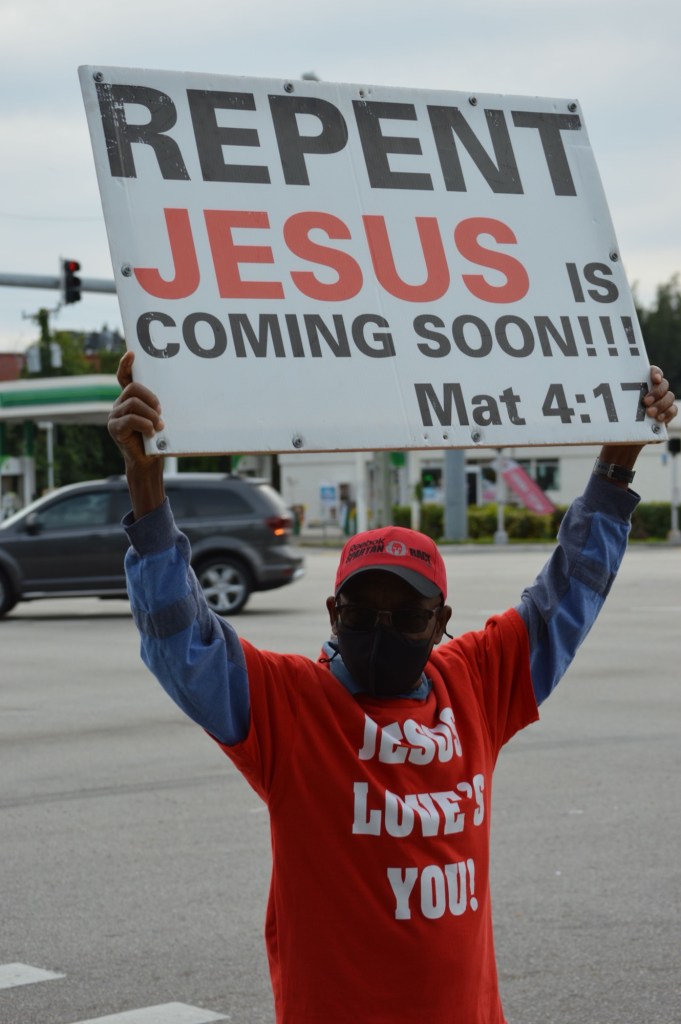
Mark, in the passages that we have covered in this article, validates that Jesus is the Christ, the Savior of the world, has come; He fulfilled all Scriptures. As John states, God did not send Jesus Christ into the world to condemn the world, but to save it.
Why then are there talks of a rapture and an earth-shaking judgment happening soon?
In Revelation 14, John states, “Then I saw another angel flying directly overhead, with an eternal gospel to proclaim to those who dwell on earth, to every nation and tribe and language and people” (Revelation 14:6). The preaching of the Gospel continues on after the destruction of Babylon the Great, which was Old Covenant Jerusalem. Keep in mind that John described Babylon the Great as the woman and the great city in Revelation 17:18. And earlier in Revelation 11:8, the Bible defined the great city as the place where Jesus was crucified, which no doubt was Jerusalem.
Mark urges his contemporaries to notice the signs of their age. We should understand that we have moved beyond that era. Living in the eternal period of grace, we need not be unsettled by worldly events; instead, we should live by faith.
Peter, in the words of Acts 3:6, declared, “I possess neither silver nor gold, but in the name of Jesus Christ, I offer you what I have.” Share this article freely, for you freely receive. Take note, underlines and highlights are clickable links for definitions or Bible references. Stay updated by heading to our about page and subscribe directly to receive notifications in your inbox. Blessings!