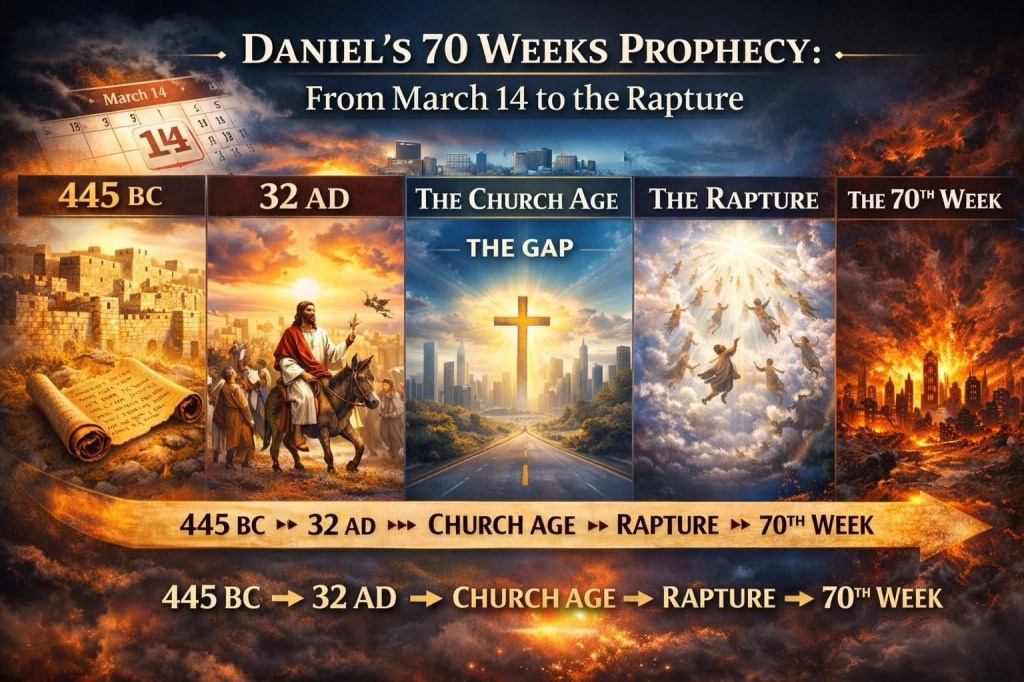
Let me warn Christians that anyone who claims and teaches that the present conflict in Iran is a prelude to the Second Coming of Jesus Christ is delusional and false. All the prophecies in the Old Testament were fulfilled in Christ Jesus.
After His resurrection, Jesus Christ declared, “These are My words that I spoke to you (i.e., the disciples) while I was still with you. Everything written about Me in the Law of Moses, the Prophets, and the Psalms must be fulfilled.” (Luke 24:44) During His sermon on the mount, Jesus emphasized, “Do not think that I have come to abolish the Law or the Prophets; I have not come to abolish them but to fulfill them” (Matthew 5:17). In essence, Jesus Christ proclaimed that He was fulfilling Scriptures from the very beginning of His earthly ministry and even after His resurrection. It’s crucial to understand that if Jesus didn’t fulfill all Scriptures, He wouldn’t be true to His Word and couldn’t be the Christ. However, Jesus certainly is the Christ.
Hebrews teaches that the coming of Jesus Christ signaled the last days. See Scripture, “Long ago, at many times and in many ways, God spoke to our fathers by the prophets, but in these last days He has spoken to us by His Son, whom He appointed the heir of all things, through whom also He created the world” (Hebrews 1:1-2). The Bible says “it’s the last days”, not millennia. Peter affirmed it’s the last days in Acts 2:16-40, same as Paul and other apostles (2 Timothy 3:1; James 5:3; 2 Peter 3:3).
Contrary to contemporary Christian teachings, God’s kingdom cannot be postponed. Daniel prophesied that it will come during the reign of the fourth Gentile kingdom ruling over Israel, asserting that it’s certain and sure (Daniel 2:44-45). Rome was the fourth empire after Babylon (Daniel 2:36-38), Persia, and Greece (Daniel 8:20-21). The fact is, even the Jewish religious leaders, despite denying Christ, knew its time; hence, Jesus said they were forcing themselves into the kingdom. See Luke 16:16, “The Law and the Prophets were until John; since then the good news of the kingdom of God is preached, and everyone forces his way into it.”
The teaching about a Revived Roman Empire was developed to circumvent God’s declarations. There are many more lies invented to justify their assertions, and sadly many Christians have fallen into their myths and deceptions.
God’s kingdom is spiritual. The Bible nowhere teaches it would be physical. Jesus made clear it’s not coming in ways that can be observed.
Jesus Christ declared the arrival of God’s kingdom; see Luke 17:20-21, “Being asked by the Pharisees when the kingdom of God would come, Jesus answered them, ‘The kingdom of God is not coming in ways that can be observed, nor will they say, “Look, here it is!” or “There!” for behold, the kingdom of God is in the midst of you.’”
See Christ’s conversation with the Samaritan woman: “Jesus said to her, ‘Woman, believe Me, the hour is coming when neither on this mountain nor in Jerusalem will you worship the Father. You worship what you do not know; we worship what we know, for salvation is from the Jews. But the hour is coming, and is now here, when the true worshipers will worship the Father in spirit and truth, for the Father is seeking such people to worship Him. God is spirit, and those who worship Him must worship in spirit and truth.’ The woman said to Him, ‘I know that Messiah is coming (He who is called Christ). When He comes, He will tell us all things.’ Jesus said to her, ‘I who speak to you am He.’” (John 4:21-26)
Without a doubt, Jesus is the Christ, the Messiah who was to come. He came, therefore the Messianic kingdom was inaugurated; that’s the reason the temple was destroyed in 70 A.D. Take note, Jesus did say, with His coming, Jerusalem would cease to be the place for worship. Believers are no longer confined to spaces or a sanctuary, but are to worship God in truth and spirit.
The Messianic kingdom was spoken in Psalm 2. Jesus Christ is the King of Zion, a fulfillment of Isaiah 9:6-7 and Isaiah 7:14 as declared in Matthew 1:22-23. The Bible never spoke of a gap in the prophetic fulfillment of God’s kingdom. The talk of a rapture is nonsense. With the coming of Jesus, the Messianic kingdom has begun. Paul, in Acts, declared the fulfillment of Psalm 2, “And we bring you the good news that what God promised to the fathers, this He has fulfilled to us, their children, by raising Jesus, as also it is written in the second Psalm, ‘You are My Son, today I have begotten You’” (Acts 13:32-33). The Messianic kingdom is God’s kingdom – the kingdom of heaven – as heralded by John the Baptist (Matthew 3:1-2) and announced by Jesus Christ to have arrived (Matthew 4:17; 12:28; Luke 11:20).
What is too hard to understand? It’s plain and simple. But contemporary Christianity resists the truth and insists on what they have been told and taught. Example of the lie below:
Taken from Tony Campbell
Now that another Middle East crisis is at hand, soothsayers once more are abound. But Jesus Christ alone is the true prophet of God, to whom we ought to listen. At the transfiguration of Jesus, God declared, “This is My beloved Son, with whom I am well pleased; listen to Him.” (Matthew 17:5)
Christians, let us not be alarmed by claims or teachings that supposedly the end of the world is coming. The Bible never spoke of the end of the world, but the end of the age. Jesus Christ taught about two ages only, the present age and the age to come, see Mark 10:29-30 and Luke 18:29-30. By “present age or in this age”, Jesus didn’t mean our time but the Old Covenant age – the period in which He came, lived, died, and resurrected, which consists of regulations, offerings, and animal sacrifices – see Hebrews 9:1-15. The Bible teaches that Christ Jesus has made it obsolete, with the passing of the Jewish temple (Hebrews 8:13). Making it impossible for the Mosaic regulations to be observed and practiced. The Bible declared Christ Jesus the mediator of the New Covenant (Hebrews 9:15; 12:24).
Paul, in Ephesians, expounded on the mystery of God about the church also teaches only two ages (Ephesians 1:21-22).
However, Jewish survivors of the A.D. 70 destruction of the temple continued in disbelief, so they came out with the Talmudic writings. Prominent on its declaration is a third rebuilding of the Jewish temple, which was nowhere taught in the Old or New Testament Scripture, but has been promoted by some Christians who hold dispensational theology. Beware of what you are learning, believing, and teaching. You might be disseminating falsehoods.
Study the Bible thoroughly with a clear mind, free from biases introduced by mainstream Christianity. Just a few decades after Jesus Christ’s resurrection, false gospels began spreading, prompting Paul to confront them by writing letters to various churches (Galatians 1:6-9; 2 Corinthians 11:1-4). Also, the writing of the gospels ensued— Matthew, Mark, Luke, and John. Today, it remains an issue even millennia later. The root cause seems to be Christianity’s tendency to rely on the writings of early church fathers, those of the Reformers, or modern scholars rather than the Bible itself.
Peter, in the words of Acts 3:6, declared, “I possess neither silver nor gold, but in the name of Jesus Christ, I offer you what I have.” Share this article freely, for you freely receive. Take note, underlines and highlights are clickable links for definitions or Bible references. Stay updated by heading to our about page and subscribe directly to receive notifications in your inbox. Blessing!
Quoting Paul’s words, “For I wrote to you out of much affliction and anguish of heart and with many tears, not to cause you pain but to let you know the abundant love that I have for you.” Speaking God’s truth in love, as taught in 2 Corinthians 2:4, so I share out of love for God’s church.
Without a doubt, no one can truly be a Christian without doctrine. Doctrine refers to a set of beliefs or teachings that define one’s faith. In the context of Christianity, doctrine encompasses the fundamental truths about Jesus Christ, His salvation, His kingdom, and other related matters. Consequently, no Christian can claim to believe in Christ Jesus without being deeply concerned about the doctrine. Paul emphasized the significance of vigilance and perseverance in one’s life and doctrine, stating, “Be vigilant about your life and doctrine. Persevere in them, for if you do, you will save both yourself and your listeners.” (1 Timothy 4:16)
Clearly, doctrine and faith are closely intertwined; it’s impossible to claim one without the other. The Christian faith is a set of doctrines centered on Christ Jesus. It’s no wonder that twice Paul condemned those who distorted the Gospel (see Galatians 1:6-7; 2 Corinthians 11:2-4). The Gospel is God’s doctrine for salvation. Ignorance and arrogance are dangerous predicaments for individuals claiming to be Christians. Be discerning and avoid falling for such lies.
The Bible alone holds the authority to definitively speak about God’s doctrine for salvation. When read and taught in its context, Scripture remains inspired and inerrant. Consequently, Christians must be aware of potential errors, human influences, or biases that may arise when they read and listen to extra-biblical literatures. Scripture quotes must always be consistent with the biblical teaching of their text. The apostle taught Christians, saying, “I have applied all these things to myself and Apollos for your benefit, brothers, that YOU MAY LEARN BY US NOT TO GO BEYOND WHAT IS WRITTEN, that none of you may be puffed up in favor of one against another.” (1 Corinthians 4:6)
Lately, with the recent events in Israel, many Christians have been making predictions about the future, claiming they are based on biblical prophecy. However, a closer look at their approach reveals that they have been quoting Scriptures without considering their context. I challenge anyone who claims to have found a prophecy about a third rebuilding of the Jewish temple in the Scriptures to provide the specific passage.
Paul gave a warning to the church, saying, “For the time is coming when people will not endure sound teaching, but having itching ears they will accumulate for themselves teachers to suit their own passions, and will turn away from listening to the truth and wander off into myths.” (2 Timothy 4:3-4)
That time occurred during Paul’s era, and unfortunately, it persists to this day. As I mentioned in my article “A Love Letter to the Church,” “since the decline in doctrinal standards has been ongoing for decades, if not centuries, defective doctrines have become the norm. Consequently, truthful biblical teachings have become indistinguishable to most Christians.” We don’t require another reformation; instead, we need a renewed interest in biblical truth. We can’t find it unless we revisit the writings of the first-century church, the Bible, and learn from there. That’s why our ministry is named “Unlearning Tradition, Relearning Scripture.” May God grant us grace to make time for this, even amidst our busy schedules. If securing our future here is important to you, I emphasize that our spiritual well-being is of utmost importance cause it’s about now and forevermore.
Paul emphasized this in his letter to the church, “Let us focus on the unseen rather than the visible. The visible is fleeting, while the unseen is eternal.” (2 Corinthians 4:18)
P.S. After encountering contradictions in the traditional teachings of the church, I made an effort to relearn Scripture. Despite knowing that Scripture is a unity, I couldn’t reconcile the traditional teachings. With the help of my seminary training, I embarked on a journey of restudying the Bible. As God promised in Proverbs 2:1-5, if we receive God’s words, treasure its commandments, and make ourselves attentive to its wisdom, yearning for understanding like that of hidden treasures, we will be given understanding and knowledge.
With utmost humility and confidence in the Lord, I share that my understanding of the Scripture has grown. By God’s grace, I have found the courage to teach and explain it in my Bible study groups. If I were solely concerned with gaining acceptance and personal benefits, would I risk challenging the prevailing popular beliefs? However, driven by concern for my own salvation and the hope of reuniting with my departed son, I could not remain silent and continue adhering to conventional Bible teachings. Recognizing that my ultimate reward lies with the Lord Jesus Christ, I have chosen to openly share the Word to honor God and out of love for His church. Ultimately, God alone is the ultimate arbiter of truth, as revealed in His sacred Bible.
Keep in mind that back in the days of Jesus Christ and the early church, the Sanhedrin, the Jewish religious order, was the recognized authority of Scripture. However, they led the people astray. Therefore, titles alone do not signify authority in conveying the truthful teachings of God’s word; correct exposition does. Hence, Paul emphasized, “Do your utmost to present yourself to God as one approved, a worker who has no need to be ashamed, rightly handling the word of truth.” (2 Timothy 2:15) Didn’t Paul uphold the doctrines of the Bible?
Peter , in the words of Acts 3:6, declared, “I possess neither silver nor gold, but in the name of Jesus Christ, I offer you what I have.” Share freely, for you freely receive. Stay updated by heading to our about page and subscribe directly to receive notifications in your inbox. Blessing!
The Hastings’ Dictionary of the Bible defined “eschatology” as
The department of theology which is concerned with the “last things,” that is, with the state of individuals after death, and with the course of human history when the present order of things has been brought to a close. It includes such matters as the consummation of the age, the day of judgment, the second coming of Christ, the resurrection, the millennium and the fixing of the conditions of eternity.
The Book of Revelation has been the most neglected writings in the New Testament. It is rarely preached or taught from the pulpit due to the perception that it can cause division. Whenever it has been taught to Christians, controversies—often leading to arguments—ensue. As a result, many Christian congregations avoid the book, not by the members but at the insistence of their leaders. However, the relevance of Revelation cannot be ignored. Like the final words of a dying man, it conveys the last messages of Jesus Christ to the Old Covenant people of God.
The underlined phrase from Hastings sheds light on the current confusion surrounding eschatology. However, if we adjust this idea by replacing some words, we may be able to explore the unity of Scripture without contradictions. Please compare the statement below with Hastings’ original.
“Eschatology concerns the ‘last things,” with the state of individuals after death, and with the course of human history when the Old Covenant of God has been brought to a close.”
I simply change the phrase “the Old Covenant of God” to “the present order of things.” Oops! That statement could already spark controversy, though it might be nothing for ordinary readers.
Currently, biblical scholars recognize at least four different perspectives on the Book of Revelation and prophetic literature. None of these views is considered heretical or false teaching, as each is supported by passages from Scripture. The issue lies not with the Scripture itself, but with its interpretation. All four proponents of eschatology affirm the absolute authority and inerrancy of the 66 books of the Bible. Therefore, the problem ultimately stems from human error, a point on which all sides can agree.
Despite Christianity’s two-millennia-long history, many arguments and debates remain unresolved. This is why none of the four perspectives of eschatology are classified as heresy or false teaching; for now, they are simply considered “debatable.”
The four views of eschatology, namely the Futurist view, the Preterist view, the Historical view, and the Idealist view.
Christian Theology by Millard J. Erickson was a required reading for us during my time at seminary. It spanned four semesters in our Systematic Theology class. I have a particular interest in this subject, especially because it addresses the topic of death, which I feel compelled to explore in search of the truth about what happens after we die. If you’ve read all my blogs, you may know that I came to faith following the tragic death of my only son. I shared my journey in a blog post titled “Regarding Wilmer.”
Here is an excerpt from Christian Theology, by Willard J. Erickson:
At this point it will be helpful to note a system which is used to classify the various interpretations of prophetic or apocalyptic material in Scripture. While it is often most utilized as a means of classifying interpretations of the Book of Revelation or, more generally, all such prophetic literature, the system can also be applied to distinguish views of eschatology:
1. The futuristic viewholds that most of the events described are in the future. They will come to fulfillment at the close of the age, many of them probably clustered together.
2. The preterist viewholds that the events described were taking place at the time of the writer, Since they were current for the writer, they are now in the past.
3. The historical viewholds that the events described were in the future at the time of writing, but refer to matters destined to take place throughout the history of the church. Instead of looking solely to the future for their occurrence, we should also search for them within the pages of history and consider whether some of them may be coming to pass right now.
4. The symbolic or idealist viewholds that the events described are not to be thought of in a time sequence at all. They refer to truths which are timeless in nature, not to singular historical occurrences.
I understand that the definition provided can be difficult to grasp, even for those who deeply appreciate Scripture. This complexity often arises from the perceived vagueness of some biblical passages. That’s why attending seminary can be beneficial for many. Even after I left the organized religious system and began my ministry independently, I encouraged someone to enroll in the same seminary, and he did. He is now serving in a local congregation.
I would like to express my gratitude for my professors during my time at the seminary. They provided me with solid training and equipped me well for studying the Bible. However, it’s important to acknowledge that, much like learning to drive a car, while skills can be taught and acquired, true excellence comes with practice and real-world experience. I want to clarify that I am not claiming to have achieved excellence, but rather that I feel eligible to engage in exegesis (the critical explanation or interpretation of a biblical text) and to apply hermeneutics (the knowledge required for interpreting the Bible).
The futurist view is likely the most familiar perspective for many people. Scripture contains revelations and prophecies that speak of the future; to them only a portion of these prophecies has been fulfilled, while the rest are still pending. Since the 1970s, numerous novels and films have been created about the anticipated Second Coming of Christ, contributing to its popularity. Additionally, the Scofield Reference Bible from the early 1900s has had a significant impact on Christians for over a century.
In this context, there’s a video teaching by Bruce Gore that offers a comprehensive analysis of the dominant futurist view and explores its questionable origins. The futurist perspective comes in various forms and continues to evolve.
Herewith also is a shorter video from Ben Witherington III, a professor of New Testament Interpretation at Asbury Theological Seminary in Wilmore, Kentucky. However, I encourage you to invest the time to watch Bruce Gore’s more detailed video, as it is well worth it.
Many pastors today, being futurists, often claim that Jesus Christ is coming soon. However, many may not realize that according to the dispensational futurist view, the kingdom of heaven has yet to arrive. In contrast, Jesus Christ clearly stated the presence of God’s kingdom, as seen in Matthew 12:28.
But if it is by the Spirit of God that I [Jesus Christ] cast out demons, then the kingdom of God has come upon you.
Studying the Bible is essential. If you clicked on the link for the Scofield Reference Bible, you’ll find that GotQuestions.org offers positive remarks about it. However, Bruce Gore and Ben Witherington III have differing opinions. Their disagreement isn’t about the Bible itself, but rather about its notes and commentary.
It has been two millennia since the Book of Revelation was written, where Jesus promised He is coming soon, not just once, but repeatedly, as stated in Revelation 1:1-3.
The revelation of Jesus Christ, which God gave Him to show to His servants the things that must soon take place. He made it known by sending His angel to His servant John, who bore witness to the word of God and to the testimony of Jesus Christ, even to all that he saw. Blessed is the one who reads aloud the words of this prophecy, and blessed are those who hear, and who keep what is written in it, for the time is near.
“I am coming soon. Hold fast what you have, so that no one may seize your crown.” (Revelation 3:11)
“And behold, I am coming soon. Blessed is the one who keeps the words of the prophecy of this book.” (Revelation 22:7)
“Behold, I am coming soon, bringing My recompense with Me, to repay each one for what he has done. I am the Alpha and the Omega, the first and the last, the beginning and the end.” (Revelation 22:12-13)
“He who testifies to these things says, ‘Surely I am coming soon.’ Amen. Come, Lord Jesus!” (Revelation 22:20)
Proponents of futurism, particularly the dispensationalist view commonly associated with contemporary Christianity, are known for their constant vigilance in searching for signs that could indicate the impending arrival of the Second Coming. In light of our current situation, the COVID-19 pandemic has sparked both excitement and fear, with many believing that Jesus Christ’s return is near. However, we can look back to the early 1900s when the “Spanish Flu” pandemic likely generated similar expectations. If that had been the case, Christians would have been proclaiming that Jesus was coming soon for a century now. I find it difficult to consider a hundred years as “soon.” Unfortunately, the futurist perspective may have become akin to the fable of “The Boy Who Cried Wolf.”
Here is a well-reasoned and valuable presentation by Bruce Gore on the historical context of the Book of Revelation. To view it, click on the highlight. I won’t delve deeper into this perspective, but it’s worth noting that it is also futurist, clearly overshadowed by futurist interpretations.
Below is an excerpt from GotQuestion.Org on the idealist view. Click the link to read.
In the idealist interpretation, the symbols in Revelation are not normally thought to refer to specific individuals and historic events but to typical individuals and events. For instance, every generation will have an “antichrist” and a “mark of the beast”—any number of individuals, world leaders, or empires who exalt themselves against God are the “antichrist,” and those who follow those leaders receive his “mark.” Some part of the church is always going through tribulation, and there will be martyrs in every generation. The idealist interprets Revelation as the ongoing struggle between God and His people and Satan and those who follow him.
The idealist perspective’s refusal to recognize a singular fulfillment of biblical prophecies, viewing them instead as repeated events throughout human history, may unintentionally align closely with the futurist approach. However, the issue arises from the implication that there would be no actual fulfillment of these prophecies, even if this conclusion has not been explicitly stated.
The Preterist view stands apart from the other three interpretations, but that shouldn’t lead us to dismiss it outright. I admit that I was once guilty of this during my seminary days. I recall a moment when my professor briefly introduced the idea that the second coming might have already been fulfilled. Not a single student in the class considered this possibility or took the initiative to reexamine the Scriptures; it was dismissed without thought. Perhaps that explains why the professor didn’t delve deeper into the topic.
The professor may find himself in trouble later for exploring and teaching certain ideas, given the strong influence of futurism among local congregations across the country. If you’re familiar with Martin Luther’s struggles during the Reformation in the 16th century, you can understand the potential challenges he might face if he were to delve deeper into the Preterist view. Herewith is a short video explaining the Reformation.
Looking back, despite its shortcomings, the Reformation opened the floodgate for believers to freely study and rediscover the original teachings of Jesus Christ and the apostles.
“And they devoted themselves to the apostles’ teaching and the fellowship, to the breaking of bread and the prayers”
Yet, like any movement, left in the hands of man, combining Scripture and human ideas, the Reformation movement somehow went south. To read more about my perspective on the Reformation, click on this link “Reformation Went Poof!“
In formatting his eschatology, Dodd pays particular attention to the biblical references to the day of the Lord. He notes that whereas in the Old Testament the day of the Lord is viewed as a future matter, in the New Testament it is depicted as a present occurrence
“Present occurrence” means, at the time of its writing – first-generation Christianity.Herein lies the strong argument for a Preterist view of the Bible. It has been more than a decade since I became a Christian. As you can read from my blog “Regarding Wilmer,” it was due to the death of my only son that I became a Christian. The reality of death came staring at me. All my previous beliefs failed to answer a simple question about human existence – what happens after death? To make the long story short, my earnest desire to find the answer to life’s most practical question and in the course of studying and leading Bible studies, I was led back to that brief moment in the seminary when we were asked if we would consider the possibility that Jesus had returned.
It was a struggle. I often found myself wanting to ignore clear and obvious biblical passages that indicated Jesus had indeed returned, all to avoid rejection, ridicule, and persecution. However, I eventually surrendered to the teachings of Scripture. My quest to deepen my understanding of the Bible has been rewarding. I was able to reconcile the seemingly loose ends of biblical teachings, particularly regarding the unity of Scripture’s eschatology on the topics of death and the Second Coming of Jesus Christ.
A few years ago, my pastor friend, who also believes that Jesus has returned, and I had a friendly discussion with another pastor friend who is a futurist. We posed an important question: “Where do Christians go after death?” His response was, “There are actually three possibilities to that question.” He couldn’t confidently say, “A Christian goes straight to heaven,” even though we often hear that in funeral services. Is this idea just a cliché meant to comfort grieving families? Surely that was not the intention. The issue arises from conflicting passages that oppose each other, especially when we consider the eschatology surrounding death alongside the future return of Jesus Christ.
To support my point, I want to highlight that my futurist pastor friend is not alone in facing this dilemma. While some may confidently assert that Christians immediately go to heaven upon death, I challenge anyone making that claim—who also believes that Jesus has yet to return—to provide biblical passages that back it up. The reality is more nuanced. I’m quoting an excerpt from Thomas G. Long, a professor at Candler School of Theology, who addressed the question: “Do they go directly to heaven or hell, or to a holding place until Christ returns for the final judgment?”
“There are two images in the New Testament about what happens. First, the Resurrection Day, when the trumpet will sound and the dead will be raised up incorruptible. If you only had that image, what we would imagine is that when people die, they lie in some intermediate state awaiting the great Resurrection Day.
“The other image, however, is that death contains no victory over us at all. As soon as we die, we are with God. We get this in the Book of Revelation where John looks up and already the saints who have died are praising God around the throne. In terms of linear time, we can’t work this out. We’ve got two competing images: You either wait until the general resurrection or you go immediately to be with God.
“But the imposition of linear time on what is an eternal idea is what creates the contradiction. I don’t try to make a theologian out of Einstein, but he did show us that events that happen in sequence can also be events that happen simultaneously. If Einstein can imagine that in terms of physics, theologians can imagine it also in terms of the intrusion of eternity into linear time – that we are both immediately raised and raised together.”
With such an answer, it seems to me that there is no assurance that a Christian can immediately enter heaven after death. Don’t you think that poses a serious dilemma? If the Bible relies on science to explain its teachings, it raises significant doubts about the security of salvation. This is the impact of what could be called an “eschatological divide.” The doctrine of salvation is closely tied to the eschatology surrounding Christ’s return. Without a comprehensive understanding of this return, we may feel as if we’re left in a precarious situation. Clearly, the futurist perspective leaves us wanting for answers.
Fellow pastors, we can’t be pulling people’s legs just to comfort them. The Bible, in Ephesians 4:11-14, said:
And He [Jesus Christ] gave the apostles, the prophets, the evangelists, the shepherds [pastors] and teachers, to equip the saints for the work of ministry, for building up the body of Christ, until we all attain to the unity of the faith and of the knowledge of the Son of God, to mature manhood, to the measure of the stature of the fullness of Christ, so that we may no longer be children, tossed to and fro by the waves and carried about by every wind of doctrine, by human cunning, by craftiness in deceitful schemes.
Since we all affirm in unity that Scripture is true and authoritative in matters of life and death—without error—shouldn’t we approach justice with the Words of Christ? We ought to explain our declarations with firm conviction, supported by clear and valid Scriptural passages. After all, by faithfully fulfilling our duty to Christ Jesus our Lord, we will be rewarded accordingly with the unfading crown of glory.
“Shepherd the flock of God that is among you, exercising oversight, not under compulsion, but willingly, as God would have you; not for shameful gain, but eagerly; not domineering over those in your charge, but being examples to the flock. And when the chief Shepherd appears, you will receive the unfading crown of glory.“
It is a misconception to believe that this passage is no longer relevant if Christ has returned. Jesus Christ is the King Eternal, and His reign has no end. Therefore, pastors must continue to seek the approval of Christ Jesus, the Chief Shepherd of God’s flock.
I understand that many questions need to be asked and answered. However, I also recognize that it can be challenging to absorb everything at once. This is the goal of this blog: to unlearn traditional beliefs and relearn the teachings of Scripture. As the saying goes, “Patience is a virtue.” With time and dedication to reading and studying the Bible, you too will come to see the light.
In conclusion, all of my citations come from the futurist perspective, with the exception of Bruce Gore, who is a partial Preterist. If you find futurism lacking in substance, I recommend starting with a couple of videos: one by Bruce Gore and another by Kenneth Gentry, who is also a partial Preterist, discussing the dating of Revelation.
Disclaimer: We do not fully endorse all the sites or sources we have cited; our endorsement is limited to the ones we share here. Additionally, we cannot claim to have watched or listened to all the videos or teachings that those sites have posted. Over time, you will learn to discern which sources to embrace or disregard.
Blessings!
If you want to follow our journey of unlearning tradition and relearning Scripture, you can stay updated by heading to our about page and subscribe directly to receive notifications in your inbox.
As noted in my earlier post, the Sabbath serves as the central theme in John 5. The Gospel mentions the Sabbath ten times, with four occurrences in this chapter alone. This focus makes sense because the events in John 5 take place during the Jewish Fall Harvest Festival—the Feast of Booths—since the core of that celebration is Sabbath rest.
This theme of rest is particularly meaningful when contrasted with the unrest of exile. As a young man, the prophet Daniel was taken into exile (Daniel 1:3–6). This Exile, also known as the Seventy Years of Babylonian Captivity, fulfilled God’s declared judgment on Judah, the southern kingdom and final remnant of David and Solomon’s monarchy. For context, see Jeremiah 25:3–14.
For twenty-three years, from the thirteenth year of Josiah the son of Amon, king of Judah, to this day, the word of the LORD has come to me, and I have spoken persistently to you, but you have not listened. You have neither listened nor inclined your ears to hear, although the LORD persistently sent to you all His servants the prophets, saying, “Turn now, every one of you, from his evil ways and evil deeds, and dwell upon the land that the LORD has given to you and your fathers from of old and forever. Do not go after other gods to serve and worship them, or provoke Me to anger with the work of your hands. Then I will do you no harm.” Yet you have not listened to Me, declares the LORD, that you might provoke Me to anger with the work of your hands to your own harm.
Therefore thus says the LORD of hosts: Because you have not obeyed My words, behold, I will send for all the tribes of the north, declares the LORD, and for Nebuchadnezzar the king of Babylon, My servant, and I will bring them against this land and its inhabitants, and against all these surrounding nations, I will devote them to destruction, and make them a horror, a hissing, and an everlasting desolation. Moreover, I will banish from them the voice of the mirth and the voice of gladness, the voice of the bridegroom and the voice of the bride, the grinding of the milestones and the light of the lamp. The whole land shall become a ruin and a waste, and these nations shall serve the king of Babylon seventy years. Then after the seventy years are completed, I will punish the king of Babylon and that nation, the land of the Chaldeans, for their iniquity, declares the LORD, making the land an everlasting waste. I will bring upon the land all the words that I have uttered against it, everything written in this book, which Jeremiah prophesied against all the nations. For many nations and great kings shall make slaves even of them, and I will recompense them according to their deeds and the work of their hands.
By Daniel’s later years, he may have reached his eighties, since seventy years had passed after his exile to Babylon. See Daniel 9:1–2.
In the first year of Darius the son of Ahasuerus, by descent a Mede, who was made king over the realm of Chaldeans – in the first year of his reign, I Daniel, perceived in the books the number of years that, according to the word of the LORD to Jeremiah the prophet, must pass before the end of the desolations of Jerusalem, namely, seventy years.
After the seventy-year Babylonian captivity ended—the judgment God announced through Jeremiah—Daniel asked the LORD for mercy and restoration. The answer to Daniel’s prayer and request appears in Daniel 9:24–27. We can examine Daniel 9:24, which captures the full scope of God’s declaration:
Seventy weeks are decreed about your people and your holy city, to finish the transgression, to put an end to sin, and to atone for iniquity, to bring in everlasting righteousness, to seal both vision and prophet, and to anoint a most holy place.
Perhaps to Daniel’s surprise, God is not finished with Israel; he was informed of the final judgment, described as “to finish transgression, to put an end to sin.” The atonement was “to atone for iniquity, to bring in everlasting righteousness,” and finally, God’s dwelling presence—the tabernacle (booths)—was “to anoint a most holy place.” By the way, the themes in Daniel 9:24 align with elements in John 5.
John 5:30, spoke of Judgment, which is the culmination of the Feast of Trumpets.
I can do nothing of My own. As I hear, I judge, and My judgment is just, because I seek not My own will but the will of Him [God the Father] who sent Me.
Next, John 5:21, spoke of Resurrection, the fulfillment of the Feast of Atonement.
For as the Father raises the dead and gives them life, so also the Son gives life to whom He will.
Finally, John 5:24, spoke of Eternal Life, the consummation of the Feast of Booths.
Truly, truly, I say to you, whoever hears My word and believes Him who sent Me has eternal life. He does not come into judgment, but has passed from death to life.
Daniel’s life spanned the era of the first Gentile kingdom, Babylon, and into the second, the Medo-Persian Empire. He understood this transition when he was called to interpret the dream of King Nebuchadnezzar (Daniel 2). In this dream, God revealed that four Gentile kingdoms would rule over Israel before the coming of the Son of Man—the Anointed One, the Deliverer of Israel (Daniel 2:44-45). This prophetic confirmation is further elaborated in Daniel 7.
The fulfillment of God’s Messianic Kingdom, as foretold, would take place during the reign of the fourth Gentile kingdom (Daniel 2:40–45). Scripture names the first three kingdoms: Babylon (Daniel 2:37–38), Medo-Persia, and Greece (Daniel 8:20–21). The fourth kingdom remains unnamed, but Daniel 7:7 provides a vital clue about its identity.
After this I saw in the night visions, and behold, a fourth beast, terrifying and dreadful and exceedingly strong. It had great iron teeth; it devoured and broke into pieces and stamped what was left with its feet. It was different from all the beasts that were before it, and it had ten horns.
About 600 years later, the identity of the fourth kingdom was finally revealed by the apostle John. See Revelation 13:1 and 17:7-11.
And I saw a beast rising out of the sea, with ten horns and seven heads, with ten diadems on its horns and blasphemous names on its heads. (Revelation 13:1)
But the angel said to me [John], “Why do you marvel? I will tell you the mystery of the woman, and of the beast with seven heads and ten horns that carries her. The beast that you saw was, and is not, and is about to rise from the bottomless pit and go to destruction. And the dwellers on earth whose names have not been written in the books of life from the foundation of the world will marvel to see the beast, because it was and is not and it to come. This calls for a mind of wisdom: the seven heads are the seven mountains on which the woman is seated; they are also the seven kings, five of whom have fallen, one is, the other has not yet come, and when he does come he must remain only a little while. As for the beast that was and is not, it is an eight but it belongs to the seven, and it goes to destruction.” (Revelation 17:7-11)
It should be noted that in the Greek, the seven mountains could also be translated as “seven hills,” and there is only one city at the time of the apostle, perhaps even now, that was known to sit on seven hills— that is, Rome. The seven kings, five of whom have fallen, refers to the Roman emperors, beginning with (1) Julius Caesar, (2) Augustus Caesar, (3) Tiberius Caesar, (4) Caligula Caesar, (5) Claudius Caesar; “one is,” refers to Nero Caesar— the emperor reigning at the time of Peter, John, and Paul.
I, John, your brother and partner in the tribulation and the kingdom and the patient endurance that are in Jesus, was on the island called Patmos on account of the Word of God and the testimony of Jesus. I was in the Spirit on the Lord’s Day, and I heard behind me a loud voice like a trumpet saying, “Write what you see in a book and send it to the seven churches, to Ephesus and to Smyrna and to Pergamum and to Thyatira and to Sardis and to Philadelphia and to Laodicea.”
According to the King James Concordance, “trumpet” is mentioned eleven times in the New Testament, with six of those instances appearing in the Book of Revelation, including Revelation 1:10. This frequent use of the trumpet imagery calls to mind the Fall Harvest Festivals of Leviticus 23, which begin with the Feast of Trumpets, followed by the Feast of Atonement, and finally the Feast of Booths.
Incidentally, the “Lord’s Day” of Revelation 1:10, which the Strong’s Hebrew and Greek Dictionaries said was “from G2962; belonging to the Lord,” could not be referring to a Sunday, as traditionally suggested, but the Sabbath. See Genesis 2:2–3.
And on the seventh day God finished His work that He had done, and He rested on the seventh day from all His work that He had done. So God blessed the seventh day and made it holy, because on it God rested from all His work that He had done in creation.
Brown-Driver-Briggs’ Hebrew Definition defined “holy” as to consecrate, sanctify, prepare, dedicate, be hallowed, be holy, be sanctified, be separate. Therefore, the seventh day, which is the Sabbath, was sanctified, consecrated, and set apart for the LORD God; hence, the Lord’s Day or a “day belonging to the Lord.”
Remember the Sabbath day, to keep it holy. Six days you shall labor and do all your work, but the seventh day is a sabbath of the LORD your God … For in six days the LORD made the heavens and the earth, the sea and all that is in them, and rested on the seventh day; therefore the LORD blessed the sabbath day and made it holy.
The Lord’s Day cannot be a Sunday, which traditionally was derived from the phrase “first day of the week” found in every gospel narrative concerning the resurrection of Jesus Christ.
So because of the Jewish Day of Preparation, since the tomb was close at hand, they laid Jesus there. Now on the first day of the week Mary Magdalene came to the tomb early, while it was still dark, and saw that the stone had been taken away from the tomb.
Since it was the day of Preparation, and so that the bodies would not remain on the cross on the Sabbath (for that Sabbath was a high day), the Jew asked Pilate that their legs might be broken and that they might be taken away.
Every Passover and Unleavened Bread Festival, there would be two Sabbaths in the week: a regular Sabbath [the seventh day of the week; Saturday to us] and the High or Special Sabbath, which could be any day of the week as long as it is the fifteenth of Nisan. Leviticus 23:7 states, “On the first day you shall have a holy convocation; you shall not do any ordinary work [Sabbath rest].” The first day of the Feast of Unleavened Bread was the beginning of the Passover-week festival, the fifteenth of Nisan.
The Passover event in Exodus occurred “between the two evenings” (Exodus 12:6–8, translated “twilight”), beginning on the fourteenth of Nisan, which was the Preparation for the Passover. The Jewish day begins at sunset and ends before sunset (6pm to before 6pm); unlike ours, which is 12 midnight to before 12 midnight. Hence, Exodus 12:29 states:
At midnight [Hebrew “middle of two night” H2677 & H3915] the LORD struck down all the firstborn in the land of Egypt …
Jesus, then, was crucified on the day of Preparation (John 19:14). He was buried before sundown, the beginning of the High Sabbath, 15th of Nisan (John 19:30, 42). Now, in John 20:1, “first day of the week” in the Greek actually means on “one Sabbath or first Sabbath“— meaning, first Sabbath after the High Sabbath. Yes, “Sabbath” (G4521, from Hebrew H7676) but was somehow translated “week” by the English translation of the Bible.
So because the Jewish Day of Preparation, since the tomb was close at hand, they laid Jesus there. Now on the [One]first [Sabbath]day of the week Mary Magdalene came to the tomb early, while it was still dark, and saw that the stone had been taken away from the tomb.
Interlinear Bible for John 20:1,
<1161> The first <3391> day of the week <4521> cometh <2064> (5736) Mary <3137> Magdalene <3094> early <4404>, when it was <5607> (5752) yet <2089> dark <4653>, unto <1519> the sepulchre <3419>, and <2532> seeth <991> (5719) the stone <3037> taken away <142> (5772) from <1537> the sepulchre <3419>.
A check on an interlinear Bible said “The first” G3391, irregular feminine of G1520, which Thayer’s Greek Definitiondefined to mean “one.” Next, “day of the week” G4521, defined by Strong’s Hebrew and Greek Dictionaries as “Of Hebrew origin” [H7676]— the Sabbath.
And when evening had come, since it was the day of Preparation [14th of Nisan], that is, the day before the Sabbath [15th of Nisan] … Mary Magdalene and Mary the mother of Jesus saw where He was laid. When the Sabbath [High] was past, Mary Magdalene, Mary the mother of James, and Salome brought spices, so that they might go and anoint Him. And very early on thefirst[One, G1520]day of the week[Sabbath, G4521], when the sun had risen, they went to the tomb.
Then they returned and prepared the spices and perfumes. And on the Sabbath [High] they rested according to the commandment. But on the first [One, G1520] day ofthe week[Sabbath, G4521], at early dawn, they came to the tomb bringing the spices which they had prepared.”
Lastly, Matthew 28:1
Now after the Sabbath [High], toward the dawn of the first [One, G1520] dayof the week[Sabbath, G4521], Mary Magdalene and the other Mary went to see the tomb.
Now Paul, in 1 Corinthians 5:7 declared Jesus Christ as the Passover Lamb that has been sacrificed. Then, in 1 Corinthians 15:23, Christ was the firstfruits, speaking of His resurrection. Therefore, another proof that Jesus could not have resurrected on a Sunday, as traditionally taught and believed, but rather on a Sabbath, fulfilling the Feast of Firstfruits of Leviticus 23, which occurred on a Sabbath (G4521), following the High Sabbath (John 19:31).
See Leviticus 23:10-11,15-16 from the NASB translation, a literal word-for-word translation.
“Speak to the sons of Israel and say to them, ‘When you enter the land which I am going to give to you and reap its harvest, then you shall bring in the sheaf of the first fruits of your harvest to the priest. He shall wave the sheaf before the LORD for you to be accepted; on the day after the Sabbath the priest shall wave it.”
“You shall also count for yourselves from the day after the Sabbath,from the day when you brought in the sheaf of the wave offering; there shall be seven complete Sabbaths. You shall count fifty days to the day after the seventh Sabbath …“
To count seven complete sabbaths, then the beginning of the count must also be on a Sabbath; thereby, the day after the High Sabbath refers to the regular weekly Sabbath. Clearly then, Jesus resurrected back to life on a Sabbath, not Sunday; fulfilling therefore the Feast of Firstfruits.
To review: Paul, in 1 Corinthians 5:7 declared Jesus Christ is the Passover Lamb that has been sacrificed. Then, in 1 Corinthians 15:23, Christ was the firstfruits, speaking of His resurrection. Therefore, once more, another proof that Jesus could not have resurrected on a Sunday, as traditionally taught and believed, but rather on a Sabbath, fulfilling the Feast of Firstfruits of Leviticus 23:10–11, which always occurs on a Sabbath following the High Sabbath.
Although Rome leveled Jerusalem in AD 70 during summer instead of winter, it is striking that Jesus observed, “Pray that your flight may not be in winter or on a Sabbath.” (Matthew 24:20)
From our earlier study, it follows that the timing must align with a Sabbath, since Revelation describes John hearing a loud voice like a trumpet “on the Lord’s Day.” The events throughout the Book of Revelation point to the Last Day and the Second Coming of Jesus Christ, completing the Fall Harvest Festivals in Leviticus 23.
Then I saw another angel flying directly overhead, with an eternal gospel to proclaim to those who dwell on earth, to every nation and tribe and language and people. And he said with a loud voice, “Fear God and give Him glory, because the hour of His judgment has come, and worship Him who made heaven and earth, the sea and the springs of water … And I heard a voice from heaven saying, “Write this: Blessed are the dead who die in the Lord from now on. ‘Blessed indeed,” says the Spirit, “that they may rest from their labors, for their deeds follow them!’”
By the way, “a loud voice” in Revelation 1:10 was said to be “like a trumpet,” so similarly “a loud voice” in Revelation 14:7 must also be “like a trumpet,” which declared the arrival of the time of God’s judgment. Following the sound of the trumpet, a voice from heaven then declared, “Blessed are the dead who die in the Lord from now on. Blessed indeed, that they may rest from their labors, for their deeds follow them!”
So there remains a Sabbath rest for the people of God. For the one who has entered His rest has himself also rested from his works, as God did from His.
Perhaps that was why Jesus would heal even on a Sabbath, indicating therefore that He was working— first to make Himself known and believed by people (John 6:29) and second, to fulfill the true Sabbath Rest (Revelation 14:13; Hebrews 4:9–10), which would be a reality only after God rested from His work (Hebrews 4:9–10). So the apostle’s narrative on John 5:16–17 makes real sense now.
And this was why the Jews were persecuting Jesus, because He was doing these things on the Sabbath. But Jesus answered them, “My Father is working until now, and I am working.”
It should be worth mentioning then that on top of the Seven Jewish Feasts of Leviticus 23 was the command to observe the Sabbath (Leviticus 23:3), since that was the essence of all the festivities of Israel, the fulfillment or the renewal of Genesis 2:2–3.
See Leviticus 23:3.
Six days shall work be done, but on the seventh day is a Sabbath of solemn rest, a holy convocation. You shall do no work. It is a Sabbath to the LORD in all your dwelling places.
Next, Genesis 2:2-3.
And on the seventh day God finished His work that He had done, and He rested on the seventh day from all His work that He had done. God blessed the seventh day and made it holy, because on it God rested from all His work that He had done in creation.
A small detail indeed reveals a lot. We must seek to know the true teachings of the Scripture. Traditions have blinded us from understanding the true essence of the Sabbath, which speaks of the salvation plan of God. Not until God had rested from His work would His creation ever experience and understand the true Sabbath Rest of God. See Revelation 21:3–4.
And I heard a loud voice from the throne, saying, “Behold, the dwelling place [tabernacle] of God is with man, and He will dwell with them, and they will be His people, and God Himself will be with them as their God. He will wipe away every tear from their eyes, and death shall be no more, neither shall there be mourning, nor crying, nor pain anymore, for the former things have passed away.
The doctrine of the Second Coming of Jesus and his fulfillment of the Final Harvest Feast, the Fall Festivals, need not be divided into specific events, since Paul noted this.
Behold, I tell you a mystery; we will not all sleep, but we will all be changed, in a moment, in the twinkling of an eye, at the last trumpet; for the trumpet will sound, and the dead will be raise imperishable, and we will be changed … But when this perishable will have put on the imperishable, and this mortal will have put on immortality, then will come about the saying that is written, “Death is swallowed up in victory.” (1 Corinthians 15:51-52,56)
Truly, a little deflection from the truth can indeed lead to a devastating false assumption. The Roman Empire, the fourth Gentile kingdom reigning over Israel, ceased to exist for more than a millennium now. So what does that tell us? Be reminded that God showed Daniel that the Messianic reign of Jesus Christ would occur within the time of the fourth Gentile kingdom, Rome. The Bible never spoke of a revived Roman Empire. Don’t you think we ought to take seriously our study of the Bible?
P.S. I have always wanted to understand the doctrine of the last things, eschatology. It was quite important and personal to me, for I wanted to be assured of what happened after death. That was the question that bothered me while I was at the wake of my only son. It’s been twenty years now. Glory be to God that finally I now comprehend Scripture, and the Lord Jesus Christ has graciously provided me understanding concerning the said doctrine.
The Lord Jesus Christ impressed His words in Isaiah 30:20–21 upon me while I wrestled with whether to begin seminary training so late in life. Scripture says, “And though the Lord give you the bread of adversity and the water of affliction, yet your Teacher will not hide himself anymore, but your eyes shall see your Teacher. And your ears shall hear a word behind you, saying, ‘This is the way, walk in it,’ when you turn to the right or when you turn to the left.” (Isaiah 30:20–21)
Looking back, I recognize that the Lord, my Teacher, Jesus Christ, graciously led me and my family to know Him and grasp His Word. This journey started at my son’s wake, who posthumously showed me God’s goodness through a penholder he had given me months before joining the Lord. Here is a link to the blog “Regarding Wilmer,” which recounts my path to Christianity.
Peter, in the words of Acts 3:6, declared, “I possess neither silver nor gold, but in the name of Jesus Christ, I offer you what I have.” Share this article freely, for you freely receive. Take note, underlines and highlights are clickable links for definitions or Bible references. Stay updated by heading to our about page and subscribe directly to receive notifications in your inbox. Blessings!