Some Christian congregations argue that hymns should be sung during gatherings, not contemporary music. Is there really a basis for such contention? Three times in the New Testament, Paul spoke about hymns; Ephesians 5:19 & Colossians 3:16.
“addressing one another in psalms and hymns and spiritual songs, singing and making melody to the Lord with your heart,” (Ephesians 5:19)
“Let the word of Christ dwell in you richly, teaching and admonishing one another in all wisdom, singing psalms and hymns and spiritual songs, with thankfulness in your hearts to God.” (Colossians 3:16)
The third was in Acts: “About midnight Paul and Silas were praying and singing hymns to God, and the prisoners were listening to them” (Acts 16:25). Paul, an apostle of Jesus Christ, was the authority behind Luke; he wrote both the Gospel of Luke and Acts.
Yes, all of the New Testament writings have apostolic authority. The same may be said of Hebrews, though modern Bible scholars debate over its authorship. Keep in mind Peter’s statement: “Knowing this first of all, that no prophecy of Scripture comes from someone’s own interpretation. For no prophecy was ever produced by the will of man, but men spoke from God as they were carried along by the Holy Spirit” (2 Peter 1:20-21). Though Peter here refers to the Old Testament Scriptures, are we to believe that the New Testament Scriptures are not of divine inspiration? Here is Paul’s testimony that he received divine inspiration from Jesus Christ:
“For I would have you know, brothers, that the gospel that was preached by me is not man’s gospel. For I did not receive it from any man, nor was I taught it, but I received it through a revelation of Jesus Christ.” (Galatians 1:11-12)
John also, attested that his writings was of divine inspiration from Jesus Christ:
“The revelation of Jesus Christ, which God gave Him to show to His servants (i.e. John and the rests) the things that must soon take place. He made it known by sending his angel to his servant John, who bore witness to the word of God and to the testimony of Jesus Christ, even to all that he saw.” (Revelation 1:1-2)
Note: ScriptureDirect, a Greek linguistic tool, clearly distinguishes between “servants” and “his servant John”. The former is described as a plural noun, while the latter is singular. Here’s the link to download the app.
Peter also implied that his letters were divinely inspired. See 2 Peter 3:15-16, “And count the patience of our Lord as salvation, just as our beloved brother Paul also wrote to you according to the wisdom given him, as he does in all his letters when he speaks in them of these matters. There are some things in them that are hard to understand, which the ignorant and unstable twist to their own destruction, as they do the other Scriptures.” (2 Peter 3:15-16)
Now, the hymns that some Christians ascribe to are not the hymns that Paul referred to. By hymns, Paul referred to the Psalms in the Bible, which are of divine inspiration. Inerrant and prophetic, they speak about the coming of the Christ or Messiah, or the Messianic kingdom. All hymns written outside the Scripture were authored from the 2nd and 3rd centuries AD, and after the Reformation.
Modern Christian songwriters, like their secular counterparts, draw inspiration from their personal experiences and observations. Theology also significantly influences their songwriting. It’s important to note that no Christian would contest that no post-AD 70 Christian songwriters can claim the inerrancy of their lyrics, unlike those of the Psalms in the Bible. Hebrews 1:1-2 states, “Long ago, at many times and in many ways, God spoke to our fathers by the prophets, but in these last days He has spoken to us by His Son, whom He appointed the heir of all things, through whom also He created the world.” This implies that Jesus Christ holds the final revelation of God.
A thorough examination of all the New Testament Scriptures reveals that none of its writings mention the fall of Jerusalem as a historical event. Instead, they emphasize that God’s judgment is imminent and about to be fulfilled at the time of their writings. Since all Scripture was written before A.D. 70, the fall of Jerusalem, a pivotal event that could not have escaped the writings of the New Testament, it is evident that all New Testament Scripture was composed before this date. For further clarification, please refer to this link, which explains that even Revelation was written before the fall of Jerusalem, contrary to the 90s suggestion made by some modern biblical scholars who relied on the writings of early church fathers from the second century of Christianity. None of them were infallible; a quick online search would easily reveal how they contradicted facts. For instance, Irenaeus’ book, ironically titled “Against Heresies,” Book two, chapter 22, claims that Jesus lived to be around 50 years old before His crucifixion. This is a clear contradiction of Scripture. Luke 3:23 explicitly states that Jesus was 30 years old when He began His ministry. According to the accounts of the John’s Gospel, which count the Passover Feasts He was present to and His crucifixion, His ministry lasted approximately 3.5 years. Modern Bible scholars have relied on Irenaeus’ writings to suggest that John wrote Revelation in the 90s. So, who should we believe: the Bible or Irenaeus? Should we rely on the internal evidence of Revelation or Irenaeus?
Now, back to our topic, are hymns outside the Bible more reliable and truthful to the Scripture than modern Christian music? I would say it’s a case-by-case basis, or maybe not. Am I suggesting that we ought not to listen to modern hymns and contemporary Christian music? No, I am not.
Modern hymns and contemporary Christian music are no different from personal testimonies of conversion narratives to the faith. They are not universal to all; we came to faith in different ways, but should have one Lord, one faith, one baptism, one God and Father of all (Ephesians 4:5-6).
Why don’t Christians simply agree to disagree for the time being regarding modern hymns and contemporary Christian music? Let’s prioritize learning from the Bible, which is of utmost importance. As stated in Ephesians 5:25-26, by faith, we have been sanctified, cleansed, and washed for Christ Jesus. By studying the Scriptures, we can individually grow in our understanding of God’s Word. Consequently, we will be able to discern which modern hymns and contemporary Christian music are not aligned with the Scriptures.
The same process should be experienced by each individual Christian. We all ought to grow in faith. Paul states, “And Christ gave some to be apostles, some prophets, some evangelists, some pastors and teachers, to equip the saints for the work of ministry, to build up the body of Christ, until we all reach unity in the faith and in the knowledge of God’s Son, growing into maturity with a stature measured by Christ’s fullness. Then we will no longer be little children, tossed by the waves and blown around by every wind of teaching, by human cunning with cleverness in the techniques of deceit. But speaking the truth in love, let us grow in every way into him who is the head — Christ.” (Ephesians 4:11-15)
We no longer have the apostles with us. And I will argue that neither do we have prophets because Jesus already came. He spoke God’s revelation to us, which are now in our Bibles. Perhaps we still have evangelists, pastors, and teachers, but all of whom should be known and verified by their teachings and lives. Jesus Christ declares, “Everyone then who hears these words of mine and does them will be like a wise man who built his house on the rock. And the rain fell, and the floods came, and the winds blew and beat on that house, but it did not fall, because it had been founded on the rock. And everyone who hears these words of mine and does not do them will be like a foolish man who built his house on the sand. And the rain fell, and the floods came, and the winds blew and beat against that house, and it fell, and great was the fall of it.” (Matthew 7:24-27)
Discern carefully, have you learned from the Rock, no other but Jesus Christ? Be careful not to be part of those who sought the wide gate (Matt 7:13-20), instead of the narrow gate, the way of Christ (John 14:6-7). Christ Jesus may no longer be with us physically, but His presence can be learned and experienced through the Scriptures. Paul states, “For we walk by faith, not by sight.” (2 Corinthians 5:7)
Again Paul declares, we ought not to seek things that can be seen but the things that are unseen. For the things that are seen are transient, but the things that are unseen are eternal (2 Corinthians 4:18). Once we have learned to be guided by the things unseen, that is by faith in Christ Jesus, then unlike Adam, nothing in this world can entice you to forsake God.
So, should we focus on hymns or contemporary Christian music? Let’s not get bogged down by trivial matters. Instead, let’s focus on the Word of God, and we’ll no longer be concerned with such things. Only then can we truly serve Jesus Christ. Remember Christ’s words, “If the blind lead the blind, both will fall into a pit.” (Matthew 15:14)
Peter , in the words of Acts 3:6, declared, “I possess neither silver nor gold, but in the name of Jesus Christ, I offer you what I have.” Note: Click on underlines and highlights for definitions or Bible references. Freely, for you freely receive. Stay updated by heading to our about page and subscribing directly to receive notifications in your inbox. Blessing!
Let me warn Christians that anyone who claims and teaches that the present conflict in Iran is a prelude to the Second Coming of Jesus Christ is delusional and false. All the prophecies in the Old Testament were fulfilled in Christ Jesus.
After His resurrection, Jesus Christ declared, “These are My words that I spoke to you (i.e., the disciples) while I was still with you. Everything written about Me in the Law of Moses, the Prophets, and the Psalms must be fulfilled.” (Luke 24:44) During His sermon on the mount, Jesus emphasized, “Do not think that I have come to abolish the Law or the Prophets; I have not come to abolish them but to fulfill them” (Matthew 5:17). In essence, Jesus Christ proclaimed that He was fulfilling Scriptures from the very beginning of His earthly ministry and even after His resurrection. It’s crucial to understand that if Jesus didn’t fulfill all Scriptures, He wouldn’t be true to His Word and couldn’t be the Christ. However, Jesus certainly is the Christ.
Hebrews teaches that the coming of Jesus Christ signaled the last days. See Scripture, “Long ago, at many times and in many ways, God spoke to our fathers by the prophets, but in these last days He has spoken to us by His Son, whom He appointed the heir of all things, through whom also He created the world” (Hebrews 1:1-2). The Bible says “it’s the last days”, not millennia. Peter affirmed it’s the last days in Acts 2:16-40, same as Paul and other apostles (2 Timothy 3:1; James 5:3; 2 Peter 3:3).
Contrary to contemporary Christian teachings, God’s kingdom cannot be postponed. Daniel prophesied that it will come during the reign of the fourth Gentile kingdom ruling over Israel, asserting that it’s certain and sure (Daniel 2:44-45). Rome was the fourth empire after Babylon (Daniel 2:36-38), Persia, and Greece (Daniel 8:20-21). The fact is, even the Jewish religious leaders, despite denying Christ, knew its time; hence, Jesus said they were forcing themselves into the kingdom. See Luke 16:16, “The Law and the Prophets were until John; since then the good news of the kingdom of God is preached, and everyone forces his way into it.”
The teaching about a Revived Roman Empire was developed to circumvent God’s declarations. There are many more lies invented to justify their assertions, and sadly many Christians have fallen into their myths and deceptions.
God’s kingdom is spiritual. The Bible nowhere teaches it would be physical. Jesus made clear it’s not coming in ways that can be observed.
Jesus Christ declared the arrival of God’s kingdom; see Luke 17:20-21, “Being asked by the Pharisees when the kingdom of God would come, Jesus answered them, ‘The kingdom of God is not coming in ways that can be observed, nor will they say, “Look, here it is!” or “There!” for behold, the kingdom of God is in the midst of you.’”
See Christ’s conversation with the Samaritan woman: “Jesus said to her, ‘Woman, believe Me, the hour is coming when neither on this mountain nor in Jerusalem will you worship the Father. You worship what you do not know; we worship what we know, for salvation is from the Jews. But the hour is coming, and is now here, when the true worshipers will worship the Father in spirit and truth, for the Father is seeking such people to worship Him. God is spirit, and those who worship Him must worship in spirit and truth.’ The woman said to Him, ‘I know that Messiah is coming (He who is called Christ). When He comes, He will tell us all things.’ Jesus said to her, ‘I who speak to you am He.’” (John 4:21-26)
Without a doubt, Jesus is the Christ, the Messiah who was to come. He came, therefore the Messianic kingdom was inaugurated; that’s the reason the temple was destroyed in 70 A.D. Take note, Jesus did say, with His coming, Jerusalem would cease to be the place for worship. Believers are no longer confined to spaces or a sanctuary, but are to worship God in truth and spirit.
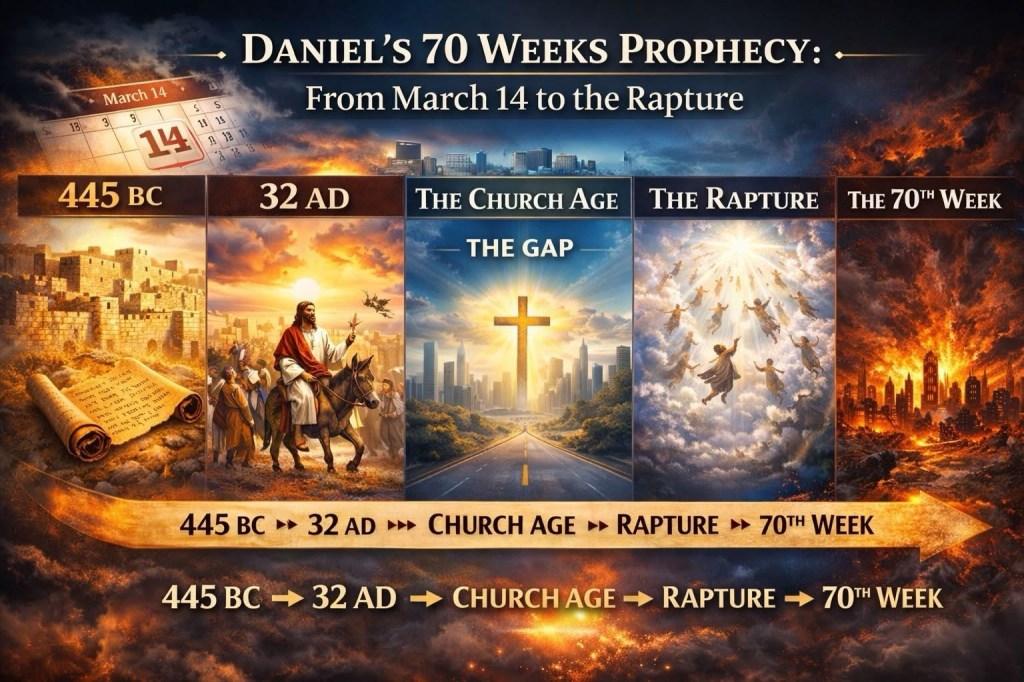
The Messianic kingdom was spoken in Psalm 2. Jesus Christ is the King of Zion, a fulfillment of Isaiah 9:6-7 and Isaiah 7:14 as declared in Matthew 1:22-23. The Bible never spoke of a gap in the prophetic fulfillment of God’s kingdom. The talk of a rapture is nonsense. With the coming of Jesus, the Messianic kingdom has begun. Paul, in Acts, declared the fulfillment of Psalm 2, “And we bring you the good news that what God promised to the fathers, this He has fulfilled to us, their children, by raising Jesus, as also it is written in the second Psalm, ‘You are My Son, today I have begotten You’” (Acts 13:32-33). The Messianic kingdom is God’s kingdom – the kingdom of heaven – as heralded by John the Baptist (Matthew 3:1-2) and announced by Jesus Christ to have arrived (Matthew 4:17; 12:28; Luke 11:20).
What is too hard to understand? It’s plain and simple. But contemporary Christianity resists the truth and insists on what they have been told and taught. Example of the lie below:
Taken from Tony Campbell
Now that another Middle East crisis is at hand, soothsayers once more are abound. But Jesus Christ alone is the true prophet of God, to whom we ought to listen. At the transfiguration of Jesus, God declared, “This is My beloved Son, with whom I am well pleased; listen to Him.” (Matthew 17:5)
Christians, let us not be alarmed by claims or teachings that supposedly the end of the world is coming. The Bible never spoke of the end of the world, but the end of the age. Jesus Christ taught about two ages only, the present age and the age to come, see Mark 10:29-30 and Luke 18:29-30. By “present age or in this age”, Jesus didn’t mean our time but the Old Covenant age – the period in which He came, lived, died, and resurrected, which consists of regulations, offerings, and animal sacrifices – see Hebrews 9:1-15. The Bible teaches that Christ Jesus has made it obsolete, with the passing of the Jewish temple (Hebrews 8:13). Making it impossible for the Mosaic regulations to be observed and practiced. The Bible declared Christ Jesus the mediator of the New Covenant (Hebrews 9:15; 12:24).
Paul, in Ephesians, expounded on the mystery of God about the church also teaches only two ages (Ephesians 1:21-22).
However, Jewish survivors of the A.D. 70 destruction of the temple continued in disbelief, so they came out with the Talmudic writings. Prominent on its declaration is a third rebuilding of the Jewish temple, which was nowhere taught in the Old or New Testament Scripture, but has been promoted by some Christians who hold dispensational theology. Beware of what you are learning, believing, and teaching. You might be disseminating falsehoods.
Study the Bible thoroughly with a clear mind, free from biases introduced by mainstream Christianity. Just a few decades after Jesus Christ’s resurrection, false gospels began spreading, prompting Paul to confront them by writing letters to various churches (Galatians 1:6-9; 2 Corinthians 11:1-4). Also, the writing of the gospels ensued— Matthew, Mark, Luke, and John. Today, it remains an issue even millennia later. The root cause seems to be Christianity’s tendency to rely on the writings of early church fathers, those of the Reformers, or modern scholars rather than the Bible itself.
Peter, in the words of Acts 3:6, declared, “I possess neither silver nor gold, but in the name of Jesus Christ, I offer you what I have.” Share this article freely, for you freely receive. Take note, underlines and highlights are clickable links for definitions or Bible references. Stay updated by heading to our about page and subscribe directly to receive notifications in your inbox. Blessing!
Recently, my wife and I took a bus trip to Baguio City. It’s a good idea to buy your tickets in advance because the ticket counters at the station can get really crowded. A lot of people end up standing in line, hoping to get a ticket and board the bus. These people are betting on chance passengers.
The apostle James says, “Your life is like a mist that vanishes quickly.” (Jas 4:14) Don’t take chances. Always bet on God’s word. Peter says, “As the Scriptures say, ‘People are like grass; their beauty is like a flower in the field. The grass withers and the flower fades. But the word of the Lord remains forever.’ That word is the Good News you heard.” (1Pet 1:24-25, NLT)
Matthew 9:9-13 tells us about the calling of Matthew, and cross-referencing it to Hosea 6:6 together with its biblical context, as quoted by Matthew (Matt 9:13).
The Jewish people of the Old Covenant and cohabiting people like the Samaritans, who lived during Jesus’ time, eagerly awaited the arrival of the Christ (John 1:41; 4:25; Luke 2:9-11). However, many of them missed their chance due to their arrogance, not ignorance. Isaiah 10:20-23; 65:1-17 and Daniel 12:4,7-9 prophesied the complete end or the time of the end for Old Covenant Israel. Jesus spoke of the temple’s final destruction (Matthew 23:37-38; 24:2; Luke 21:20-22), fulfilling Zechariah’s prophecy of the New heavenly Jerusalem (Zechariah 14), also described by John in Revelation 21-22. With the temple destroyed for the second and final time, the declaration in Hebrews 8:13, stating that the Old Covenant became obsolete, reached its climax. Old Covenant Israel relied on the Mosaic law rather than the grace offered through Christ Jesus, which caused them to miss their chance. (Galatians 3:10-11)
Consequently, God through Jesus Christ came to call on the lost, so He replied to the self-righteous Pharisees, who refused to mingle with outcasts, “Those who are well have no need of a physician, but those who are sick” (Matt 9:12). Of course, the context of Matthew 9:9-13 does not involve literally sickly people, but the outcasts and sinners.
Let me clarify that God does not love sinners; instead, He detests them. Consequently, we witnessed God’s punishment and destruction of all humanity in the Genesis 6-9 account of Noah’s flood, leaving only eight individuals alive. Scripture explicitly states that this was because Noah found grace in God’s sight (Genesis 6:8). Yes, the translated word “favor” in that verse in most modern Bible translations originates from the Hebrew word “grace.” This was because God was fulfilling His covenant to restore His creation that had fallen in Adam through Jesus Christ (Hosea 1:10-11; Romans 9:25-26; 11:1-2, 26-29; 1 Corinthians 15:22).
Matthew presents himself as the perfect example of the sick—spiritually, of course. He was a tax collector, which in the context of Old Covenant Israel made him a traitor, since he collected taxes from his own countrymen on behalf of their oppressor, Rome.
Matthew identified those dining with Jesus as tax collectors and sinners (Matthew 9:10). These individuals weren’t known for their blatant sins; rather, they belonged to the lost tribes of Israel, specifically the ten tribes of the Northern kingdom. God had denounced these ten tribes in Hosea 6:6-10. Consequently, they were referred to as sinners in Matthew 9:10 and the lost sheep of the house of Israel in Matthew 10:6. Ephraim was a reference to Israel, the ten northern tribes.
Like Adam, who was banished from the Garden of Eden for breaking God’s covenant—not to eat from the tree of knowledge of good and evil (Genesis 2:15-16; Genesis 3)—Israel, particularly the ten tribes of the Northern kingdom, was lost. God through Hosea declared, “But like Adam, they (i.e. Israel) transgressed the covenant; there they dealt faithlessly with Me.” (Hosea 6:7)
Jesus came to restore both Israel and Judah to God, and this truth extends to all humanity. The Bible states, “For as in Adam all die, so also in Christ shall all be made alive.” (1Co 15:22) Therefore, the Gospel of Jesus Christ is intended for everyone to hear and believe.
From God’s perspective, being “lost” signifies death. Jesus illustrated this concept in his parable of the prodigal son. The father exclaimed, “For this my son was dead, and is alive again; he was lost, and is found.” (Luke 15:24) Consequently, like Adam, Israel, or the ten northern tribes, they died covenantally or spiritually. As a result, anyone without Christ Jesus, the last Adam, would not possess eternal life, as mentioned in 1 Corinthians 15:45.
As evident in the opening chapter of Hosea, particularly Hosea 1:4-9, God’s judgment against Israel was consistently clear and reiterated throughout the book. However, in Hosea 2:14-23 and other passages like Hosea 6:1-2, God revealed His restoration through the resurrection of Christ on the third day. Can you comprehend the logical progression from death to resurrection? Adam’s death, which affected all humanity, was spiritual in nature, so the remedy is also spiritual, not physical. Jesus articulated this truth in John 2:18-22 and Matthew 16:18, and Paul reaffirmed it in Ephesians 1:20-23. Paul explained that this restoration would occur through the church, which is a spiritual awakening or renewal of people, just as Jesus had declared to the apostles in Matthew 16:17-18. Furthermore, 1 Peter 2:9-10 indicated that this restoration was already underway. (Incidentally, the correct translation for Matthew 16:18 should be “the gates of Hades,” referring to the place of death, rather than “hell.”)
In Hosea chapters 3 to 5, God revealed that Israel would continue to disobey Him. However, by His grace, God would call a remnant from Israel to salvation (Hosea 1:10-11; Romans 9-11), which Paul announced was already at work (Romans 9:1-8; 11:1-6, 25-27). Jesus Christ and His Gospel would be the instruments of God’s call (Romans 10:12-17).
As evident in the Gospel of Matthew, the dominant religious authorities—the Sanhedrin—comprising Sadducees and Pharisees—were mostly self-righteous and adhered to beliefs inconsistent with the Bible. Jesus Christ was primarily rejected because He taught according to the Word of God, not human traditions (Mark 7:1-7). Jesus addressed the unbelieving Jews, stating, “I know that you are descendants of Abraham; yet you seek to kill Me because My word has no place in you.” (John 8:37)
Christ’s Gospel and teachings were new to the people, causing resistance from the crowd. Consequently, Jesus stressed the significance of entering through the narrow gate, which leads to life, while the wide gate leads to destruction. He explained that the narrow gate is challenging to find and few enter, whereas many pass through the easy, wide gate (Matthew 7:13-14). Here, Jesus was comparing His teachings, which are the narrow gate, to the contemporary teachings of that era—the wide gate. Similarly, during the Reformation era initiated by Martin Luther, he was among a select few who believed and taught correctly from Scripture that salvation is achieved by grace, through faith, not of works. He emphasized that the righteous shall live by faith (Romans 1:16-17).
The same can be said today. Throughout the millennia, modern Christianity has embraced many teachings and beliefs that are not in accordance with the Bible. Hence, sound doctrine would be heard and believed by a minority; most would suspect it’s a heresy. As the saying goes, “Repeat a lie often, and it becomes the truth”. This was because modern Christianity has focused on the writings of the so-called “early church fathers,” particularly those from one or two centuries after the last apostle of Jesus Christ. Moreover, during the reign of Emperor Constantine, this trend worsened. The Reformation occurred during the 16th century, and yet, it also produced its own flaws. The Bible’s teaching wasn’t fully restored.
Many claim faith in Jesus but then revert to old routines, with little real change. They attend churches or online services but struggle to distinguish biblical passages or interpret them correctly. They rarely join Bible study groups. This indifference damages faith and stems mostly from discrepancies between church teachings and Scripture.
The Bible can be confusing. Many say, “I cannot understand Scripture,” and pastors’ explanations differ. These are common feelings among believers. Some, frustrated, become indifferent.
Matthew’s and the rest of the Gospels were written precisely because of distortions to the Gospel. Paul wrote Galatians before any of the gospels were written, and he states, “I am astonished that you are so quickly deserting Him (i.e. God) who called you in the grace of Christ and are turning to a different gospel—not that there is another one, but there are some who trouble you and want to distort the gospel of Christ.” (Gal 1:6-7)
Both Matthew and Mark were written around the same time as Paul’s letters to the Corinthians. In 2 Corinthians 11:3, Paul addresses the same issue he had mentioned in Galatians. He warns that, just as the serpent deceived Eve with his cunning, their thoughts could be led astray from a sincere and pure devotion to Christ. Then Paul went on to rebuke them, saying, “For if someone comes and proclaims another Jesus than the one we proclaimed, or if you receive a different spirit from the one you received, or if you accept a different gospel from the one you accepted, you put up with it readily enough.” (2 Corinthians 11:4)
Paul, in his letter to the Corinthian church, was battling heresy. False teachings can be detrimental to one’s salvation. See Paul’s words to Timothy: “Keep a close watch on yourself and on the teaching. Persist in this, for by so doing you will save both yourself and your hearers” (1Ti 4:16). Hence, Paul told Christians in Corinth: “Do not be deceived: ‘Bad company ruins good morals’” (1Co 15:33).
We have seen in history how Christianity has been waged through swords. Examples would be the time of the Christian Crusaders. Today, it’s being done in the West, favoring Israel over any of its enemies. This was mainly due to the beliefs and teachings of Christian Zionism and Dispensationalism. The latter is the prevailing belief and teaching of most churches today. It is erroneous and inaccurate.Paul declared in Galatians, “And if you are Christ’s, then you are Abraham’s offspring, heirs according to promise” (Galatians 3:29). Old Covenant Israel missed its chance. Only a remnant of them were saved. They bet on the wrong ticket, the ride came, and they missed it. Jesus is the only ticket to salvation.
Though Israel ceased to be the chosen people of God (Matt 21:33-45), God’s wrath against the generation that crucified Jesus Christ had already been fulfilled; the temple destroyed (Matt 23:32-38). Nevertheless, the Bible declares, “For God’s anger is but for a moment, and His favor is for a lifetime” (Psalm 30:4-5). God’s word is always true. His anger and vengeance against Old Covenant Israel were fulfilled with the second and final destruction of the Jewish Temple. However, God’s grace is eternal, so there remains hope for modern-day Israel. Like everyone else, they must hear and believe the Gospel of Christ Jesus (Rev 14:6).
The Bible alone is infallible, while everything else can be erroneous and proven inaccurate when examined in light of the Scriptures. (WCF 1.4; 31.4)
Matthew’s Gospel leads us to Christ Jesus. He quoted Old Testament Scriptures to confirm that Jesus is indeed the Christ. We have four Gospels in our Bible and numerous letters from the apostles of Jesus Christ. Why rely on uninspired secondhand sources instead of the Word of God? Let’s seize the opportunity to become Christ’s disciples, learning and teaching solely from His Word (John 8:31-32). Paul exemplified this principle, stating, “Now, brothers and sisters, I have applied these things to myself and Apollos for your benefit, so that you may learn from us the meaning of the saying, ‘Do not go beyond what is written.’ Then you will not be puffed up in being a follower of one of us over against the other.’” (1 Corinthians 4:6, NIV)
Christ Jesus came and inaugurated the New Creation. Paul states, “Therefore, if anyone is in Christ, he is a new creation. The old has passed away; behold, the new has come.” (2 Corinthians 5:17) Hebrews declared that the Old Covenant became obsolete (Hebrews 8:13). Jesus Christ ushered in the age of grace, with the Gospel at its core. People must hear and believe the Gospel. It is an eternal gospel (Revelation 14:6); therefore, it is everlasting, contrary to the claims of many.
Most of the religious leaders during the time of Jesus, Paul, and the rest of the apostles insisted on their prevailing beliefs, and they missed their chance. As the saying goes, “If we have not learned from history, then we are bound to repeat its mistakes.” Missing our chance is a crucial mistake. It will cost us eternity like anyone else who rejected, mingled, muddled, and watered down God’s Word.
Matthew and the rest of the apostles, except for Judas, adhered to God’s word. Comparing Scriptures with Scriptures, they were saved by grace. Let’s not miss the chance and learn from the Bible.
So, who are you? Are you a Pharisee or an outcast, like Matthew? Christ Jesus doesn’t care about our past. The Gospel call is for everyone, but only those who recognize Christ and His Gospel would benefit from the message. That’s the lesson in Matthew 9:9-13. However, after we’ve trusted Jesus Christ, we should be different from our past lives. Paul said, “Follow me, as I follow Christ (1 Co 11:1).” Therefore, follow pastors or teachers of the Bible only if they are truly following Jesus Christ. Be a Berean, as the Bible states, “They received the word with all eagerness, examining the Scriptures daily to see if these things were so.” (Acts 17:11) Don’t be content with listening; study the Bible on your own and ask questions if needed. Then compare the answers with the Word of God and verify if they’re consistent with the Scriptures.
We have only one chance in our lifetime to bet on Christ Jesus. Don’t miss this chance.
Peter, in the words of Acts 3:6, declared, “I possess neither silver nor gold, but in the name of Jesus Christ, I offer you what I have.” Share this article freely, for you freely receive. Take note, underlines and highlights are clickable links for definitions or Bible references. Stay updated by heading to our about page and subscribe directly to receive notifications in your inbox. Blessing!
Inspired by the teachings of Jesus, we must prioritize reaching out to those who are lost rather than getting distracted by the many. If you understand the parable of the lost sheep (Luke 15:1-7), you’ll see my point.
In Luke 15:1-7, it is important to correctly identify the characters in the story. The religious leaders criticized Jesus for associating with tax collectors and sinners. In the context of Luke, the term “sinners” does not literally refer to lawbreakers; rather, it pertains to Galileans, specifically the ten lost tribes of Israel (as mentioned in Luke 13:1-2).
To illustrate this point, let’s consider the third parable in Luke 15, which specifically addresses the Pharisees. The Pharisees are depicted by the self-righteous elder son in the parable of the “Two Sons” (Luke 15:11-32). The ten lost tribes, on the other hand, are represented by the lost son, who in the parable was warmly welcomed back by his father after seeking forgiveness from both God and his father (Luke 15:21). Additionally, Jesus, when sending out His disciples, instructed them to go nowhere among the Gentiles or enter any town of the Samaritans, but rather to seek out only the lost sheep of the house of Israel (Matthew 10:5-6).
So similarly, in Luke 15:1-7, the ninety-nine sheep in the open country symbolize the Pharisees and the two tribes of Israel—Judah and Benjamin—that remained in covenant with God after Solomon’s kingdom was divided, as noted in 1 Kings 12:21-24. Moreover, it’s important to mention that only those from the tribes of Judah and Benjamin were involved in the first rebuilding of the temple (Ezra 1:5, 4:1). The one lost sheep represents the ten lost tribes of Israel, whom the Pharisees regarded as sinners. This is reminiscent of Hosea 11:12, which states, “Ephraim has surrounded Me [God] with lies, and the house of Israel with deceit, but Judah still walks with God and is faithful to the Holy One.” Additionally, tax collectors, viewed as traitors by the Jews for collecting taxes on behalf of Rome, are also classified among these so-called sinners.
Ephraim became the leading tribe of the northern kingdom (Joshua 17:15; Judges 3:27), and the capital, Samaria, was located in Ephraim’s territory. In fact, Scripture sometimes refers to Israel as simply “Ephraim,” due to the size of the tribe (e.g., Isaiah 11:13 and Jeremiah 31:6). – Excerpt from GotQuestions.Org.
Consequently, always let Scripture be our guide in matters of the church. Before leading someone to Christ Jesus, it’s crucial to acknowledge the current state of the church. Our predicament arises from the fact that Christians primarily relied on writings from early church fathers rather than Scripture. When we examine the history of the church, we tend to focus on the Reformation period and beyond. Instead of the Book of Acts, which chronicles the birth of the church, we concentrate on human writings. In essence, as long as Christians continue to study human writings, the doctrines of Jesus Christ will remain elusive and subject to ongoing debates.
Considering the various requirements, practices, and regulations in modern Christianity, one could argue that the church resembles the Sanhedrin of Jesus’ time. The Jewish religious authorities had traditions and customs that often diverged from God’s Word. In Mark 7:1-13, Christ makes a crucial point when He says, “You leave the commandment of God and hold to the tradition of men” (Mark 7:8). It’s no surprise that today, churches engage in debates about issues like the method of water baptism, forms of church governance, and other practices that are not clearly outlined in Scripture.
However, we know that repentance is explicitly a prerequisite for baptism. This raises an important question: Why is there so much controversy surrounding infant baptism? Can an infant genuinely repent before being baptized? I think it’s possible that the Reformation’s doctrine of infant baptism was just a response to the Roman Catholic practice of baptism of infants or children. These questions reflect the troubling state of modern Christianity.
A call to return to the traditions of the Reformation does not necessarily lead to a genuine return to the roots of Christianity. Instead, a true effort to revisit the traditions of the early Church should focus on the teachings found in the Book of Acts. This represents the real essence of “Scripture alone.” Unfortunately, this essence has been obscured by interpretations that incorporate the traditions, practices, and opinions of the early Church fathers. Although proponents may deny it, this approach effectively equates the Bible with the teachings of the Church fathers.
Moving forward, instead of focusing on reconstructing the current state of the church, let’s begin anew. Many have attempted a second Reformation, but it’s time to start from the beginning. Instead of relying solely on human-created discipleship materials, we should prioritize studying the Bible deeply. The principles of discipleship are clearly outlined in the Gospels by Christ Jesus, Acts, and letters attributed to the immediate apostles of our Risen Lord.
It is essential to first learn how to properly interpret Scripture. Remember, God is the true author of each book of the Bible, which means there can only be one correct interpretation of Scripture. It is irresponsible to second-guess the Bible. Our duty is to study and learn so that we can effectively teach the Bible.
You don’t need to study in seminary to learn how to interpret Scripture properly; this can be done through our online Bible study sessions. However, I wonder how many people are truly interested.
Nevertheless, for those who yearn to learn, find your way. With a will, there’s always a way. It’s not about not understanding Scripture, it’s about indifference.
Many years ago, while I was still contemplating entering seminary training, these passages in Scripture guided my decision-making. The Bible said, “And though the Lord give you the bread of adversity and the water of affliction, yet your Teacher will not hide Himself anymore, but your eyes shall see your Teacher. And your ears shall hear a word behind you, saying, ‘This is the way, walk in it,’ when you turn to the right or when you turn to the left.” (Isaiah 30:20-21) There is no other way to the truth except by the Word of Jesus Christ, our Teacher.
Lastly, as I mentioned earlier, it’s important to start fresh. Focus on reaching out to those who are not already part of conventional Christianity. Take inspiration from the Bible, specifically Acts 18:5-6, which states, “When Silas and Timothy arrived from Macedonia, Paul was occupied with the word, testifying to the Jews that the Christ was Jesus. When they opposed and reviled him, he shook out his garments and said to them, ‘Your blood be on your own heads! I am innocent. From now on, I will go to the Gentiles.’”
It can be challenging to change deeply ingrained habits or beliefs. Just as some faced risks in the synagogues (as noted in John 9:18-23), many who are entrenched in conventional beliefs may resist new ideas. Therefore, it’s crucial to share the Gospel with those outside of conventional Christianity. Once they have discovered the truth, it will be difficult for anyone to convince them otherwise.
However, do not completely disregard those who are part of conventional Christianity but are genuinely seeking the truth. Individuals with a sincere passion for the Bible will respect the Scriptures and be open to learning. They just need proper guidance along the way.
The church’s mandate is not to develop methods that make the Gospel more appealing to the majority. Instead, our responsibility is to teach the truths of the Bible, regardless of the consequences. We do not serve Jesus Christ while seeking the approval of our peers. Rather, we are called to be faithful to the Chief Shepherd of God’s flock (1 Peter 5:4; Matthew 24:31-46). Unfortunately, when it comes to the matter of Christ’s return, many churches have become like the “boy who cried wolf.” If you understand what I mean, bless you!
Peter, in the words of Acts 3:6, declared, “I possess neither silver nor gold, but in the name of Jesus Christ, I offer you what I have.” Share this article freely, for you freely receive. Take note, underlines and highlights are clickable links for definitions or Bible references. Stay updated by heading to our about page and subscribe directly to receive notifications in your inbox. Blessing!
Westminster Confession of Faith, chapter 26, section 2 states that “saints, by profession, are obligated to maintain a holy fellowship and communion in worshiping God and performing other spiritual services that contribute to their mutual edification. They are also encouraged to assist each other in practical matters, according to their abilities and needs. This communion, as God provides the opportunity, should be extended to all who call upon the name of the Lord Jesus, regardless of location.” (For reference, click on this link: WCF 26.2, search the table of contents, then go to chapter 26, section 2, and look also for the annotation to Hebrews 10:24-25.)
The doctrine presented here is not exclusive to Reformed Christians. Many Christians and preachers have misinterpreted and wrongly applied the text in Scripture, believing that Hebrews 10:24-25 emphasizes the significance of Christian gatherings, particularly Sunday gatherings. However, this is not the intended teaching of Hebrews 10:24-25. Let’s read the passage here: “And let us consider how to encourage one another to love and good works, not neglecting to meet together, as some do, but rather encouraging one another, especially as the Day approaches.”
The phrase “meet together” (Greek: episunagōgē, G1997) appears only twice in the New Testament. It specifically refers to the gathering that will occur upon the return of Christ Jesus. The other instance is found in 2 Thessalonians 2:1, where Paul states, “Now concerning the coming of our Lord Jesus Christ and our being gathered together—which is the same in Greek as ‘meet together’ in Hebrews 10:25—to him, we ask you, brothers.” Here, Paul urges Christians of his day to recognize the truth that Christ’s return is imminent within their generation. Note that Hebrews 10:25 emphasizes, “especially as you see the Day—i.e., the Day of gathering together—approaching or drawing near.”
The term “Day” in verse 25 specifically refers to the Day of the Lord, as evidenced by various biblical passages such as Acts 2:20, 1 Corinthians 5:5, 1 Thessalonians 5:2, 2 Thessalonians 2:2, and 2 Peter 3:10. Contrary to popular belief, it does not denote Sunday but rather Christ’s Day of Judgment, more commonly known as the Second Coming of Jesus, and the gathering of the church to be with Him(refer to 1 Thessalonians 4:16-17).
Another misinterpretation arises from the Lord’s Day mentioned in Revelation 1:10. The context of Revelation 1:10 reveals that John was already enduring tribulation (Revelation 1:9). This aligns with Christ’s prophecy regarding the tribulation of His apostles, which ultimately resulted in the destruction of the Jerusalem temple, as described in Matthew 24:9-15.
“Then they will deliver you (i.e. the apostles) up to tribulation and put you to death, and you will be hated by all nations for My name’s sake. And then many will fall away and betray one another and hate one another. And many false prophets will arise and lead many astray. And because lawlessness will be increased, the love of many will grow cold. But the one who endures to the end will be saved. And this gospel of the kingdom will be proclaimed throughout the whole world as a testimony to all nations, and then the end will come. ‘So when you see the abomination of desolation spoken of by the prophet Daniel, standing in the holy place (let the reader understand), then let those who are in Judea flee to the mountains.’” (Matthew 24:9-16)
If you’re uncertain whether Jesus in Matthew 24:15 was referring to the destruction of the Jewish temple, consider Luke 21:20-22, which provides a clear and direct statement that it pertains to the destruction of Jerusalem.
“But when you see Jerusalem surrounded by armies, then know that its desolation has come near. Then let those who are in Judea flee to the mountains, and let those who are inside the city depart, and let not those who are out in the country enter it, for these are days of vengeance, to fulfill all that is written.” (Luke 21:20-22)
The Lord’s Day of Revelation, therefore, is not a reference to a Sunday, as supposed by Christian traditions, but a reference to the Day of the Lord, Christ’s day of judgment. Further evidence may be seen in Revelation 1:19. John was told, “Write therefore the things that you have seen, those that are and those that are to take place after this.” (Revelation 1:19) Take note that the things that John has seen were as follows: “those that are” and “those that are to take place after this”.
Revelation 2-3 addresses “those that are,” referring to the spiritual states of the existing churches in Asia Minor at the time of John’s writing. These churches are listed as Ephesus, Smyrna, Pergamum, Thyatira, Sardis, Philadelphia, and Laodicea. (Revelation 1:11) Christ’s deliberate selection of the seven churches in Asia Minor was based on the symbolic number “seven,” which signifies completeness, as in God’s creation was completed on the Seventh day. Therefore, His commendations and rebukes apply to all churches, urging them to conduct self-assessment and improvement in preparation for His imminent arrival. So, to each church, Jesus states, “He who has an ear, let him hear.”
To Ephesus, Christ admonished, “He who has an ear, let him hear what the Spirit says to the churches. To the one who conquers I will grant to eat of the tree of life, which is in the paradise of God.” (Revelation 2:7) The “tree of life” was mentioned as well towards the end of Revelation, when all things have been made new (Revelation 21:5); see Revelation 22:2 and 22:14.
To Smyrna, Christ’s commendation, “He who has an ear, let him hear what the Spirit says to the churches. The one who conquers will not be hurt by the second death.” (Revelation 2:11) The “second death” was mentioned in Revelation 20:6; 20:14, both of which have to do with the time of judgment. Revelation 21:8 states, the cowardly, the faithless, etc., have no place in the New Jerusalem, but of the lake of fire, which is the second death.
To Pergamum, Christ’s admonished, “He who has an ear, let him hear what the Spirit says to the churches. To the one who conquers, I will give some of the hidden manna, and I will give him a white stone, inscribed with a new name that no one except the one who receives it knows.” (Revelation 2:17) The “hidden manna” and “a new name” refer to Christ Jesus, the Bread of life (John 6:48-58), and the Word of God (Revelation 19:11-13).
To Thyatira, Christ admonished, “Hold fast to what you have until I come. The one who conquers and preserves my works until the end will receive authority over the nations. He will rule them with a rod of iron, just as when earthen pots are broken into pieces. Even so, I have received authority from my Father. I will also give him the morning star. Those who have ears, let them hear what the Spirit says to the churches.” (Revelation 2:25-29) Christ is the one who rules with a rod of iron. He is the King of kings and Lord of lords. (Revelation 19:13-16) This fulfills Christ’s declaration in Matthew 8:11, “I tell you, many will come from the east and west and will recline at the table with Abraham, Isaac, and Jacob in the kingdom of heaven.” (See also Psalms 2:7-9) This is about the Messianic Reign of Jesus Christ.
To Sardis, Christ warned, “The one who conquers will be clothed in white garments, and I will never erase his name from the book of life. I will proclaim his name before my Father and before his angels. Those who have ears, let them hear what the Spirit says to the churches.” (Revelation 3:5-6) The “white garment” mentioned here is the same as the “white robe” described in Revelation 6:11. It was bestowed upon Christian martyrs and symbolizes the wedding garment of those invited to the Messianic wedding feast of the King’s Son and His Bride. (Matthew 22:11-12 and Revelation 21:2) The “Book of Life” mentioned in Revelation 13:8; 17:8; 20:12; 20:15; 21:27; 22:19; and Philippians 4:3 refers to those who have been marked for redemption by Christ Jesus.
To Philadelphia, Christ’s commendation reads, “I am coming soon. Hold fast what you have, so that no one may seize your crown. The one who conquers, I will make him a pillar in the temple of My God. Never shall he leave it, and I will write on him the name of My God, the name of the city of My God, the new Jerusalem, which comes down from My God out of heaven, and My own new name. He who has an ear, let him hear what the Spirit says to the churches.” (Revelation 3:11-13) This passage is about the “new heaven and the new earth”, the Bride adorned for Her Husband, the holy city and the New Jerusalem (Revelation 21:1-2), and the Lord God Almighty and the Lamb (Revelation 21:22).
To Laodicea, Christ addressed, saying, “Behold, I stand at the door and knock. If anyone hears my voice and opens the door, I will come in to him and eat with him, and he with me. The one who conquers, I will grant him the privilege of sitting with Me on My throne, just as I also conquered and took My seat with My Father on His throne. Those who have an ear, let them heed what the Spirit says to the churches.” (Revelation 3:20-22) This message is essentially the same as Christ’s words to Thyatira, emphasizing the Messianic Reign of Jesus Christ.
Another significant aspect we should have noticed is that Christ spoke to each churches in Messianic languages, such as “tree of life,” “second death,” “hidden manna and white stone,” “rule with a rod of iron,” “white garments,” “book of life,” “I am coming soon,” “the new Jerusalem,” and “I will grant him to sit with Me on My throne, as I conquered and sat down with My Father on His throne.” These all refer to the time of judgment and deliverance.
Finally, the statement “those that are to take place after this”, covers Revelation 4-22. In Revelation 4:1, John heard and he wrote, “Come up here, and I will show you what must take place after this.” Towards the end of Revelation, Jesus states, first, “And behold, I am coming soon. Blessed is the one who keeps the words of the prophecy of this book.” (Revelation 22:7) Then, again, “Behold, I am coming soon, bringing My recompense with Me, to repay each one for what he has done. I am the Alpha and the Omega, the first and the last, the beginning and the end.” (Revelation 22:12-13) In other words, twice, Christ Jesus mentioned His return.
Without a doubt, therefore, “the Lord’s Day” mentioned in Revelation 1:10 is not merely a reference to a Sunday. John was witnessing the events of the “Day of the Lord,” the day of Christ’s judgment. Consequently, Revelation begins with the declaration “Behold, Jesus is coming with the clouds” and concludes with Christ’s declaring twice, “Behold, I am coming soon” (Revelation 22:7, 12). Furthermore, the opening statements of Revelation are crystal clear.
“The revelation of Jesus Christ, which God gave Him to show to His servants the things that must soon take place. He made it known by sending His angel to His servant John, who bore witness to the word of God and to the testimony of Jesus Christ, even to all that he saw. Blessed is the one who reads aloud the words of this prophecy, and blessed are those who hear, and who keep what is written in it, for the time is near.” (Revelation 1:1-3)
Consequently, Hebrews 10:25 cautioned Christians against neglecting the imminent arrival of Jesus Christ and the gathering with Him. This warning was raised by Paul in 2 Thessalonians 2:1-2, decades before the writing of Hebrews. It stemmed from the claims that “the Day of the Lord” had come even while the temple was still standing. If true, it would imply that Old Covenant Israel had been restored and spared from God’s judgment. However, this contradicts Christ’s declaration in Matthew 24, where He explained that the end of the Old Covenant Israel would be evident when the temple was desecrated. Moreover, in Matthew 24, following Christ’s repeated declaration of the temple’s desolation (Matthew 24:2; Matthew 23:37-38), the disciples understood Christ’s words and asked, “Tell us, when will these things be, and what will be the sign of your coming and the end of the age?” (Matthew 24:3). Christ then recounted the events leading up to His coming and the conclusion of the Old Covenant era. See Luke 21:20-28, Jesus Christ states:
“But when you see Jerusalem surrounded by armies, then know that its desolation has come near. Then let those who are in Judea flee to the mountains, and let those who are inside the city depart, and let not those who are out in the country enter it, for these are days of vengeance, to fulfill all that is written. Alas for women who are pregnant and for those who are nursing infants in those days! For there will be great distress upon the earth and wrath against this people. They will fall by the edge of the sword and be led captive among all nations, and Jerusalem will be trampled underfoot by the Gentiles, until the times of the Gentiles are fulfilled. ‘And there will be signs in sun and moon and stars, and on the earth distress of nations in perplexity because of the roaring of the sea and the waves, people fainting with fear and with foreboding of what is coming on the world. For the powers of the heavens will be shaken. And then they will see the Son of Man coming in a cloud with power and great glory. Now when these things begin to take place, straighten up and raise your heads, because your redemption is drawing near.’” (Luke 21:20-28)
Clearly, as stated by Christ Jesus, salvation in its completed state and His Second Coming are not two separate fulfillments, as many Christians believe, but are intertwined together. This is also evident in Hebrews 9:28, which states, “so also Christ, having been offered once to bear the sins of many, will appear a second time, not to bear sin, but to bring salvation to those who are waiting for Him.” (Hebrews 9:28)
Hence, there isn’t a major doctrine—salvation—and the latter a minor one, eschatology— Christ’s Second Coming— after all. Redemption, which means “to be set free for a ransom”, is synonymous with salvation. It means we are no longer in bondage to death, but have eternal life. Consequently, Paul declared, “For our sake, God made Jesus to be sin who knew no sin, so that in Him we might become the righteousness of God.” (2 Corinthians 5:21)
Again, Paul states, “For there is one God, and there is one mediator between God and men, the man Christ Jesus, who gave Himself as a ransom for all, which is the testimony given at the proper time.” (1 Timothy 2:5-6)
Ironically, Hebrews 10:25 has been misinterpreted to refer solely to a Sunday gathering of Christians. However, it goes beyond a Sunday observance and specifically refers to the “Day of the Lord,” as mentioned in Revelation 1:10. There is indeed a pressing need to unlearn outdated traditions and rediscover the teachings of Scripture. I implore God-fearing Christians, those who hold the Word of God in high regard, to make concerted efforts to restore authentic Christian teachings. Christ Jesus is truly honored when we uphold the truths of His Word.
P.S. Sunday holds no significance in the Scriptures. It was introduced only during the reign of Emperor Constantine, a follower of “Sol Invictus,” the sun god. Below is a Youtube documentary that delves into Constantine’s beliefs.
The notion that Jesus resurrected on a Sunday contradicts the Scriptures. The phrase “first day of the week” mentioned in Matthew 28:1, Mark 16:2, Luke 24:1, John 20:1, 19, Acts 20:7, and 1 Corinthians 16:2, was a modern translation from “one Sabbath” in Greek, which refers to a regular Sabbath day in a week, distinct from the high or special Sabbath, the 15th of Nissan, during the annual Leviticus 23 festal week of the Passover.
Which Sabbath was God referring to? During the Passover week, there were two Sabbaths: a regular Sabbath and a special Sabbath. The instruction was to wave the offerings on the day after the special Sabbath, which means it’s the regular Sabbath of the week. How do we know it should be a regular Sabbath and not just any day after the 15th of Nisan? The 15th of Nisan can be any day of the week as long as it falls on that day.
If it’s not a regular Sabbath, the next festival, Leviticus 23:16, would not align with God’s instruction. Scripture states, “You shall count seven full weeks from the day after the Sabbath, starting from the day you brought the sheaf of the wave offering (i.e. the feast of firstfruits, the resurrection day of Jesus). Then, count fifty days until the day after the seventh Sabbath. On that day, present a grain offering of new grain to the LORD.” (Leviticus 23:15-16) Next, “The priest shall wave them with the bread of the firstfruits as a wave offering before the LORD, along with the two lambs. They shall be holy to the LORD for the priest. On the same day, proclaim a holy convocation. Hold a holy assembly and refrain from any ordinary work. This is a statute that shall remain in all your dwelling places throughout your generations.” (Leviticus 23:20-21)
Clearly, except for the special Sabbath on the 15th of Nissan, which was also the beginning of the Feast of Unleavened Bread (Leviticus 23:7-8), all regular Sabbaths during the festival week were referred to as the day for holy convocation. As mentioned in Leviticus 23:2-4, no work should be done on this day. So Christ resurrected on a regular Sabbath, and counting seven full weeks onto the 50th day brings us to Pentecost. Yes, the day of Pentecost is always a Sabbath. All Sabbath, including the special Sabbath (15th of Nisan), were regulated by God, that no work should be done. This explains why the Jews rejected Christ because He performed His signs (healing or miracles) on a Sabbath. However, Jesus responded, “For the Son of Man is lord of the Sabbath.”” (Matthew 12:8)
On a parallel account to Matthew 12’s story, Mark added, “And Jesus said to the Pharisees, ‘The Sabbath was made for man, not man for the Sabbath. So the Son of Man is lord even of the Sabbath.’” (Mark 2:27-28) Jesus points out that He was the One who commands the Sabbath regulation. Hence, being Lord of the Sabbath, He is not subordinate to its regulations. Consequently, in Matthew’s account on the same story, Jesus declared, “I tell you, something greater than the temple is here.” (Matthew 12:6)
It’s worth noting that in 321 A.D., Constantine issued an edict declaring that on the revered day of the Sun, magistrates and city dwellers should rest, and all workshops should be closed. (Codex Justinianus lib. 3, tit. 12, 3; trans. in Philip Schaff, History of the Christian Church, Vol. 3, p. 380, note 1)1. Many Christians believed that this edict by Constantine played a significant role in the adoption of Sunday as the official day of worship for Christianity during that era. If this is true, could these traditions that have been passed down through the millennia have influenced the translation of “one Sabbath” from Greek to “First Day of the week,” which is commonly understood as Sunday? Consequently, the resurrection of Jesus was believed to have occurred on a Sunday.
The YouTube video below refutes the belief that Constantine was genuinely converted to Christianity. It presents evidence that Constantine continued to worship Sol Invictus, the Roman Sun God. If this is the case, Christianity under Constantine was likely legalized for convenience or as a political maneuver. Therefore, while Christianity under Constantine appeared to be advancing, it was also compromised.
Peter, in the words of Acts 3:6, declared, “I possess neither silver nor gold, but in the name of Jesus Christ, I offer you what I have.” Share freely, for you freely receive. Take note, click on underlines and highlights for definitions or Bible references. Stay updated by heading to our about page and subscribe directly to receive notifications in your inbox. Blessing!