Vine’s New Testament Dictionary defines “pastor” in Greek as poimen (G4166), meaning a shepherd, one who tends herds or flocks. This term appears 18 times in the New Testament: 13 times referring to Jesus Christ, 4 times to literal shepherds at His birth, and once to pastors in Ephesians 4:11.
In 1 Peter 2:25, the Bible states: “For you were straying like sheep, but have now returned to the Shepherd and Overseer of your souls.” Here, Jesus is both the Shepherd (poimen, G4166) and Overseer (episkopos, G1985), often translated as bishop or elder. This raises the question: is there a difference between “pastor” and “bishop”?
1 Peter 5:1-4 provides insight:
“So I exhort the elders among you, as a fellow elder … shepherd the flock of God that is among you, exercising oversight…” This shows that elders (presbuteros, G4245) are called to shepherd (poimainō, G4165) and oversee (episkopeō, G1983). Verse 5 clarifies that presbuteros refers to seasoned believers, not necessarily overseers or bishops (episkopos, G1985). In the New Testament, episkopos appears five times (1Ti 3:2; Tit 1:7; 1Pe 2:25; Php 1:1; Act 20:28), generally in reference to church leaders.
Apart from 1 Peter 2:25, where Jesus is the Overseer of our souls, the other occurrences refer to Christian leaders tasked to care for God’s flock: “Pay careful attention to yourselves and to all the flock, in which the Holy Spirit has made you overseers…” (Acts 20:28). This suggests that pastors and bishops or overseers function as under-shepherds of Christ, sharing in His ministry of guidance and care.
Paul, in Ephesians 4:11-16, identifies the pastoral office alongside apostles, prophets, evangelists, and teachers, tasked “to equip Christians for the work of ministry, for building up the body of Christ.” Biblically, a pastor is called and gifted to unify and ground believers in truth, protecting them from false teachings.
True Christian unity resides in the doctrines of the Bible, not on trivial matters. That’s exactly Paul’s assertion in Ephesians 4, “There is one body and one Spirit—just as you were called to the one hope that belongs to your call—one Lord, one faith, one baptism, one God and Father of all, who is over all and through all and in all.” (Eph 4:4-6) Apostles, prophets, pastors, teachers, and evangelists are called and appointed by Jesus Christ precisely to keep the unity of the faith. (Eph 4:1-16)
Jesus Himself taught discernment in Matthew 7:13-29, warning against false prophets and emphasizing fruit as the evidence of true ministry. Not all who claim His name are known by Him, highlighting the weight of pastoral responsibility.
Not all seminary graduates are necessarily pastors in the biblical sense. Many may be better recognized as elders (presbuteros, G4245), faithful and seasoned in the faith but not specifically called to teach. The same may be said of many elders in churches today. Faithful to God, but not necessarily equipped to teach. Paul’s instruction in 1 Timothy 5:17 reflects this distinction: “Let the elders who rule well be considered worthy of double honor, especially those who labor in preaching and teaching.”
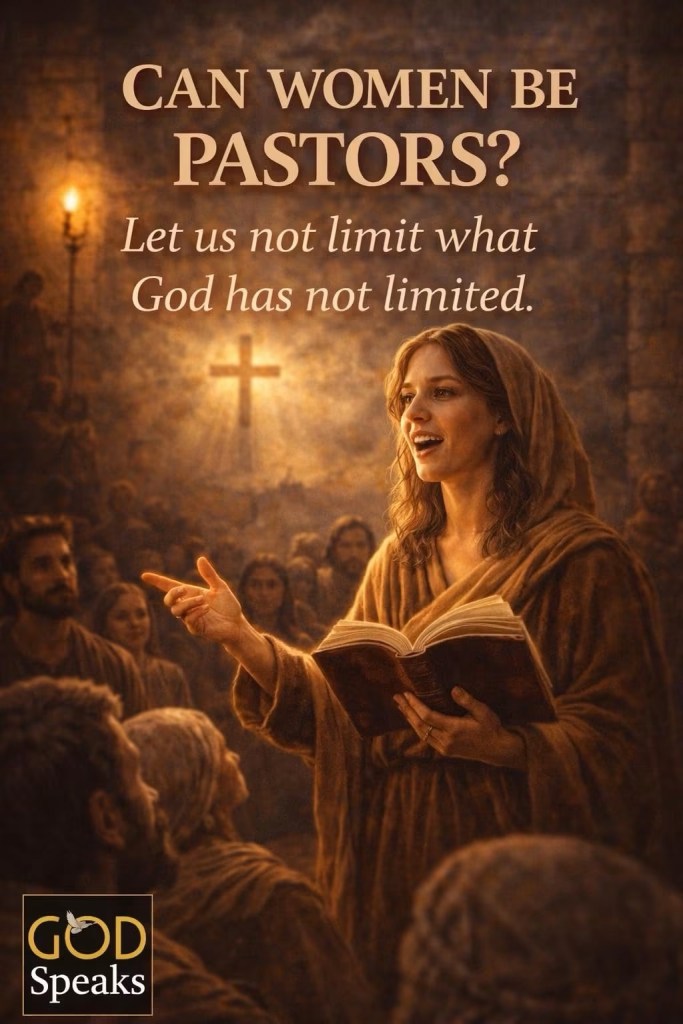
The attached photo caption reads, “Can women be pastors? Let us not limit what God has not limited.” It’s a captivating phrase, but we should also remember that we shouldn’t attribute to anyone what God hasn’t given.
Discussions about whether women can be pastors should also consider the biblical framework in discussion. Women like Priscilla faithfully taught and explained the gospel (Acts 18:24-26), yet Scripture does not title her as a pastor. Respect and honor are due to all Christian leaders and faithful women, as Paul reminds in 1 Timothy 5:19-20 and Philippians 4:2-3.
Hebrews 13:7,17 exhorts believers to remember, imitate, obey, and support leaders who watch over their souls, for they will give an account to God.
Ultimately, earthly titles mean little if Christ Himself does not commend our labor. There’s vanity in human titles. Let our aim be His approval as we work in His vineyard.
Peter, in the words of Acts 3:6, declared, “I possess neither silver nor gold, but in the name of Jesus Christ, I offer you what I have.” Share this article freely, for you freely receive. Take note, underlines and highlights are clickable links for definitions or Bible references. Stay updated by heading to our about page and subscribe directly to receive notifications in your inbox. Blessings!

