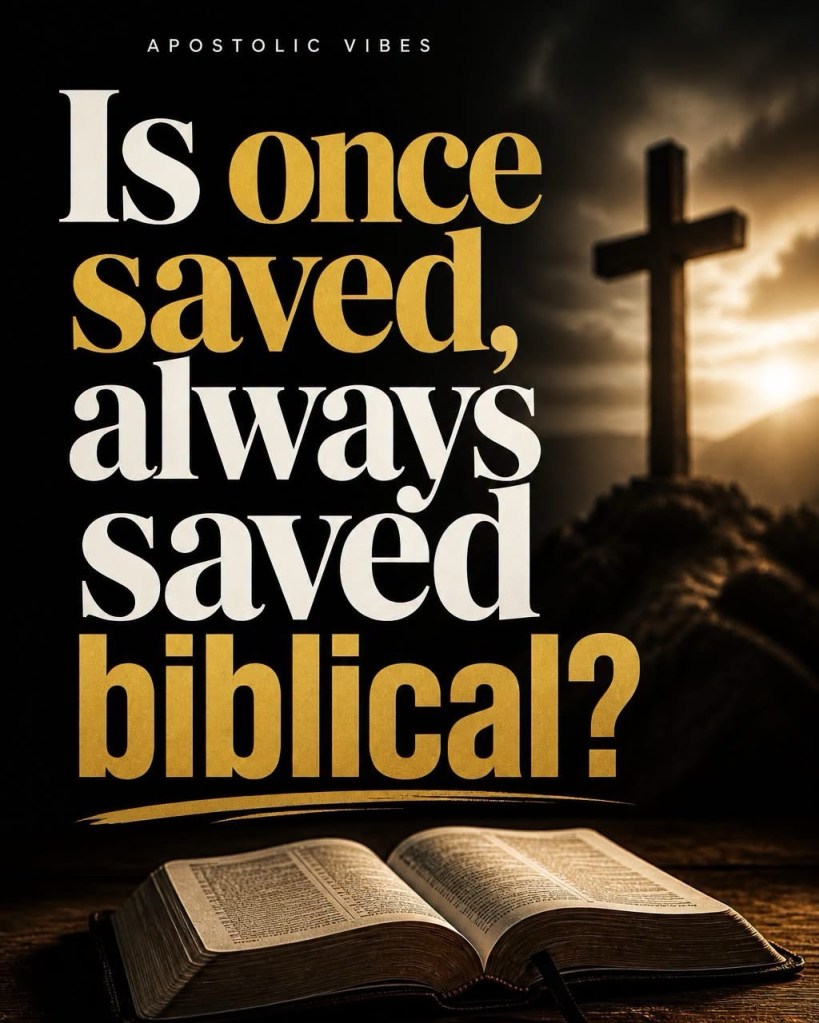
The idea of “once saved, always saved” stems from misinterpretations of selected Bible verses by some Christians. These passages seem to imply that God predestines certain individuals for salvation. Yet, a closer and more comprehensive reading of Scripture shows that this belief is inaccurate. The Bible does not universally call all believers the elect; rather, it speaks to a specific generation—the Jews who lived during Jesus’ ministry, the generation that rejected Him and contributed to His crucifixion.
Paul clarified this in Romans 11:1-6, where he spoke of a “remnant chosen by grace”:
> “I ask, then, has God rejected His people? By no means! For I myself am an Israelite, a descendant of Abraham, a member of the tribe of Benjamin. God has not rejected His people whom He foreknew. Do you not know what the Scripture says of Elijah, how he appeals to God against Israel? ‘Lord, they have killed Your prophets, they have demolished Your altars, and I alone am left, and they seek my life.’ But what is God’s reply to him? ‘I have kept for Myself seven thousand men who have not bowed the knee to Baal.’ So too at the present time there is a remnant, chosen by grace. But if it is by grace, it is no longer on the basis of works; otherwise grace would no longer be grace.”
Jesus expressed the same principle in several passages:
John 6:38-40 – “For I have come down from heaven, not to do My own will but the will of Him who sent Me… that I should lose nothing of all that He has given Me, but raise it up on the last day.”
John 6:44 – “No one can come to Me unless the Father who sent Me draws him. And I will raise him up on the last day.”
John 6:65 – “This is why I told you that no one can come to Me unless it is granted him by the Father.”
These verses affirm that salvation is achieved not by human effort or desire, but by God’s grace through faith in Christ. The Gospel is the power by which God calls people to faith—not an exclusive key held only for a select group, as extreme interpretations of “election” suggest.
The teaching that God chooses some for salvation and rejects others can breed spiritual arrogance. It is presumptuous to claim such privilege, especially when lives labelled as “elect” sometimes fail to reflect Christ’s character.
Paul’s statement in Romans 11:5—“a remnant chosen by grace”—points to the fulfillment of Old Testament promises found in Isaiah 11:11-16 and Jeremiah 31:31-34:
> “In that day the Lord will extend his hand yet a second time to recover the remnant that remains of his people, from Assyria, from Egypt, from Pathros, from Cush, from Elam, from Shinar, from Hamath, and from the coastlands of the sea… And there will be a highway from Assyria for the remnant that remains of his people, as there was for Israel when they came up from the land of Egypt.” (Isaiah 11:11-16)
> “Behold, the days are coming, declares the LORD, when I will make a new covenant with the house of Israel and the house of Judah… I will put my law within them, and I will write it on their hearts. And I will be their God, and they shall be my people… For I will forgive their iniquity, and I will remember their sin no more.” (Jeremiah 31:31-34)
These passages remind us that God’s covenant and salvation are rooted in His grace, not in human assumptions of guaranteed election.
Christians, live your lives in a way that truly honours Jesus. Do not depend on an empty confession of faith in Him. Genuine Christianity requires a transformed life. One is either a Christian or not; there is no middle ground. May we find inspiration in Paul’s declaration:
> “For I am already being poured out as a drink offering, and the time of my departure has come. I have fought the good fight, I have finished the race, I have kept the faith. Henceforth there is laid up for me the crown of righteousness, which the Lord, the righteous judge, will award to me on that day, and not only to me but also to all who have loved His appearing.” (2 Timothy 4:6-8)
Peter, in the words of Acts 3:6, declared, “I possess neither silver nor gold, but in the name of Jesus Christ, I offer you what I have.” Share this article freely, for you freely receive. Take note, underlines and highlights are clickable links for definitions or Bible references. Stay updated by heading to our about page and subscribe directly to receive notifications in your inbox. Blessings!
As I study the Bible, I realized Christians have misunderstood the doctrine of “election” as the selective picking and choosing act of God, rather than God’s mercy and grace. Let us take a look at Paul’s words in Romans regarding the fate of Old Covenant Israel.
“But it is not as though the word of God has failed. For not all who are descended from Israel belong to Israel, and not all are children of Abraham because they are his offspring, but ‘Through Isaac shall your offspring be named.’ This means that it is not the children of the flesh who are the children of God, but the children of the promise are counted as offspring. For this is what the promise said: ‘About this time next year I will return, and Sarah shall have a son.’ And not only so, but also when Rebekah had conceived children by one man, our forefather Isaac, though they were not yet born and had done nothing either good or bad—in order that God’s purpose of election might continue, not because of works but because of him who calls— she was told, ‘The older will serve the younger.’ As it is written, ‘Jacob I loved, but Esau I hated.’ What shall we say then? Is there injustice on God’s part? By no means! For He says to Moses, ‘I will have mercy on whom I have mercy, and I will have compassion on whom I have compassion.’ So then it depends not on human will or exertion, but on God, who has mercy.” (Romans 9:6-18)
Paul’s quotation from Exodus 33:19, “I will have mercy on whom I have mercy, and I will have compassion on whom I have compassion (Romans 9:15),” provides context for explaining God’s election. The Old Testament stories serve as narratives that illustrate God’s redemptive works. Recall that Israel was destined for destruction at Mount Sinai, and God’s presence should no longer be with them (Exodus 32:30-33:3). However, upon Moses’ pleas, God extended grace and mercy to Israel through His election. See Paul’s confirmation on Romans 9:16, “So then it depends not on human will or exertion, but on God, who has mercy.”
The doctrine of election has caused considerable division, confusion, and arrogance among its followers. However, election was an act of God’s mercy and grace, not a selective process of choosing individuals for salvation, as it has been misinterpreted in modern Christianity. How did God’s mercy manifest in Old Covenant Israel?
Paul asserts, “For Christ is the end of the (i.e., Mosaic) law for righteousness to everyone (i.e., both Jew and Gentile) who believes.” (Romans 10:4) In Galatians, Paul further explains, “So then, the law was our (i.e., Israel’s) guardian until Christ came, in order that we might be justified by faith.” (Galatians 3:24) Finally, Paul concludes, “Therefore, faith comes from hearing, and hearing through the word of Christ.” (Romans 10:17) So he went on to state, “Their voice has gone out to all the earth, and their words to the ends of the world.” (Romans 10:18)
The Book of Acts proves the Gospel reached the end of the then-known world of the Jew-the Empire of Rome. Paul was imprisoned in Rome preaching the Gospel to both Jew and Gentile (Acts 28:17-31). Doubtless then, God’s declaration in Acts 1:8 was fulfilled and documented by Luke, bringing to a conclusion, therefore, Christ’s Word concerning the end of Old Covenant Israel. Jesus Christ states:
“And this gospel of the kingdom will be proclaimed throughout the whole world as a testimony to all nations, and then the end will come. ‘So when you see the abomination of desolation spoken of by the prophet Daniel, standing in the holy place (let the reader understand), then let those who are in Judea flee to the mountains. Let the one who is on the housetop not go down to take what is in his house, and let the one who is in the field not turn back to take his cloak. And alas for women who are pregnant and for those who are nursing infants in those days! Pray that your flight may not be in winter or on a Sabbath. For then there will be great tribulation, such as has not been from the beginning of the world until now, no, and never will be.’” (Matthew 24:14-21)
If there’s any disagreement with Christ’s declaration and its fulfillment, let the Word of God stand as a witness, not man. Luke, in writing a parallel account of Christ’s declaration, states:
“But when you see Jerusalem surrounded by armies, then know that its desolation has come near. Then let those who are in Judea flee to the mountains, and let those who are inside the city depart, and let not those who are out in the country enter it, for these are days of vengeance, to fulfill all that is written. Alas for women who are pregnant and for those who are nursing infants in those days! For there will be great distress upon the earth and wrath against this people. They will fall by the edge of the sword and be led captive among all nations, and Jerusalem will be trampled underfoot by the Gentiles, until the times of the Gentiles are fulfilled.” (Luke 21:20-24)
“Times of the Gentiles” refers to the end of Gentiles lording over God’s people. God told Daniel about this:
“And in the days of those kings (i.e. fourth kingdom of “iron and clay”, see Daniel 2:40-43) the God of heaven will set up a kingdom that shall never be destroyed, nor shall the kingdom be left to another people. It shall break in pieces all these kingdoms and bring them to an end, and it shall stand forever, just as you saw that a stone was cut from a mountain by no human hand, and that it broke in pieces the iron, the bronze, the clay, the silver, and the gold. A great God has made known to the king what shall be after this. The dream is certain, and its interpretation sure.”” (Daniel 2:44-45)
Jesus Christ fulfilled Daniel’s prophecy and is the cornerstone upon which the church is built. As stated in Matthew 16:18, “the gates of hades shall not prevail upon it.” John asserts “whoever believes in the Son has eternal life; whoever does not obey the Son shall not see life, but the wrath of God remains on him” (John 3:36).
Christ Jesus did not come to establish a physical kingdom, but rather a spiritual one. He declared, “God is spirit, and those who worship Him must worship in spirit and truth.” (John 4:24) On another occasion, when the Pharisees inquired about the kingdom of God’s arrival, Jesus responded, “The kingdom of God is not coming in a manner that can be observed, nor will they proclaim, ‘Look here!’ or ‘There!’ for behold, the kingdom of God is already within you.” (Luke 17:20-21) The advent of Jesus, the Christ, signifies the manifestation of God’s kingdom. Initially, it is an “already but not yet” until Jerusalem was destroyed with finality in 70 A.D.
God’s grace upon Old Covenant Israel was manifested through the Gospel proclamation. Paul’s quotation in Romans 10:15 declaring God’s grace and mercy on everyone who believes the Gospel was cited from Isaiah 52:7, and Nahum 1:15 which says, “How beautiful upon the mountains are the feet of Him who brings good news, who publishes peace, who brings good news of happiness, who publishes salvation, who says to Zion, ‘Your God reigns.’” Same as in Nahum, Isaiah states, “Behold, upon the mountains, the feet of Him who brings good news, who publishes peace! Keep your feasts, O Judah; fulfill your vows, for never again shall the worthless pass through you; he is utterly cut off.”
In both Old Testament passages, the Scripture refers to Christ—”the feet of Him”—as the bearer of the Gospel. Both Isaiah and Nahum preached of a coming period of grace and mercy in the midst of God’s judgment. Paul’s quotation of Isaiah 52:7 and Nahum 1:15 was changed from “Him” to “those” because the disciples of Jesus—that’s Paul and everyone else who preaches the Gospel—preach nothing else but the Words of Christ Jesus. They are the extension and messengers of the Gospel, for as long as the Gospel was preached precisely according to Christ’s Word. See Isaiah 49:5-6:
“And now the LORD says, He who formed Me (i.e. Jesus) from the womb to be His servant, to bring Jacob back to Him; and that Israel might be gathered to Him— for I am honored in the eyes of the LORD, and My God has become My strength— He says: “It is too light a thing that You should be My servant to raise up the tribes of Jacob and to bring back the preserved of Israel; I will make you as a light for the nations, that My salvation may reach to the end of the earth.””
Isaiah obviously was speaking about Jesus Christ, and His Gospel is for everyone, Jew and Gentile alike. After the death, resurrection and ascension of Jesus, Paul and Barnabas applied Isaiah 49:6 to themselves, see Acts 13:46-47:
“And Paul and Barnabas spoke out boldly, saying, ‘It was necessary that the word of God be spoken first to you (i.e. the Jews). Since you thrust it aside and judge yourselves unworthy of eternal life, behold, we are turning to the Gentiles. For so the Lord has commanded us, saying, “I have made you a light for the Gentiles, that you may bring salvation to the ends of the earth.”‘”
The same application was done for Paul’s change from “Him” to “those” in his quotation of Isaiah 52:7 and Nahum 1:15.
Does God still elect people to salvation? Old Covenant Israel has ceased. Hebrews 8:13 states, “In speaking of a new covenant, He makes the first one obsolete. And what is becoming obsolete and growing old is ready to vanish away.” (Hebrews 8:13) Israel today is just like any other person on Earth. They ceased to be God’s people without Christ. Paul states, “From now on, therefore, we regard no one according to the flesh (i.e. circumcision, sign under the Mosaic Covenant). Even though we once regarded Christ according to the flesh, we regard Him thus no longer. Therefore, if anyone is in Christ, he is a new creation. The old has passed away; behold, the new has come.” (2 Corinthians 5:16-17)
So does God elect people to salvation as it has been taught today? Such teaching simply has no basis in Scripture. Again, Paul asserts, “So faith comes from hearing, and hearing through the word of Christ.” (Romans 10:17) Consequently, Paul states as well, “For by grace you have been saved through faith. And this is not your own doing; it is the gift of God, not a result of works, so that no one may boast.” (Ephesians 2:8-9) The Gospel is the manifestation of God’s grace and mercy to everyone who believes. God does not arbitrarily decree some to salvation and others to damnation.
I understand that most would find my exposition perplexing. But it is so mainly because we have been convinced to see, understand, and believe Christian teachings in its present form. True Christian doctrines are founded in the teachings of Jesus Christ, not of biblical scholars or renowned pastors or Christian figures. Paul states, “For when one says, ‘I follow Paul,’ and another, ‘I follow Apollos,’ are you not being merely human? What then is Apollos? What is Paul? Servants through whom you believed, as the Lord assigned to each. I planted, Apollos watered, but God gave the growth. So neither he who plants nor he who waters is anything, but only God who gives the growth. He who plants and he who waters are one, and each will receive his wages according to his labor. For we are God’s fellow workers. You are God’s field, God’s building. According to the grace of God given to me, like a skilled master builder I laid a foundation, and someone else is building upon it. Let each one take care how he builds upon it. For no one can lay a foundation other than that which is laid, which is Jesus Christ.” (1 Corinthians 3:4-11)
I became a Christian and later on a pastor after the tragic passing of my only son. God amazingly turned our brokenness for His glory by turning my family and me to His Gospel. That is the reason I am seriously studying the Bible and willing to change my perspective when it’s contradicted by Scripture’s teachings. Yes, it comes with a cost. Fellow believers who hold to contemporary Christian teachings will ridicule and persecute you. But Christ did say that’s exactly what will happen once you faithfully follow Him. Jesus states, “A disciple is not above His teacher, nor a servant above His master. It is enough for the disciple to be like His teacher, and the servant like His master. If they have called the Master of the house Beelzebul, how much more will they malign those of His household” (Matthew 10:24-25). And we only have one true Teacher, no other than Jesus Christ. Isaiah prophesied His coming, saying:
“Therefore the LORD waits to be gracious to you, and therefore He exalts Himself to show mercy to you. For the LORD is a God of justice; blessed are all those who wait for Him. For a people shall dwell in Zion, in Jerusalem; you shall weep no more. He will surely be gracious to you at the sound of your cry. As soon as He hears it, He answers you. And though the Lord give you the bread of adversity and the water of affliction, yet your Teacher will not hide Himself anymore, but your eyes shall see your Teacher. And your ears shall hear a word behind you, saying, “This is the way, walk in it,” when you turn to the right or when you turn to the left.” (Isaiah 30:18-21)
Let us all learn from the Teacher, Jesus Christ, who is the Word (John 1:1, 14-18). During the transfiguration of Jesus Christ, God declares, “This is My beloved Son, with whom I am well pleased; listen to Him.” (Matthew 17:5; Mark 9:7; Luke 9:35) Have you been listening to Jesus or to the traditions of men?
In conclusion, a change of perspective isn’t inherently negative, provided that the change aligns our faith and beliefs with Scripture. The Bible states:
“And beginning with Moses and all the Prophets, Jesus interpreted to the disciples in all the Scriptures the things concerning Himself.” (Luke 24:27)
“All Scripture is breathed out by God and profitable for teaching, for reproof, for correction, and for training in righteousness, that the man of God may be complete, equipped for every good work.” (2 Timothy 3:16-17)
“Now these Jews were more noble than those in Thessalonica; they received the word with all eagerness, examining the Scriptures daily to see if these things were so.” (Acts 17:11)
“And we impart this in words not taught by human wisdom but taught by the Spirit, interpreting spiritual truths to those who are spiritual.” (1 Corinthians 2:13)
“Do your best to present yourself to God as one approved, a worker who has no need to be ashamed, rightly handling the word of truth.” (2 Timothy 2:15)
Paul state, “I have applied all these things to myself and Apollos for your benefit, brothers, that you may learn by us not to go beyond what is written, that none of you may be puffed up in favor of one against another.” (1 Corinthians 4:6)
The Reformation initiated by Martin Luther and others was a significant turning point in Christian history. However, it didn’t entirely restore the Bible’s teachings to its original state. We ought to make the change for the better and for good. This can only be achieved through the interpretation of Scripture by Scripture, reconciling the Old Covenant Scriptures with the New Covenant and vice versa.
Peter, in the words of Acts 3:6, declared, “I possess neither silver nor gold, but in the name of Jesus Christ, I offer you what I have.” Share this article freely, for you freely receive. Take note, underlines and highlights are clickable links for definitions or Bible references. Stay updated by heading to our about page and subscribe directly to receive notifications in your inbox. Blessings!
The article says, Ajoy, now 34, is one of a growing network of “ex-evangelicals” who have removed themselves from what they now view as the damaging beliefs of some evangelical, Pentecostal, and Baptist churches. She runs a popular TikTok account discussing faith and, among other things, the effects of traumatic religious experiences that can last for years – even a lifetime. Click to read the full article below.
Scaring people into believing doesn’t work. It has resulted in people who claim to believe in Christ Jesus but wouldn’t endure for their faith. Their sole desire was to be raptured and escape the supposed seven years of tribulation that follow the rapture.
Here is a short video explaining how the teaching about rapture came to exist.
Paul, in his letter to the church, emphasized, “For it has been granted to you that for the sake of Christ you should not only believe in Him but also suffer for His sake, engaged in the same conflict that you witnessed I had and now hear that I still endure.” (Philippians 1:29-30)
John, the apostle of Christ Jesus, was already facing tribulation. John in Revelation said, “I, John, your brother and partner in the tribulation and the kingdom and the patient endurance that are in Jesus, was on the island called Patmos on account of the word of God and the testimony of Jesus.” (Revelation 1:9) Yes, the tribulation that Jesus Christ taught in Matthew 24:9-14, which applies to His followers— Christians of John’s era.
How can we be certain that this applies to the first-century Christians, particularly during John’s time? Jesus spoke of a Great Tribulation that would follow, as mentioned in Matthew 24:15-35. This refers to the Old Covenant Jews, specifically the destruction of the temple and city by the Romans.
If you are not convinced, see the context of Matthew 24, leading to Christ’s teaching on the tribulation and great tribulation. Scripture in Matthew 24 told us: “Jesus left the temple and was going away, when His disciples came to point out to Him the buildings of the temple. But He answered them, ‘You see all these, do you not? Truly, I say to you, there will not be left here one stone upon another that will not be thrown down.’ As He sat on the Mount of Olives, the disciples came to Him privately, saying, ‘Tell us, when will these things be, and what will be the sign of your coming and of the end of the age?’” (Matthew 24:1-3)
What age was ending? Jesus only spoke of two ages. Refer to Mark 10:29-30: “Jesus declared, ‘Truly, I say to you, no one who has forsaken home, brothers, sisters, mother, father, children, or possessions for my sake and for the gospel will not receive a hundredfold reward in this present age—houses, brothers, sisters, mothers, children, and possessions—along with persecutions. And in the age to come, eternal life.’”
The present age that Jesus spoke of was the Old Covenant Age, while the age to come is the New Covenant, which we understand as the Church Age.
One significant piece of evidence that the Old Covenant Age has ended is the absence of the Jewish temple. The Book of Hebrews illustrates this point, specifically in Hebrews 9:8-28. Let’s examine these passages to understand their proper teaching.
First, the scripture teaches us that the Holy Spirit indicates that the way into the holy places is not yet opened as long as the first section (the temple) is still standing, which symbolizes the present age. (Hebrews 9:1-10)
Next, from Hebrews 9:11-26:
Under this arrangement, gifts and sacrifices are offered that cannot perfect the conscience of the worshiper; they only address food, drink, and various washings—regulations for the body imposed until the time of reformation. However, when Christ appeared as the High Priest of the good things that have come, He entered once for all into the holy places—not by means of the blood of goats and calves but by means of His own blood, thus securing an eternal redemption.
If the blood of goats and bulls, and the sprinkling of defiled persons with the ashes of a heifer, can sanctify for the purification of the flesh, how much more will the blood of Christ, who through the eternal Spirit offered Himself without blemish to God, purify our conscience from dead works to serve the living God?
Therefore, Jesus Christ is the mediator of a new covenant, so that those who are called may receive the promised eternal inheritance, because a death has occurred that redeems them from the transgressions committed under the first covenant. Where there is a will, the death of the one who made it must be established. A will takes effect only at death; it is not in force while the one who made it is alive. Thus, not even the first covenant was inaugurated without blood.
When every commandment of the law was declared by Moses to all the people, he took the blood of calves and goats along with water, scarlet wool, and hyssop, and sprinkled both the book itself and all the people, saying, “This is the blood of the covenant that God commanded for you.” In the same way, he sprinkled the blood on the tent and all the vessels used in worship. Indeed, under the law, almost everything is purified with blood, and without the shedding of blood, there is no forgiveness of sins.
Therefore, it was necessary for the copies of the heavenly things to be purified with these rites, but the heavenly things themselves required better sacrifices than these. For Christ has entered, not into holy places made with hands, which are copies of the true things, but into heaven itself, now to appear in the presence of God on our behalf.
He did not need to offer Himself repeatedly, as the high priest enters the holy places every year with blood not his own; otherwise, He would have had to suffer repeatedly since the foundation of the world. But as it is, He has appeared once for all at the end of the ages (the term “aiōn” in Greek could be translated as “age,” not necessarily “ages”) to put away sin by the sacrifice of Himself.
Lastly, Hebrews 9:27-28:
Just as it is appointed for man to die once and after that comes judgment, so Christ, having been offered once to bear the sins of many, will appear a second time, not to deal with sin but to save those who are eagerly waiting for Him.
The Christian church has lost its grip on truth. When will Christians wake up to realize that their primary mission is not simply to maintain the existence of the organized church? The means does not always justify the end. Christians should uphold the truths of the Bible. If believing in those truths causes some Christians to leave, so be it.
We can learn from the story in John 6. Jesus Christ shared the truth about Himself with the Jews, but they found it strange and unacceptable. Scripture states, “When many of Christ’s disciples heard it, they said, ‘This is a hard saying; who can listen to it?’” Jesus, aware that His disciples were grumbling, responded, “Do you take offense at this? Then what if you were to see the Son of Man ascending to where He was before? It is the Spirit who gives life; the flesh is no help at all. The words that I have spoken to you are spirit and life” (John 6:60-63).
Jesus went on to say: “This is why I told you that no one can come to Me unless it is granted him by the Father.” After this, many of His disciples turned back and no longer walked with Him. So Jesus said to the twelve, “Do you want to go away as well?” Simon Peter answered Him, “Lord, to whom shall we go? You have the Words of eternal life, and we have believed and have come to know that You are the Holy One of God.” Jesus answered them, “Did I not choose you, the twelve? And yet one of you is a devil.” He spoke of Judas, the son of Simon Iscariot, for he, one of the twelve, was going to betray Him. (John 6:65-71)
Paul, in Romans 10:17, concluded his lengthy discourse on election, which began in Romans 9, by stating, “So faith comes from hearing, and hearing through the word of Christ.” God calls people through His Word. Jesus has earlier emphasized this concept in John 6:63, saying, “My Word is spirit and life.” This is the biblical manifestation of election, not a supernatural, random selection by God.
Following the story of John 6, in another similar occasion, “Jesus said to Jews, “If God were your Father, you would love Me, for I came from God and I am here. I came not of My own accord, but He sent Me. Whydoyou not understand what I say? It is because you cannot bear to hear My WORD.” (John 8:42-43)
Christianity revolves around Jesus Christ and His Word, nothing more and nothing less. I encourage fellow Christians to engage in a sincere study of God’s Word. There is a reason why believers should attend seminary and graduate before becoming pastors; this training equips them to teach from Scripture correctly.
However, If they still cannot teach solely from the Bible, they should seek additional training to learn how to handle the Bible correctly, as instructed by the apostle Paul (2 Timothy 2:15).
Let me remind everyone of what the apostle James said about us who teach from the Bible: “My brothers, not many of you should become teachers, for you know that we who teach will be judged more strictly.” (James 3:1)
A lot of Christians desires to learn from the Bible. As the saying goes in a Spiderman movie, “With great powers comes great responsibility”, the same may be said of us who teach from the Bible. Jesus Christ said, “Can a blind man lead a blind man? Will they not both fall into a pit? A disciple is not above his teacher, but everyone when he is fully trained will be like his teacher.” (Luke 6:39-40)
In Isaiah 30:20, the Bible promised, “And though the Lord give you the bread of adversity and the water of affliction, yet your Teacher will not hide Himself anymore, but your eyes shall see your Teacher.” Christ Jesus is the manifestation of God’s promised Teacher. Shouldn’t Christians seek to learn from Him alone? Jesus is the Word (John 1:14-17). He further emphasized in Luke 6:40 that we could emulate Him by comprehending God’s Word.
Peter, in the words of Acts 3:6, declared, “I possess neither silver nor gold, but in the name of Jesus Christ, I offer you what I have.” Share this article freely, for you freely receive. Take note, underlines and highlights are clickable links for definitions or Bible references. Stay updated by heading to our about page and subscribe directly to receive notifications in your inbox. Blessing!
I recall feeling unsettled after attending the seminary for just a few days. I struggled with comprehending the concept of election, which teaches that God chooses individuals for salvation. Seeking clarification, I reached out to my pastor, who affirmed that the idea of election is indeed present in the Bible. However, I still harbored reservations about it. It wasn’t until I delved deeply into the New Testament on my own that I realized how pervasive the theme of election is throughout the Bible. Ultimately, I embraced election as a doctrine, but even after becoming a pastor, I remained cautious about it.
The concept of God’s election is evident in various biblical passages. For instance, in the Gospel of John, God is described as the one who chooses individuals. Jesus states, “Unless the Father draws someone, no one can come to Him.” Similar themes can be found in Ephesians, Colossians, 2 Thessalonians, Romans, 2 Timothy, Titus, 1 Peter, and 2 John. While these passages were certainly accurate during the time of the apostles, their relevance may not be universally applicable in today’s context. In this blog, I aim to explore this topic further and highlight aspects that have often been overlooked.
Christians should not be confused by those who emphasize the doctrine of election in relation to salvation today. The teachings on election found in the Bible are specific to the context of Old Covenant Israel and are not directly applicable to us. For instance, if you read Paul’s letter to the Romans with proper attention to its context and timeline, you will clearly understand this. See Romans 9:6-11.
“But it’s not as though the word of God has failed. Not all descendants of Israel are part of Israel, and not all are children of Abraham because they are his offspring. Instead, the promise states, ‘Through Isaac shall your offspring be named.’ This means that it’s not the children of the flesh who are God’s children, but the children of the promise are considered God’s offspring. This is what the promise said: ‘About this time next year, I will return, and Sarah shall have a son.’ Moreover, even when Rebekah conceived children through Isaac, who was not yet born and had done nothing good or bad, God’s purpose of election was maintained. It wasn’t because of their works, but because of God’s call. Paul here spoke of two distinct children of God: those born of the flesh and those born of the promise, with election applied to the latter.”
Paul explains a similar concept in Galatians 4:21-28, using Sarah and Hagar as symbols of two distinct covenants. Hagar represents the earthly Jerusalem during Paul’s time, while Sarah symbolizes the New Jerusalem, which is heavenly. Paul, speaking to the church, made clear that they are the children of the promise; see Galatians 4:28, “Now you, brothers, like Isaac, are children of promise.” I highly recommend reading the entire passage from Galatians 4:21 to 5:6. The heavenly Jerusalem is also referred to as the New Heaven and New Earth; click and see Revelation 21:1-2.
In Romans 11:28, Paul addresses the misunderstanding about Old Covenant Israel, stating, “Regarding the gospel, they are enemies for your sake. But regarding election, they are beloved because of their forefathers.” A key issue we encounter is the tendency to overlook timestamps in Scripture. In this context, Paul clarifies, “So too at the present time there is a remnant, chosen by grace” (Rom 11:5). He explicitly uses the phrase “at the present time,” referring to the era of the Apostle Paul, not our own.
Consequently, Paul, by election, was referring to the remnants of Old Covenant Israel. Consider again these two passages: first, Paul stated, “And Isaiah cries out concerning Israel: ‘Though the number of the sons of Israel be as the sand of the sea, only a remnant of them will be saved,’” (Romans 9:27); second, “So too at the present time there is a remnant, chosen by grace.” (Romans 11:5)
Why only a remnant of Israel? Because that was the promised of God in the OT Scripture. Here are a couple of Old Testament prophecies about God recovering a remnant of Israel: “In that day the Lord will extend His hand yet a second time to recover the remnant that remains of His people, from Assyria, from Egypt, from Pathros, from Cush, from Elam, from Shinar, from Hamath, and from the coastlands of the sea.” (Isaiah 11:11)
Again, God said, “In that day the remnant of Israel and the survivors of the house of Jacob will no more lean on him who struck them, but will lean on the LORD, the Holy One of Israel, in truth. A remnant will return, the remnant of Jacob, to the mighty God. For though your people Israel be as the sand of the sea, only a remnant of them will return. Destruction is decreed, overflowing with righteousness. For the Lord GOD of hosts will make a full end, as decreed, in the midst of all the earth.” (Isa 10:20-23)
Jesus Christ, on His Sermon on the Mount said, “Enter by the narrow gate. For the gate is wide and the way is easy that leads to destruction, and those who enter by it are many. For the gate is narrow and the way is hard that leads to life, and those who find it are few.” (Mat 7:13-14)
The elect were those who discovered the narrow path—the way to salvation. Scripture proclaims, “Jesus Christ is the way, the truth, and the life,” and He alone is the path to the Father (John 14:6). In a particular parable of Christ, Jesus teaches that they were those who had heard the word and understood (Matthew 13:23).
Therefore, don’t worry about whether you’ve been elected or not. Instead, focus on whether you’ve truly surrendered to Jesus Christ and honored His Word.
God has only one means in His call for salvation, as evident in Romans 10:12-17.
“For there is no distinction between Jew and Greek; for the same Lord is Lord of all, bestowing his riches on all who call on Him. For “everyone who calls on the name of the Lord will be saved.” How then will they call on Him in whom they have not believed? And how are they to believe in Him of whom they have never heard? And how are they to hear without someone preaching? And how are they to preach unless they are sent? As it is written, “How beautiful are the feet of those who preach the good news!” But they have not all obeyed the gospel. For Isaiah says, “Lord, who has believed what he has heard from us?” So faith comes from hearing, and hearing Through the word of Christ.”
When Christ Jesus called upon people to follow Him, He unveiled the truth about Himself and His mission, which is the Gospel.
At Pentecost, Peter preached the Gospel of Christ, inviting people to believe in Jesus.
Stop changing God’s methods for calling people to salvation. The Gospel is the only path to salvation. God doesn’t select individuals through some mysterious means; instead, He uses the preaching of the Gospel. For more information, refer to the following Scriptures: Romans 1:16-17; 1 Corinthians 1:17-18; 1 Corinthians 4:15; 2 Corinthians 4:3-7; Galatians 1:6-7; Ephesians 1:13-14; Ephesians 3:6-7; Colossians 1:4-6; 2 Timothy 1:8-9; and 1 Thessalonians 1:4-5, where Paul clearly states, “For we know, dear brothers loved by God, that He has chosen you because our Gospel came to you not only in word but also in power and the Holy Spirit, with full conviction. You know the kind of men we proved to be among you for your sake.”
“Chosen” here is actually the same Greek word for “election,” G1589. Therefore, Paul clearly teaches that election is not a mystery as some believe, but rather, people are elected to salvation by responding to the Gospel message.
The 16th-century doctrine of election contradicts the teachings of the Bible. If we adhere to it, aren’t we being self-righteous and claiming salvation while putting others in doubt? Self-righteousness is not commended in Scripture. It is precisely because of self-righteousness that the Old Covenant Israel missed out on their opportunity for salvation, as evident in Romans 10:1-4.
Paul declared: “Brothers, my heart’s desire and prayer to God for them is that they may be saved. For I bear them witness that they have a zeal for God, but not according to knowledge. For, being ignorant of the righteousness of God, and seeking to establish their own, they did not submit to God’s righteousness. For Christ is the end of the law for righteousness to everyone who believes.”
Let’s be straightforward. In the 16th century, Christians were engaged in a struggle against the heresy of Roman Catholicism, presenting counterarguments to its flaws. Unfortunately, in their efforts, they inadvertently introduced teachings that are not found in Scripture. Moreover, we are certain that only the Bible is inspired. Therefore, it would be more advantageous to study the Bible directly rather than relying on the writings of reformers, who are undoubtedly not infallible.
Here are the declarations from their own creeds and confessions:
WCF 1:4, The authority of the holy Scripture, for which it ought to be believed and obeyed, dependeth not upon the testimony of any man or church, but wholly upon God (who is truth itself), the Author thereof; and therefore it is to be received, because it is the Word of God.
WCF 1:9, The infallible rule of interpretation of Scripture, is the Scripture itself; and therefore, when there is a question about the true and full sense of any scripture (which is not manifold, but one), it may be searched and known by other places that speak more clearly.
WCF 1:10, The Supreme Judge, by which all controversies of religion are to be determined, and all decrees of councils, opinions of ancient writers, doctrines of men, and private spirits, are to be examined, and in whose sentence we are to rest, can be no other but the Holy Spirit speaking in the Scripture.
WCF 31:3, All synods or councils since the apostles’ times, whether general or particular, may err, and many have erred; therefore they are not to be made the rule of faith or practice, but to be used as a help in both.
Defending the inerrancy of the Bible should not be seen as arrogance, even though some may view it that way. However, it is important to be cautious when defending Reformed doctrine to ensure that you do not misrepresent or alter God’s Word. Anyone who prioritizes human teachings over divine Scripture cannot be considered a true disciple of Christ Jesus.
In conclusion, we can only assert that we were called by God through His Gospel. Regarding the concept of election in the Bible, it is evident that the remnant of Israel was the elect. Therefore, I pose a question to anyone who continues to hold this doctrine today: “From whom did God elect you to be His remnant?”
Election and calling are two distinct terms in the Bible. Paul attributed election specifically to Old Covenant Jews, while calling applies to both Jews and Gentiles, as illustrated in 1 Corinthians 1:24.
Now, in line with our discussion, I would like to point out some fundamental flaws within our current church. The primary responsibility of Christian ministers is to make the Bible clear and understandable to everyone. During our seminary training, we received comprehensive education in hermeneutics and other subjects that equipped us with the knowledge necessary for proper Bible exegesis. So, why do some individuals complicate what should be a straightforward explanation? I can only speculate that it might be because they haven’t been diligently studying the Bible, delving into its intricate nuances, customs, and metaphors. Perhaps they have been content to focus on human writings, whether from the 16th century or modern times.
Paul gave two key instructions to Timothy, ministers of the word like us today:
First, “Keep a close watch on yourself and on the teaching. Persist in this, for by so doing you will save both yourself and your hearers.” (1 Timothy 4:16)
People could be saved or lost by what we teach. Always teach the right doctrine and live accordingly.
Second, “Do your best to present yourself to God as one approved, a worker who has no need to be ashamed, rightly handling the word of truth.” (2 Timothy 2:15)
We can only be approved by God if we have handled His word rightly. Therefore, it is our duty to study before we preach or teach. First, we should understand the word before we talk. Here’s the irony today: Churches have been inviting outside speakers, some without the approval of their pastors. They do this because they are pleased with or know the speaker. They don’t understand that such behavior has been condemned by Paul in 1 Corinthians 3:1-4, calling the church worldly. We all know that worldliness has no place in God’s church.
Pastors are supposed to be guardians of God’s flock, but unfortunately, not everyone truly understands the Bible even after graduating. On the other hand, we have leaders who, perhaps with good intentions, but lack the necessary biblical knowledge. Consequently, they rule based on their own understanding, similar to how CEOs make decisions. This is partly due to the fact that we no longer adhere to the qualifications for elders and deacons outlined by Paul. This dilemma is prevalent in most churches today. However, which group falls short first—pastors, unqualified elders, or deacons? This is another classic chicken-and-egg scenario.
Many Christians, frustrated by the state of the church, choose to split off and start anew. It’s true that building from scratch is easier than renovating old, damaged structures. However, starting anew without proper guidance and a clear understanding of the Bible ultimately leads you back to where you began. You intended to make a complete 180-degree change, but it’s just a 360-degree turn. Regrettably, people realize they’ve returned to their starting point late in the journey.
Learn from the Bible. It doesn’t necessarily have to be about numbers; it’s about the quality of people you have around you. Recognize each person’s gifts and guide them to fulfill their roles. Let everyone know that there’s no hierarchy in the church, except for Christ Jesus and His Word. Everyone is important for the well-being of God’s church.
We may not realize its true potential until years later, or even after we’re gone. However, just as we guided our children with God’s Word and demonstrated what it means to live by faith and His Word, they would continue to follow the same path even after we’re gone. Just as we witness with Christ Jesus and His apostles, Paul with his disciples—Timothy, Titus, Luke, and many others—so on and so forth. Remember that the church is Christ’s body, not anyone’s possession, but Christ Jesus Himself.
Stop dwelling on your mistakes. If necessary, start anew. However, begin with a strong foundation, which is the Word of God.
Scripture teaching about the church said, “For no one can lay a foundation other than that which is laid, which is Jesus Christ.” (1 Corinthians 3:11)
Note: Click on underlines and highlights for definitions or Bible references.
Peter , in the words of Acts 3:6, declared, “I possess neither silver nor gold, but in the name of Jesus Christ, I offer you what I have.” Share freely, for you freely receive. Stay updated by heading to our about page and subscribe directly to receive notifications in your inbox. Blessing!
The immediate consequences of Adam’s fall, the representative of all humanity, were evident in the story of Cain and Abel. Cain, acted like the devil, he murdered his brother Abel. Jesus Christ condemned the unbelieving Old Testament Jews, declaring, “You are of your father the devil, and your will is to do your father’s desires. He was a murderer from the beginning and does not stand in the truth, for there is no truth in him. When he lies, he speaks out of his own character, for he is a liar and the father of lies.” (John 8:44)
We may therefore say, anyone who destroys Christ’s body, His church, is the same. Hence, Christ’s command to the apostles, in John 13, was to love one another. And it is echoed throughout the NT Scripture.
Consequently, the notion that humanity has become utterly depraved, lacking the capacity to please God, can be challenged by the same narrative. The story of Abel’s offerings, which were pleasing and acceptable to God, exemplifies this. However, it is crucial to acknowledge that Abel did not attain salvation for himself. After the fall of Adam, mankind retains the ability to choose between good and evil. Nevertheless, they have lost the ability to return to the original condition of God’s creation—in His image and likeness. Refer to Genesis 5:1-3, and compare Adam’s condition when God created him to that of Adam having Shem. After the fall, Shem no longer reflects God’s likeness, but Adam’s.
Here’s one reason, among many others, why I didn’t embrace the Reformed perspective of the Bible. I believe we should study the Bible without the bias of history, whether from the early church fathers or the Reformation, but only from the historical context of the biblical church, which is covered in the Gospels, Acts, and Revelation.
The letters of Paul were apologetic, serving as a defense of the faith against the prevalent false teachings, particularly targeting Judaism and Judaizers. These principles remain relevant today. Just as comparing counterfeit money to genuine money requires learning, understanding, and intimate knowledge of the genuine ones, so too does it require learning, understanding, and intimate knowledge of the genuine teachings of the Bible. So, even if the counterfeit money continues to evolve and appear like the genuine money, it will still be distinguishable to you. The same may be said for the Christian teachings.
Scripture is timeless, but it has cultural nuisances that needed to be understood, learned and correlated to today. So Paul’s words continue to resonate now, he said: “Do your best to present yourself to God as one approved, a worker who has no need to be ashamed, rightly handling the word of truth.” (2 Timothy 2:15)
And again Paul instructed, “Keep a close watch on yourself and on the teaching. Persist in this, for by so doing you will save both yourself and your hearers.” (1 Timothy 4:16)
Note: Click on underlines and highlights for definitions or Bible references.
Peter , in the words of Acts 3:6, declared, “I possess neither silver nor gold, but in the name of Jesus Christ, I offer you what I have.” Share freely, for you freely receive. Stay updated by heading to our about page and subscribe directly to receive notifications in your inbox. Blessing!
This morning we studied John 7:16-18. Jesus Christ said, “My teaching is not Mine, but His [God the Father] who sent Me. If anyone’s will is to do God’s will, he will know whether the teaching is from God or whether I am speaking on My own authority. The one who speaks on his own authority seeks his own glory; but the one who seeks the glory of Him [God] who sent him is true, and in him there is no falsehood.”
We have had this passage for some time. There is simply a lot to learn and explore in this passage. Christ Jesus calls on us to learn and teach only from that of God the Father and Jesus Christ, which is also that of the Spirit (John 16:13). As an example, we explore the doctrine of election as it has been taught conventionally. We would like to know if it would pass scrutiny of Scripture. We touched on Romans 9, Galatians 4, and Genesis 17.
Embracing the conventional teaching on “election” would certainly conclude a “double predestination” – if there are people who are elected to be saved, then there are also people elected to be damned. This has been rejected and debated much. Rightly so, for if God is the God of love and grace, how do we justify saying He picks and chooses those He saves and reprobates others? On the other hand, if “election” is indeed according to the teaching of the Bible – electing and reprobating people for and from salvation – then we ought to find Scripture’s clear teaching on the doctrine. Adhering to confessions, writings of men, would not suffice. Only Scripture is inerrant and infallible.
As We have studied this morning. Paul’s teaching on election was applied to a specific time and people group. In Romans 9, Paul highlighted one Israel by ethnicity, and the other by promise (see Romans 9:6-13). Two Israels, by two sons of Abraham. Galatians said, “One by Hagar, the other Sarah” (see Galatians 4:21-31) – the latter was by God’s unilateral covenant with Abraham (Genesis 17:15-16, 21); the first, on the other hand, was a bilateral covenant by circumcision (Genesis 17:10-14). That’s exactly Paul’s teaching from Galatians 4:21 to 5:10.
Herewith is an excerpt from GotQuestions.Org with an explainer of the two covenants. “A covenant is an agreement between two parties. There are two basic types of covenants: conditional and unconditional. A conditional or bilateral covenant is an agreement that is binding on both parties for its fulfillment. Both parties agree to fulfill certain conditions. If either party fails to meet their responsibilities, the covenant is broken and neither party has to fulfill the expectations of the covenant. An unconditional or unilateral covenant is an agreement between two parties, but only one of the two parties has to do something. Nothing is required of the other party.”
Old Covenant Israel ceased with the destruction of the temple in 70 A.D. Without the temple, together with its regulations gone, then Old Covenant Israel could no longer exist (Hebrews 9:1-10). Rightly so, for Christ Jesus was the true acceptable offering for salvation (Hebrews 9:11-15). In Romans 9, written 57 A.D., the temple was still standing; hence, there were still two Israels: one born by the covenant of circumcision (bilateral) and the other born of the spirit (John 3:3, 5-6), or the covenant of faith or promise.
So before the end of the Jewish Age, Paul explained the reality of God’s election for the salvation of some Jews (Old Covenant Israel). With Paul saying, “So too at the present time there is a remnant, chosen by grace.” (Romans 11:5)
The “present time” is not today, but the days of Paul, the era of his generation. So obviously it’s history to us. Paul then concludes in Romans 11:28, saying, “As regards the gospel, they [Old Covenant Israel] are enemies for your sake. But as regards election, they [Israel of Promise] are beloved for the sake of their forefathers [forefathers, referring to God’s covenant to Abraham, Isaac, and Israel or Jacob].”
Therefore, there was no double predestination in reality even then. Old Covenant Israel had been under God’s wrath; hence, they awaited a coming Messiah (Christ Jesus). Look, John the Baptist was announcing exactly that: “Repentance is now, judgment is imminent” (see Matthew 3:2, “Repent, for the kingdom of heaven is at hand”).
See also Matthew 3:7-10. “But when he [John the Baptist] saw many of the Pharisees and Sadducees coming to his baptism, he said to them, “You brood of vipers! WHO WARNED YOU TO FLEE FROM THE WRATH TO COME? BEAR FRUIT IN KEEPING WITH REPENTANCE. And do not presume to say to yourselves, ‘We have Abraham as our father,’ for I tell you, God is able from these stones to raise up children for Abraham. EVEN NOW THE AXE IS LAID TO THE ROOT OF THE TREES. Every tree therefore that does not bear good fruit is cut down and thrown into the fire.”
“Raising children for Abraham from stones” certainly is not by natural conception or birth. Like the incarnate Jesus Christ, His birth was by God’s promise and His Spirit (Gen 3:15; Isa 7:14; Matt 1:23). So that’s the reason Jesus Christ told Nicodemus, “You must be born again [John 3:3], born of the Spirit not of flesh [John 3:5-7].”
Without a doubt, the axe was symbolic of God’s wrath and impending judgment. The trees were to be cut from its roots. Isn’t that a metaphor of an impending cessation of Old Covenant Israel? Just as I shared earlier, without the temple and its ordinances, Old Covenant Israel ceased to exist.
Keep in mind that with the coming of Christ Jesus, God’s grace has been for everyone. There is no more Jew or Gentile in the eyes of God (Galatians 3:26-29).
There is no teaching of double predestination in the Bible. God’s church is the manifestation of God’s unilateral covenant with Abraham. It’s a covenant of promise, which rests in Christ Jesus, so it’s also a covenant of faith. Salvation is in Christ Jesus alone, through faith in Him. Faith in Christ Jesus encompasses His deeds and His Word.
1 Thessalonians 1:4-5 has to be the most interesting and glaring vis-à-vis the conventional teaching on election, a cherry-picking election.
God’s grace has been offered to everyone because all have sinned and fallen short of God’s glory (Romans 3:21-23). Isn’t it paradoxical that God offers grace and yet He elects?
Now see 1 Thessalonians 1:4-5. Paul said, “For we know, brothers loved by God, that HE HAS CHOSEN YOU, BECAUSE OUR GOSPEL CAME TO YOU not only in word, but also in power and in the Holy Spirit and with full conviction. You know what kind of men we proved to be among you for your sake.”
Point #1. By “we”, Paul refers to himself and his co-workers. In other words, living Christians of his era. That’s respecting time relevance.
Point #2. The word translated “chosen” was from the Greek word translated “election” in Romans 9 & 11; 2 Peter and Acts. Therefore, it’s the same. Paul was talking about the election of the Thessalonians believers. That’s respecting the context, audience, and time relevance.
Point #3. Therefore, “election or chosen” does not imply or mean God selects, picks, or chooses somebody and outright rejects others. Rather, God elects people by the preaching and teaching of His Word. See 1 Thessalonians 1:4-5 again; Scripture said, “God has chosen you because our Gospel came to you”.
Christ Jesus taught in Matthew 13:18-23 reasons that hinder a person from becoming good soil of His Word. In Matthew 13:23, Jesus Christ concludes, “As for what was sown on good soil, this is the one who HEARS THE WORD AND UNDERSTANDS IT. He indeed bears fruit and yields, in one case a hundredfold, in another sixty, and in another thirty.”
Keep in mind that Jesus Christ is the Sower in His parables (Matt 13:37). He sows the Word of God (Matt 13:18-23).
Lastly, the audience of Paul in 1 Thessalonians were Jewish Christians. Once more, see 1 Thessalonians 2:13-15. Paul said, “And we also thank God constantly for this, that WHEN YOU RECEIVED THE WORD OF GOD, WHICH YOU HEARD FROM US, YOU ACCEPTED IT NOT AS THE WORD OF MEN BUT AS WHAT IT REALLY IS, THE WORD OF GOD, WHICH IS AT WORK IN YOU BELIEVERS. For you, brothers, became imitators of the churches of God in Christ Jesus that are in Judea. FOR YOU SUFFERED THE SAME THINGS FROM YOUR OWN COUNTRYMEN AS THEY DID FROM THE JEWS, who killed both the Lord Jesus and the prophets, and drove us out, and displeased God and opposed all mankind.”
Let us learn well the teachings of the Word so that we may silence those who teach from men’s teachings. The point is not to debate, but to explain to those who truly seek God’s Word but were misled.
Truly, there is no double predestination in Scripture, but if anyone misreads Scripture and teaches outside the teachings of the Trinity God, it could end in double the trouble, for you and your hearers. Paul warned, “Keep a close watch on yourself and on the teaching. Persist in this, for by so doing you will save both yourself and your hearers.” (1 Timothy 4:16)
Always learn from the Word of God, not men’s teaching. Scripture alone is the arbiter of truth, not men.
Peter, in the words of Acts 3:6, declared, “I possess neither silver nor gold, but in the name of Jesus Christ, I offer you what I have.” Share freely, for you freely receive. Stay updated by heading to our about page and subscribe directly to receive notifications in your inbox. Blessing!