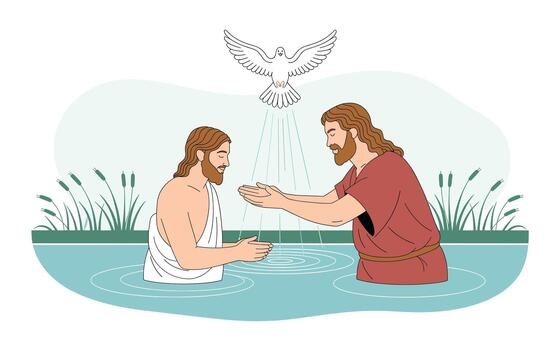
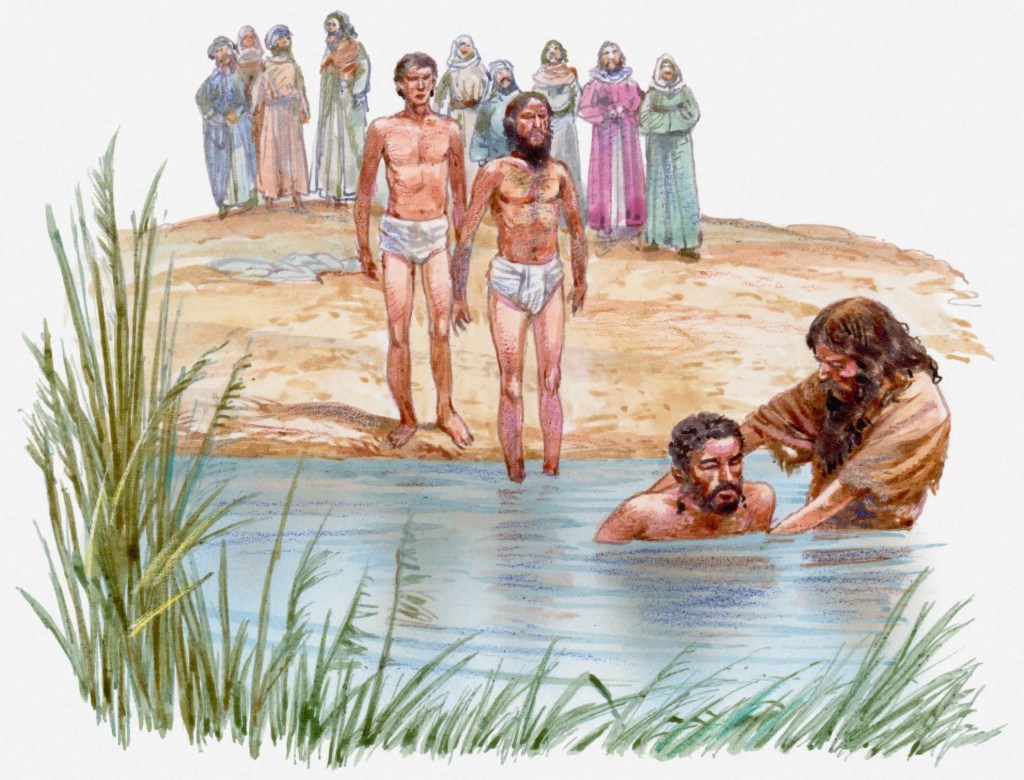
Our passage begins with the baptism of Jesus in the Jordan River. “In those days Jesus came from Nazareth of Galilee and was baptized by John in the Jordan. And when He came up out of the water, immediately He saw the heavens being torn open and the Spirit descending on Him like a dove. And a voice came from heaven, ‘You are My beloved Son; with You I am well pleased.’” (Mark 1:9-11)
Mark situates this moment during the ministry of John the Baptist, who was calling people to repentance and baptizing in the Jordan. Matthew’s Gospel provides more detail, showing John’s initial reluctance: “I need to be baptized by You, and do You come to me?” (Matthew 3:14). Jesus responded, “Let it be so now, for thus it is fitting for us to fulfill all righteousness,” and John consented (Matthew 3:15).
Though Jesus was sinless, He submitted to baptism to fulfill God’s plan. That’s what it means when Jesus said, “to fulfill all righteousness.” John the Baptist explained the purpose of his ministry: “I myself did not know Him, but for this purpose I came baptizing with water, that He might be revealed to Israel.” (John 1:31) Through His baptism, Jesus was publicly revealed as the Messiah, in line with the prophecies of Isaiah 40:3-5 and Malachi 3:1.
This event was divinely affirmed. The Spirit descended upon Jesus like a dove, and God the Father declared from heaven, “You are My beloved Son; with You I am well pleased” (Mark 1:10-11). The same confirmation came from God the Father at the transfiguration of Jesus (Mark 9:7; Matthew 17:5; Luke 9:35). This confirmed Jesus’ identity and His mission.
Immediately after, the Spirit led Jesus into the wilderness and fasted for forty days (Mark 1:13; Matthew 4:2), where He was tempted by Satan (Mark 1:12-13; Matthew 4:3-10). Unlike Adam, who fell into temptation, Jesus overcame all of Satan’s attacks, remaining sinless and faithful to God, while angels ministered to Him. (Matthew 4:11)
The apostle Paul writes, “For our sake God made Jesus to be sin who knew no sin, so that in Him we (the church) might become the righteousness of God.” (2 Corinthians 5:21)
He also declares, “For as by the one man’s disobedience the many were made sinners, so by the one man’s obedience the many will be made righteous.” (Romans 5:19) This is the grace of God, received through faith in Christ alone.
Scripture teaches us that Abraham’s unwavering faith in God was considered righteousness (Romans 4:3). Let us be encouraged to live in obedience to God’s will, trusting in Christ, who has triumphed over sin and temptation for us. By doing so, we can also be counted as righteous, which is the essence of being followers of Jesus Christ.
Peter, in the words of Acts 3:6, declared, “I possess neither silver nor gold, but in the name of Jesus Christ, I offer you what I have.” Share this article freely, for you freely receive. Take note, underlines and highlights are clickable links for definitions or Bible references. Stay updated by heading to our about page and subscribe directly to receive notifications in your inbox. Blessings!
In our Bibles, the Old Testament ends with Malachi, and the New Testament begins with Matthew. Malachi is often regarded as the last prophet to speak directly to Israel, and after his prophecy, there was a span of roughly four hundred years before John the Baptist appeared. This period mirrors the time between Joseph’s passing (Genesis 50:26) and the rise of Moses, when Israel endured four centuries of slavery in Egypt. God’s words to Abraham were fulfilled, as stated in Genesis 15:13-14:
> “Then the LORD said to Abram, ‘Know for certain that your offspring will be sojourners in a land that is not theirs and will be servants there, and they will be afflicted for four hundred years. But I will bring judgment on the nation that they serve, and afterward they shall come out with great possessions.’”
During those four hundred silent years in Egypt, Scripture records nothing new, and God seemed silent. It was only in Exodus 2:24 that we read:
> “And God heard their groaning, and God remembered His covenant with Abraham, with Isaac, and with Jacob.”
From the time of Malachi to the ministry of John the Baptist, history repeated itself with another four hundred years of silence. The arrival of Jesus Christ signified the culmination of this period, a moment that could be called the Second Exodus. Luke 9:30-31 affirms this during the transfiguration:
> “And behold, two men talked with Jesus, who were Moses and Elijah, who appeared in glory and spoke of His exodus, which He was about to accomplish at Jerusalem.”
For the second time, Jesus Christ was leading Israel out of bondage—this time from the law into grace (John 1:14-17). Paul highlights this transition in Galatians 3:23: “Before faith came, we were held captive under the law, imprisoned until the coming faith would be revealed.” Understanding this backdrop is crucial to grasping the Gospel of Mark.
The first instance of this is mentioned by Paul in his letter to the Corinthians, describing the exodus. He emphasizes that the ancestors of the Jews were all under the cloud, passed through the sea, and were baptized into Moses in both the cloud and the sea. They shared the same spiritual nourishment and drank from the spiritual Rock that accompanied them, which was Christ. (1 Corinthians 10:1-4)
Now, Mark begins by declaring Jesus Christ as the Son of God and the beginning of the Gospel. He cites two Old Testament prophecies, though he attributes them to Isaiah alone:
> “As it is written in Isaiah the prophet, ‘Behold, I send My messenger before Your face, who will prepare Your way, the voice of one crying in the wilderness: “Prepare the way of the Lord, make His paths straight.”’”
The two referenced prophets are Isaiah (40:3) and Malachi (3:1). John the Baptist, therefore, is presented as the partial fulfillment of these prophecies, with the complete fulfillment through the coming of Jesus Christ.
Malachi 3:1 foretold:
> “Behold, I send My messenger, and he will prepare the way before Me. And the Lord whom you seek will suddenly come to His temple; and the messenger of the covenant in whom you delight, behold, He is coming, says the LORD of hosts.”
Mark then introduces John the Baptist:
> “John appeared, baptizing in the wilderness and proclaiming a baptism of repentance for the forgiveness of sins. And all the country of Judea and all Jerusalem were coming to him and were being baptized by him in the river Jordan, confessing their sins. Now John was clothed with camel’s hair and wore a leather belt around his waist and ate locusts and wild honey. And he preached, saying, ‘After me comes He who is mightier than I, the strap of whose sandals I am not worthy to stoop down and untie. I have baptized you with water, but He will baptize you with the Holy Spirit.’” (Mark 1:2-8)
John’s message, “Repent, for the kingdom of heaven is at hand” (Matthew 3:2), puzzled many. The Jews knew Old Testament prophecy well, and Daniel had foretold that God’s kingdom would appear during the reign of the Fourth Gentile Kingdom—Rome—following Babylon, Medo-Persia, and Greece. With John and Jesus’ arrival, the kingdom of God had indeed come.
Yet, as in John’s day, people today debate whether the kingdom truly arrived, expecting an earthly utopia. Many Jews back in the days of John and Jesus were also disheartened when political circumstances did not change, remaining under Roman rule. Judas Iscariot, a Zealot hoping for rebellion, betrayed Jesus when his expectations were unmet. Despite spending three years with Jesus, Judas never abandoned his own agenda.
Jesus confirmed John’s role as the Elijah who was to come:
> “From the days of John the Baptist until now, the kingdom of heaven has suffered violence, and the violent take it by force. For all the Prophets and the Law prophesied until John, and if you are willing to accept it, he is Elijah who is to come.” (Matthew 11:12-14)
Understanding these truths lays the proper foundation for studying the Gospel of Mark, which shows Jesus as the fulfillment of the Law and Prophets (Matthew 5:17; Luke 24:25-27) and the dawn of God’s kingdom.
Peter, in the words of Acts 3:6, declared, “I possess neither silver nor gold, but in the name of Jesus Christ, I offer you what I have.” Share this article freely, for you freely receive. Take note, underlines and highlights are clickable links for definitions or Bible references. Stay updated by heading to our about page and subscribe directly to receive notifications in your inbox. Blessings!
I’ve come to realize that many pastors are hesitant to discuss money because they’ve been taught and told not to speak on the topic. However, Paul addressed this issue on several occasions. Are pastors inferior to an apostle? Paul made it clear in Ephesians that both are mandated by Christ Jesus for His ministry. (Ephesians 4:11-14) While I understand that some people assume the role of a pastor but lack the necessary skills or love for God’s ministry. Some view the ministry not as a calling but as a profession, even worse, as an opportunity to gain wealth. (1 Timothy 6:3-5)
No wonder Paul said, “For we are not, like so many, peddlers of God’s word, but as men of sincerity, commissioned by God, in the sight of God we speak in Christ.” (2 Corinthians 2:17) This article applies only to the latter group: people who are genuinely committed to doing God’s work.
Here’s the silent truth: Pastors are even ridiculed when people discover that someone has been supporting them, despite the clear biblical teaching that it’s the right of the pastor to receive support.
For example, Paul said, “In the same way, the Lord commanded that those who proclaim the Gospel should get their living by the Gospel.” (1 Corinthians 9:14) It’s the right of pastors to receive their living from the Gospel, because it’s commanded by Jesus Christ (Luke 10:2-8).
Paul also said, “Let the one who is taught the word share all good things with the one who teaches.” (Galatians 6:6) This clearly teaches that the giving and receiving of ministry support is directly between the teacher and the learner.
Furthermore, Jesus instructed His disciples, “The harvest is abundant, but the laborers are few. Go your way; behold, I am sending you out as lambs in the midst of wolves. Carry no moneybag, no knapsack, no sandals, and greet no one on the road. Whenever you enter a house, first say, ‘Peace be to this house!’ If a son of peace is there, your peace will rest upon him. But if not, it will return to you. Stay in the same house, eating and drinking what they provide, for the laborer deserves his wages. Do not go from house to house.” (Luke 10:2-7)
Despite these clear teachings, God’s workers often face little support and are subjected to ridicule and accusations of wrongdoing. Paul himself expressed his frustration, stating, “Did I commit a sin in humbling myself so that you might be exalted? Because I preached God’s Gospel to you without charge? I robbed other churches by accepting support from them in order to serve you. And when I was with you and in need, I did not burden anyone. The brothers who came from Macedonia supplied my need. So I refrained and will refrain from burdening you in any way.” (2 Corinthians 11:7-9)
The Corinthian church was biblically obligated to actively support Paul’s ministry in their midst. Scripture emphasizes the responsibility of believers to help God’s workers, declaring, “Therefore, we ought to support God’s workers like these, so that we may be fellow workers for the truth.” (3 John 1:8)
Despite this clear mandate, Paul did not receive the support that was rightfully due him from the Corinthians. Instead, he endured their criticisms. In response, he wrote:
“I am here for the third time, ready to come to you. I will not be a burden because I seek not what is yours but you. Children are not obligated to save for their parents, but parents for their children. I will gladly spend and be spent for your souls. If I love you more, am I to be loved less? But since I did not burden you, you say, I was crafty and got the better of you by deceit.” (2 Corinthians 12:14‑16)
Paul’s words reveal his profound love for the Corinthians and his willingness to sacrifice for their spiritual growth, even without receiving the support that was biblically warranted. This passage serves as a reminder to recognize, honor, and assist those who faithfully labor in God’s work, fulfilling the partnership that Scripture envisions between God’s servants and His people.
God designed it that way. Both God’s workers and Christians who support them are considered workers in the Gospel. (3 John 1:8) God intended it to be a partnership. Therefore, Paul expressed his gratitude to the Philippians, saying, “I thank my God in all my remembrance of you, always in every prayer of mine for you all, making my prayer with joy, because of your partnership in the Gospel from the first day until now.” (Philippians 1:3-5) The Macedonians and the Philippians are essentially the same people. Paul revealed that they are his sole supporters, stating, “And you Philippians yourselves know that in the beginning of the gospel, when I left Macedonia, no church entered into partnership with me in giving and receiving, except you only.” (Philippians 4:15)
John teaches that those who prevent people from directly supporting God’s workers are considered evildoers. (3 John 1:9-11)
Demetrius, who welcomes and supports God’s workers, contrasts sharply with Diotrephes, who refuses and hinders others from doing the same. It is crucial to discern who you listen to and follow.
Shame on you, Diotrephes! You are wrongfully accusing God’s workers of wrongdoing by denying them support and hindering others from doing so. Let’s not be deceived by the cunning and deceitful reasoning of some people who exploit your ignorance of Bible teachings. Regrettably, some have accused God’s workers of wrongdoing while neglecting accountability in their own collections of donations from God’s people.
I am simply stating the truth. I have received an unusual call from God. My mission is to study the Bible, explain its teachings clearly and without restraint, and share them with others. God’s people should not be offended by God’s Word. If you have any doubts, I encourage or even challenge you to study the Bible thoroughly. Discover for yourself the authentic teachings of the Scriptures.
P.S. This is a follow through to my previous posting “Supporting Christian Workers: A Biblical Approach”
Peter, in the words of Acts 3:6, declared, “I possess neither silver nor gold, but in the name of Jesus Christ, I offer you what I have.” Share this article freely, for you freely receive. Take note, underlines and highlights are clickable links for definitions or Bible references. Stay updated by heading to our about page and subscribe directly to receive notifications in your inbox. Blessings!
Recently, I was asked how we can support Christian workers, which might have been prompted by a Facebook post I shared. Scripture provides numerous teachings on this matter, but I will focus on one passage to highlight the principle clearly.
In 3 John 1:1-14, the apostle John commends Gaius for his faithfulness and generosity towards traveling brothers serving in Christ’s name. Gaius’s actions show that he not only walks in the truth but also honors God’s work by helping those who proclaim it.
Key Principles from the Passage
1. Supporting Christian Workers is Commended
John praises Gaius for showing love and hospitality to Christian workers, even though they were strangers. He notes that sending them off “in a manner worthy of God” is a faithful act, making believers fellow workers in the truth.
The same principle has been endorsed by Paul: “Let the elders who rule well be considered worthy of double honor, especially those who labor in preaching and teaching. For the Scripture says, ‘You shall not muzzle an ox when it treads out the grain,’ and, ‘The laborer deserves his wages.’” (1 Timothy 5:17-18)
The first quotation has been used by Paul in reference to support for God’s workers (1 Corinthians 9:9, 14). The latter is quoted from Jesus Christ. When He sent out His disciples, He called on them to be faithful to the Gospel and trust God’s people for their provision. (Luke 10:2-9)
2. Christian Workers Depend on Believers’ Support
These workers “have gone out for the sake of Jesus’ name, accepting nothing from unbelievers,” meaning the responsibility of support falls on the church and fellow Christians.
3. Warning Against Hindering Support
John rebukes Diotrephes for his pride, refusal to welcome Christian workers, and for stopping others from supporting them. Scripture warns that imitating such behaviour is evil.
4. Imitate Good, Not Evil
Believers are encouraged to follow the example of Gaius and Demetrius, who have good testimonies, and avoid the divisive behaviour of Diotrephes.
Applying the Principles Today
Scripture encourages us to directly support Christian workers—missionaries, pastors, or evangelists. While many now rely on mission organisations to channel support, the biblical model emphasizes personal participation and partnership in the Gospel.
Paul teaches, “The point is this: whoever sows sparingly will also reap sparingly, and whoever sows bountifully will also reap bountifully. Each one must give as he has decided in his heart, not reluctantly or under compulsion, for God loves a cheerful giver. And God is able to make all grace abound to you, so that having all sufficiency in all things at all times, you may abound in every good work.” (2 Corinthians 9:6-8)
Christian giving is a personal decision and choice. By helping those who labor for Christ, we become co-workers in spreading the truth and experience the joy of participating in God’s mission. (3 John 1:5-8)
Important Insights on Giving
In the Bible, support was always direct—given straight to God’s workers. Modern practice often routes help through organizations or committees, which can delay or even withhold rightful support. In the name of accountability, this system sometimes creates the opposite effect: funds are mismanaged or stalled. Returning to the biblical model of direct giving would be simpler and more faithful.
Biblical Basis for Direct Support
Philippians 4:15‑16 – The Philippians sent aid directly to Paul, even multiple times.
Galatians 6:6 – Believers are called to share all good things directly with their instructors.
1 Timothy 5:17‑18 – Elders who teach are worthy of financial honour, just as labourers deserve wages.
Furthermore, Jesus teaches that giving should be discreet (Matthew 6:1‑4), done to please God rather than to be seen by others.
A Matter of Conscience
In the end, giving should follow God’s leading and the guidance of your conscience. It is not dependent on the approval of committees or organisations. Some Christians may prefer the modern method of routed support; it is their responsibility and choice. But it is wrong to impose such rules on those who wish to follow the biblical model. One of the worst things a Christian can do is to try to play God in the lives of others.
Supporting Christian workers directly is both a responsibility and a blessing, making us true co-laborers in God’s mission.
Peter, in the words of Acts 3:6, declared, “I possess neither silver nor gold, but in the name of Jesus Christ, I offer you what I have.” Share this article freely, for you freely receive. Take note, underlines and highlights are clickable links for definitions or Bible references. Stay updated by heading to our about page and subscribe directly to receive notifications in your inbox. Blessings!
The notion that Paul was a “tentmaker,” in the contemporary interpretation of the Bible, holding a secular or business to support his ministry, is not explicitly confirmed in Scripture. Acts 18 describes Paul’s time in Corinth, where he resided with Aquila and Priscilla, both of whom were tentmakers by profession (Acts 18:1-4). During this period, he momentarily collaborated with them while continuing his ministry. However, Acts 18:5 reveals that after Silas and Timothy arrived from Macedonia, Paul dedicated himself entirely to preaching and teaching that Jesus is the Christ.
Paul, despite not relying on financial support from the Corinthians during his ministry among them (2Co 11:7), still faced allegations of hidden motives. This is evident in 2 Corinthians 12:16, where he acknowledges that while he didn’t burden them, they still accused him of being crafty and deceiving them.
Paul states, “Was it a sin for me to humble myself in order to exalt you, because I preached the gospel of God to you free of charge? I robbed other churches by accepting their support in order to serve you. And when I was with you and in need, I was not a burden to anyone; for the brothers who came from Macedonia supplied my needs. I have refrained from being a burden to you in any way, and I will continue to do so.” (2Co 11:7-9)
The passage in 2 Corinthians 11:7-9 clearly connects to Acts 18:5, where Luke mentions Timothy and Silas. These two individuals brought the financial support from Macedonia to Paul, enabling him to focus solely on his ministry work.
Furthermore, in his letter to the Philippians, Paul demonstrates that his material needs were met through their unwavering partnership in the Gospel. Philippians 4:10-16 captures his gratitude: “I rejoiced greatly in the Lord that you have finally revived your concern for me. You were indeed concerned for me, but you lacked the opportunity to do so. I understand how to be humbled and how to flourish. I can accomplish all things through him who strengthens me. And you, Philippians, yourselves are aware that at the beginning of the Gospel, when I departed from Macedonia, no church entered into partnership with me in giving and receiving, except for you alone. Even in Thessalonica, you sent me assistance for my needs repeatedly.”
The idea of tentmakers supposedly derived from Paul is clearly unfounded. Paul’s view of ministry and support follows the teachings of Jesus, who instructed the apostles in Matthew 10:9-14 not to acquire provisions for their own journey but to rely on the hospitality of those who received their message: “The laborer deserves his food… And if anyone will not receive you or listen to your words, shake off the dust from your feet when you leave that house or town.”
Paul’s teaching in 1 Corinthians 11:1—“You are to imitate me, just as I imitate Christ”—becomes more understandable when we consider how both he and Jesus lived by faith. Paul’s life and ministry were a reflection of Christ’s example, characterized by trust and reliance on God’s provision rather than self-sufficiency. It’s worth noting that many people may not realize that Jesus never performed miracles to meet His daily needs. He didn’t turn stones into bread or multiply loaves for His own sustenance.
Luke’s account in Luke 8:1–3 shows the practical side of Jesus’ ministry: He travelled from town to town with the Twelve, proclaiming the good news of the Kingdom of God. While doing so, He and His disciples were supported by women who had experienced His grace—Mary Magdalene, Joanna the wife of Chuza, Susanna, and many others—who ministered to them out of their own resources. This example demonstrates a life of faith, receiving what God provided through the generosity of others.
In the same way, Paul lived and served by faith, relying on God’s provision through the support of fellow believers, mirroring the very pattern set by Christ during His earthly ministry.
Scripture’s teachings humbled me. Instead of seeking ways to support our independent Bible studies, we initially relied solely on our savings and occasional assistance from brethren in Metro Manila. Initially, I even contemplated sending letters to solicit support. However, after reflecting on the ministry principles outlined in Jesus Christ’s life and teachings, I abandoned that plan.
Was it hard? It was, but it became doable when I remembered God’s grace from the very moment I believed. God does not change, and His faithfulness sustains.
This principle is reinforced in Hebrews 13:5-8: “Keep your life free from love of money, and be content with what you have… The Lord is my helper; I will not fear…” It reminds believers that Jesus Christ remains constant—yesterday, today, and forever.
Scripture clearly teaches that both those who labour for God and those who support the ministry are united as fellow workers in the truth. As John writes in his letter:
“Beloved, you are faithful in what you are doing for the brothers, even though they are strangers to you. They have testified to the church about your love. You will do well to send them on their way in a manner worthy of God. For they have gone out for the sake of the Name, accepting nothing from the unbelievers. Therefore, we ought to support such men, so that we may be fellow workers for the truth.” (3 John 1:5-8)
This passage highlights the partnership between those who go out to serve and those who uphold them, showing that both share in the mission to advance the truth of God’s Word.
If such faith and reliance on the Lord were possible then, it remains possible now. Our service to the same unchanging Jesus calls us to embrace the faith modeled in Scripture and the ministry journey of the apostles. Ultimately, it all comes down to faith.
P.S. This message is not meant to belittle any of God’s workers who rely on the support of churches or mission organizations. Rather, it stands as a reminder that Jesus Christ is the same yesterday, today, and forever (Hebrews 13:8). He has said, “If you abide in My words, you are truly My disciples, and you will know the truth, and the truth will set you free.” (John 8:31-32) Place your trust in Jesus, even if others may hesitate. In doing so, you will truly experience His grace and goodness, free from human pressures and influences. For those serving in God’s ministry, remember that Jesus Himself commanded that those who proclaim the Gospel should make their living through the Gospel (1 Corinthians 9:14). Likewise, Paul instructed believers: “Let the one who is taught the word share all good things with the one who teaches” (Galatians 6:6).
Peter, in the words of Acts 3:6, declared, “I possess neither silver nor gold, but in the name of Jesus Christ, I offer you what I have.” Share this article freely, for you freely receive. Take note, underlines and highlights are clickable links for definitions or Bible references. Stay updated by heading to our about page and subscribe directly to receive notifications in your inbox. Blessings!
No, that is not correct. The recent earthquakes are not connected to Christ’s return. Let us look into Scripture to see where such an idea might have originated. The Bible says:
“Jesus left the temple and was going away when His disciples came to show Him the temple buildings. But He said to them, ‘Do you see all of these? Truly, I tell you, not one stone here will remain on another; every one will be thrown down.’ Later, as He sat on the Mount of Olives, the disciples approached Him privately and asked, ‘Tell us, when will these things happen, and what will be the sign of Your comingand of the end of the age?’” (Matthew 24:1-3)
Let us explore the question: When will the temple be destroyed? What will be the sign of Your coming and of the end of the age? These seemingly three distinct questions collectively encapsulate a single, overarching inquiry.
Take note, the disciples sought the sign of Jesus’ coming because of His prediction of the temple’s destruction. They were well aware of the connection between the desolation of the temple and the two other events – the coming of Jesus and the end of the age. Jesus first warned them about the deceptive nature of false prophets. He cautioned them:
“Be on guard against false prophets. Many will come in My name, claiming to be the Christ, and they will lead many astray.” (Matthew 24:4-5)
Let’s quickly address the concept of “end of the age.” The Bible states:
“On many past occasions and in many different ways, God spoke to our fathers through the prophets. But in these last days He has spoken to us by His Son, whom He appointed heir of all things, and through whom He made the universe” (Hebrews 1:1-2).
Here’s the proof that God is going to create a new people, see Isaiah 65:17-19:
“For behold, I create new heavens and a new earth, and the former things shall not be remembered or come into mind. But be glad and rejoice forever in that which I create; for behold, I create Jerusalem to be a joy, and her people to be a gladness. I will rejoice in Jerusalem and be glad in My people; no more shall be heard in it the sound of weeping and the cry of distress.”
In the Gospel of Luke, during the Last Supper or the Passover meal, the Bible states:
“And Jesus took bread, and when He had given thanks, He broke it and gave it to His disciples, saying, ‘This is My body, which is given for you. Do this in remembrance of Me.’ And likewise the cup after they had eaten, saying, ‘This cup that is poured out for you is the new covenant in My blood.’” (Luke 22:19-20)
Here is the essence of Christ’s declaration of the New Covenant. Paul, in 2 Corinthians 5:16-17 states:
“From now on, therefore, we regard no one according to the flesh (i.e., circumcision or Old Covenant). Even though we once regarded Christ according to the flesh, we regard Him thus no longer. Therefore, if anyone is in Christ, he is a new creation. The old has passed away; behold, the new has come.”
Back to Christ’s warning against deceptive false prophets (Matthew 24:4-5). As students of the Bible, we should have noticed Jesus’ repeated warning to His disciples on this matter in Matthew 24. Jesus cautions:
“Then if anyone says to you, ‘Look, here is the Christ!’ or ‘There he is!’ do not believe it. For false christs and false prophets will arise and perform great signs and wonders, so as to lead astray, if possible, even the elect. See, I have told you beforehand. So, if they say to you, ‘Look, he is in the wilderness,’ do not go out. If they say, ‘Look, he is in the inner rooms,’ do not believe it’” (Matthew 24:23-26).
It was undoubtedly of utmost importance for Jesus to reiterate this warning three times, as seen for the first time in Matthew 24:4-5. But why did He do so?
Let’s take a look at Jesus’ declaration, both to the Pharisees and to His disciple on the same reference “look, here it is! or there!”
“Being asked by the Pharisees when the kingdom of God would come, Jesus answered them, “The kingdom of God is not coming in ways THAT CAN BE OBSERVED, nor will they say, ‘Look, here it is!’ or ‘There!’ for behold, the kingdom of God is in the midst of you.” And Jesus said to the disciples, “The days are coming when you will desire to see one of the days of the Son of Man, and you will not see it. And they will say to you, ‘Look, there!’ or ‘Look, here!’ Do not go out or follow them. For as the lightning flashes and lights up the sky from one side to the other, so will the Son of Man be in His day. But first He must suffer many things and be rejected by this generation.” (Luke 17:20-25)
Contrary to popular belief, Jesus wasn’t implying that His coming would be swift and easily noticeable by saying, “For as the lightning flashes and illuminates the sky from one side to the other.” Instead, Christ was quoting Zechariah 9:14:
“Then the LORD will appear over them, and His arrow will be sent forth like lightning; the Lord GOD will sound the trumpet and will march forth in the whirlwinds of the south.”
In essence, Jesus declares that He, the Son of Man, will return in the glory of LORD or YHWH, the covenant name of God. God Almighty – God the Father, God the Son and the Holy Spirit.
Look at Jesus words again: “The days are coming when you will desire to see one of the days of the Son of Man, and you will not see it. And they will say to you, ‘Look, there!’ or ‘Look, here!’ Do not go out or follow them.” (Luke 17:22-23)
By quoting from Zechariah 9, Jesus assures His disciples that He is the Christ, the King who came to Jerusalem riding a donkey (Zechariah 9:9). This prophecy was fulfilled just days later in Luke 19:28-38. Contrary to contemporary Christian beliefs and teachings, the Bible never taught about two separate comings of Jesus Christ. With the coming of Jesus, the Christ, He was to fulfill Scriptures (Matthew 5:17; Luke 24:44). The Book of Hebrews clearly teaches:
“Just as man is appointed to die once, and after that to face judgment, so also Christ was offered once to bear the sins of many; and He will appear a second time, not to bear sin, but to bring salvation to those who eagerly await Him” (Hebrews 9:27-28).
It is not two comings, but by His return, He completed His salvation work for all who believe in Him. Christ Jesus’ return would be marked by glory and power, not by a visible appearance, but rather by the event of the temple’s desolation or destruction, which occurred in 70 AD. Contrary to contemporary Christian teachings and beliefs, Acts 1:11 explicitly states that Jesus will return in glory, not in a physical form. Jesus’ coming on the clouds signifies His return in glory, as specifically stated by Paul in 1 Timothy 3:16.
“Indeed, we confess, is the mystery of godliness: He was manifested in the flesh, vindicated by the Spirit, seen by angels, proclaimed among the nations, believed on in the world, and taken up in glory.”
After Christ’s ascension, Jesus manifested Himself to Stephen before his martyrdom for the faith and to Paul during his Damascus encounter. In Acts, Jesus was either seen on the right hand of God (Acts 7:55-56), in glory (Acts 9:3-7), or in the Spirit (Acts 16:7).
Consequently, Jesus cautioned His disciples against believing claims of seeing Him visibly during His coming. Refer to Luke 17:22-24, where He addressed the disciples and said:
“The days are coming when you will yearn to witness one of the days of the Son of Man, but you will not be able to see it. They will say to you, ‘Look, there!’ or ‘Look, here!’ Do not go out or follow them. For as the lightning flashes and illuminates the sky from one side to the other, so will the Son of Man be in His day.”
The same message was conveyed by Jesus in Matthew 24:23-27. In verse 27, Jesus seems to have likened His return to the lightning that illuminates the sky from one side to the other (Luke 17:24), but in reality, He quotes Zechariah 9:14:
“Then the LORD will appear over them, and His arrow will go forth like lightning; the Lord GOD will sound the trumpet and will march forth in the whirlwinds of the south”
The declaration in Zechariah 9:14-17 signifies that Jesus would return in glory and power, and His salvation would be completed upon His return, same with Hebrews 9:28.
“So also Christ was offered once to bear the sins of many; and He will appear a second time, not to bear sin, but to bring salvation to those who eagerly await Him.” (Hebrews 9:28)
There’s no huge gap after all in Christ’s coming, unlike the beliefs of many today. It’s been millennia since Jesus appeared. Instead, Jesus fulfilled Scriptures, as foreshadowed by the Exodus to the Promised Land. Israel spent forty years in Exodus with Moses before Joshua led them in conquering the Promised Land. Luke explained the transfiguration of Jesus, stating:
“Suddenly two men, Moses and Elijah, began talking with Jesus. They appeared in glory and spoke about His departure, which He was about to accomplish at Jerusalem” (Luke 9:30-31).
The Greek word translated “departure” literally means “exodus,” so like the Exodus, which was the shadow of things to come. Jesus was in fulfillment of Scriptures; He led His people in exodus to the true Promised Land. The Bible states:
“For if Joshua had given them rest, God would not have spoken of another day later on. So then, there remains a Sabbath rest for the people of God, for whoever has entered God’s rest has also rested from his works as God did from His.” (Hebrews 4:8-10)
The Promised Land signifies rest. God has welcomed back mankind – that is, those who believe in Jesus Christ – to the Garden of Eden, where God is in communion with man, and man works not to survive, but in the command of God. (Genesis 2:15) Jesus Christ declares:
“Do not work for the food that perishes, but for the food that endures to eternal life, which the Son of Man will give to you. For on Him God the Father has set His seal.” (John 6:27)
Work on how to increase your faith, and always believe in Jesus Christ. For Jesus states:
“So don’t worry about these things, saying, ‘What will we eat? What will we drink? What will we wear?’ These things dominate the thoughts of unbelievers, but your heavenly Father already knows all your needs. Seek the Kingdom of God above all else, and live righteously, and He will give you everything you need.” (Matthew 6:31-33)
Next, in Matthew 24:6-8, Jesus states:
“And you will hear of wars and rumors of wars. See that you are not alarmed, for this must take place, but the end is not yet. For nation will rise against nation, and kingdom against kingdom, and there will be famines and earthquakes in various places. All these are but the beginning of the birth pains.”
During the time of the disciples, were there no wars or rumors of wars, nor were there any earthquakes? The Jewish war occurred during the era of Jesus Christ’s disciples. According to the Jewish historian Flavius Josephus, a severe earthquake struck Jerusalem during the festival of Pentecost (Shavuot) in 66 AD, just before the outbreak of the Jewish-Roman War. Josephus also recorded the occurrence of famine during that period.
Furthermore, the decades preceding the 70 AD destruction of Jerusalem and the temple were marked by a series of geological upheavals throughout the Roman Empire. Although not confined to Jerusalem, earthquakes devastated cities in Crete, Smyrna, Miletus, Campania, and the renowned 63 AD earthquake that obliterated Pompeii. These events were widely interpreted by early followers as forewarnings of the city’s impending downfall.
Continuing on, in Matthew 24:9-15, Jesus next states:
“Then they will deliver you (i.e., the disciples) up to tribulation and put you to death, and you will be hated by all nations for My name’s sake. And then many will fall away and betray one another and hate one another. And many false prophets will arise and lead many astray. And because lawlessness will be increased, the love of many will grow cold. But the one who endures to the end will be saved. And this gospel of the kingdom will be proclaimed throughout the whole world as a testimony to all nations, and then the end will come.”
The Book of Acts chronicles the spread of the Gospel. It begins in Jerusalem (Acts 2-7), extends to all Judea and Samaria (Acts 8), and ultimately reaches the ends of the earth (Acts 11:19-28:31). Paul was in Rome at the conclusion of Luke’s narration in Acts. As the capital of the Roman Empire, Rome represented the culmination of the then-known Jewish world, fulfilling Acts 1:8. Jesus prophesied to His apostles:
“But you will receive power when the Holy Spirit has come upon you, and you will be my witnesses in Jerusalem and in all Judea and Samaria, and to the ends of the earth.”
Jesus finally revealed the sign of His coming, saying:
“So, when you see the abomination of desolation spoken of by the prophet Daniel standing in the holy place (let the reader understand), then let those in Judea flee to the mountains. Those on the housetop should not descend to take what is in their house, and those in the field should not turn back to retrieve their cloaks. Alas, women who are pregnant and those who are nursing infants during those days! Pray that your flight may not occur in winter or on a Sabbath. For then there will be great tribulation, such as has never been experienced since the beginning of the world and will never be again. If those days had not been shortened, no human being would be saved. However, for the sake of the elect, those days will be shortened.” (Matthew 24:15-22)
The destruction of the temple was the sign of Jesus’ coming, as mentioned in Daniel’s prophecies (Daniel 8:13, 9:26-27, and 12:11-13). Anyone still skeptical that Jesus in Matthew 24:15 spoke of the temple’s desolation should simply refer to Luke’s narration on the same event.
“But when you see Jerusalem surrounded by armies, then know that its desolation has come near. Then let those who are in Judea flee to the mountains, and let those who are inside the city depart, and let not those who are out in the country enter it, for these are days of vengeance, to fulfill all that is written. Alas for women who are pregnant and for those who are nursing infants in those days! For there will be great distress upon the earth and wrath against this people. They will fall by the edge of the sword and be led captive among all nations, and Jerusalem will be trampled underfoot by the Gentiles, until the times of the Gentiles are fulfilled.” (Luke 21:20-24)
Interestingly, many people overlooked the fact that Jesus quoted Daniel 12:1 in Matthew 24:21, stating:
“For then there will be great tribulation, such as has not been from the beginning of the world until now, no, and never will be.”
Moreover, it’s crucial to note that Daniel 12:3 states:
“And those who are wise shall shine like the brightness of the sky above; and those who turn many to righteousness, like the stars forever and ever.”
Jesus quoted this verse when He spoke about the kingdom of heaven. Refer to Matthew 13:43. Let us learn from Christ’s teaching on Daniel 12:3 or Matthew 13:43, the context for Jesus’ teaching in Matthew 13:44-52.
“Then the righteous will shine like the sun in the kingdom of their Father. He who has ears, let him hear (Daniel 12:3). The kingdom of heaven is like treasure hidden in a field, which a man found and covered up. Then in his joy he goes and sells all that he has and buys that field.” “Again, the kingdom of heaven is like a merchant in search of fine pearls, who, on finding one pearl of great value, went and sold all that he had and bought it.” “Again, the kingdom of heaven is like a net that was thrown into the sea and gathered fish of every kind. When it was full, men drew it ashore and sat down and sorted the good into containers but threw away the bad. So it will be at the end of the age. The angels will come out and separate the evil from the righteous and throw them into the fiery furnace. In that place there will be weeping and gnashing of teeth.” “Have you understood all these things?” They said to Jesus, “Yes.” And He said to them, “Therefore every scribe who has been trained for the kingdom of heaven is like a master of a house, who brings out of his treasure what is new and what is old.” And when Jesus had finished these parables, he went away from there,” (Matthew 13:43-53)
So, here’s the challenge: have we truly been trained for the kingdom of heaven? Sadly, the fallacy concerning the Return of Jesus has persisted for too long that people have accepted it as the truth. Indeed, as the saying goes, “Repeat a lie often enough, and it becomes the truth.”
Have we been obedient to do our part in God’s kingdom? Paul wrote in Romans:
“So we (i.e., God’s church), though many, are one body in Christ, and individually members one of another. Having gifts that differ according to the grace given to us, let us use them: if prophecy, in proportion to our faith; if service, in our serving; the one who teaches, in his teaching; the one who exhorts, in his exhortation; the one who contributes, in generosity; the one who leads, with zeal; the one who does acts of mercy, with cheerfulness.” (Romans 12:5-8)
Some individuals have been serving for financial gain, but Paul emphasizes that they are not like many others who peddle God’s word. Instead, they are sincere men, commissioned by God, who speak in Christ in the presence of God. (2 Corinthians 2:17) Others, similarly fixated on their calculators evaluating their contributions to God’s work, behave like stock market investors. When their investments decrease, their giving also diminishes. However, what happens when the market is thriving? Do their giving practices align with the increase in their financial standing?
Here’s a story from the Bible:
“Jesus sat opposite the treasury and observed the people depositing money into the offering box. Many wealthy individuals contributed substantial sums. However, a poor widow approached and placed two small copper coins, which constitute a penny. Jesus then called His disciples to Him and said, ‘Truly, I say to you, this impoverished widow has contributed more than all those who are giving to the offering box. They all contributed out of their abundance, but she, despite her poverty, has given everything she had, all that she needed to sustain herself.’” (Mark 12:41-44)
Let us all give to the Lord what has been entrusted to us first. Scripture state:
“Beware lest you say in your heart, ‘My power and the might of my hand have gotten me this wealth.’ You shall remember the LORD your God, for it is He who gives you power to get wealth.” (Deuteronomy 8:17-18)
Christ Jesus told of a person who came to Him, asking about eternal life. Sadly though, being rich, Jesus issued a challenge to him. He walked away sorrowfully. (Matthew 19:16-22) Jesus then turned to His disciples and said:
“Truly, I say to you, only with difficulty will a rich person enter the kingdom of heaven. Again I tell you, it is easier for a camel to go through the eye of a needle than for a rich person to enter the kingdom of God.” (Matthew 19:23-24)
In several instance, the Bible warns against the love of money (1 Timothy 6:10; Hebrews 13:5). Some individuals are called to fulfill their work full-time in Christ’s ministry, while others are blessed with wealth. The Bible states:
“God’s workers accept nothing from people who are not believers. Therefore, we ourselves should support them so that we can be their partners as they teach the truth.” (3 John 5-8)
This serves as a test of our faithfulness to Jesus Christ, for both us as servants of God’s work and all Christians. God’s workers should remain faithful to His Word, and the church should partner with them through support and giving. Consider the story of Elijah in 1 Kings 17. It was not Elijah who was provided with sustenance, but the widow who gave him food.
“So Elijah arose and went to Zarephath. And when he came to the gate of the city, behold, a widow was there gathering sticks. And he called to her and said, ‘Bring me a little water in a vessel, that I may drink.’ And as she was going to bring it, he called to her and said, ‘Bring me a morsel of bread in your hand.’ And she said, ‘As the LORD your God lives, I have nothing baked, only a handful of flour in a jar and a little oil in a jug. And now I am gathering a couple of sticks that I may go in and prepare it for myself and my son, that we may eat it and die.’ And Elijah said to her, ‘Do not fear; go and do as you have said. But first make me a little cake of it and bring it to me, and afterward make something for yourself and your son. For thus says the LORD, the God of Israel, “The jar of flour shall not be spent, and the jug of oil shall not be empty, until the day that the LORD sends rain upon the earth.” And she went and did as Elijah said. And she and he and her household ate for many days. The jar of flour was not spent, neither did the jug of oil become empty, according to the word of the LORD that He spoke by Elijah.” (1 Kings 17:10-16)
Back to our topic, thrice, Jesus warned the disciples, saying:
“If anyone says to you, ‘Look, here is the Christ!’ or ‘There!’ don’t believe it. False christs and false prophets will rise and perform great signs and wonders to deceive, if possible, even the elect. I have already told you this. Therefore, if they say to you, ‘Look, He is in the desert!’ don’t go out; or ‘Look, He is in the inner rooms!’ don’t believe it. Just as the lightning flashes from the east to the west, so too will the coming of the Son of Man. Wherever the dead body is, the eagles will gather around it.” (Matthew 24:23-28)
For Matthew 24:28, most modern translations of the Bible have it as “Wherever the corpse is, there the vultures will gather.” However, the above translation from the NKJV uses “eagle” instead of “vultures.” In Greek, the word “Aetos” (G105) should have been translated as “eagles” instead of “vultures.” This verse is a reference to Deuteronomy 28:49, which states:
“The LORD will bring a nation against you (i.e., the Old Covenant Israel) from far away, from the end of the earth, swooping down like the eagle, a nation whose language you do not understand.”
In 70 AD, Rome, the foreign nation, destroyed both the city of Jerusalem and the sanctuary. God’s judgment was imminent for the generation that crucified Jesus, oppressed, and killed His apostles. Jesus declared:
“Truly, I say to you, all these things will come upon this generation” (Matthew 23:36).
Christ reiterated His judgment, stating:
“Truly, I say to you, this generation will not pass away until all these things take place” (Matthew 24:34).
So, why did post-first-century Christianity commit mistakes until today? Why is our current understanding of Christ’s return completely different from what I explained here? Christian theologians heavily relied on the early church fathers writings instead of the Scriptures, leading to their errors becoming our errors. Jesus emphasized the importance of discipleship, stating:
“Can a blind man lead a blind man? Will they not both fall into a pit? A disciple is not above his teacher, but everyone when he is fully trained will be like his teacher.” (Luke 6:39-40)
We have only one Teacher, and that’s Jesus Christ, our Lord and Savior. (Isaiah 30:22-21; 1 Corinthians 3:5-11) Let us learn from His Word, not from human writings. Be a Berean, verifying every teaching we hear or read from Scripture. (Acts 17:11) The Bible alone is inerrant.
At Unlearning Tradition, Relearning Scripture, we strive to restore the Bible’s authentic teachings. However, the only effective approach is to return to the traditional study of the Bible, as we were trained in seminary. This involves exegeting each passage, analyzing its context, audience, and historical relevance. Before the Bible addressed us, it first spoke to the early Christian community. Reading the Bible in the context of our current events would be eisegesis, which involves inserting our own ideas into the text rather than reading it as it was originally intended.
God through Jesus Christ promised us His eternal blessings. But distorted teachings on the Bible, and the need to live and survive have challenged our faith. How can we understand God’s Word in the midst of life’s turmoil?
The Bible states, “Be still, and know that I am God. I will be exalted among the nations, I will be exalted in the earth!” (Psalm 46:10). Take time to learn from the Bible, and live in faith. Live a victorious life in Jesus Christ.
Jesus states, “I have said these things to you, that in Me you may have peace. In the world you will have tribulation. But take heart; I have overcome the world.” (John 16:33)
Peter, in the words of Acts 3:6, declared, “I possess neither silver nor gold, but in the name of Jesus Christ, I offer you what I have.” Share this article freely, for you freely receive. Take note, underlines and highlights are clickable links for definitions or Bible references. Stay updated by heading to our about page and subscribe directly to receive notifications in your inbox. Blessings!
God works in mysterious ways. Instead of focusing on pent-up frustration, I turned on Spotify to listen to Christian music while reading the verse of the day from a Bible app as a starting point to studying a whole book or passages. This morning it’s Micah 6:8. “He (i.e, God) has told you, O man, what is good; and what does the LORD require of you but to do justice, and to love kindness, and to walk humbly with your God?”
Micah prophesied during the reigns of Jotham, Ahaz, and Hezekiah, all kings of Judah—a contemporary of Isaiah. It was a time of prosperity, and Micah denounced the wealthy for oppressing the poor and warned of God’s impending judgment (Micah 1:3-5). The northern kingdom had actually fallen during Micah’s ministry, in 722 BC, and Judah almost did as well (2 Kings 18-20).
Micah prophesied against the rulers and prophets of both Judah and Israel, who falsely claimed to speak from God (Micah 3). The highlight of Micah’s prophecy concerns the last days, the arrival of God’s kingdom (Micah 4:1-7; Isaiah 2:2-4; Romans 10:8-18), and Christ Jesus (Micah 5:2-5). Micah 6:6-8 reveals God’s heart and desire for His people: “With what shall I come before the LORD, and bow myself before God on high? Shall I come before Him with burnt offerings, with calves a year old? Will the LORD be pleased with thousands of rams, with ten thousands of rivers of oil? Shall I give my firstborn for my transgression, the fruit of my body for the sin of my soul?” “He has told you, O man, what is good; and what does the LORD require of you but to do justice, and to love kindness, and to walk humbly with your God?” (Micah 6:6-8)
God changes not. Micah 6:6-8 is precisely reflected in Hosea 6:6, which was quoted twice by Jesus Christ, first in Matthew 9:12-13, “Those who are well have no need of a physician, but those who are sick. Go and learn what this means: ‘I desire mercy, and not sacrifice.’ For I came not to call the righteous, but sinners.” Christ’s coming was to offer a second chance, a restoration to God.
The Bible states that everyone is born of Adam, born after Adam had fallen from the grace of God (Romans 5:12). Jesus Christ, therefore, is our only way back to God. He is the mediator of the New Covenant (Hebrews 9:11-12, 15; 12:22-24; Luke 22:19-20; 1 Corinthians 11:25). The Bible states, “For as in Adam all die, so also in Christ shall all be made alive (1 Corinthians 15:22).” That’s the essence of our Christian water baptism. We die to Adam and are alive in Jesus, rising out of the water a new person in Christ . But unless we acknowledge being sinners, then Christ’s calling or the Gospel makes no sense to us. And unless we truly have become a new person in Christ, then our water baptism does not mean a thing. Water baptism is just an expression of one’s testimony that the person now belongs to Jesus Christ.
The second time is in Matthew 12:6-8, “I tell you, something greater than the temple is here. And if you had known what this means, ‘I desire mercy, and not sacrifice,’ you would not have condemned the guiltless. For the Son of Man is Lord of the Sabbath.”
Jesus Christ is the true temple of God (Matthew 12:6; John 2:19, 21). Christ is the Head, and the church is His body (Colossians 1:18), built on the foundation of the apostles and prophets. Jesus Himself is the cornerstone, and by His death and resurrection, we Christians grow together into a holy temple in the Lord (Ephesians 2).
Yes, we Christians, the holy temple in the Lord, is greater than the Old Covenant Jerusalem temple. Hence, Jesus, in John 4 states, “Believe Me, the hour is coming when neither on this mountain nor in Jerusalem will you worship the Father. You worship what you do not know; we worship what we know, for salvation is from the Jews. But the hour is coming, and IS NOW HERE, when the true worshipers will worship the Father in spirit and truth, for the Father is seeking such people to worship Him. God is spirit, and those who worship Him must worship in spirit and truth.” (John 4:21-24)
What does it take to worship God in spirit and truth? Surely, it does not mean simply going to the Sunday worship service or a building where Christians supposedly gather for worship, but to walk the talk. Here’s Paul’s words regarding worship: “I appeal to you (i.e. the church) therefore, brothers, by the mercies of God, to present your bodies as a living sacrifice, holy and acceptable to God, which is your spiritual worship. Do not be conformed to this world, but be transformed by the renewal of your mind, that by testing you may discern what is the will of God, what is good and acceptable and perfect.” (Romans 12:1-2)
Let me be clear, Paul, by “your bodies” refers to the church. See Romans 12:5, “So we, though many, are one body in Christ, and individually members one of another.”
Christ is the Lord of the Sabbath—a declaration Jesus revealed about Himself, making known that He is the God of creation (see Matthew 12:8; Genesis 1:1-2:2). Yes, Genesis creation account isn’t about God’s narration of His creation of all things, though indeed He alone is the creator of all things (Psalm 33:6-9; Colossians 1:16-17). God in Genesis used creation language to reveal His creation of His people. Hence, Paul, in 2 Corinthians 4:6, quotes Genesis 1:3, to explain God’s Old Covenant vis-à-vis the New, and God’s Old Covenant people vis-à-vis the New, His Church.
John also did the same, quoting Genesis 1:3, and referring it to Jesus, the Word. He even used the same opening phrase in Genesis “in the beginning” to connect the two. See John 1:1-5, “In the beginning was the Word, and the Word was with God, and the Word was God. He was in the beginning with God. All things were made through Him, and without Him was not any thing made that was made. In Him was life, and the life was the light of men. The light shines in the darkness, and the darkness has not overcome it.”
God, through Christ Jesus, creates a new people for Himself, and we—the church—are God’s New Covenant people. (2 Corinthians 5:17-19) But have we truly learned from God’s Word?
How is it that Christians are still enticed by the world and its riches, if we have known true riches is only with Jesus Christ?
Have we Christians shown justice and mercy to our fellowmen?
Have our pastors truly been speaking Christ’s Word? Are we worshipping God and Jesus Christ in truth and in spirit? Why is it there are a lot of nominal Christians?
Have we been sharing the faith to our loved ones, fiancés, friends, and children? Why is it many times Christians fear men rather than God?
And I have a lot more vented frustrations having seen Christianity in its present mode. Until when will a Christian truly walk by faith? Does everyone need to have a Damascus experience or a denial like that of Peter before walking truthfully with Jesus? Sadly, many have walked the way of Judas, denying Jesus because He doesn’t suit their expectation of the Christ.
Jesus Christ, without a doubt, has arrived. His kingdom is a present reality, though it isn’t of this world. When asked by the Pharisees when God’s kingdom would come, Jesus states, “The kingdom of God is not coming in ways that can be observed, nor will they say, ‘Look, here it is!’ or ‘There!’ for behold, the kingdom of God is in the midst of you.” (Luke 17:20-21)
The Bible states, “For Jesus must reign until He has put all His enemies under His feet. The last enemy to be destroyed is death” (1 Corinthians 15:25-26). Isn’t death destroyed already? If not, why are pastors saying in wakes, “Our Christian friend is now with the Lord Jesus Christ or in a better place?”
Christians have misunderstood the concept of death being destroyed. It doesn’t imply that Christians would cease to die physically. Instead, death is no longer an end to life, as Jesus states, “Truly I tell you, anyone who hears My word and believes Him who sent Me has eternal life and will not face judgment but has transcended death to life.” (John 5:24)
Here’s the proof from Scripture that “death has been swallowed up in victory” (1 Corinthians 15:54). The Bible, in 1 Corinthians 15:56 states, “The sting of death is sin, and the power of sin is the law.”
Do we still have the Jerusalem temple standing today? If not, how can the Mosaic Law now be observed? Didn’t Christ’s death make obsolete the Mosaic regulations of animal offerings? With the second and final destruction of the Jerusalem temple, Daniel’s visions of the end came to be fulfilled. Scripture states, “When the shattering of the power of the holy people comes to an end; all these things would be finished (Daniel 12:7)”. The Mosaic law is the power of the Old Testament people (Deuteronomy 7:6-11), and it has become obsolete, fulfilled in Christ Jesus (Matthew 5:17; Hebrews 9; Luke 24:25-26; 24:44). Jesus is the true Israel (Isaiah 49:3). Similarly then, we Christians are nobody before God except by faith in Christ Jesus, the mediator of the New Covenant.
Even Adam’s death no longer holds power over Christians. Paul, in Romans, explains, “Therefore, there is no condemnation for those in Christ Jesus. The law of the Spirit of life in Christ Jesus (i.e., the Gospel) has set you free from the law of sin and death (i.e., the law of Adam’s death [Genesis 2:16-17]). For what the law (i.e., the Mosaic law) could not accomplish because it was weakened by the flesh, God did. He condemned sin in the flesh by sending His own Son in the likeness of sinful flesh as a sin offering, so that the law’s requirement would be fulfilled in us who do not walk according to the flesh but according to the Spirit.” (Romans 8:1-4)
Christians, let us live by faith in Jesus Christ, then we shall see the workings of God’s kingdom. And in Him alone will we find peace, and not be frustrated. For Jesus Christ is the same yesterday, and today, and forever (Hebrews 13:8). Paul states, “Rejoice in the Lord always. I will say it again: Rejoice! Let your graciousness be known to everyone. The Lord is near. (Let me be clear, with Paul, Jesus is near, but now God’s with us [Matthew 1:23; Revelation 21:1-3].) Don’t worry about anything, but in everything, through prayer and petition with thanksgiving, present your requests to God. And the peace of God, which surpasses all understanding, will guard your hearts and minds in Christ Jesus.” (Philippians 4:4-7) Therefore, compared to Paul’s era, today’s Christians have the assurance of God’s peace. Unlike the beliefs and teachings of contemporary Christianity, the promises of Jesus are not delayed or long in coming; instead, they are a present reality.
Let us therefore turn our lament into praise. That’s how the psalms were written. That’s how prophets of the Old Testament comforted themselves. At the end of our laments, let us learn that God alone is our peace. Therefore, as Paul states, “If then you have been raised with Christ, seek the things that are above, where Christ is, seated at the right hand of God. Set your minds on things that are above, not on things that are on earth.” (Colossians 3:1-2)
All glory be to God and Jesus Christ alone!
Peter, in the words of Acts 3:6, declared, “I possess neither silver nor gold, but in the name of Jesus Christ, I offer you what I have.” Share this article freely, for you freely receive. Take note, underlines and highlights are clickable links for definitions or Bible references. Stay updated by heading to our about page and subscribe directly to receive notifications in your inbox. Blessings!
Since last week, our study was on Matthew 12:1-8. The focus of Matthew 12 may be seen in verses 6-8. Jesus states,“I tell you, something greater than the temple is here. And if you had known what this means, ‘I desire mercy, and not sacrifice,’ you would not have condemned the guiltless. For the Son of Man is Lord of the Sabbath.” (Matthew 12:6-8)
Key to understanding Matthew 12 boils down to comprehending its context, Christ’s declarations, and His quote from Hosea 6:6, “For I desire mercy and not sacrifice, the knowledge of God rather than burnt offerings.”
Christ’s Quotation of Hosea 6:6
Hosea, the last prophet to condemn the Ten Tribes of Israel, particularly the Northern kingdom, delivered his prophecies long after the kingdom’s division during the reign of Rehoboam. Despite its prosperity under Jeroboam’s rule, the Northern kingdom became insecure that Jews from the North might continue to travel to Jerusalem for worship, as per the Law of Moses. Consequently, Jeroboam constructed a rival temple in both Bethel and Dan. (1 Kings 12:25-33) This act marked the beginning of the Northern kingdom’s decline, ultimately leading to its conquest by the Assyrians in 722 BC, fulfilling God’s pronouncement of judgment upon the Ten Tribes – “I will put an end to the kingdom of the house of Israel.” (Hosea 1:4)
Before Hosea, Amos had already prophesied the downfall of Israel. The LORD declared, “Behold, I am establishing a plumb line in the midst of My people Israel;I will never again pass by them. The high places of Isaac shall be desolate, and the sanctuaries of Israel shall be laid waste, and I will rise against the house of Jeroboam with the sword.” (Amos 7:8-9) Amos repeated this same message of judgment, see Amos 8:2, “The end has come upon my people Israel;I will never again pass by them.”
Christ’s quotation of Hosea 6:6, “For I desire mercy and not sacrifice, the knowledge of God rather than burnt offerings,” was a pivotal moment. Interestingly, this wasn’t the first time Jesus had quoted this verse. He had done so earlier in Matthew 9:13, highlighting the primary purpose of His coming—to offer redemption (“For I did not come to call the righteous, but sinners”).
Context of Matthew
The context of Matthew was the arrival of Jesus, the promised Christ (or Messiah) of the Old Testament Scripture. And yet, Jews of Jesus’ days, though acknowledging His signs (John 2:23), refused to acknowledge the truth; they were in denial.
Christ’s Declaration
In John’s Gospel, Jesus makes a bold declaration: “Destroy this temple, and in three days I will raise it up.” (John 2:19) John clarifies that Jesus is referring to the temple of His body, which is His church. (John 2:21-22) Jesus delves into the theme of the temple in Matthew 12. Let us explore the story.
Pharisees questioned Jesus for allowing His disciples to pluck grain and eat on the Sabbath. In response, Jesus cited the example of David taking the bread of Presence, which was forbidden to him under the Mosaic Law because it was reserved for the priests. This pointed out their hypocrisy. Jesus then addressed the priests, noting that they were engaged in slaughtering animals for sacrifice on the Sabbath and other days, as per Numbers 28:9-10, yet they were not guilty. To emphasize the truth, Jesus declared, “I tell you, something greater than the temple is here.” He emphasized that if priests were not guilty for performing their duty, then Jesus Christ, who was greater than the temple, was even more deserving of their reverence. He then quoted Hosea 6:6 to support his claim: “Jesus is the fulfillment of God’s offer for redemption, as stated in Hosea 6:1-2: ‘Come, let us return to the LORD; for He has torn us apart so that He may heal us; He has struck us down, and He will bind us up. After two days, He will revive us; on the third day, He will raise us up, so that we may live before Him.’” Consequently, Jesus declared in John 2:19 that He would raise this temple (which, as explained in John 2:21, refers to His body) after three days.
Understanding the Doctrine of the Church
Understanding the doctrine of the church begins with recognizing that its establishment is rooted in the proclamation of the Gospel and the resurrection of Christ. Hosea 6:2, “On the third day He will raise us up, that we may live before Him,” holds significant importance in this context. It is essential to grasp that the church is not a physical structure or a place of assembly, but rather God’s people who are saved by grace through faith in Christ’s death and resurrection. As Jesus stated to Peter, “On this rock—referring to the confession of Peter, Jesus is the Christ, the Son of God (Matthew 16:16)—I will build My church, and the gates of Hades will not overpower it. I will give you the keys of the kingdom of heaven, and whatever you bind on earth will have been bound in heaven, and whatever you loose on earth will have been loosed in heaven.” (Matthew 16:18-19) Christ Jesus and His Gospel serve as the keys to entrance into God’s kingdom. Jesus further emphasizes, “I am the way, and the truth, and the life. No one comes to the Father except through Me.” (John 14:6)
Hebrews clearly taught that for as long as the temple in Jerusalem stands, the present age (i.e. the Jewish age, Hebrews 9:8-10) exists, which deals with food and drink and various washings, regulation until the time of reformation. (Hebrews 9:1-10) The reformation here has nothing to do with the reformation of Martin Luther and his contemporaries, but all about God’s workings. Hebrews 2:5 called it “the world to come“, while in 6:5, it’s referred to as the “age to come“. Jesus Christ and Paul spoke of only two ages, the present age and the age to come. See Luke 20:34-36.
“And Jesus said to them, “The sons of this age marry and are given in marriage, but those who are considered worthy to attain to that age and to the resurrection from the dead neither marry nor are given in marriage, for they cannot die anymore, because they are equal to angels and are sons of God, being sons of the resurrection.” (Luke 20:34-36)
It’s evident that “the present age or this age” refers to the era before the resurrection of the dead. The age that follows would be the age of the New Heaven and the New Earth. Hebrews 9:8-10 provides a brief reference. The present age encompasses the period when temple regulations and sacrifices were still practiced. The time of Reformation would mark the cessation of the temple and its regulations and offerings. Do you still see the temple standing today?
Sabbath
Back on our discussion on Matthew. Jesus Christ further highlights His claim of divinity by declaring “For the Son of Man is Lord of the Sabbath” (Matthew 12:8). “Son of Man” is a reference to the Anointed One, the Christ (or Messiah) of Daniel 7:13-14. The Messiah was tasked with ruling over God’s kingdom.
“I saw in the night visions, and behold, with the clouds of heaven there came one like a Son of Man, and He came to the Ancient of Days and was presented before Him. And to Him was given dominion and glory and a kingdom, that all peoples, nations, and languages should serve Him; His dominion is an everlasting dominion, which shall not pass away, and His kingdom one that shall not be destroyed.” (Daniel 7:13-14)
As the Lord of the Sabbath, Jesus actually shifted the discussion to His role as the Lord of creation. Genesis begins with God as the Creator (Genesis 1:1). The subsequent passages in Genesis 1 use creation language until Genesis 2:1-2, where God completed all His work and rested on the seventh day, which is the Sabbath. This is the underlying implication of Christ’s assertion that He is the Lord of the Sabbath.
Creation language was clearly in play when Paul explained in Romans 8:18-23 the expectations and hope of redemption of Israel.
“For I consider that the sufferings of this present time are not worth comparing with the glory that is to be revealed to us. For the creation waits with eager longing for the revealing of the sons of God. For the creation was subjected to futility, not willingly, but because of Him who subjected it, in hope that the creation itself will be set free from its bondage to corruption and obtain the freedom of the glory of the children of God. For we know that the whole creation has been groaning together in the pains of childbirth until now. And not only the creation, but we ourselves, who have the firstfruits of the Spirit, groan inwardly as we wait eagerly for adoption as sons, the redemption of our bodies. For in this hope we were saved. Now hope that is seen is not hope. For who hopes for what he sees? But if we hope for what we do not see, we wait for it with patience. Likewise the Spirit helps us in our weakness. For we do not know what to pray for as we ought, but the Spirit himself intercedes for us with groanings too deep for words. And He who searches hearts knows what is the mind of the Spirit, because the Spirit intercedes for the saints according to the will of God. And we know that for those who love God all things work together for good, for those who are called according to His purpose. For those whom He foreknew He also predestined to be conformed to the image of his Son, in order that He might be the firstborn among many brothers. And those whom He predestined He also called, and those whom He called He also justified, and those whom He justified he also glorified.” (Romans 8:18-30)
As I have wrote and explained in several of my articles. Do not be bothered by doctrines such as “foreknowledge”, “predestination”, supposedly supporting the idea of “election”. All these terms applies only to the Old Covenant Israel. See Romans 11:5-8.
“So too at the present time there is a remnant, chosen – Greek word same as “election” – by grace. But if it is by grace, it is no longer on the basis of works; otherwise grace would no longer be grace. What then? Israel failed to obtain what it was seeking. The elect obtained it, but the rest were hardened, as it is written, “God gave them a spirit of stupor, eyes that would not see and ears that would not hear, down to this very day.”” (Romans 11:5-8)
Paul made it clear that, despite the election, salvation is still by grace. He reiterated his teaching in Ephesians 2:8-9, stating, “For by grace you have been saved through faith. This is not your own doing; it is a gift from God, not a result of works, so that no one may boast.”
Now, even with Revelation, the concept of creation language was evident. Jesus Christ, in Revelation 21:5 states, “Behold, I am making all things new.” “It is done! I am the Alpha and the Omega, the beginning and the end.” (Revelation 21:6)
John, in Revelation, saw the passing of the first heaven and the first earth, and the coming of the new heaven and a new earth. This connects us back to Genesis 1:1, “In the beginning, God created the heavens and the earth“. So, was it a literal passing away of the physical creation or covenant creation language? Paul, in Romans 8, used creation language to assure believers of God’s covenant redemption. Or in plain words, God’s promised redemption.
The theme of a new heaven and a new earth may be found in Isaiah 65:17-66:24. It speaks of the renewal of God’s people. Hence, “heaven and earth” is covenant language of God’s creation. Proof may be seen in Isaiah 51:16. God declared, “And I have put My words in your mouth and covered you in the shadow of My hand, establishing the heavens and laying the foundations of the earth, and saying to Zion, ‘You are My people.’” (Isaiah 51:16)
The Bible, particularly in Hebrews 4:4, quotes Genesis 2:1-2. Surprisingly, Hebrews asserts that the Sabbath rest for the people of God is not yet complete. This is evident in Hebrews 4:9-10, which states, “So then, there remains a Sabbath rest for the people of God, for whoever has entered God’s rest has also rested from his works as God did from His.” This implies that God is still actively engaged in His creation work. Interestingly, in John’s Gospel, when Jesus was questioned about healing on a Sabbath, he responded, “My Father is working until now, and I am working.” (John 5:17) What was the work that Jesus Christ ought to complete? In Matthew 5:17-18, Jesus states, “Do not think that I have come to abolish the Law or the Prophets; I have not come to abolish them but to fulfill them. For truly, I say to you, until heaven and earth pass away, not an iota, not a dot, will pass from the Law until all is accomplished.” The phrase “heaven and earth” refers to the Old Covenant Israel. With the judgment of God against them, destroying the temple and scattering them in AD 70, the Mosaic law, which was the basis of them being instituted as God’s people became the source of their judgment. See Deuteronomy 28:15-68 & Leviticus 26:14-46, but for a quick summary of the Mosaic Covenant on Disobedience, see Deuteronomy 28:58-61.
“If you are not careful to do all the words of this law that are written in this book, that you may fear this glorious and awesome name, the LORD your God, then the LORD will bring on you and your offspring extraordinary afflictions, afflictions severe and lasting, and sicknesses grievous and lasting. And He will bring upon you again all the diseases of Egypt, of which you were afraid, and they shall cling to you. Every sickness also and every affliction that is not recorded in the book of this law, the LORD will bring upon you, until you are destroyed.”
John, in Revelation saw the visions of God’s judgment, see Revelation 8:6-9:21; 15-16, 18, and noticed covenant language of God’s punishment from the Law and the Prophets. Paul, in Romans 8 states, “There is therefore now no condemnation for those who are in Christ Jesus. For the law of the Spirit of life (i.e. The Gospel of the New Covenant) has set you free in Christ Jesus from the law of sin and death (Genesis 2:16-17; Romans 5:12-14; 1 Corinthians 15:21-22). For God has done what the law (i.e Mosaic Law), weakened by the flesh, could not do. By sending His own Son in the likeness of sinful flesh and for sin, He condemned sin in the flesh, in order that the righteous requirement of the law might be fulfilled in us, who walk not according to the flesh but according to the Spirit.” (Romans 8:1-4)
How was the righteous requirement of the law fulfilled in us? See Hebrews 9:11-12, 15, 28.
“But Christ has appeared as a high priest of the good things that have come. In the greater and more perfect tabernacle not made with hands (that is, not of this creation), He entered the most holy place once for all time, not by the blood of goats and calves, but by his own blood, having obtained eternal redemption.” (Hebrews 9:11-12)
“Therefore, Jesus is the mediator of a new covenant, so that those who are called might receive the promise of the eternal inheritance, because a death has taken place for redemption from the transgressions committed under the first covenant.” (Hebrews 9:15)
“So also Christ, having been offered once to bear the sins of many, will appear a second time, not to bear sin, but to bring salvation to those who are waiting for Him.” (Hebrews 9:28)
Conclusion
The temple, the Sabbath, they were all pointing to the fact that mankind remains outside of the Garden of Eden. See Revelation 21:1, with the passing of the first heaven and the first earth, and the arrival of the new heaven and the earth, John saw no temple. Because the Lord God the Almighty and the Lamb are its temple. (Revelation 21:22). No wonder, Paul states, “Therefore let no one pass judgment on you in questions of food and drink, or with regard to a festival or a new moon or a Sabbath. These are a shadow of the things to come, but the substance belongs to Christ.” (Colossians 2:16-17)
Moreover, in another vision, but the same context, after God’s judgment on Old Covenant Israel, Scripture states, “Here is a call for the endurance of the saints, those who keep the commandments of God and their faith in Jesus. And I heard a voice from heaven saying, ‘Write this: Blessed are the dead who die in the Lord from now on.’ ‘Blessed indeed,’ says the Spirit, ‘that they may rest from their labors, for their deeds follow them!‘” (Revelation 14:12-13)
Isn’t this the fulfillment of God’s promised of Sabbath rest for His people? Scripture states, “For whoever has entered God’s rest has also rested from his works as God did from His” (Hebrews 4:9-10). Henceforth, Christians shouldn’t be bothered by the Sabbath, nor the temple. With the completion of the New Creation, the New Heaven and the New Earth, Scripture states, “Behold, the dwelling place of God is with man. He will dwell with them, and they will be His people, and God Himself will be with them as their God.” (Revelation 21:3)
No wonder Jesus declares, “Woman, believe Me, the hour is coming when neither on this mountain nor in Jerusalem will you worship the Father. You worship what you do not know; we worship what we know, for salvation is from the Jews. But the hour is coming, and is now here, when the true worshipers will worship the Father in spirit and truth, for the Father is seeking such people to worship him. God is spirit, and those who worship him must worship in spirit and truth.” (John 4:21-24)
Did Jesus just hint at the temple’s impending destruction? Consequently, He told the Samaritan woman, “The hour is coming when neither on this mountain nor in Jerusalem will you worship the Father.” On the other hand, when Jesus said, “But the hour is coming and is now here,” He declared that henceforth, people should worship God in truth and in spirit because judgment is imminent. The temple, together with all its regulations and practices has become obsolete, see Hebrews 8:13, “In speaking of a new covenant, He makes the first one obsolete. And what is becoming obsolete and growing old is ready to vanish away.”
Is everyone now enjoying God’s Sabbath rest? No, according to the Bible, “Blessed are those who wash their robes, so that they may have the right to the tree of life and that they may enter the city by the gates. Outside are the dogs, sorcerers, sexually immoral people, murderers, idolaters, and everyone who loves and practices falsehood.” (Revelation 22:14-15) The preaching of the Gospel remains significant. Scripture states, “Then I saw another angel flying directly overhead, with an eternal gospel to proclaim to those who dwell on earth, to every nation, tribe, language, and people.” (Revelation 14:6)
We Christians are called to live by faith and share the Good News of the Bible with those who are outside, not yet part of God’s grace, so that they may also experience the same blessings we have. Unfortunately, many Christians remain confused and don’t understand the blessings they already possess. They often confuse material possessions as indicators of God’s blessings, leading them to be too busy pursuing these possessions and neglecting the need to study the Bible and truly comprehend God’s true riches. They settle for Sunday worship services, which are not as substantial as joining a Bible study group. This is the true reason why the church isn’t growing in Christ Jesus. Take time to reflect on your walk with Jesus Christ. The Bible states, “The things that are seen are transient, but the things that are unseen are eternal” (2 Corinthians 4:18). So, decide which one should be your priority?
Blessings!
Peter, in the words of Acts 3:6, declared, “I possess neither silver nor gold, but in the name of Jesus Christ, I offer you what I have.” Share this article freely, for you freely receive. Take note, underlines and highlights are clickable links for definitions or Bible references. Stay updated by heading to our about page and subscribe directly to receive notifications in your inbox. Blessings!
As I study the Bible, I realized Christians have misunderstood the doctrine of “election” as the selective picking and choosing act of God, rather than God’s mercy and grace. Let us take a look at Paul’s words in Romans regarding the fate of Old Covenant Israel.
“But it is not as though the word of God has failed. For not all who are descended from Israel belong to Israel, and not all are children of Abraham because they are his offspring, but ‘Through Isaac shall your offspring be named.’ This means that it is not the children of the flesh who are the children of God, but the children of the promise are counted as offspring. For this is what the promise said: ‘About this time next year I will return, and Sarah shall have a son.’ And not only so, but also when Rebekah had conceived children by one man, our forefather Isaac, though they were not yet born and had done nothing either good or bad—in order that God’s purpose of election might continue, not because of works but because of him who calls— she was told, ‘The older will serve the younger.’ As it is written, ‘Jacob I loved, but Esau I hated.’ What shall we say then? Is there injustice on God’s part? By no means! For He says to Moses, ‘I will have mercy on whom I have mercy, and I will have compassion on whom I have compassion.’ So then it depends not on human will or exertion, but on God, who has mercy.” (Romans 9:6-18)
Paul’s quotation from Exodus 33:19, “I will have mercy on whom I have mercy, and I will have compassion on whom I have compassion (Romans 9:15),” provides context for explaining God’s election. The Old Testament stories serve as narratives that illustrate God’s redemptive works. Recall that Israel was destined for destruction at Mount Sinai, and God’s presence should no longer be with them (Exodus 32:30-33:3). However, upon Moses’ pleas, God extended grace and mercy to Israel through His election. See Paul’s confirmation on Romans 9:16, “So then it depends not on human will or exertion, but on God, who has mercy.”
The doctrine of election has caused considerable division, confusion, and arrogance among its followers. However, election was an act of God’s mercy and grace, not a selective process of choosing individuals for salvation, as it has been misinterpreted in modern Christianity. How did God’s mercy manifest in Old Covenant Israel?
Paul asserts, “For Christ is the end of the (i.e., Mosaic) law for righteousness to everyone (i.e., both Jew and Gentile) who believes.” (Romans 10:4) In Galatians, Paul further explains, “So then, the law was our (i.e., Israel’s) guardian until Christ came, in order that we might be justified by faith.” (Galatians 3:24) Finally, Paul concludes, “Therefore, faith comes from hearing, and hearing through the word of Christ.” (Romans 10:17) So he went on to state, “Their voice has gone out to all the earth, and their words to the ends of the world.” (Romans 10:18)
The Book of Acts proves the Gospel reached the end of the then-known world of the Jew-the Empire of Rome. Paul was imprisoned in Rome preaching the Gospel to both Jew and Gentile (Acts 28:17-31). Doubtless then, God’s declaration in Acts 1:8 was fulfilled and documented by Luke, bringing to a conclusion, therefore, Christ’s Word concerning the end of Old Covenant Israel. Jesus Christ states:
“And this gospel of the kingdom will be proclaimed throughout the whole world as a testimony to all nations, and then the end will come. ‘So when you see the abomination of desolation spoken of by the prophet Daniel, standing in the holy place (let the reader understand), then let those who are in Judea flee to the mountains. Let the one who is on the housetop not go down to take what is in his house, and let the one who is in the field not turn back to take his cloak. And alas for women who are pregnant and for those who are nursing infants in those days! Pray that your flight may not be in winter or on a Sabbath. For then there will be great tribulation, such as has not been from the beginning of the world until now, no, and never will be.’” (Matthew 24:14-21)
If there’s any disagreement with Christ’s declaration and its fulfillment, let the Word of God stand as a witness, not man. Luke, in writing a parallel account of Christ’s declaration, states:
“But when you see Jerusalem surrounded by armies, then know that its desolation has come near. Then let those who are in Judea flee to the mountains, and let those who are inside the city depart, and let not those who are out in the country enter it, for these are days of vengeance, to fulfill all that is written. Alas for women who are pregnant and for those who are nursing infants in those days! For there will be great distress upon the earth and wrath against this people. They will fall by the edge of the sword and be led captive among all nations, and Jerusalem will be trampled underfoot by the Gentiles, until the times of the Gentiles are fulfilled.” (Luke 21:20-24)
“Times of the Gentiles” refers to the end of Gentiles lording over God’s people. God told Daniel about this:
“And in the days of those kings (i.e. fourth kingdom of “iron and clay”, see Daniel 2:40-43) the God of heaven will set up a kingdom that shall never be destroyed, nor shall the kingdom be left to another people. It shall break in pieces all these kingdoms and bring them to an end, and it shall stand forever, just as you saw that a stone was cut from a mountain by no human hand, and that it broke in pieces the iron, the bronze, the clay, the silver, and the gold. A great God has made known to the king what shall be after this. The dream is certain, and its interpretation sure.”” (Daniel 2:44-45)
Jesus Christ fulfilled Daniel’s prophecy and is the cornerstone upon which the church is built. As stated in Matthew 16:18, “the gates of hades shall not prevail upon it.” John asserts “whoever believes in the Son has eternal life; whoever does not obey the Son shall not see life, but the wrath of God remains on him” (John 3:36).
Christ Jesus did not come to establish a physical kingdom, but rather a spiritual one. He declared, “God is spirit, and those who worship Him must worship in spirit and truth.” (John 4:24) On another occasion, when the Pharisees inquired about the kingdom of God’s arrival, Jesus responded, “The kingdom of God is not coming in a manner that can be observed, nor will they proclaim, ‘Look here!’ or ‘There!’ for behold, the kingdom of God is already within you.” (Luke 17:20-21) The advent of Jesus, the Christ, signifies the manifestation of God’s kingdom. Initially, it is an “already but not yet” until Jerusalem was destroyed with finality in 70 A.D.
God’s grace upon Old Covenant Israel was manifested through the Gospel proclamation. Paul’s quotation in Romans 10:15 declaring God’s grace and mercy on everyone who believes the Gospel was cited from Isaiah 52:7, and Nahum 1:15 which says, “How beautiful upon the mountains are the feet of Him who brings good news, who publishes peace, who brings good news of happiness, who publishes salvation, who says to Zion, ‘Your God reigns.’” Same as in Nahum, Isaiah states, “Behold, upon the mountains, the feet of Him who brings good news, who publishes peace! Keep your feasts, O Judah; fulfill your vows, for never again shall the worthless pass through you; he is utterly cut off.”
In both Old Testament passages, the Scripture refers to Christ—”the feet of Him”—as the bearer of the Gospel. Both Isaiah and Nahum preached of a coming period of grace and mercy in the midst of God’s judgment. Paul’s quotation of Isaiah 52:7 and Nahum 1:15 was changed from “Him” to “those” because the disciples of Jesus—that’s Paul and everyone else who preaches the Gospel—preach nothing else but the Words of Christ Jesus. They are the extension and messengers of the Gospel, for as long as the Gospel was preached precisely according to Christ’s Word. See Isaiah 49:5-6:
“And now the LORD says, He who formed Me (i.e. Jesus) from the womb to be His servant, to bring Jacob back to Him; and that Israel might be gathered to Him— for I am honored in the eyes of the LORD, and My God has become My strength— He says: “It is too light a thing that You should be My servant to raise up the tribes of Jacob and to bring back the preserved of Israel; I will make you as a light for the nations, that My salvation may reach to the end of the earth.””
Isaiah obviously was speaking about Jesus Christ, and His Gospel is for everyone, Jew and Gentile alike. After the death, resurrection and ascension of Jesus, Paul and Barnabas applied Isaiah 49:6 to themselves, see Acts 13:46-47:
“And Paul and Barnabas spoke out boldly, saying, ‘It was necessary that the word of God be spoken first to you (i.e. the Jews). Since you thrust it aside and judge yourselves unworthy of eternal life, behold, we are turning to the Gentiles. For so the Lord has commanded us, saying, “I have made you a light for the Gentiles, that you may bring salvation to the ends of the earth.”‘”
The same application was done for Paul’s change from “Him” to “those” in his quotation of Isaiah 52:7 and Nahum 1:15.
Does God still elect people to salvation? Old Covenant Israel has ceased. Hebrews 8:13 states, “In speaking of a new covenant, He makes the first one obsolete. And what is becoming obsolete and growing old is ready to vanish away.” (Hebrews 8:13) Israel today is just like any other person on Earth. They ceased to be God’s people without Christ. Paul states, “From now on, therefore, we regard no one according to the flesh (i.e. circumcision, sign under the Mosaic Covenant). Even though we once regarded Christ according to the flesh, we regard Him thus no longer. Therefore, if anyone is in Christ, he is a new creation. The old has passed away; behold, the new has come.” (2 Corinthians 5:16-17)
So does God elect people to salvation as it has been taught today? Such teaching simply has no basis in Scripture. Again, Paul asserts, “So faith comes from hearing, and hearing through the word of Christ.” (Romans 10:17) Consequently, Paul states as well, “For by grace you have been saved through faith. And this is not your own doing; it is the gift of God, not a result of works, so that no one may boast.” (Ephesians 2:8-9) The Gospel is the manifestation of God’s grace and mercy to everyone who believes. God does not arbitrarily decree some to salvation and others to damnation.
I understand that most would find my exposition perplexing. But it is so mainly because we have been convinced to see, understand, and believe Christian teachings in its present form. True Christian doctrines are founded in the teachings of Jesus Christ, not of biblical scholars or renowned pastors or Christian figures. Paul states, “For when one says, ‘I follow Paul,’ and another, ‘I follow Apollos,’ are you not being merely human? What then is Apollos? What is Paul? Servants through whom you believed, as the Lord assigned to each. I planted, Apollos watered, but God gave the growth. So neither he who plants nor he who waters is anything, but only God who gives the growth. He who plants and he who waters are one, and each will receive his wages according to his labor. For we are God’s fellow workers. You are God’s field, God’s building. According to the grace of God given to me, like a skilled master builder I laid a foundation, and someone else is building upon it. Let each one take care how he builds upon it. For no one can lay a foundation other than that which is laid, which is Jesus Christ.” (1 Corinthians 3:4-11)
I became a Christian and later on a pastor after the tragic passing of my only son. God amazingly turned our brokenness for His glory by turning my family and me to His Gospel. That is the reason I am seriously studying the Bible and willing to change my perspective when it’s contradicted by Scripture’s teachings. Yes, it comes with a cost. Fellow believers who hold to contemporary Christian teachings will ridicule and persecute you. But Christ did say that’s exactly what will happen once you faithfully follow Him. Jesus states, “A disciple is not above His teacher, nor a servant above His master. It is enough for the disciple to be like His teacher, and the servant like His master. If they have called the Master of the house Beelzebul, how much more will they malign those of His household” (Matthew 10:24-25). And we only have one true Teacher, no other than Jesus Christ. Isaiah prophesied His coming, saying:
“Therefore the LORD waits to be gracious to you, and therefore He exalts Himself to show mercy to you. For the LORD is a God of justice; blessed are all those who wait for Him. For a people shall dwell in Zion, in Jerusalem; you shall weep no more. He will surely be gracious to you at the sound of your cry. As soon as He hears it, He answers you. And though the Lord give you the bread of adversity and the water of affliction, yet your Teacher will not hide Himself anymore, but your eyes shall see your Teacher. And your ears shall hear a word behind you, saying, “This is the way, walk in it,” when you turn to the right or when you turn to the left.” (Isaiah 30:18-21)
Let us all learn from the Teacher, Jesus Christ, who is the Word (John 1:1, 14-18). During the transfiguration of Jesus Christ, God declares, “This is My beloved Son, with whom I am well pleased; listen to Him.” (Matthew 17:5; Mark 9:7; Luke 9:35) Have you been listening to Jesus or to the traditions of men?
In conclusion, a change of perspective isn’t inherently negative, provided that the change aligns our faith and beliefs with Scripture. The Bible states:
“And beginning with Moses and all the Prophets, Jesus interpreted to the disciples in all the Scriptures the things concerning Himself.” (Luke 24:27)
“All Scripture is breathed out by God and profitable for teaching, for reproof, for correction, and for training in righteousness, that the man of God may be complete, equipped for every good work.” (2 Timothy 3:16-17)
“Now these Jews were more noble than those in Thessalonica; they received the word with all eagerness, examining the Scriptures daily to see if these things were so.” (Acts 17:11)
“And we impart this in words not taught by human wisdom but taught by the Spirit, interpreting spiritual truths to those who are spiritual.” (1 Corinthians 2:13)
“Do your best to present yourself to God as one approved, a worker who has no need to be ashamed, rightly handling the word of truth.” (2 Timothy 2:15)
Paul state, “I have applied all these things to myself and Apollos for your benefit, brothers, that you may learn by us not to go beyond what is written, that none of you may be puffed up in favor of one against another.” (1 Corinthians 4:6)
The Reformation initiated by Martin Luther and others was a significant turning point in Christian history. However, it didn’t entirely restore the Bible’s teachings to its original state. We ought to make the change for the better and for good. This can only be achieved through the interpretation of Scripture by Scripture, reconciling the Old Covenant Scriptures with the New Covenant and vice versa.
Peter, in the words of Acts 3:6, declared, “I possess neither silver nor gold, but in the name of Jesus Christ, I offer you what I have.” Share this article freely, for you freely receive. Take note, underlines and highlights are clickable links for definitions or Bible references. Stay updated by heading to our about page and subscribe directly to receive notifications in your inbox. Blessings!