Quoting Paul’s words, “For I wrote to you out of much affliction and anguish of heart and with many tears, not to cause you pain but to let you know the abundant love that I have for you.” Speaking God’s truth in love, as taught in 2 Corinthians 2:4, so I share out of love for God’s church.
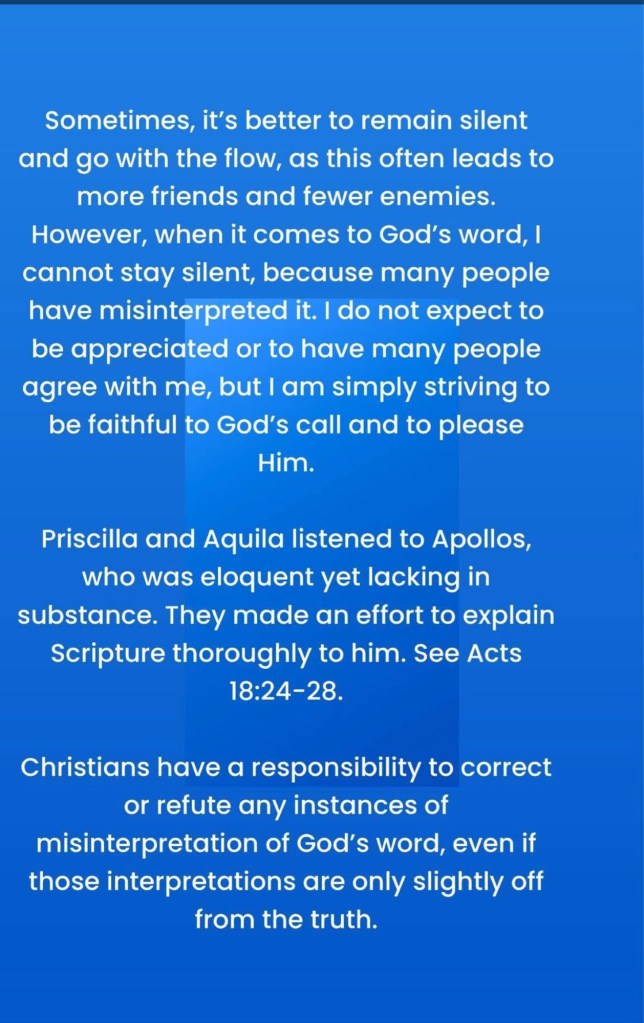
Without a doubt, no one can truly be a Christian without doctrine. Doctrine refers to a set of beliefs or teachings that define one’s faith. In the context of Christianity, doctrine encompasses the fundamental truths about Jesus Christ, His salvation, His kingdom, and other related matters. Consequently, no Christian can claim to believe in Christ Jesus without being deeply concerned about the doctrine. Paul emphasized the significance of vigilance and perseverance in one’s life and doctrine, stating, “Be vigilant about your life and doctrine. Persevere in them, for if you do, you will save both yourself and your listeners.” (1 Timothy 4:16)
Clearly, doctrine and faith are closely intertwined; it’s impossible to claim one without the other. The Christian faith is a set of doctrines centered on Christ Jesus. It’s no wonder that twice Paul condemned those who distorted the Gospel (see Galatians 1:6-7; 2 Corinthians 11:2-4). The Gospel is God’s doctrine for salvation. Ignorance and arrogance are dangerous predicaments for individuals claiming to be Christians. Be discerning and avoid falling for such lies.
The Bible alone holds the authority to definitively speak about God’s doctrine for salvation. When read and taught in its context, Scripture remains inspired and inerrant. Consequently, Christians must be aware of potential errors, human influences, or biases that may arise when they read and listen to extra-biblical literatures. Scripture quotes must always be consistent with the biblical teaching of their text. The apostle taught Christians, saying, “I have applied all these things to myself and Apollos for your benefit, brothers, that YOU MAY LEARN BY US NOT TO GO BEYOND WHAT IS WRITTEN, that none of you may be puffed up in favor of one against another.” (1 Corinthians 4:6)
Lately, with the recent events in Israel, many Christians have been making predictions about the future, claiming they are based on biblical prophecy. However, a closer look at their approach reveals that they have been quoting Scriptures without considering their context. I challenge anyone who claims to have found a prophecy about a third rebuilding of the Jewish temple in the Scriptures to provide the specific passage.
Paul gave a warning to the church, saying, “For the time is coming when people will not endure sound teaching, but having itching ears they will accumulate for themselves teachers to suit their own passions, and will turn away from listening to the truth and wander off into myths.” (2 Timothy 4:3-4)
That time occurred during Paul’s era, and unfortunately, it persists to this day. As I mentioned in my article “A Love Letter to the Church,” “since the decline in doctrinal standards has been ongoing for decades, if not centuries, defective doctrines have become the norm. Consequently, truthful biblical teachings have become indistinguishable to most Christians.” We don’t require another reformation; instead, we need a renewed interest in biblical truth. We can’t find it unless we revisit the writings of the first-century church, the Bible, and learn from there. That’s why our ministry is named “Unlearning Tradition, Relearning Scripture.” May God grant us grace to make time for this, even amidst our busy schedules. If securing our future here is important to you, I emphasize that our spiritual well-being is of utmost importance cause it’s about now and forevermore.
Paul emphasized this in his letter to the church, “Let us focus on the unseen rather than the visible. The visible is fleeting, while the unseen is eternal.” (2 Corinthians 4:18)
P.S. After encountering contradictions in the traditional teachings of the church, I made an effort to relearn Scripture. Despite knowing that Scripture is a unity, I couldn’t reconcile the traditional teachings. With the help of my seminary training, I embarked on a journey of restudying the Bible. As God promised in Proverbs 2:1-5, if we receive God’s words, treasure its commandments, and make ourselves attentive to its wisdom, yearning for understanding like that of hidden treasures, we will be given understanding and knowledge.
With utmost humility and confidence in the Lord, I share that my understanding of the Scripture has grown. By God’s grace, I have found the courage to teach and explain it in my Bible study groups. If I were solely concerned with gaining acceptance and personal benefits, would I risk challenging the prevailing popular beliefs? However, driven by concern for my own salvation and the hope of reuniting with my departed son, I could not remain silent and continue adhering to conventional Bible teachings. Recognizing that my ultimate reward lies with the Lord Jesus Christ, I have chosen to openly share the Word to honor God and out of love for His church. Ultimately, God alone is the ultimate arbiter of truth, as revealed in His sacred Bible.
Keep in mind that back in the days of Jesus Christ and the early church, the Sanhedrin, the Jewish religious order, was the recognized authority of Scripture. However, they led the people astray. Therefore, titles alone do not signify authority in conveying the truthful teachings of God’s word; correct exposition does. Hence, Paul emphasized, “Do your utmost to present yourself to God as one approved, a worker who has no need to be ashamed, rightly handling the word of truth.” (2 Timothy 2:15) Didn’t Paul uphold the doctrines of the Bible?
Peter , in the words of Acts 3:6, declared, “I possess neither silver nor gold, but in the name of Jesus Christ, I offer you what I have.” Share freely, for you freely receive. Stay updated by heading to our about page and subscribe directly to receive notifications in your inbox. Blessing!
Since June is an occasion for fathers, I am writing this letter to call on the attention of Christian fathers. Many Christian fathers are unable to minister to their families these days, perpetuating a cycle of decline. Since most Christian churches grow through birth rather than evangelism, it’s no surprise that we’re witnessing a decline in Christian leadership over time. To address this present dilemma, we must train the next generation in biblical interpretation. We should teach them how to properly explain Scripture, as people have been prioritizing communication skills over faithfulness to the content. Consequently, we see Christians adopting diverse and peculiar doctrines.
However, since the deterioration in doctrine has been occurring for decades, if not centuries, defective doctrines have become the norm. Consequently, truthful biblical teaching has become indistinguishable to most Christians.
The sanctity of the church hinges on two key aspects: right doctrine and Christian living, and these two aspects are intrinsically linked. How can we discern true Christian living if our doctrines are flawed? How can the church remain unified if each individual has their own interpretation of the church or its doctrine? Remember that Paul emphasized that true Christian unity rests on its doctrine. See Scripture below:
“As a prisoner for the Lord, I urge you to walk in a manner befitting your calling. Be humble and gentle, patient, and loving towards one another. Let us strive to maintain the unity of the Spirit in the bond of peace. We are one body and one Spirit, just as you were called to the ONE hope that belongs to your calling. We have ONE Lord, ONE faith, ONE baptism, ONE God and Father of all, who is over all, through all, and in all.
Grace has been given to each of us according to the measure of Christ’s gift. Therefore, it says, “When He ascended on high, He led a host of captives and gave gifts to men.” (In saying “He ascended,” what does it mean but that He also descended into the lower regions, the earth? He who descended is the one who also ascended far above all the heavens, so that He might fill all things.)
He gave the apostles, the prophets, the evangelists, the pastors, and the teachers to EQUIP the saints for the work of ministry and to BUILD UP the body of Christ, the church. Until we all attain to the UNITY OF FAITH (i.e. beliefs or doctrines) and knowledge of the Son of God, we will mature into men, reaching the measure of the fullness of Christ. Then we will no longer be children, tossed to and fro by the waves and carried about by every wind of doctrine, human cunning, and deceitful schemes.” Rather than SPEAKING THE TRUTH IN LOVE, we are to grow up in every way into Christ, the head of the church, from whom the whole body (i.e. the church), joined and held together by every joint, when each part works properly, makes the body grow so that it builds itself up in love. (Ephesians 4:1-16)
Love, as defined in Scripture, encompasses, rather centers on, right doctrines. So, why has the church chosen to prioritize protecting its aesthetics over its inner self or constitution (i.e., its doctrines)? Until when will Christians continue to be pretentious, claiming that everything is well with the church?
Lies, deceptions, or prosthetics can only keep those who are indifferent, naive in Scripture, or fatally attached due to relational bonds, but not the thinking, intellectually inclined, and truth-seeking Christians. Are you truly not aware of the reasons behind the church’s failures? The church has long ceased to effectively fulfill its mandate from Christ.
If you claim ignorance, then you don’t deserve to lead the church (1Timothy 3:1-13; Titus 1:5-9) . However, if you are aware of the situation, your silence and indifference are harming God’s church. Let me remind everyone of Paul’s words: “If anyone destroys God’s temple (i.e., the church), God will destroy him. For God’s temple is holy, and you are that temple.” (1 Corinthians 3:17)
Each Christian is obligated to uphold the sanctity of God’s church, particularly ministers, pastors, elders, deacons, and those who claim to be reverends.
Quoting Paul’s words: “For I wrote to you out of much affliction and anguish of heart and with many tears, not to cause you pain but to let you know the abundant love that I have for you.” (2 Corinthians 2:4)
As the saying goes, “Sharing is caring.” Let’s consider this article in the context of loving and caring for God’s church.
Peter , in the words of Acts 3:6, declared, “I possess neither silver nor gold, but in the name of Jesus Christ, I offer you what I have.” Share freely, for you freely receive. Stay updated by heading to our about page and subscribe directly to receive notifications in your inbox. Blessing!
Today we held our weekly family gathering, which includes only my wife, our two daughters, and me. We started this tradition shortly after leaving organized or conventional church. Over time, others joined us, and wanting to share the grace we’ve experienced with those attending, we opened our meetups to their family members, resulting in our Sunday gatherings. Unfortunately, due to negative comments and intrigues from people around their family members causing disharmony, learning from Scripture’s example, we decided to focus solely on those who are genuinely seeking the truth. We hope that as they become better equipped, they will reach out to their own families later.
Meanwhile, I noticed that during our online Sunday Bible studies, my family often felt left out because most of the interaction occurred with people meeting me online. They were right beside me, yet unable to participate or see screen shares. With my wife’s support, I decided to hold separate sessions exclusively for our family. As a result, I now have a second session every Sunday, in addition to our regular Bible study session.
Despite an awkward start today, I was able to communicate the importance of remaining faithful in studying God’s word. We ended the session on a positive note, and the initial discomfort faded. I pray that our devotion to studying God’s word will help them navigate the challenges and questions they face in life.
True blessings come from God’s words. We should not only hear God’s words but also strive to understand them if we desire to be the good soil described by Christ Jesus (Matthew 13:23; Luke 8:15). We came to faith not solely for ourselves but so that our lights may shine before others. This is especially true for our children and partners in life. Jesus Christ said, “No one after lighting a lamp covers it with a jar or puts it under a bed, but puts it on a stand, so that those who enter may see the light. For nothing is hidden that will not be made manifest, nor is anything secret that will not be known and come to light. Take care then how you hear, for to the one who has, more will be given, and from the one who has not, even what he thinks he has will be taken away.” (Luke 8:16-18)
Our claim to Christian faith holds no meaning unless God’s word lives within us and shines before others. As James says, “But be doers of the word, and not hearers only, deceiving yourselves.” (James 1:22)
Paul adds, “Keep a close watch on yourself and on the teaching. Persist in this, for by so doing you will save both yourself and your hearers.” (1 Timothy 4:16)
I share this as a reminder and encouragement to my Christian friends: prioritize your first ministry—your family. I use the word “first,” not “primary,” because your family is within your immediate sphere of influence. Therefore, I do not suggest they be your priority, especially if they do not align with you in faith. That’s why Jesus gave the challenge to anyone who wants to follow Him: “Do not think that I have come to bring peace to the earth. I have not come to bring peace, but a sword. For I have come to set a man against his father, and a daughter against her mother, and a daughter-in-law against her mother-in-law. And a person’s enemies will be those of his own household. Whoever loves father or mother more than Me is not worthy of Me, and whoever loves son or daughter more than Me is not worthy of Me. And whoever does not take his cross and follow Me is not worthy of Me. Whoever finds his life will lose it, and whoever loses his life for My sake will find it.” (Matthew 10:34-39)
Parents, everyone comes to faith under different circumstances. It’s rare, like us, to find faith after the loss of a loved one, such as our son. However, our circumstances shouldn’t be an excuse. For those whose families have disagreements with the faith, it becomes their ministry field. As Christians, we shouldn’t yield to opposition; instead, we should be strong in our faith. Otherwise, how will our light shine before them?
On the other hand, if family members become too destructive and resist the faith, you may need to live your faith in the midst of opposition. In such cases, we might have to adopt Christ’s words in Matthew 10:14: “And if anyone will not receive you or listen to your words, shake off the dust from your feet when you leave that house or town.” I don’t mean to abandon them; instead, we should continue to keep them in our prayers. Perhaps, by God’s grace and mercy, they too will find their way to Him in time.
Meanwhile, like a soldier preparing for a battle, Christians should be trained and discipled so that when the time comes, we are equipped to lead our once hostile family or loved ones to the faith.
The Christian life or journey is not always a smooth ride; there will always be humps and bumps. However, if we truly want to reach our destination or goal, we must persevere through the rough terrain until we achieve our objective.
The Bible, at least four times, expresses the idea that “what is impossible to man, all things are possible with God.” Therefore, we should not give up but keep our faith in God.
Peter, in the words of Acts 3:6, declared, “I possess neither silver nor gold, but in the name of Jesus Christ, I offer you what I have.” Share freely, for you freely receive. Stay updated by heading to our about page and subscribe directly to receive notifications in your inbox. Blessing!
Most people enjoy hearing the positive aspects of being a Christian. Yes, Christians are assured of God’s presence and grace. However, Christianity comes with a price. Jesus Christ called on all who desire to follow Him to bear his own cross.
“Then Jesus told His disciples, ‘If anyone would come after Me, let him deny himself and take up his cross and follow Me. For whoever would save his life will lose it, but whoever loses his life for My sake will find it. For what will it profit a man if he gains the whole world and forfeits his soul? Or what shall a man give in return for his soul?’ (Matthew 16:24-26)”
Christ Jesus carried and went to the cross in obedience to God the Father. Christians, in the same way, ought to carry our own cross in obedience to God’s word. Therefore, anything or anyone that hinders us from obeying God’s word becomes a cross we must carry if we truly want to follow Jesus Christ.
Again, Jesus Christ declared, “Whoever loves father or mother more than Me is not worthy of Me, and whoever loves son or daughter more than Me is not worthy of Me. And whoever does not take his cross and follow Me is not worthy of Me. Whoever finds his life will lose it, and whoever loses his life for My sake will find it.’ (Matthew 10:37-39)”
There are no ifs or buts in following Jesus Christ. Jesus Christ faithfully fulfilled Scripture; we, in turn, ought to fully adhere to His Word. Whatever you consider impossible, entrust it all to Jesus, so that we may faithfully follow Christ.
In Matthew’s Gospel, the disciples witnessed Jesus walking on the water. Having been assured by Christ that it was He, Peter exclaimed, “Lord, if it is you, command me to come to You on the water.” Jesus responded, “Come.” Peter then stepped out of the boat and walked on the water, eventually reaching Jesus. However, when he encountered the wind, he became frightened and began to sink, crying out, “Lord, save me!” Jesus promptly extended His hand and grasped him, asking, “Why did you doubt, you of little faith?” (Matthew 14:26-31)
Following Jesus Christ comes with a price: it demands our unwavering allegiance, commitment, and trust—an all-or-nothing proposition. That’s why faith is the key.
We are not expected to walk on water to demonstrate faith. Instead, we should trust His providential grace in our daily lives and extend grace to others, especially when we have been given more. For further reading, refer to Luke 18:17-30 and Luke 19:2-10.
Peter, in the words of Acts 3:6, declared, “I possess neither silver nor gold, but in the name of Jesus Christ, I offer you what I have.” Share freely, for you freely receive. Stay updated by heading to our about page and subscribe directly to receive notifications in your inbox. Blessing!
Some Christian pastors argue that the church vanished after Revelation 3, suggesting that this indicates the rapture of the church. However, consider the photo above: did everything around the mushroom disappear, or was the focus solely on the mushroom? This analogy suggests that the idea of a church rapture is not necessarily valid. Rather, John shifts his focus to the judgment of Old Covenant Israel. This is evident in Revelation 11:15, where the seventh angel blows his trumpet, and heavenly voices proclaim, “The kingdom of the world has become the kingdom of our Lord and of His Christ, and He shall reign forever and ever.”
In John’s Gospel (the Book of Revelation was also written by him), Christ Jesus, confronted by the Sanhedrin, the religious order of the Jews, declared, “My kingdom is not of this world. If My kingdom were of this world, My servants would have been fighting so that I might not be handed over to the Jews. But My kingdom is not of this world.” (John 18:36)
Therefore, the kingdom that Christ Jesus conquered was that of the Old Covenant Israel. In Matthew 21, when confronted by the chief priests and Jewish elders, questioning His signs and authority to teach, Jesus Christ responded, “Therefore I tell you, the kingdom of God will be taken away from you and given to a people producing its fruits” (Matthew 21:43). Now, let’s consider the language of imminence that Christ Jesus spoke to the seven churches in Revelation.
First, to Ephesus, “Remember therefore from where you have fallen; repent, and do the works you did at first. If not, I WILL COME TO YOU and remove your lampstand from its place, unless you repent. Yet this you have: you hate the works of the Nicolaitans, which I also hate. He who has an ear, let him hear what the Spirit says to the churches. To the one who conquers I WILL GRANT TO EAT OF THE TREE OF LIFE, which is in the paradise of God.” (Revelation 2:5-7)
Repentance is only possible during one’s lifetime, not after death, as demonstrated by Christ’s teachings in the story of Lazarus and the rich man (Luke 16:19-31). Therefore, Jesus’ warning is directed at the living church of Ephesus, urging them to repent before His return. Isn’t it logical then that Jesus implied His return would be in their lifetime?
Second, to Smyrna, “Don’t be afraid of what you’re about to endure. The devil is about to imprison some of you for ten days, testing your faith. Be steadfast until death, and I’ll give you the crown of life. He who has an ear, let him hear what the Spirit says to the churches. THE ONE WHO CONQUERS WON’T BE HARMED BY THE SECOND DEATH.” (Revelation 2:10-11)
The second death occurred at the final judgment of Christ Jesus, as described in Revelation 20:11-15. Concerning Christ’s deliverance and justice, refer to Luke 18:1-8, where Christ delivers a parable about an unjust judge. Jesus emphasizes the swift and imminent nature of His justice, stating that it would be speedy. I doubt the faithful Christians of Smyrna understood a millennial as the idea of such swift justice. However, it’s important to note that Christ’s teachings in Luke 18:1-8 were delivered in the context of Luke 17:20-31, where Jesus speaks about the coming of His kingdom. More importantly, in Luke 18:8, Jesus implicitly assures His disciples that His swift justice would be with them during their lifetime. Jesus said “Nevertheless, when the Son of Man comes, will he find faith on earth?” (Luke 18:8)
Third, to Pergamum, “Repent, or I’LL COME TO YOU SOON and wage war against them with the sword of my mouth. He who has an ear, let him hear what the Spirit says to the churches. To the one who conquers, I’ll give some of the hidden manna and a white stone with a new name written on it, a name known only to the one who receives it.” (Revelation 2:16-17)
Jesus prophesied that His coming to Christians in Pergamum would be imminent, not a millennium later. Why do Christians choose to complicate the straightforward statements of Christ Jesus? Keep in mind that Jesus Christ warns not to add or deduct from His Words written in Revelation: “I warn everyone who hears the words of the prophecy of this book: if anyone adds to them, God will add to him the plagues described in this book, and if anyone takes away from the words of the book of this prophecy, God will take away his share in the tree of life and in the holy city, which are described in this book. He who testifies to these things says, ‘SURELY I AM COMING SOON.’ Amen. Come, Lord Jesus!” (Revelation 22:18-20)
Fourth, to Tyatira, “HOLD ON TO WHAT YOU HAVE UNTIL I RETURN. The one who conquers and keeps My works until the end will receive authority over the nations and rule them with an iron rod, just as I received authority from My Father.” (Revelation 2:25-27)
Isn’t “until I return” an assurance of imminent arrival? Jesus Christ, once again, assures churches of John’s lifetime that they should keep the faith because He is coming soon.
Fifth, to Sardis, “remember what you received and heard. Keep it and repent. If you don’t wake up, I WILL COME LIKE A THIEF, and you won’t know when I will attack you again. However, there are still a few names in Sardis, people who haven’t defiled themselves, and they will walk with Me in white, for they are worthy. The one who conquers will be clothed in white garments, and I will never erase his name from the book of life. I will proclaim his name before My Father and before His angels. He who has an ear, let him hear what the Spirit says to the churches.” (Revelation 3:3-6)
The phrase “coming like a thief” suggests that Jesus’ return will be an unexpected event. This underscores the significance of the church’s role during this momentous occasion. If no one is present to witness it, what purpose does it serve for Christ to emphasize to the church that His return will be like a thief in the night? It’s important to remember that this message was addressed to the church during John’s time. In other words, the church wouldn’t have a precise understanding of the exact time of Christ’s return, but it would certainly be within the lifetime of John and his immediate audience.
Sixth, to Philadelphia, “I AM COMING SOON. Hold on to what you have so that no one can take away your crown. The one who conquers will become a pillar in the temple of My God. They will never leave it, and I will write on them the name of My God and the name of the city of My God, the new Jerusalem, which descends from My God from heaven, and My own new name.” (Revelation 3:11-12)
I suppose this time, it’s quite straightforward to understand. Jesus Christ had promised Christians in Philadelphia that His return would be imminent, not in the distant future of churches during John’s lifetime, but even ours, as futurists have led many to believe.
Lastly, the seventh, to Laodicea, “Behold, I STAND AT THE DOOR AND KNOCK. If anyone hears My voice and opens the door, I will come in to them and eat with them, and they will eat with Me. The one who conquers will be granted a place with Me on My throne, just as I conquered and sat down with My Father on His throne. He who has an ear, let him hear what the Spirit says to the churches.” (Revelation 3:20-22)
Jesus Christ was speaking to the church of Laodicea, not to us. This is a recurring theme in John’s writings, referring to churches in his lifetime. Unless you believe that John would remain alive, as John clarified in his Gospel that this was not what Christ had told Peter. Instead, John wrote, “Jesus said to Peter, ‘If it is My will that he (John) remain until I come, what is that to you? You follow Me!’” See John 21:20-25. Can you comprehend Christ’s declaration to Peter? Or have you been blinded by tradition to the point where it seems incomprehensible to you? Jesus Christ implicitly communicated to Peter that His return would occur during John’s lifetime.
Christ Jesus has fulfilled His purpose and promises. He declared that He alone would establish His church. The church is eternal, and even Hades has no power over it as seen in Matthew 16:18-19. The church is not just a parenthesis to Israel, its fulfillment signals the end of Old Covenant Israel. Keep in mind that “hades and death” were thrown to the lake of fire before John declared the passing of the first heaven and first earth and the coming of the new heaven and new earth (Revelation 21:1). Incidentally, the first heaven and the first earth refer to the Old Covenant, while the New Heaven and New Earth is the New Covenant. Consequently, Paul explained in 2 Corinthians 5:16-17, “From now on, therefore, we regard no one according to the flesh (that is, circumcision). Even though we once regarded Christ according to the flesh, we regard Him thus no longer. Therefore, IF ANYONE IS IN CHRIST, HE IS A NEW CREATION. The old has passed away; behold, the new has come.”
See Galatians 6:11-15, for a parallel teaching of Paul on circumcision and flesh: “See with what large letters I am writing to you with my own hand. It is those who want to make a good showing IN THE FLESH WHO WOULD FORCE YOU TO BE CIRCUMCISED, and only in order that they may not be persecuted for the cross of Christ. For even those who are circumcised do not themselves keep the law, but they desire to have you circumcised that they may boast in your flesh. But far be it from me to boast except in the cross of our Lord Jesus Christ, by which the world has been crucified to me, and I to the world. FOR NEITHER CIRCUMCISION COUNTS FOR ANYTHING, NOR UNCIRCUMCISION, BUT A NEW CREATION.”
I completely understand if my discussion here might have confused you. I was in a similar situation many years ago. However, after being persuaded by Christ’s words, I dedicated myself to a serious and sincere study of God’s word. Today, there is a resurgence of Christians embracing the authentic teachings of the Bible. If you want to understand, all you need to do is to keep your focus, read, and study the Bible. While reading the Bible, avoid getting sidetracked by unnecessary details and focus on the main subject. In God’s own time, you will fully comprehend Scripture.
Peter, in the words of Acts 3:6, declared, “I possess neither silver nor gold, but in the name of Jesus Christ, I offer you what I have.” Share freely, for you freely receive. Stay updated by heading to our about page and subscribe directly to receive notifications in your inbox. Blessing!
Peter, in the words of Acts 3:6, declared, “I possess neither silver nor gold, but in the name of Jesus Christ, I offer you what I have.” Share freely, for you freely receive. Stay updated by heading to our about page and subscribe directly to receive notifications in your inbox. Blessing!
The call for discipleship has veered off course. Many have projected their ministries as discipleship but have primarily focused on strategies. While some of these are indeed proper ways to do discipleship, those are mere forms, lacking substance. The true essence of discipleship lies in teachings about Christ Jesus, His church, salvation, and many other biblical truths. That’s the short answer to our title’s question.
In today’s context, discipleship has been centered around activities like food, games, and camaraderie, which have neglected the true essence of Christian fellowship. True fellowship is built on shared faith, belief, and a deep understanding of God’s word. It is a call for partnership, as illustrated by the passages below, which offer a comprehensive explanation of this concept.
The apostle Paul writing to a church said, “I am filled with gratitude for your constant remembrance in all my prayers for you all. I pray with joy because of your PARTNERSHIP in the gospel from the very beginning until now.” (Philippians 1:3-5)
Note that the word “partnership,” translated from the Greek word “koinōnia,” is the same Greek word translated as “fellowship”. So the ultimate objective of discipleship is to establish a fellowship or partnership.
How did the Philippians partner with Paul? First, they shared a common faith (as evident in Philippians 1:25-30). Second, they diligently supported Paul’s ministry (as demonstrated in Philippians 4:15-18).
See Acts 2:41-47, “Those who received his word were baptized, and approximately three thousand souls were added that day. They devoted themselves to the apostles’ teachings and FELLOWSHIP, breaking bread and praying together. Awe filled every soul, and many wonders and signs were performed by the apostles. All who believed were united and shared everything in common. They sold their possessions and distributed the proceeds to those in need. Day by day, they attended the temple together and shared meals in their homes. They received their food with joy and generosity, praising God and being well-liked by everyone. The Lord continued to add to their number day by day those who were being saved.”
Doubtless, Christians’ fellowship is a partnership that involves sharing God’s grace. The Apostle Paul emphasizes this in Galatians 6:6-7, stating that those who learn the word should share all good things with those who teach. He warns against deception, emphasizing that whatever one sows, they will reap. In this partnership, servants of God’s word and learners are equal partners in the ministry. It is crucial to not shortchange each other but to share all good things. Hebrews 13:16 further underscores this principle, encouraging us not to neglect doing good and sharing what we have, as such sacrifices are pleasing to God. The same truth about fellowship is evident in Romans 15:26-27 and 2 Corinthians 9:6-15.
Next passage, “For they gave according to their means, as I can testify, and beyond their means, of their own accord, begging us earnestly for the favor of TAKING PART in the relief of the saints— and this, not as we expected, but they gave themselves first to the Lord and then by the will of God to us.” (2 Corinthians 8:3-5)
In the context of Corinthians, the same Greek word for fellowship and partnership was translated “taking part.” This implies that fellowship requires involvement and, once again, a genuine concern for the common good.
Next, consider Ephesians 3:8-10, the apostle Paul said, “To me, though I am the very least of all the saints, this grace was given, to preach to the Gentiles the unsearchable riches of Christ, and to bring to light for everyone what is the PLAN of the mystery hidden for ages in God, who created all things, so that through the church the manifold wisdom of God might now be made known to the rulers and authorities in the heavenly places.”
In this passage, koinōnia refers to God’s plan that enables Christians to grasp the truths of His mystery. This passage serves as a call for a deeper understanding of God’s word. As Paul explained in Romans, “How then will they call on Him in whom they have not believed? And how are they to believe in Him of whom they have never heard? And how are they to hear without someone preaching? And how are they to preach unless they are sent? As it is written, ‘How beautiful are the feet of those who preach the good news!’” (Romans 10:14-15) Christians are called to honor those who faithfully proclaim the Gospel. Jesus Christ declared, “Truly, truly, I say to you, whoever receives the one I send receives Me, and whoever receives Me receives the one who sent Me.” (John 13:20) Be cautious not to reject or malign those who faithfully serve God’s word.
As you can see, fellowship isn’t just about spending time together. It does not simply involve playing games, eating together, but more importantly, sharing each other’s burdens, studying, and understanding God’s word.
In John’s epistle, he declared, “That which was from the beginning, which we have heard, which we have seen with our eyes, which we looked upon and have touched with our hands, concerning the word of life— the life was made manifest, and we have seen it, and testify to it and proclaim to you the eternal life, which was with the Father and was made manifest to us— that which we have seen and heard we proclaim also to you, so that you too may have FELLOWSHIP with us; and indeed our FELLOWSHIP is with the Father and with His son Jesus Christ.” (1 John 1:1-3)
John emphasizes that genuine Christian fellowship cannot be devoid of God’s truth. Christians can only be in fellowship with fellow believers. Paul declared, “Do not be unequally yoked with unbelievers. For what partnership has righteousness with lawlessness? Or what fellowship has light with darkness?” (2 Corinthians 6:14). Isn’t this truth a contradiction with our present order of the church? Are you certain you have been fellowshipping only with believers every Sunday? Isn’t that the reason so-called churches today are chaotic? In your discipleship programs, are you imparting God’s truths? Have you been diligently studying Scripture accurately? While many Christians dislike theology, it is the cornerstone of true Christian fellowship.
The Book of Revelation concludes with Christ Jesus’ final words to the church. It explains the fulfillment of all prophecy, as Scripture states, “And He who was seated on the throne said, ‘Behold, I am making all things new.’ Also, He said, ‘Write this down, for these words are trustworthy and true.’ And He said to me (John), ‘It is done! I am the Alpha and the Omega, the beginning and the end. To the thirsty I will give from the spring of the water of life without payment. The one who conquers will have this inheritance, and I will be his God, and he will be My son.’” (Revelation 21:5-7)
Unfortunately, as long as Christians have diverse interpretations of God’s Word, the truthful teachings of Christ Jesus will never be universally proclaimed. However, this does not mean that we cannot know God’s truth by our own. We simply need to study the Word of God diligently.
Once more, Paul cautions Christians, “I appeal to you, brothers, to watch out for those who cause divisions and create obstacles contrary to the doctrine that you have been taught; avoid them. For such persons do not serve our Lord Christ, but their own appetites, and by smooth talk and flattery they deceive the hearts of the naive.” (Rom 16:17-18) Mind you, Paul wasn’t referring to what has been taught today but the teachings of his generation— the Scripture.
John emphasizes the significance of adhering to God’s truth. He asserts that those who disregard Christ’s teachings do not have God. Conversely, those who remain steadfast in his teachings are blessed with the Father and the Son. Additionally, John warns against accepting individuals who bring false teachings into one’s home or offer greetings, as such actions can contribute to their wicked deeds. (See 2 John 1:9-11.)
Discipleship centered around God’s word is the true essence of discipleship. It involves learning and living in accordance with His teachings. Jesus Christ affirms, “If you abide in My word, you are truly My disciples, and you will know the truth, and the truth will set you free.” (John 8:31-32) Discipleship is not a program or strategy; it is a call to follow Jesus Christ and abide in His Word.
In John 6, after Jesus Christ unveiled truths about Himself and the purpose of His coming, His large following dwindled. Scripture stated, “When many of His disciples heard it, they said, ‘This is a difficult saying; who can listen to it?’ (John 6:60). After this, many of His disciples turned back and no longer walked with Him” (John 6:66). Are we superior to Christ Jesus? Are we more adept at presenting God’s truth that we measure ministry success based on the number of people joining Christian programs? Or perhaps these programs fail to impart the challenging truths about following Jesus Christ? Perhaps these programs lack substance; they are designed to entice people rather than teach them to bear their crosses and follow Christ Jesus? Christ’s parable of the sower cannot be a mistake. Consider that only one type of soil is suitable—the one that listens to God’s word and comprehends. Perhaps Christians ought to carefully assess their programs if they have gained widespread acceptance. Verify if their programs indeed are aligned with God’s word. Christians’ ministry is never measured by numbers but by substance.
Peter’s message at Pentecost was a resounding success, attracting three thousand souls to faith. Could this number be a majority compared to the vast crowd gathered at Pentecost? Scripture declares, “And Isaiah cries out concerning Israel: ‘Though the number of the sons of Israel be as the sand of the sea, only a remnant of them will be saved, for the Lord will carry out His sentence upon the earth fully and without delay.’ And as Isaiah predicted, ‘If the Lord of hosts had not left us offspring, we would have been like Sodom and become like Gomorrah’” (Romans 9:27-29). Paul further emphasized God’s words, stating, “So too at the present time, there is a remnant, chosen by grace” (Romans 11:5). A remnant certainly does not represent the majority; rather, it is a small remaining quantity of a total number. Do you dare say Scripture was wrong? Or perhaps, Christian ministers today are better than Jesus Christ? Instead of focusing on the ninety-nine who never realized they too were lost, let’s focus on the one sheep that was lost but has returned. Isn’t that the teachings of Christ Jesus in His parable of the lost sheep? (Luke 15:1-7)
Jesus Christ declared, “Enter by the narrow gate. For the gate is wide and the way is easy that leads to destruction, and those who enter by it are many. For the gate is narrow and the way is hard that leads to life, and those who find it are few.” (Matthew 7:13-14)
Be cautious, as the Bible, particularly in Proverbs, twice warns, “There is a way that appears to be right to a man, but its end leads to death.” (Proverbs 14:12; 16:25)
Peter, in the words of Acts 3:6, declared, “I possess neither silver nor gold, but in the name of Jesus Christ, I offer you what I have.” Share freely, for you freely receive. Stay updated by heading to our about page and subscribe directly to receive notifications in your inbox. Blessing!
Christians have always been eagerly anticipating a better tomorrow—a day when all our earthly troubles would cease to exist. Most Christians believe this will happen upon the return of Jesus Christ.
The LORD of hosts, the God of Israel, declared in Scripture, “For I know the plans I have for you,” declares the LORD, “plans for welfare and not for evil, to give you a future and a hope,”Jeremiah 29:11. This passage has been misinterpreted and misused, often falsely taught as a guarantee of material prosperity. One possible reason for this misinterpretation is the translation of the Hebrew word “shâlôm,” which means “peace or tranquility,” into “prosper” in the New International Version (NIV).
Jeremiah 1:1-2 introduces Jeremiah’s ministry, which began during the 13th year of Josiah’s reign as the king of Judah. The Bible Hub timeline suggests that Jeremiah’s ministry started around 627 B.C. and lasted for approximately 40 years. This ministry culminated in the downfall of the nation of Judah and the destruction of its capital, Jerusalem, in 586 B.C., as recorded in Jeremiah 52.
It’s fascinating to observe that, as per God’s Word in Jeremiah 29:10, the rebuilding of the temple was completed in 516 B.C., precisely seventy years after the Jews were exiled to Babylon (586 B.C.). Subsequently, the exiles returned and joyfully celebrated the dedication of God’s house (Ezra 6:14-16).
Jeremiah 29:11 therefore proclaims God’s promise of “peace” to His people, even amidst severe judgment against Judah. This may seem contradictory, but it’s not. It’s crucial to understand that God declared a seventy-year captivity and exile against the Jews as a punishment for their sin before their return and the rebuilding of the city and the temple (see Jeremiah 25:12; 29:10). In retrospect, we know that after their return and the rebuilding of Jerusalem and its temple, most of the Jews remained unfaithful to the LORD God, breaking His Covenant (see Malachi 1:14; 3:8-9). How then do we make sense of Jeremiah 29:11? Surely, God cannot be promising one thing then failing to deliver.
Let us explore the full promise of God in Jeremiah 29:11-14.
“For thus says the LORD: When seventy years are completed for Babylon, I will visit you, and I will fulfill to you My promise and bring you back to this place. For I know the plans I have for you, declares the LORD, plans for welfare and not for evil, to give you a future and a hope. Then you will call upon Me and come and pray to Me, and I will hear you. You will seek Me and find Me, when you seek Me with all your heart. I will be found by you, declares the LORD, and I will restore your fortunes and gather you from all the nations and all the places where I have driven you, declares the LORD, and I will bring you back to the place from which I sent you into exile.”
Daniel, God’s prophet after Jeremiah’s ministry, was a young man among the exiles in Babylon (Daniel 1:1-6). After seventy years had passed, Daniel remembered Jeremiah’s prophecy of Israel’s return and yearned for its restoration (Daniel 9:1-2). He then prayed to God for mercy and the rebuilding of God’s temple (Daniel 9:17-19). However, to his dismay, God announced a second desolation of the Jewish temple before forgiveness, atonement, and restoration to God’s presence becomes a reality (Daniel 9:20-27). Notably, God used the number “seventy,” but instead of years, it was seventy prophetic weeks (Daniel 9:24), culminating in the final “week” or “one seven.” Additionally, Daniel aligned God’s judgment of Israel with that of Deuteronomy 28-31, stating, “As it is written in the Law of Moses” (Daniel 9:13) – blessings for obedience, and God’s curse for disobedience.
I won’t delve into explaining Daniel 9:24-27 because it would significantly extend the length of this blog post. However, it’s important to remember that all prophecies will be fulfilled when the “abomination of desolation” spoken by Daniel has come to pass (Dan 9:26-27; Matt 24:15). Interestingly, Jesus Christ specifically predicted that the event would occur when the temple was destroyed, emphasizing its finality (Matthew 23:36-38; 24:2-3, 14-21). The second and final destruction of the Jewish temple was future both to Daniel and at the time of the incarnate Jesus Christ. Check out two key verses from Matthew 24:14-21.
“So when you see the abomination of desolation spoken of by the prophet Daniel, standing in the holy place (let the reader understand),” Matthew 24:15 says. Without a doubt, Jesus was referring to Daniel 9:24-27. Of utmost importance, Jesus declared, “For then there will be great tribulation, such as has not been from the beginning of the world until now, and never will be,” Matthew 24:21, a reference to Daniel 12. This declaration highlights the end of the Old Covenant Israel.
As I have mentioned earlier, the desolation of the temple occurred in 70 A.D. Understand also that though there was a return of the Jews in 1948, unlike the first return, the temple was never rebuilt. Without the temple, the Jews ceased to be God’s people. God has removed His dwelling presence from Old Covenant Israel.
So back to Jeremiah 29:12-13, God next declared, “Then you will call upon Me and come and pray to Me, and I will hear you. You will seek Me and find Me, when you seek Me with all your heart.” Interestingly, Jesus Christ spoke the reverse to the unbelieving Jewish religious leaders. See John 7:33-34. “Jesus then said, ‘I will be with you a little longer, and then I am going to Him who sent Me. You will seek Me and you will not find Me. Where I am you cannot come.’”
Now, comparing Jeremiah 29:12-13 with that of Isaiah 65:24, God declared, “Before they call, I will answer; while they are still speaking, I will hear.” It’s the same comforting assurance saying that God now hears—an exact contrast to God’s pronouncement of judgment against Israel, that even if they call upon the LORD, He would not listen. See Jeremiah 11:11 & 14:11-12; Isaiah 1:15; Ezekiel 8:17-18; Micah 3:4; Zechariah 7:13-14; Luke 13:24-28; all spoken against Old Covenant Israel.
Finally, see Jeremiah 29:14, God said, “I will bring you back to the place from which I sent you into exile.” From where were the Jews exiled? Jerusalem, isn’t it? Amazingly, Isaiah 65 spoke of a New Jerusalem, which was also spoken by John in Revelation.
Once again, let’s compare Isaiah 65:17-19 with that of Revelation 21:1-4. In Isaiah, God said, “For behold, I create new heavens and a new earth … I will rejoice in Jerusalem and be glad in My people; NO MORE SHALL BE HEARD IN IT THE SOUND OF WEEPING AND THE CRY OF DISTRESS.” Now in Revelation 21:1-4, “Then I saw a new heaven and a new earth, for the first heaven and the first earth had passed away, and the sea was no more. And I saw the holy city, new Jerusalem, coming down out of heaven from God … HE WILL WIPE AWAY EVERY TEAR FROM THEIR EYES, AND DEATH SHALL BE NO MORE, NEITHER SHALL THERE BE MOURNING, NOR CRYING, NOR PAIN ANYMORE, for the former things have passed away.”
Aren’t both passages expressing the idea of “peace and tranquility”? Precisely God’s promise in Jeremiah 29:11. Reading from the Christian Standard Bible,it says, “For I know the plans I have for you”— this is the LORD’s declaration —“plans for your well-being [Shâlôm, meaning peace in the Hebrew language], not for disaster, to give you a future and a hope.”
Therefore, in Jeremiah 29:14, God’s promise of return isn’t about the physical land of Jerusalem, but the heavenly one. The Jewish return and rebuilding of the temple during the time of Nehemiah, Zerubbabel and Ezra fell short of fulfilling God’s promise. Now, consider this: in Revelation, John was in the tribulation, exiled to Patmos (Rev 1:9), as prophesied by Jesus Christ in Matthew 24:9-21 to His apostles. He foresaw the imminent arrival of God’s New Heaven and New Earth, the heavenly Jerusalem, as well as the passing of the Old Covenant Jerusalem (Revelation 21:1-2). Therefore, Jeremiah 29:11-14, Isaiah 65:17-25, and Revelation 21-22 all spoke about the time of the New Creation.
Do we still see the Jewish temple standing in Jerusalem? The Dome of Rock now stands at the very site of the former Herod’s temple-a restoration and expansion of Zerubbabel’s second temple. This was the temple where Jesus taught the Scripture occasionally, which was destroyed by the Romans in 70 A.D., just as prophesied by Christ Jesus, therefore bringing to an end the Jewish Age (click and read Matthew 23:36-24:3; 24:14-21).
See Luke’s account concerning God’s vengeance against Israel and its desolation. “But when you see Jerusalem surrounded by armies, then know that its desolation has come near. Then let those who are in Judea flee to the mountains, and let those who are inside the city depart, and let not those who are out in the country enter it, for these are days of vengeance, to fulfill all that is written.” (Luke 21:20-22)
The desolation of Jerusalem marked the end of the Old Covenant Israel-the Jewish age. As Paul declared in 2 Corinthians 5:17, “Therefore, if anyone is in Christ, he is a new creation. The old had passed away; behold, the the new has come.” Undoubtedly, Christians now experience the blessings of God’s New Covenant. While we may still encounter challenges worldwide, we should keep the peace of God—that is, our belief and faith, knowing that He holds our future in His hands. In reality, our tomorrow is already here; Christ Jesus has conquered the curse of Adam’s fall. All we need to do is persevere in our faith, regardless of our current temporal circumstances.
Truly ironic that modern Christianity has been teaching the reverse. They insist the Jews continue to be God’s people despite them denying Christ Jesus. To justify their teachings, they invented a future coming of Jesus Christ and a second grace for Israel, contradicting everything that Paul had taught in Romans 9-11; Galatians 3-5, and his many other letters. I surmise this happened because Christians fail to study the Bible. Instead of delving into Scripture, they chose to study from men’s writings. Rather than exegeting the Scripture, they chose to study Bible commentaries. Keep in mind that only the Bible is inerrant; all else has erred.
With the arrival of the New Heaven and the New Earth, God’s New Covenant finally became a full reality. Revelation 21:22-23 said, “And I [John the Beloved] saw no temple in the city, for its temple is the Lord God the Almighty and the Lamb. And the city has no need of sun or moon to shine on it, for the glory of God gives it light, and its lamp is the Lamb.” In John 2:19, the incarnate Jesus Christ declared, “Destroy this temple, and in three days I will raise it up,” to which John later explained in his Gospel, “But He [Jesus Christ] was speaking about the temple of His body (John 2:21)”. The apostle Paul then explained the church was the body of Christ Jesus, see Ephesians 2:19-22. “So then you [Gentile Christians] are no longer strangers and aliens, but you are fellow citizens with the saints [1st Century Jewish Converts to Christianity] and members of the household of God, built on the foundation of the apostles and prophets [Scripture, both Old and New Testament], Christ Jesus Himself being the cornerstone, in whom the whole structure, being joined together, grows into a holy temple in the Lord. In Him you also are being built together into a dwelling place for God by the Spirit.”
With the coming of Christ Jesus, Galatians told us there is no longer distinctions between Jews and Gentiles. All that are in Christ Jesus are Abraham’s offspring, heirs according to His promise. Click and read Galatians 3:25-29. So why does Modern Christianity insist that Jews today remains to be people of God? Aren’t they digressing from the true message of the Gospel?
Incidentally, for proper biblical ecclesiology (Doctrine of the Church), understand that only Christ Jesus builds His Church and no one else. The incarnate Jesus Christ declared in Matthew 16:18, “And I also say to you that you are Peter, and on this Rock, I will build My Church, and the gates of Hades will not overpower it.” Hades not having power over the Church means death no longer has power over the Church. Therefore, salvation and eternal life have become a reality, not just a promise. Christ Jesus is the Rock, not Peter; click and read 1Co 10:4.
Jesus Christ promised His disciples “peace” before His betrayal, crucifixion, and death. See John 14:27, where Jesus said, “Peace I leave with you; My peace I give to you. Not as the world gives do I give to you. Let not your hearts be troubled, neither let them be afraid.” Doesn’t this imply that believing in Christ Jesus is the key to finding peace even in difficult times? The same “peace” that Paul urges Christians to have in his letter to the Philippians (see Philippians 4:6-7). Therefore, in Scripture, “peace” is synonymous with faith and belief. In other words, Christians cannot claim faith and belief without experiencing God’s peace. That is, trusting Him that everything will be well because He is in control.
Jeremiah 29:11 is God’s promise of peace fulfilled through Christ Jesus’ death, resurrection, ascension, and return, completing therefore His New Covenant. Yes, Jesus has already secured our future, and it’s here now for all who believe in Him. To truly comprehend this, we must cultivate faith and trust in His word, as He consistently communicated through the Bible.
Peter, in the words of Acts 3:6, declared, “I possess neither silver nor gold, but in the name of Jesus Christ, I offer you what I have.” Share freely, for you freely receive. Stay updated by heading to our about page and subscribe directly to receive notifications in your inbox. Blessing!
Although others may teach about a possible chance even after death, the Bible is unequivocal that our sole opportunity for salvation lies in this present life or existence. Jesus Christ, through a parable, imparted this profound truth.
“There was a rich man who was clothed in purple and fine linen and who feasted sumptuously every day. And at his gate was laid a poor man named Lazarus, covered with sores, who desired to be fed with what fell from the rich man’s table. Moreover, even the dogs came and licked his sores. The poor man died and was carried by the angels to Abraham’s side. The rich man also died and was buried, and in Hades, being in torment, he lifted up his eyes and saw Abraham far off and Lazarus at his side. And he called out, ‘Father Abraham, have mercy on me, and send Lazarus to dip the end of his finger in water and cool my tongue, for I am in anguish in this flame.’ But Abraham said, ‘Child, remember that you in your lifetime received your good things, and Lazarus in like manner bad things; but now he is comforted here, and you are in anguish. And besides all this, between us and you a great chasm has been fixed, in order that those who would pass from here to you may not be able, and none may cross from there to us.’ And he said, ‘Then I beg you, father, to send him to my father’s house— for I have five brothers—so that he may warn them, lest they also come into this place of torment.’ But Abraham said, ‘They have Moses and the Prophets; let them hear them.’ And he said, ‘No, father Abraham, but if someone goes to them from the dead, they will repent.’ He said to him, ‘If they do not hear Moses and the Prophets, neither will they be convinced if someone should rise from the dead.’” (Luke 16:19-31)
Here are some detailed facts:
After death, both Lazarus and the rich man found themselves in Hades. Hades was the place of death before God’s final judgment at the coming of Christ Jesus (as mentioned in 2 Corinthians 5:10, John 5:28-29; Revelation 20:11-14, and so on).
The rich man, who had lived luxuriously and cared little for Lazarus’ destitute state, ended up in the place of torment. In contrast, Lazarus, despite being poor, was also in Hades but in a blissful state, in Abraham’s bosom.
Perhaps you might ask, “Why did Lazarus find himself in a state of bliss? Was it simply because he was poor?” The answer to that question wasn’t explicitly stated in the story, but rather in the context of the parable. See Luke 16:13-16:
Jesus Christ said, “No servant can serve two masters, for either he will hate the one and love the other, or he will be devoted to the one and despise the other. You cannot serve God and money.” The Pharisees, who were lovers of money, heard all these things, and they ridiculed Him. And He (Jesus) said to them, “You are those who justify yourselves before men, but God knows your hearts. For what is exalted among men is an abomination in the sight of God. “The Law and the Prophets were until John; since then the good news of the kingdom of God is preached, and everyone forces his way into it.”
The parable was spoken in response to the Pharisees’ hardness of heart. They refused God’s offer of salvation because they had much to give up—they were lovers of money. Consequently, by inference, Lazarus, despite having no riches, was dependent on God’s mercy and trusted in His grace, which explains why he ended up in Abraham’s side. Keep in mind that Abraham was the father of faith, as Paul states in Romans 4:9-12. Therefore, by implication, Lazarus also, lived in faith.
Hoping that this simple explanation would clear out myths about death and heaven. Paul, writing to the Corinthians, said, “I know a man in Christ who fourteen years ago was caught up to the third heaven—whether in the body or out of the body I do not know, God knows. And I know that this man was caught up into paradise—whether in the body or out of the body I do not know, God knows— and he heard things that cannot be told, which man may not utter.” (2 Corinthians 12:2-4)
Easton’s Bible Dictionary explain: According to the Jewish notion there were three heavens,
Clearly, at the time of Paul, heaven remained inaccessible to man. He was only privileged to glimpse a vision of heaven even before Christ had returned.
Furthermore, in Christ’s parable, Jesus made it clear that there was a vast chasm between the realms of the living and the dead, and no one from either side could cross over. Therefore, after death, the destination of people was sealed, and they were only waiting for the final judgment. Hence, the idea of praying for the dead is nowhere in the Bible.
Jesus asserted that no one would be permitted to return to the realm of the living after death. Christ further explained that even those who had been informed about His resurrection would ultimately end up in the place of torment in Hades because they had failed to believe the teachings of Moses and the Prophets—a reference to the Old Testament Scriptures. Jesus, speaking about His resurrection, said, “These are My words that I spoke to you while I was still with you, that everything written about Me in the Law of Moses, the Prophets, and the Psalms must be fulfilled.” (Luke 24:44)
The entire Bible is about Jesus Christ. Therefore, it is crucial to be careful not to reject His Word.
Yes, God’s offer of salvation through Christ Jesus is a second chance. Better yet, a limited chance because it is only valid while we are still alive. Once we die, our time is up. Go, therefore, and share the Gospel with your loved ones, family, and friends. Knowing that it’s their chance of a lifetime.
Peter, in the words of Acts 3:6, declared, “I possess neither silver nor gold, but in the name of Jesus Christ, I offer you what I have.” Share freely, for you freely receive. Stay updated by heading to our about page and subscribe directly to receive notifications in your inbox. Blessing!
One of the many incredible prophecies of Christ Jesus could be that of His death and resurrection. In Matthew 12:38, when challenged for a sign, Jesus stated, “For just as Jonah was three days and three nights in the belly of the great fish, so will the Son of Man be three days and three nights in the heart of the earth” (Matthew 12:40).
In John 2:19, again being asked for a sign, Jesus replied, “Destroy this temple, and in three days I will raise it up” (John 2:19). John explained that Jesus was talking about the temple of His body (John 2:21)
The resurrection of Jesus after three days and three nightsin the grave is clearly a central proof that He indeed was the Christ. Sadly, however, the modern church has diminished Christ Jesus’ declaration by insisting on a Friday death and burial, and a Sunday resurrection. This fascination with Sunday has no roots in the early church; rather, it’s a modern concept. Tracing its beginning almost always leads back to the time of Constantine. When politics and religion intermingle, there is always a risk. Christians should remember that Jesus Christ declared to the Jewish religious leaders, “My kingdom is not of this world. If My kingdom were of this world, My servants would have been fighting, that I might not be delivered over to the Jews. But My kingdom is not from the world” (John 18:36).
It is indeed difficult to pinpoint the exact day Jesus was crucified. However, if He was to be the sacrificial lamb acceptable to God, He must have fulfilled Scripture. The slaying of the Passover lamb has always occurred on the 14th of Nisan, regardless of the day of the week. On the 15th of Nisan, that is always a special or high Sabbath (John 19:31; Leviticus 23:6-8). Christ’s body was hurriedly placed in the burial site before dusk, just before the special or high Sabbath, as no work can be done on a Sabbath (John 19:40-42).
Since the 14th and 15th of Nisan can fall on different days, similar to how our birthdays shift each year due to the calendar cycle, the number of days between Passover and the Feast of Firstfruits will vary annually. Considering that Jesus Christ was fulfilling His prophecy of three days and three nights, these must be the exact days in between required to fulfill that prophecy.
The Feast of Firstfruits, however, cannot occur on just any day; it always takes place on the first regular Sabbath following the High Sabbath or the 15th of Nisan. Yes, the resurrection of Jesus Christ did not occur on a Sunday but rather on a regular Sabbath. Refer to Leviticus 23:10-11:
“Speak to the people of Israel and say to them: ‘When you enter the land that I am giving you and harvest its crops, you shall bring a sheaf of the firstfruits of your harvest to the priest. He shall wave the sheaf before the LORD, so that you may be accepted. On the day after the (15th of Nisan) Sabbath, the priest shall wave it.’” Hence, Paul refers to Jesus Christ as the firstfruits in 1 Corinthians 15:23.
As I have explained, during the Passover festival week, there would be two Sabbaths: the special or high Sabbath (15th of Nisan) and the regular Sabbath. Leviticus 23:10-11 refers to the day (or Sabbath) after the high or special Sabbath. How do I know this for sure? Because the following festival, the Feast of Weeks (commonly known as Pentecost), is counted starting from the day the wave offering of Firstfruits has been presented, which is the regular Sabbath. See Leviticus 23:15-16:
“You shall count seven full weeks from the day (Sabbath) after the Sabbath (15th of Nisan), starting from the day (Sabbath) you brought the sheaf for the wave offering. You will count fifty days to the day after the seventh Sabbath. Then you shall present a grain offering of new grain to the LORD.”
Contrary to common Christian teachings and traditions, Pentecost always falls on a Sabbath, not a Sunday. This distinction is significant for Jewish people. As a result, many modern Christians’ emphasis on Sunday observance has led Jews to reject Jesus Christ and the Gospel, as they believe Jesus did not fulfill Scripture.
So here lies the cause of confusion: modern Christians have been observing the traditions of men rather than adhering to Scripture. Don’t we Christians realize that the words of Jesus Christ, spoken against the Jewish religious leaders, are very much applicable to our discussion here? See Mark 7:6-8:
“Jesus said, ‘Well did Isaiah prophesy of you hypocrites, as it is written: ‘This people honors Me with their lips, but their heart is far from Me; in vain do they worship Me, teaching as doctrines the commandments of men.’ ‘You leave the commandment of God and hold to the tradition of men.’”
Whenever Christians neglect Scripture and follow the traditions of men, we misread and misapply the Bible. To further prove my point, let’s look at New Testament accounts concerning the resurrection. See Mark 16:1-2:
“When the Sabbath was past, Mary Magdalene, Mary the mother of James, and Salome bought spices so that they might go to anoint Him. Very early on the first day of the week, when the sun had risen, they went to the tomb.”
Mark referred to two Sabbaths in his narrative. Here, the first one is correctly translated into English as “Sabbath,” pointing to the special or high Sabbath. The second, which is translated as “first day of the week,” actually refers to the first regular weekly Sabbath. A quick check on an interlinear Bible would show both terms, “Sabbath” and “week,” were derive from the Greek word #4522, “sabbaton.”
Mary Magdalene and the other women visited the empty tomb on the regular Sabbath, not on a Sunday. This misinterpretation may have arisen during the time of Constantine, as the Romans had an affinity for the Sun God, Sol Invictus. I encourage you to conduct your own research on this topic.
Jesus Christ fulfilled three of the feasts outlined in Leviticus 23. As I mentioned in a previous post, these festivals served as rehearsals, anticipating the coming of the Messiah. This explains the excitement of the Jews when Jesus entered Jerusalem on a donkey (John 12:12-15).
The three festivals are the Feasts of Passover and Unleavened Bread (crucifixion), and the Feast of Firstfruits (resurrection). Please see Scripture for confirmation.
Paul explains in 1 Corinthians 5:7-8: “Cleanse out the old leaven that you may be a new lump, as you really are unleavened. For Christ, our Passover lamb, has been sacrificed. Let us therefore celebrate the festival, not with the old leaven, the leaven of malice and evil, but with the unleavened bread of sincerity and truth.”
Jesus Christ was the Passover lamb; through His sacrifice and offering, He made all who believe in Him righteous (unleavened) in God’s sight.
Furthermore, Paul explained in 1 Corinthians 15:23: “But each in his own order: Christ the firstfruits, then at His coming those who belong to Christ.”
Without a doubt, Paul referred to Christ’s resurrection as the fulfillment of the Feast of Firstfruits, thus designating Jesus as the firstfruits.
Before I conclude this discussion, I want to highlight what Luke’s Gospel reveals about the expectations of the Jews, particularly Jewish Christians. You can find this in Luke 24:13-27. In this account, the risen Lord Jesus Christ first listened to the conversation of two of His disciples before engaging with them. One of the disciples expressed their hopes by saying, “But we had hoped that He (Jesus) was the one to redeem Israel. Yes, and besides all this, it is now the third day since these things happened” (Luke 24:21).
Christ’s resurrection comes with the certainty that He would be buried for three days and three nights before rising from the dead. The Jewish religious leaders understood the significance of Jesus fulfilling His prophecy, which is why they placed guards outside the tomb to prevent any human intervention. You can find this account in Matthew 27:62-65. Ultimately, Jesus rose from the dead exactly as He had predicted—”on the third day.”
The purpose of sharing this information is not to confuse or cause discord among Christians. Instead, it aims to educate, clarify, and explain the truths of Scripture, so that Christians may find unity in their faith. Also, it serves to affirm inerrancy of the New Testament Scripture.
Many Christians may easily dismiss this discussion by saying, “Oh, it’s a small thing. The important thing is that I believe in Jesus.” However, we must remember that Christ Jesus warned us to be careful not to become a stumbling block for others in their faith. We live in an age where information is readily available, but both falsehoods and truths are prevalent on the internet. Those who evaluate, study, and scrutinize the Bible alongside Christian claims and practices often choose not to engage with Christianity due to inconsistencies in its teachings, claims, and practices.
Each Christian is a defender of the faith. While being unable to explain God’s word is one issue, being part of the misrepresentation is another matter entirely. It’s essential to recognize that our belief in Christ Jesus comes with a responsibility to others. Jesus Christ and the apostles warned us about the consequences of causing others to stumble in their faith.
The Gospel of Jesus Christ is God’s power for salvation (Romans 1:16). We Christians possess immense power. Isn’t it often said, “With great power comes great responsibility”? This is the story of Jesus Christ presented in the Gospels from the Feast of Passover to that of the Firstfruits. We know Jesus is the Christ because He fulfilled Scripture.
Peter, in the words of Acts 3:6, declared, “I possess neither silver nor gold, but in the name of Jesus Christ, I offer you what I have.” Share freely, for you freely receive. Stay updated by heading to our about page and subscribe directly to receive notifications in your inbox. Blessing!








 Unlearning Tradition, Relearning Scripture