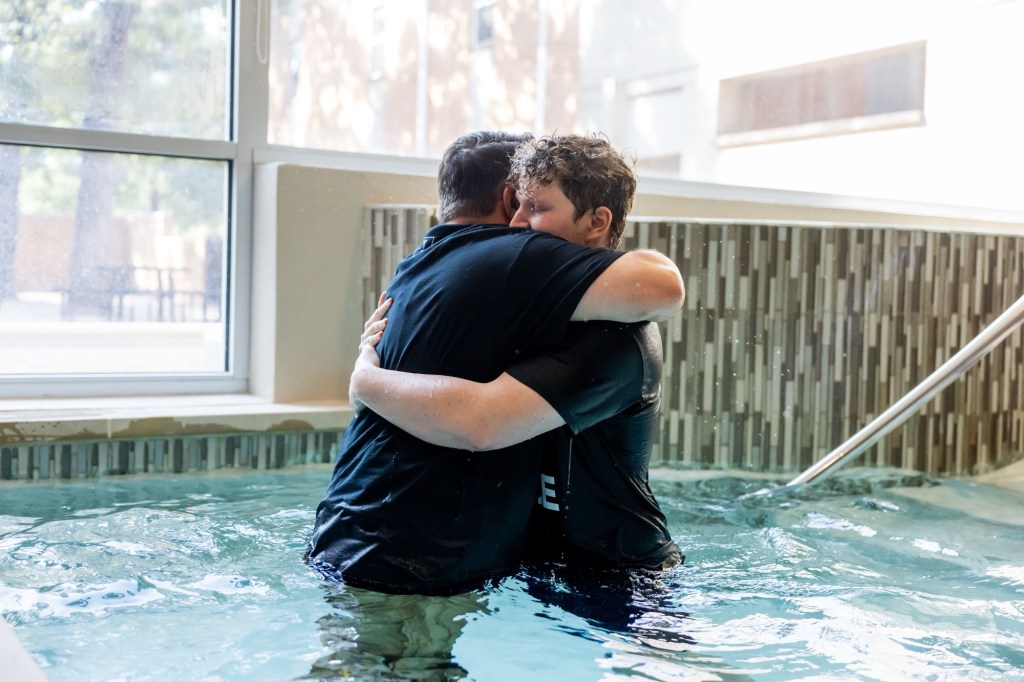
John the Baptist declared, “I have baptized you with water, but the Lord will baptize you with the Holy Spirit.” (Mark 1:8) After His resurrection, Jesus appeared for forty days, proving His resurrection and teaching about the kingdom of God. (Acts 1:3) He said, “You heard from Me; for John baptized with water, but you will be baptized with the Holy Spirit not many days from now.” (Acts 1:4–5) This was fulfilled in the outpouring of the Spirit at Pentecost (Acts 2:1–4):
> “When the day of Pentecost arrived, they were all together in one place. And suddenly there came from heaven a sound like a mighty rushing wind, and it filled the entire house where they were sitting. And divided tongues as of fire appeared to them and rested on each one of them. And they were all filled with the Holy Spirit and began to speak in other tongues as the Spirit gave them utterance.”
Peter, filled with the Holy Spirit, identified this event as the fulfillment of Joel’s prophecy (Acts 2:14–21), declaring that God’s Spirit would be poured out on all flesh, culminating in salvation for “everyone who calls upon the name of the Lord” (Acts 2:21).
Jesus had earlier told Nicodemus that a person must be “born of water and the Spirit” to enter God’s kingdom (John 3:5). He later told His disciples, those who had stayed with Him, saying, “The words that I have spoken to you are spirit and life” (John 6:63), showing the deep connection between the Spirit and the Word of God. Paul affirms this in Ephesians 5:25–26, saying Christ sanctifies the Church by “the washing of water with the Word.”
John’s baptism was a baptism of repentance, pointing forward to Christ (Acts 19:1–7). But the true baptism that saves is the baptism of Jesus—by the Word, which is the Spirit. As John himself said, “He must increase, but I must decrease” (John 3:30w). When the Gospel is proclaimed, the Spirit comes with it, as seen in Acts 10:44–46, where the Holy Spirit fell on Gentiles simply by hearing the Word, without any laying on of hands.
Scripture also clearly states that Jesus Himself never baptized with water (John 4:1–2). Paul declared, “For Christ did not send me to baptize but to preach the gospel, and not with words of eloquent wisdom, lest the cross of Christ be emptied of its power.” (1 Corinthians 1:17) Salvation, therefore, is by grace through faith (Ephesians 2:8–22), with the Spirit and the Word working as one. Peter confirms that Scripture is Spirit-inspired (2 Peter 1:20–21), and Paul affirms that the Gospel—the law of the Spirit of life (i.e., the Gospel)—frees believers from the law of sin and death (Genesis 2:16-17; Romans 8:1–4).
In essence, the baptism of the Holy Spirit is the cleansing and life-giving work of God through His Word, fulfilling John’s prophecy about Jesus Christ and securing eternal life for all who believe in His Word.
The Bible declares:
“In the beginning was the Word, and the Word was with God, and the Word was God.” (John 1:1)
“And the Word became flesh and lived among us. We have seen His glory, the glory as of the only Son from the Father, full of grace and truth.” (John 1:14)
“For from His fullness we have all received, grace upon grace. For the law was given through Moses; grace and truth came through Jesus Christ.” (John 1:16-17)
Here’s an honest question then: Why do some pastors imply there’s something special to be baptized at the Jordan River? Isn’t baptism at the Jordan River the epitome of John’s baptism, which cannot save one who has not received the Holy Spirit? If we have been baptized as Christians, is it not then a regression to submit ourselves for baptism at the Jordan River?
Christ’s Great Commission in Matthew 28:19-20 calls us not only to baptize but also to teach believers to obey all that He has commanded. While water baptism is an outward sign of faith and an important act of obedience, the mission of the Church goes beyond this initial step. If we recognize that the Holy Spirit works through the Word of God, then the emphasis must be on guiding Christians to live according to His Word—allowing the Spirit to transform their hearts and actions. Assurance of salvation is vital, but it should be coupled with ongoing discipleship, where believers are taught, challenged, and equipped to follow the commands of Christ daily. True discipleship involves a life shaped by the Word, not just a moment of ritual.
The parable of the sower, as taught by Jesus Christ, affirms that genuine Christian transformation occurs when one hears and truly understands the Word of God (Matthew 13:23). In harmony with this, Paul teaches in Romans that faith is born through hearing—specifically, by hearing the words of Christ (Romans 10:17).
Here’s the call for all of us Christians: If we truly desire to improve the church, we must return to the Bible. Let us relearn the authentic teachings of Scripture and let go of traditions that have, over time, weakened the church. Together, we can make the church shine as the true light of the world by faithfully reflecting the teachings of Jesus Christ.
Peter, in the words of Acts 3:6, declared, “I possess neither silver nor gold, but in the name of Jesus Christ, I offer you what I have.” Share this article freely, for you freely receive. Take note, underlines and highlights are clickable links for definitions or Bible references. Stay updated by heading to our about page and subscribe directly to receive notifications in your inbox. Blessings!