Peter, in the words of Acts 3:6, declared, “I possess neither silver nor gold, but in the name of Jesus Christ, I offer you what I have.” Share freely, for you freely receive. Stay updated by heading to our about page and subscribe directly to receive notifications in your inbox. Blessing!
The call for discipleship has veered off course. Many have projected their ministries as discipleship but have primarily focused on strategies. While some of these are indeed proper ways to do discipleship, those are mere forms, lacking substance. The true essence of discipleship lies in teachings about Christ Jesus, His church, salvation, and many other biblical truths. That’s the short answer to our title’s question.
In today’s context, discipleship has been centered around activities like food, games, and camaraderie, which have neglected the true essence of Christian fellowship. True fellowship is built on shared faith, belief, and a deep understanding of God’s word. It is a call for partnership, as illustrated by the passages below, which offer a comprehensive explanation of this concept.
The apostle Paul writing to a church said, “I am filled with gratitude for your constant remembrance in all my prayers for you all. I pray with joy because of your PARTNERSHIP in the gospel from the very beginning until now.” (Philippians 1:3-5)
Note that the word “partnership,” translated from the Greek word “koinōnia,” is the same Greek word translated as “fellowship”. So the ultimate objective of discipleship is to establish a fellowship or partnership.
How did the Philippians partner with Paul? First, they shared a common faith (as evident in Philippians 1:25-30). Second, they diligently supported Paul’s ministry (as demonstrated in Philippians 4:15-18).
See Acts 2:41-47, “Those who received his word were baptized, and approximately three thousand souls were added that day. They devoted themselves to the apostles’ teachings and FELLOWSHIP, breaking bread and praying together. Awe filled every soul, and many wonders and signs were performed by the apostles. All who believed were united and shared everything in common. They sold their possessions and distributed the proceeds to those in need. Day by day, they attended the temple together and shared meals in their homes. They received their food with joy and generosity, praising God and being well-liked by everyone. The Lord continued to add to their number day by day those who were being saved.”
Doubtless, Christians’ fellowship is a partnership that involves sharing God’s grace. The Apostle Paul emphasizes this in Galatians 6:6-7, stating that those who learn the word should share all good things with those who teach. He warns against deception, emphasizing that whatever one sows, they will reap. In this partnership, servants of God’s word and learners are equal partners in the ministry. It is crucial to not shortchange each other but to share all good things. Hebrews 13:16 further underscores this principle, encouraging us not to neglect doing good and sharing what we have, as such sacrifices are pleasing to God. The same truth about fellowship is evident in Romans 15:26-27 and 2 Corinthians 9:6-15.
Next passage, “For they gave according to their means, as I can testify, and beyond their means, of their own accord, begging us earnestly for the favor of TAKING PART in the relief of the saints— and this, not as we expected, but they gave themselves first to the Lord and then by the will of God to us.” (2 Corinthians 8:3-5)
In the context of Corinthians, the same Greek word for fellowship and partnership was translated “taking part.” This implies that fellowship requires involvement and, once again, a genuine concern for the common good.
Next, consider Ephesians 3:8-10, the apostle Paul said, “To me, though I am the very least of all the saints, this grace was given, to preach to the Gentiles the unsearchable riches of Christ, and to bring to light for everyone what is the PLAN of the mystery hidden for ages in God, who created all things, so that through the church the manifold wisdom of God might now be made known to the rulers and authorities in the heavenly places.”
In this passage, koinōnia refers to God’s plan that enables Christians to grasp the truths of His mystery. This passage serves as a call for a deeper understanding of God’s word. As Paul explained in Romans, “How then will they call on Him in whom they have not believed? And how are they to believe in Him of whom they have never heard? And how are they to hear without someone preaching? And how are they to preach unless they are sent? As it is written, ‘How beautiful are the feet of those who preach the good news!’” (Romans 10:14-15) Christians are called to honor those who faithfully proclaim the Gospel. Jesus Christ declared, “Truly, truly, I say to you, whoever receives the one I send receives Me, and whoever receives Me receives the one who sent Me.” (John 13:20) Be cautious not to reject or malign those who faithfully serve God’s word.
As you can see, fellowship isn’t just about spending time together. It does not simply involve playing games, eating together, but more importantly, sharing each other’s burdens, studying, and understanding God’s word.
In John’s epistle, he declared, “That which was from the beginning, which we have heard, which we have seen with our eyes, which we looked upon and have touched with our hands, concerning the word of life— the life was made manifest, and we have seen it, and testify to it and proclaim to you the eternal life, which was with the Father and was made manifest to us— that which we have seen and heard we proclaim also to you, so that you too may have FELLOWSHIP with us; and indeed our FELLOWSHIP is with the Father and with His son Jesus Christ.” (1 John 1:1-3)
John emphasizes that genuine Christian fellowship cannot be devoid of God’s truth. Christians can only be in fellowship with fellow believers. Paul declared, “Do not be unequally yoked with unbelievers. For what partnership has righteousness with lawlessness? Or what fellowship has light with darkness?” (2 Corinthians 6:14). Isn’t this truth a contradiction with our present order of the church? Are you certain you have been fellowshipping only with believers every Sunday? Isn’t that the reason so-called churches today are chaotic? In your discipleship programs, are you imparting God’s truths? Have you been diligently studying Scripture accurately? While many Christians dislike theology, it is the cornerstone of true Christian fellowship.
The Book of Revelation concludes with Christ Jesus’ final words to the church. It explains the fulfillment of all prophecy, as Scripture states, “And He who was seated on the throne said, ‘Behold, I am making all things new.’ Also, He said, ‘Write this down, for these words are trustworthy and true.’ And He said to me (John), ‘It is done! I am the Alpha and the Omega, the beginning and the end. To the thirsty I will give from the spring of the water of life without payment. The one who conquers will have this inheritance, and I will be his God, and he will be My son.’” (Revelation 21:5-7)
Unfortunately, as long as Christians have diverse interpretations of God’s Word, the truthful teachings of Christ Jesus will never be universally proclaimed. However, this does not mean that we cannot know God’s truth by our own. We simply need to study the Word of God diligently.
Once more, Paul cautions Christians, “I appeal to you, brothers, to watch out for those who cause divisions and create obstacles contrary to the doctrine that you have been taught; avoid them. For such persons do not serve our Lord Christ, but their own appetites, and by smooth talk and flattery they deceive the hearts of the naive.” (Rom 16:17-18) Mind you, Paul wasn’t referring to what has been taught today but the teachings of his generation— the Scripture.
John emphasizes the significance of adhering to God’s truth. He asserts that those who disregard Christ’s teachings do not have God. Conversely, those who remain steadfast in his teachings are blessed with the Father and the Son. Additionally, John warns against accepting individuals who bring false teachings into one’s home or offer greetings, as such actions can contribute to their wicked deeds. (See 2 John 1:9-11.)
Discipleship centered around God’s word is the true essence of discipleship. It involves learning and living in accordance with His teachings. Jesus Christ affirms, “If you abide in My word, you are truly My disciples, and you will know the truth, and the truth will set you free.” (John 8:31-32) Discipleship is not a program or strategy; it is a call to follow Jesus Christ and abide in His Word.
In John 6, after Jesus Christ unveiled truths about Himself and the purpose of His coming, His large following dwindled. Scripture stated, “When many of His disciples heard it, they said, ‘This is a difficult saying; who can listen to it?’ (John 6:60). After this, many of His disciples turned back and no longer walked with Him” (John 6:66). Are we superior to Christ Jesus? Are we more adept at presenting God’s truth that we measure ministry success based on the number of people joining Christian programs? Or perhaps these programs fail to impart the challenging truths about following Jesus Christ? Perhaps these programs lack substance; they are designed to entice people rather than teach them to bear their crosses and follow Christ Jesus? Christ’s parable of the sower cannot be a mistake. Consider that only one type of soil is suitable—the one that listens to God’s word and comprehends. Perhaps Christians ought to carefully assess their programs if they have gained widespread acceptance. Verify if their programs indeed are aligned with God’s word. Christians’ ministry is never measured by numbers but by substance.
Peter’s message at Pentecost was a resounding success, attracting three thousand souls to faith. Could this number be a majority compared to the vast crowd gathered at Pentecost? Scripture declares, “And Isaiah cries out concerning Israel: ‘Though the number of the sons of Israel be as the sand of the sea, only a remnant of them will be saved, for the Lord will carry out His sentence upon the earth fully and without delay.’ And as Isaiah predicted, ‘If the Lord of hosts had not left us offspring, we would have been like Sodom and become like Gomorrah’” (Romans 9:27-29). Paul further emphasized God’s words, stating, “So too at the present time, there is a remnant, chosen by grace” (Romans 11:5). A remnant certainly does not represent the majority; rather, it is a small remaining quantity of a total number. Do you dare say Scripture was wrong? Or perhaps, Christian ministers today are better than Jesus Christ? Instead of focusing on the ninety-nine who never realized they too were lost, let’s focus on the one sheep that was lost but has returned. Isn’t that the teachings of Christ Jesus in His parable of the lost sheep? (Luke 15:1-7)
Jesus Christ declared, “Enter by the narrow gate. For the gate is wide and the way is easy that leads to destruction, and those who enter by it are many. For the gate is narrow and the way is hard that leads to life, and those who find it are few.” (Matthew 7:13-14)
Be cautious, as the Bible, particularly in Proverbs, twice warns, “There is a way that appears to be right to a man, but its end leads to death.” (Proverbs 14:12; 16:25)
Peter, in the words of Acts 3:6, declared, “I possess neither silver nor gold, but in the name of Jesus Christ, I offer you what I have.” Share freely, for you freely receive. Stay updated by heading to our about page and subscribe directly to receive notifications in your inbox. Blessing!
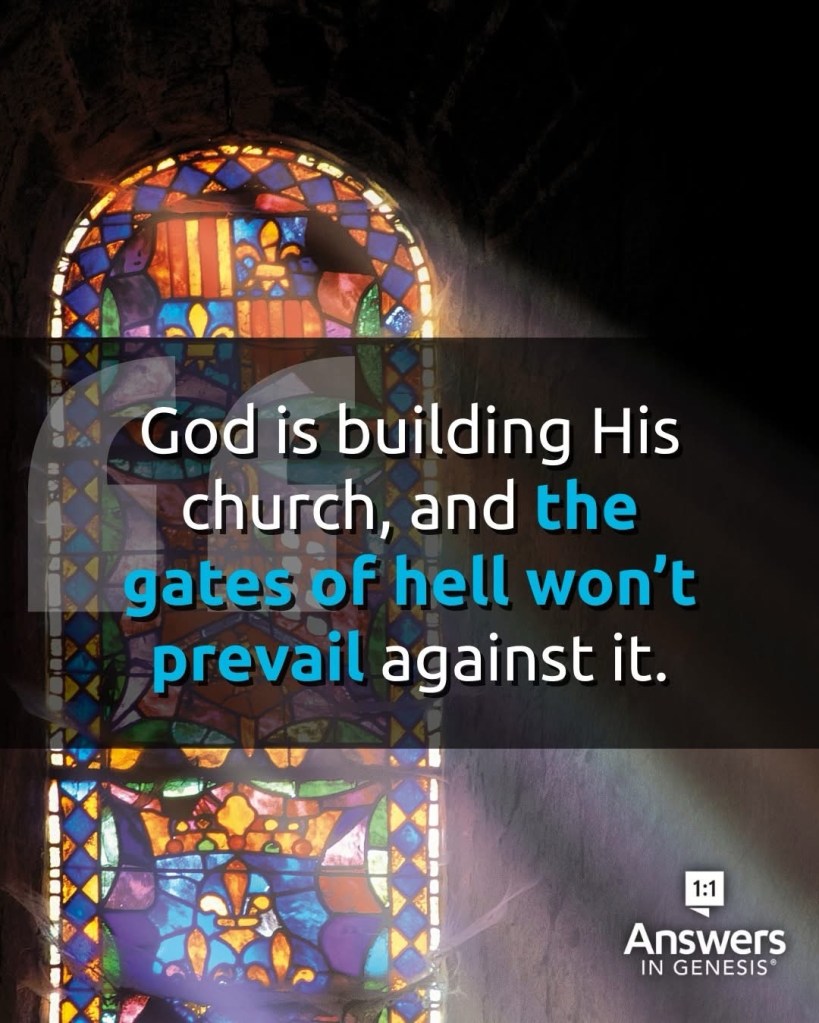
I respectfully disagree with the statement below. Christ Jesus established His church at Pentecost through His resurrection. Consequently, the gates of Hades have no power over Christ’s church.
Scripture declared, “Then I saw thrones, and seated on them were those to whom the authority to judge was committed. Also I saw the souls of those who had been beheaded for the testimony of Jesus and for the word of God, and those who had not worshiped the beast or its image and had not received its mark on their foreheads or their hands. THEY CAME TO LIFE AND REIGNED WITH CHRIST for a thousand years. The rest of the dead did not come to life until the thousand years were ended. THIS IS THE FIRST RESURRECTION. Blessed and holy is the one who shares in the first resurrection! OVER SUCH THE SECOND DEATH HAS NO POWER, but they will be priests of God and of Christ, and they will reign with Him for a thousand years.” (Revelation 20:4-6)
Christ Jesus declared, “And I also tell you that you are Peter, and on this Rock I will build My church, and the gates of Hades will not prevail over it.” (Matthew 16:18)
The apostle Paul asserted, “For no one can lay any foundation other than what has been laid down. That foundation is Jesus Christ.” (1 Corinthians 3:11)
Paul also explicitly stated that Christ Jesus is the Rock, not Peter, as evident in 1 Corinthians 10:4.
Paul once again declared, “So, then, you (Gentile Christians) are no longer foreigners and strangers, but fellow citizens with the saints, and members of God’s household, built on the foundation of the apostles and prophets, with Christ Jesus Himself as the cornerstone. In Him the whole building, being put together, grows into a holy temple in the Lord. In Him you are also being built together for God’s dwelling in the Spirit.” (Ephesians 2:19-22)
In conclusion, God’s church is spiritual, not built on stones but on the words and resurrection of Christ Jesus. Consequently, Jesus Christ declared, “God is spirit, and those who worship Him must worship in Spirit and in truth.” (John 4:24)
Peter, in the words of Acts 3:6, declared, “I possess neither silver nor gold, but in the name of Jesus Christ, I offer you what I have.” Share freely, for you freely receive. Stay updated by heading to our about page and subscribe directly to receive notifications in your inbox. Blessing!
Christians have always been eagerly anticipating a better tomorrow—a day when all our earthly troubles would cease to exist. Most Christians believe this will happen upon the return of Jesus Christ.
The LORD of hosts, the God of Israel, declared in Scripture, “For I know the plans I have for you,” declares the LORD, “plans for welfare and not for evil, to give you a future and a hope,”Jeremiah 29:11. This passage has been misinterpreted and misused, often falsely taught as a guarantee of material prosperity. One possible reason for this misinterpretation is the translation of the Hebrew word “shâlôm,” which means “peace or tranquility,” into “prosper” in the New International Version (NIV).
Jeremiah 1:1-2 introduces Jeremiah’s ministry, which began during the 13th year of Josiah’s reign as the king of Judah. The Bible Hub timeline suggests that Jeremiah’s ministry started around 627 B.C. and lasted for approximately 40 years. This ministry culminated in the downfall of the nation of Judah and the destruction of its capital, Jerusalem, in 586 B.C., as recorded in Jeremiah 52.
It’s fascinating to observe that, as per God’s Word in Jeremiah 29:10, the rebuilding of the temple was completed in 516 B.C., precisely seventy years after the Jews were exiled to Babylon (586 B.C.). Subsequently, the exiles returned and joyfully celebrated the dedication of God’s house (Ezra 6:14-16).
Jeremiah 29:11 therefore proclaims God’s promise of “peace” to His people, even amidst severe judgment against Judah. This may seem contradictory, but it’s not. It’s crucial to understand that God declared a seventy-year captivity and exile against the Jews as a punishment for their sin before their return and the rebuilding of the city and the temple (see Jeremiah 25:12; 29:10). In retrospect, we know that after their return and the rebuilding of Jerusalem and its temple, most of the Jews remained unfaithful to the LORD God, breaking His Covenant (see Malachi 1:14; 3:8-9). How then do we make sense of Jeremiah 29:11? Surely, God cannot be promising one thing then failing to deliver.
Let us explore the full promise of God in Jeremiah 29:11-14.
“For thus says the LORD: When seventy years are completed for Babylon, I will visit you, and I will fulfill to you My promise and bring you back to this place. For I know the plans I have for you, declares the LORD, plans for welfare and not for evil, to give you a future and a hope. Then you will call upon Me and come and pray to Me, and I will hear you. You will seek Me and find Me, when you seek Me with all your heart. I will be found by you, declares the LORD, and I will restore your fortunes and gather you from all the nations and all the places where I have driven you, declares the LORD, and I will bring you back to the place from which I sent you into exile.”
Daniel, God’s prophet after Jeremiah’s ministry, was a young man among the exiles in Babylon (Daniel 1:1-6). After seventy years had passed, Daniel remembered Jeremiah’s prophecy of Israel’s return and yearned for its restoration (Daniel 9:1-2). He then prayed to God for mercy and the rebuilding of God’s temple (Daniel 9:17-19). However, to his dismay, God announced a second desolation of the Jewish temple before forgiveness, atonement, and restoration to God’s presence becomes a reality (Daniel 9:20-27). Notably, God used the number “seventy,” but instead of years, it was seventy prophetic weeks (Daniel 9:24), culminating in the final “week” or “one seven.” Additionally, Daniel aligned God’s judgment of Israel with that of Deuteronomy 28-31, stating, “As it is written in the Law of Moses” (Daniel 9:13) – blessings for obedience, and God’s curse for disobedience.
I won’t delve into explaining Daniel 9:24-27 because it would significantly extend the length of this blog post. However, it’s important to remember that all prophecies will be fulfilled when the “abomination of desolation” spoken by Daniel has come to pass (Dan 9:26-27; Matt 24:15). Interestingly, Jesus Christ specifically predicted that the event would occur when the temple was destroyed, emphasizing its finality (Matthew 23:36-38; 24:2-3, 14-21). The second and final destruction of the Jewish temple was future both to Daniel and at the time of the incarnate Jesus Christ. Check out two key verses from Matthew 24:14-21.
“So when you see the abomination of desolation spoken of by the prophet Daniel, standing in the holy place (let the reader understand),” Matthew 24:15 says. Without a doubt, Jesus was referring to Daniel 9:24-27. Of utmost importance, Jesus declared, “For then there will be great tribulation, such as has not been from the beginning of the world until now, and never will be,” Matthew 24:21, a reference to Daniel 12. This declaration highlights the end of the Old Covenant Israel.
As I have mentioned earlier, the desolation of the temple occurred in 70 A.D. Understand also that though there was a return of the Jews in 1948, unlike the first return, the temple was never rebuilt. Without the temple, the Jews ceased to be God’s people. God has removed His dwelling presence from Old Covenant Israel.
So back to Jeremiah 29:12-13, God next declared, “Then you will call upon Me and come and pray to Me, and I will hear you. You will seek Me and find Me, when you seek Me with all your heart.” Interestingly, Jesus Christ spoke the reverse to the unbelieving Jewish religious leaders. See John 7:33-34. “Jesus then said, ‘I will be with you a little longer, and then I am going to Him who sent Me. You will seek Me and you will not find Me. Where I am you cannot come.’”
Now, comparing Jeremiah 29:12-13 with that of Isaiah 65:24, God declared, “Before they call, I will answer; while they are still speaking, I will hear.” It’s the same comforting assurance saying that God now hears—an exact contrast to God’s pronouncement of judgment against Israel, that even if they call upon the LORD, He would not listen. See Jeremiah 11:11 & 14:11-12; Isaiah 1:15; Ezekiel 8:17-18; Micah 3:4; Zechariah 7:13-14; Luke 13:24-28; all spoken against Old Covenant Israel.
Finally, see Jeremiah 29:14, God said, “I will bring you back to the place from which I sent you into exile.” From where were the Jews exiled? Jerusalem, isn’t it? Amazingly, Isaiah 65 spoke of a New Jerusalem, which was also spoken by John in Revelation.
Once again, let’s compare Isaiah 65:17-19 with that of Revelation 21:1-4. In Isaiah, God said, “For behold, I create new heavens and a new earth … I will rejoice in Jerusalem and be glad in My people; NO MORE SHALL BE HEARD IN IT THE SOUND OF WEEPING AND THE CRY OF DISTRESS.” Now in Revelation 21:1-4, “Then I saw a new heaven and a new earth, for the first heaven and the first earth had passed away, and the sea was no more. And I saw the holy city, new Jerusalem, coming down out of heaven from God … HE WILL WIPE AWAY EVERY TEAR FROM THEIR EYES, AND DEATH SHALL BE NO MORE, NEITHER SHALL THERE BE MOURNING, NOR CRYING, NOR PAIN ANYMORE, for the former things have passed away.”
Aren’t both passages expressing the idea of “peace and tranquility”? Precisely God’s promise in Jeremiah 29:11. Reading from the Christian Standard Bible,it says, “For I know the plans I have for you”— this is the LORD’s declaration —“plans for your well-being [Shâlôm, meaning peace in the Hebrew language], not for disaster, to give you a future and a hope.”
Therefore, in Jeremiah 29:14, God’s promise of return isn’t about the physical land of Jerusalem, but the heavenly one. The Jewish return and rebuilding of the temple during the time of Nehemiah, Zerubbabel and Ezra fell short of fulfilling God’s promise. Now, consider this: in Revelation, John was in the tribulation, exiled to Patmos (Rev 1:9), as prophesied by Jesus Christ in Matthew 24:9-21 to His apostles. He foresaw the imminent arrival of God’s New Heaven and New Earth, the heavenly Jerusalem, as well as the passing of the Old Covenant Jerusalem (Revelation 21:1-2). Therefore, Jeremiah 29:11-14, Isaiah 65:17-25, and Revelation 21-22 all spoke about the time of the New Creation.
Do we still see the Jewish temple standing in Jerusalem? The Dome of Rock now stands at the very site of the former Herod’s temple-a restoration and expansion of Zerubbabel’s second temple. This was the temple where Jesus taught the Scripture occasionally, which was destroyed by the Romans in 70 A.D., just as prophesied by Christ Jesus, therefore bringing to an end the Jewish Age (click and read Matthew 23:36-24:3; 24:14-21).
See Luke’s account concerning God’s vengeance against Israel and its desolation. “But when you see Jerusalem surrounded by armies, then know that its desolation has come near. Then let those who are in Judea flee to the mountains, and let those who are inside the city depart, and let not those who are out in the country enter it, for these are days of vengeance, to fulfill all that is written.” (Luke 21:20-22)
The desolation of Jerusalem marked the end of the Old Covenant Israel-the Jewish age. As Paul declared in 2 Corinthians 5:17, “Therefore, if anyone is in Christ, he is a new creation. The old had passed away; behold, the the new has come.” Undoubtedly, Christians now experience the blessings of God’s New Covenant. While we may still encounter challenges worldwide, we should keep the peace of God—that is, our belief and faith, knowing that He holds our future in His hands. In reality, our tomorrow is already here; Christ Jesus has conquered the curse of Adam’s fall. All we need to do is persevere in our faith, regardless of our current temporal circumstances.
Truly ironic that modern Christianity has been teaching the reverse. They insist the Jews continue to be God’s people despite them denying Christ Jesus. To justify their teachings, they invented a future coming of Jesus Christ and a second grace for Israel, contradicting everything that Paul had taught in Romans 9-11; Galatians 3-5, and his many other letters. I surmise this happened because Christians fail to study the Bible. Instead of delving into Scripture, they chose to study from men’s writings. Rather than exegeting the Scripture, they chose to study Bible commentaries. Keep in mind that only the Bible is inerrant; all else has erred.
With the arrival of the New Heaven and the New Earth, God’s New Covenant finally became a full reality. Revelation 21:22-23 said, “And I [John the Beloved] saw no temple in the city, for its temple is the Lord God the Almighty and the Lamb. And the city has no need of sun or moon to shine on it, for the glory of God gives it light, and its lamp is the Lamb.” In John 2:19, the incarnate Jesus Christ declared, “Destroy this temple, and in three days I will raise it up,” to which John later explained in his Gospel, “But He [Jesus Christ] was speaking about the temple of His body (John 2:21)”. The apostle Paul then explained the church was the body of Christ Jesus, see Ephesians 2:19-22. “So then you [Gentile Christians] are no longer strangers and aliens, but you are fellow citizens with the saints [1st Century Jewish Converts to Christianity] and members of the household of God, built on the foundation of the apostles and prophets [Scripture, both Old and New Testament], Christ Jesus Himself being the cornerstone, in whom the whole structure, being joined together, grows into a holy temple in the Lord. In Him you also are being built together into a dwelling place for God by the Spirit.”
With the coming of Christ Jesus, Galatians told us there is no longer distinctions between Jews and Gentiles. All that are in Christ Jesus are Abraham’s offspring, heirs according to His promise. Click and read Galatians 3:25-29. So why does Modern Christianity insist that Jews today remains to be people of God? Aren’t they digressing from the true message of the Gospel?
Incidentally, for proper biblical ecclesiology (Doctrine of the Church), understand that only Christ Jesus builds His Church and no one else. The incarnate Jesus Christ declared in Matthew 16:18, “And I also say to you that you are Peter, and on this Rock, I will build My Church, and the gates of Hades will not overpower it.” Hades not having power over the Church means death no longer has power over the Church. Therefore, salvation and eternal life have become a reality, not just a promise. Christ Jesus is the Rock, not Peter; click and read 1Co 10:4.
Jesus Christ promised His disciples “peace” before His betrayal, crucifixion, and death. See John 14:27, where Jesus said, “Peace I leave with you; My peace I give to you. Not as the world gives do I give to you. Let not your hearts be troubled, neither let them be afraid.” Doesn’t this imply that believing in Christ Jesus is the key to finding peace even in difficult times? The same “peace” that Paul urges Christians to have in his letter to the Philippians (see Philippians 4:6-7). Therefore, in Scripture, “peace” is synonymous with faith and belief. In other words, Christians cannot claim faith and belief without experiencing God’s peace. That is, trusting Him that everything will be well because He is in control.
Jeremiah 29:11 is God’s promise of peace fulfilled through Christ Jesus’ death, resurrection, ascension, and return, completing therefore His New Covenant. Yes, Jesus has already secured our future, and it’s here now for all who believe in Him. To truly comprehend this, we must cultivate faith and trust in His word, as He consistently communicated through the Bible.
Peter, in the words of Acts 3:6, declared, “I possess neither silver nor gold, but in the name of Jesus Christ, I offer you what I have.” Share freely, for you freely receive. Stay updated by heading to our about page and subscribe directly to receive notifications in your inbox. Blessing!